
A French Word to Live By
How to Conjugate Signifier in French
/si.ɲi.fje/
Signifier means to mean or signify — what a word, a sign, a gesture carries inside it; in formal French it also means to notify someone officially of a decision.
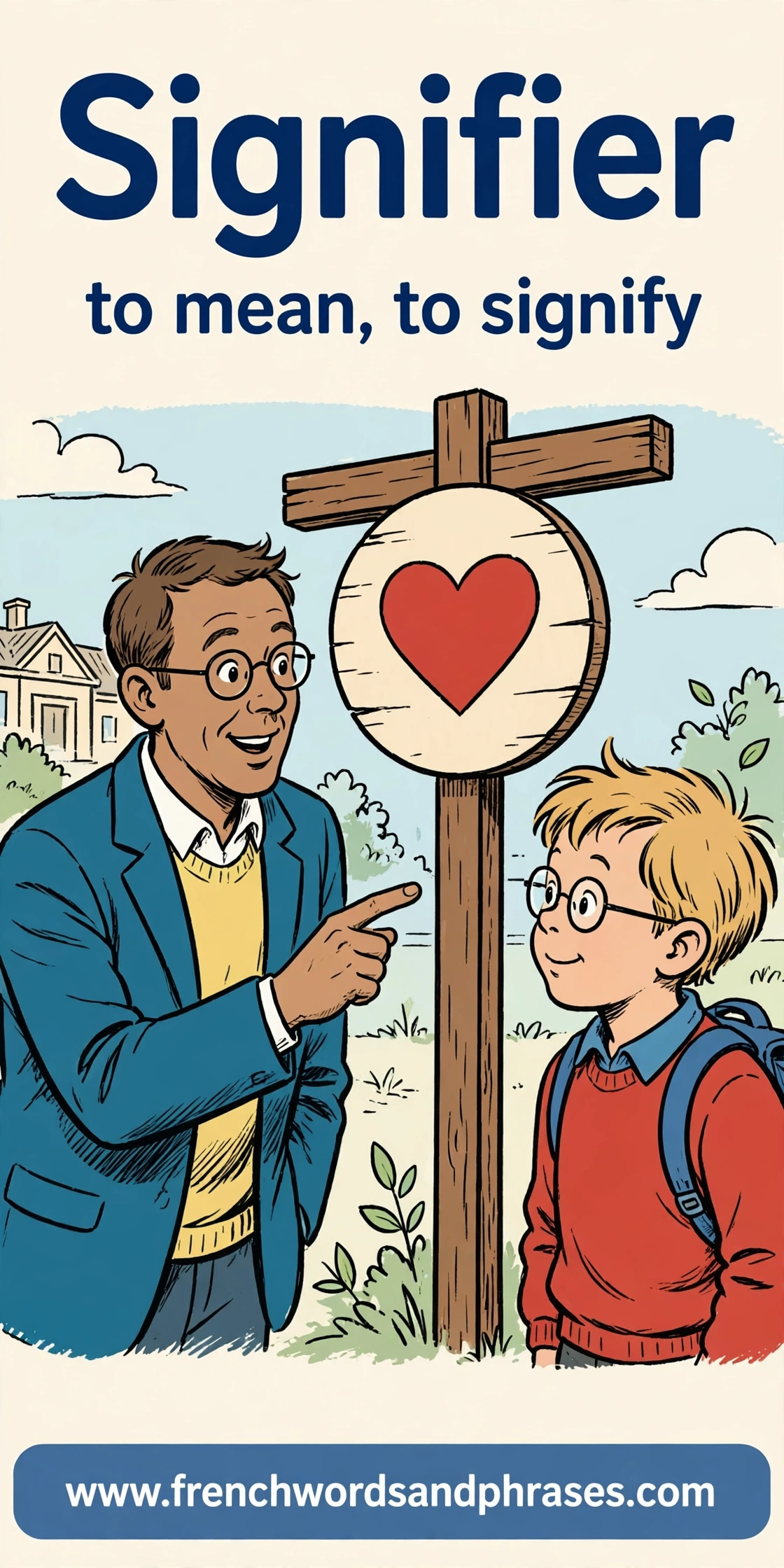
A child pointing at a word in a letter from the teacher — « ça veut dire quoi ? » — and the whole household leaning in: signifier is the verb of the meaning itself, the moment a sign opens and shows what it holds.
In this guide, you’ll learn how to conjugate signifier in all the major French tenses and moods. Explore complete conjugation tables, French examples, English translations, and practice quizzes.
Understanding the French Verb Signifier
Signifier is a regular French verb belonging to the first group of verbs, those ending in-er.
It means to mean, to signify. Its everyday home is the dictionary moment: que signifie ce mot ? is the learner’s eternal question, and the answer begins ce mot signifie… Its formal second life belongs to offices and law: signifier une décision à quelqu’un is to notify them of it officially, in writing, so that it counts.
Verb classification: First group (-er)
Auxiliary verb: Avoir
Past participle: signifié
Present participle: signifiant
English equivalents: To mean, to signify, to stand for; que signifie ce mot ? — what does this word mean?; signifier son congé — to give one’s notice (formal); cela ne signifie rien — that means nothing.
One important detail: signifier is an -ier verb, and in the nous and vous forms of the imperfect and the present subjunctive the stem’s i meets the ending’s i, giving a double i: nous signifiions, vous signifiiez. Everywhere else the verb is regular: je signifie, nous signifions (one i in the present), past participle signifié.
Experience the Word
Signifier is the verb of the inside of signs — the meaning folded within the word, the gesture, the look.
Imagine the village square in 1945, in a famous photograph: a woman raising two fingers in a V. The fingers are only fingers — but everyone who sees them knows what they signifient. They mean victory. A sign is a small thing; what it signifies can move a crowd.
The sign is seen, and the meaning arrives. That is signifier — the bridge between the mark and the mind.
How to Conjugate Signifier: Complete French Conjugation Guide
Let’s explore every major conjugation of signifier, beginning with the indicative mood.
How to Conjugate Signifier in the Indicative Mood
The indicative mood is used to express facts, observations, actions, and events.
How to Conjugate Signifier in the Present Tense (Présent)
Used for actions happening now, habitual actions, and general truths.
| Subject | Conjugation |
|---|---|
| je | signifie |
| tu | signifies |
| il / elle | signifie |
| nous | signifions |
| vous | signifiez |
| ils / elles | signifient |
Example
Ce mot signifie « maison » en anglais.
This word means ‘house’ in English.
Quick Quiz 1
Complete the sentence:
Nous ______ autrefois la paix par ce signe. (imperfect)
Reveal the answer
signifiions
Nous signifiions autrefois la paix par ce signe.
We used to mean peace by this sign — double i for -ier verbs.
How to Conjugate Signifier in the Passé Composé
Used for completed actions in the past. Signifier takes the auxiliary verb avoir.
| Subject | Conjugation |
|---|---|
| j’ | ai signifié |
| tu | as signifié |
| il / elle | a signifié |
| nous | avons signifié |
| vous | avez signifié |
| ils / elles | ont signifié |
Example
Son silence a signifié beaucoup pour elle.
His silence meant a great deal to her.
How to Conjugate Signifier in the Imparfait (Imperfect Tense)
Used for habitual past actions, descriptions, and ongoing situations in the past.
| Subject | Conjugation |
|---|---|
| je | signifiais |
| tu | signifiais |
| il / elle | signifiait |
| nous | signifiions |
| vous | signifiiez |
| ils / elles | signifiaient |
Example
Autrefois, ce symbole signifiait la paix.
In the old days, this symbol meant peace.
Quick Quiz 2
Choose the correct form:
His silence meant a lot.
Son silence ______ beaucoup. (a signifié / est signifié)
Reveal the answer
a signifié
Son silence a signifié beaucoup.
Signifier takes avoir.
How to Conjugate Signifier in the Plus-que-parfait
Used to describe an action that had already been completed before another past event.
| Subject | Conjugation |
|---|---|
| j’ | avais signifié |
| tu | avais signifié |
| il / elle | avait signifié |
| nous | avions signifié |
| vous | aviez signifié |
| ils / elles | avaient signifié |
Example
Le professeur avait signifié la réponse d’un geste.
The teacher had indicated the answer with a gesture.
How to Conjugate Signifier in the Passé Simple
Primarily used in formal writing, literature, and historical narratives. It is rarely used in everyday conversation.
| Subject | Conjugation |
|---|---|
| je | signifiai |
| tu | signifias |
| il / elle | signifia |
| nous | signifiâmes |
| vous | signifiâtes |
| ils / elles | signifièrent |
Example
Ce jour signifia le début d’une amitié.
That day marked the beginning of a friendship.
How to Conjugate Signifier in the Passé Antérieur
A literary tense used to express an action completed immediately before another past action, generally in the passé simple.
| Subject | Conjugation |
|---|---|
| j’ | eus signifié |
| tu | eus signifié |
| il / elle | eut signifié |
| nous | eûmes signifié |
| vous | eûtes signifié |
| ils / elles | eurent signifié |
Example
Quand il eut signifié son accord, la réunion se termina.
When he had signalled his agreement, the meeting ended.
How to Conjugate Signifier in the Future Tense (Futur Simple)
Used to describe actions that will take place in the future.
| Subject | Conjugation |
|---|---|
| je | signifierai |
| tu | signifieras |
| il / elle | signifiera |
| nous | signifierons |
| vous | signifierez |
| ils / elles | signifieront |
Example
Un jour, ce cadeau signifiera beaucoup pour toi.
One day, this present will mean a great deal to you.
How to Conjugate Signifier in the Futur Antérieur (Future Perfect)
Used for an action that will have been completed before a particular point in the future.
| Subject | Conjugation |
|---|---|
| j’ | aurai signifié |
| tu | auras signifié |
| il / elle | aura signifié |
| nous | aurons signifié |
| vous | aurez signifié |
| ils / elles | auront signifié |
Example
À la fin du cours, ce signe aura signifié trois choses différentes.
By the end of the lesson, this sign will have meant three different things.
How to Conjugate Signifier in the Near Future (Futur Proche)
Used to describe something that is going to happen soon. Formed with aller + infinitive.
| Subject | Conjugation |
|---|---|
| je | vais signifier |
| tu | vas signifier |
| il / elle | va signifier |
| nous | allons signifier |
| vous | allez signifier |
| ils / elles | vont signifier |
Example
Ce regard va signifier un refus, je le crains.
That look is going to mean a refusal, I fear.
How to Conjugate Signifier in the Conditional Mood
The conditional mood expresses what would happen under certain circumstances. It is also frequently used to make polite requests or express wishes.
How to Conjugate Signifier in the Present Conditional
| Subject | Conjugation |
|---|---|
| je | signifierais |
| tu | signifierais |
| il / elle | signifierait |
| nous | signifierions |
| vous | signifieriez |
| ils / elles | signifieraient |
Example
Sans contexte, ce mot signifierait autre chose.
Without context, this word would mean something else.
How to Conjugate Signifier in the Past Conditional
| Subject | Conjugation |
|---|---|
| j’ | aurais signifié |
| tu | aurais signifié |
| il / elle | aurait signifié |
| nous | aurions signifié |
| vous | auriez signifié |
| ils / elles | auraient signifié |
Example
Son sourire aurait signifié oui dans un autre pays.
Her smile would have meant yes in another country.
Signifier in the Literary Past Conditional Form
This less common literary form uses the imperfect subjunctive of avoir.
| Subject | Conjugation |
|---|---|
| j’ | eusse signifié |
| tu | eusses signifié |
| il / elle | eût signifié |
| nous | eussions signifié |
| vous | eussiez signifié |
| ils / elles | eussent signifié |
Example
Le geste eût signifié la guerre en un autre siècle.
The gesture would have meant war in another century.
How to Conjugate Signifier in the Subjunctive Mood
The subjunctive is used to express wishes, emotions, doubts, necessity, and uncertainty. It frequently follows expressions such as il faut que (it is necessary that) or bien que (although).
How to Conjugate Signifier in the Present Subjunctive
| Subject | Conjugation |
|---|---|
| que je | signifie |
| que tu | signifies |
| qu’il / qu’elle | signifie |
| que nous | signifiions |
| que vous | signifiiez |
| qu’ils / qu’elles | signifient |
Example
Il faut que ce symbole signifie la même chose pour tous.
This symbol must mean the same thing to everyone.
Quick Quiz 3
Complete the sentence using the subjunctive:
Il faut que ce symbole ______ la paix.
Reveal the answer
signifie
Il faut que ce symbole signifie la paix.
This symbol must mean peace.
How to Conjugate Signifier in the Imperfect Subjunctive
A literary tense, rarely encountered in modern spoken French.
| Subject | Conjugation |
|---|---|
| que je | signifiasse |
| que tu | signifiasses |
| qu’il / qu’elle | signifiât |
| que nous | signifiassions |
| que vous | signifiassiez |
| qu’ils / qu’elles | signifiassent |
Example
Je doutais que ce mot signifiât vraiment cela.
I doubted that this word really meant that.
How to Conjugate Signifier in the Pluperfect Subjunctive
A literary construction used to express an action completed before another past action.
| Subject | Conjugation |
|---|---|
| que j’ | eusse signifié |
| que tu | eusses signifié |
| qu’il / qu’elle | eût signifié |
| que nous | eussions signifié |
| que vous | eussiez signifié |
| qu’ils / qu’elles | eussent signifié |
Example
On expliquait que le signe eût signifié un danger autrefois.
It was explained that the sign had meant danger in the old days.
How to Conjugate Signifier in the Past Subjunctive
| Subject | Conjugation |
|---|---|
| que j’ | aie signifié |
| que tu | aies signifié |
| qu’il / qu’elle | ait signifié |
| que nous | ayons signifié |
| que vous | ayez signifié |
| qu’ils / qu’elles | aient signifié |
Example
Je suis heureux que ce mot ait signifié quelque chose pour toi.
I am glad this word meant something to you.
How to Conjugate Signifier in the Imperative
The imperative is used to give commands, instructions, invitations, or suggestions. Subject pronouns are omitted.
How to Conjugate Signifier in the Present Imperative
| Person | Conjugation |
|---|---|
| (tu) | signifie |
| (nous) | signifions |
| (vous) | signifiez |
Example
Signifie-lui la décision par écrit !
Notify him of the decision in writing!
Quick Quiz 4
How would you say What does it mean (tu form)?
Reveal the answer
Qu’est-ce que ça signifie ?
French Participles of Signifier
Participles are verb forms that can be used in compound tenses and other grammatical constructions.
Present Participle of Signifier
signifiant
En signifiant son départ, elle a surpris tout le bureau.
By giving notice of her departure, she surprised the whole office.
Past Participle of Signifier
signifié
Signifiée par lettre, la décision est officielle.
Notified by letter, the decision is official.
Signifier in Everyday French: Real-Life Examples
Now that you know the conjugations, let’s see how signifier appears in everyday French.
Example 1 — Present
Ce mot signifie « maison » en anglais.
This word means ‘house’ in English.
Example 2 — Passé composé
Son silence a signifié beaucoup pour elle.
His silence meant a great deal to her.
Example 3 — Imparfait
Ce symbole signifiait la paix autrefois.
This symbol meant peace in the old days.
Example 4 — Future
Ce cadeau signifiera beaucoup pour toi.
This present will mean a great deal to you.
Example 5 — Conditional
Ce mot signifierait autre chose sans contexte.
This word would mean something else without context.
Example 6 — Imperative
Signifie-lui la décision par écrit !
Notify him of the decision in writing!
Beyond Translation: The Meaning of Signifier
Signifier is the verb the whole science of signs is built on: French linguistics gave the world le signifiant and le signifié — the signifier and the signified, the sound and the sense — Saussure’s famous pair, born from this verb. Every word on this site lives inside that pair.
Signifier is the verb of the cargo every sign carries.
And its formal life keeps the old weight: to signifier a decision is to make meaning official, delivered, undeniable.
How to Remember the French Verb Signifier
Remember it this way: Signifier is about the two fingers raised in a V — a tiny sign carrying a meaning that moves a crowd.
- -ier verb: double i in nous/vous imperfect and subjunctive — nous signifiions, vous signifiiez.
- The learner’s question: que signifie ce mot ? — what does this word mean?
- Formal second life: signifier une décision = to notify officially.
The key idea is the two fingers raised in a V — a tiny sign carrying a meaning that moves a crowd.
Test Your Knowledge of Signifier
Let’s see how much you’ve learned. Try answering these questions before revealing the answers.
Question 1
What is the main spelling trap with signifier?
Reveal the answer
It is an -ier verb — nous signifiions and vous signifiiez take a double i in the imperfect and subjunctive.
Question 2
How do you say What does this word mean? in French?
Reveal the answer
Que signifie ce mot ?
Question 3
Translate: This symbol means peace.
Reveal the answer
Ce symbole signifie la paix.
Question 4
What is the past participle of signifier?
Reveal the answer
Signifié.
Question 5
Complete the sentence:
Il faut que ce mot ______ la même chose pour tous.
Reveal the answer
signifie
Il faut que ce mot signifie la même chose pour tous.
This word must mean the same thing to everyone.
Your Final Challenge
Can You Use It?
How would you say this in French?
For the children of the village, this old flag meant the fair, the music and the holidays.
Reveal the answer
Pour les enfants du village, ce vieux drapeau signifiait la fête, la musique et les vacances.
For the children of the village, this old flag meant the fair, the music and the holidays.
A little French. A little curiosity. A richer everyday life.
LEARN FRENCH ONE WORD AT A TIME




