A French Word to Live By
How to Conjugate Catir in French
/ka.tiʁ/
Catir means to press, to gloss — to give cloth its smooth shine by pressing it, the finishing touch of the old draper’s trade.
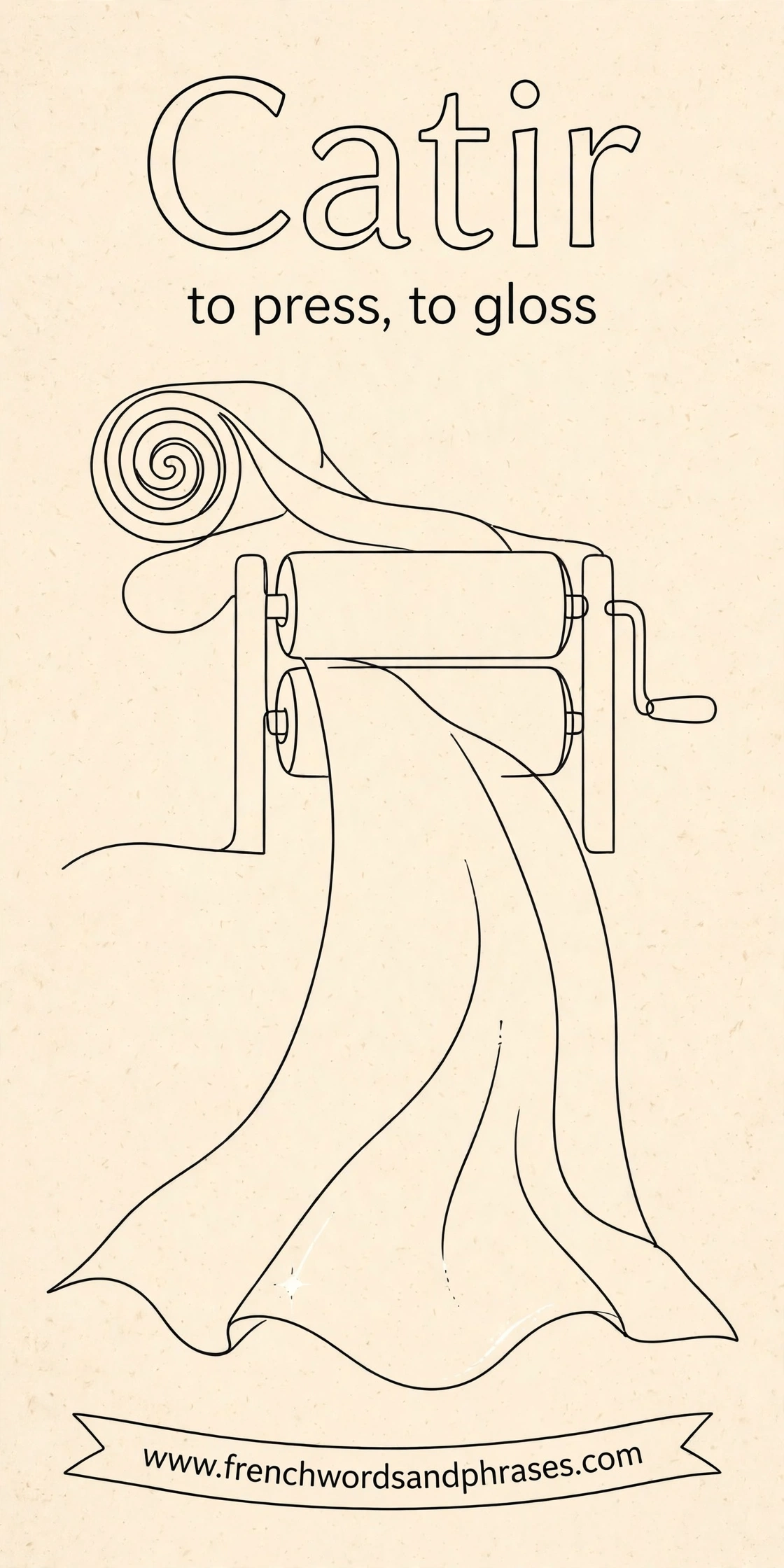
A draper’s workshop smelling of steam and hot metal, bolts of dull cloth going in one side of the press and coming out gleaming on the other — catir is the textile worker’s verb: to press fabric until it shines, the last gesture before the cloth is sold.
In this guide, you’ll learn how to conjugate catir in all the major French tenses and moods. Explore complete conjugation tables, French examples, English translations, and practice quizzes.
Understanding the French Verb Catir
Catir is a regular French verb belonging to the second group of verbs, those ending in -ir.
It means to press, to gloss. It survives in the vocabulary of drapers, tailors, bookbinders and restorers — anywhere cloth is finished by pressure and heat. Most French speakers know the result better than the verb: a fabric with a fine, soft sheen has du cati, and old manuals still describe the presses and heated cylinders that produced it.
Verb classification: Second group (-ir)
Auxiliary verb: Avoir
Past participle: cati
Present participle: catissant
English equivalents: To press and gloss (cloth), to give a lustre to fabric; catir une étoffe — to press a fabric; catir le drap — to gloss the cloth; le cati — the gloss, the finish on cloth; un tissu cati — a glossed fabric.
One important detail: catir is a regular -ir verb of the finir family, so the stem grows its tell-tale -iss- wherever finir grows it: nous catissons, vous catissez, je catissais, que nous catissions, en catissant — while the singular stays lean: je catis, tu catis, il catit, past participle cati. It is a trade word, almost never heard outside cloth and leather workshops: one catit une étoffe, un drap, du velours — pressing with heat and weight until the surface takes a shine, a finish the trade itself calls le cati.
Experience the Word
Catir is the verb of the last ten minutes of cloth-making — the dull bolt goes into the press, and silk’s poorer cousins come out shining.
Imagine a Lyon workshop in 1900. All morning the press has hissed and steamed; the apprentice feeds in length after length of grey cloth, and the master checks each one against the light as it emerges — cati, lustrous, suddenly expensive — ready for the shop windows of Paris.
The cloth has not changed colour or weight. It has been pressed — cati — and pressure has become shine.
How to Conjugate Catir: Complete French Conjugation Guide
Let’s explore every major conjugation of catir, beginning with the indicative mood.
How to Conjugate Catir in the Indicative Mood
The indicative mood is used to express facts, observations, actions, and events.
How to Conjugate Catir in the Present Tense (Présent)
Used for actions happening now, habitual actions, and general truths.
| Subject | Conjugation |
|---|---|
| je | catis |
| tu | catis |
| il / elle | catit |
| nous | catissons |
| vous | catissez |
| ils / elles | catissent |
Example
L’ouvrier catit l’étoffe pour lui donner du brillant.
The workman presses the fabric to give it a shine.
Quick Quiz 1
Complete the sentence:
Nous ______ les étoffes à la main.
Reveal the answer
catissons
Nous catissons les étoffes à la main.
We press the fabrics by hand.
How to Conjugate Catir in the Passé Composé
Used for completed actions in the past. Catir takes the auxiliary verb avoir.
| Subject | Conjugation |
|---|---|
| j’ | ai cati |
| tu | as cati |
| il / elle | a cati |
| nous | avons cati |
| vous | avez cati |
| ils / elles | ont cati |
Example
Le tailleur a cati le drap avant de le couper.
The tailor glossed the cloth before cutting it.
How to Conjugate Catir in the Imparfait (Imperfect Tense)
Used for habitual past actions, descriptions, and ongoing situations in the past.
| Subject | Conjugation |
|---|---|
| je | catissais |
| tu | catissais |
| il / elle | catissait |
| nous | catissions |
| vous | catissiez |
| ils / elles | catissaient |
Example
Autrefois, on catissait les tissus à la main.
In the old days, fabrics were pressed by hand.
Quick Quiz 2
Choose the correct form:
The tailor glossed the cloth.
Le tailleur ______ le drap. (a cati / a catissé)
Reveal the answer
a cati
Le tailleur a cati le drap.
The past participle of catir is cati, without -iss-.
How to Conjugate Catir in the Plus-que-parfait
Used to describe an action that had already been completed before another past event.
| Subject | Conjugation |
|---|---|
| j’ | avais cati |
| tu | avais cati |
| il / elle | avait cati |
| nous | avions cati |
| vous | aviez cati |
| ils / elles | avaient cati |
Example
Elle avait cati la soie avant la grande exposition.
She had glossed the silk before the great exhibition.
How to Conjugate Catir in the Passé Simple
Primarily used in formal writing, literature, and historical narratives. It is rarely used in everyday conversation.
| Subject | Conjugation |
|---|---|
| je | catis |
| tu | catis |
| il / elle | catit |
| nous | catîmes |
| vous | catîtes |
| ils / elles | catirent |
Example
L’atelier catit les pièces en une seule journée.
The workshop pressed the pieces in a single day.
How to Conjugate Catir in the Passé Antérieur
A literary tense used to express an action completed immediately before another past action, generally in the passé simple.
| Subject | Conjugation |
|---|---|
| j’ | eus cati |
| tu | eus cati |
| il / elle | eut cati |
| nous | eûmes cati |
| vous | eûtes cati |
| ils / elles | eurent cati |
Example
Quand il eut cati le velours, il le montra au client.
When he had pressed the velvet, he showed it to the customer.
How to Conjugate Catir in the Future Tense (Futur Simple)
Used to describe actions that will take place in the future.
| Subject | Conjugation |
|---|---|
| je | catirai |
| tu | catiras |
| il / elle | catira |
| nous | catirons |
| vous | catirez |
| ils / elles | catiront |
Example
Demain, nous catirons les rideaux de scène.
Tomorrow, we will press the stage curtains.
How to Conjugate Catir in the Futur Antérieur (Future Perfect)
Used for an action that will have been completed before a particular point in the future.
| Subject | Conjugation |
|---|---|
| j’ | aurai cati |
| tu | auras cati |
| il / elle | aura cati |
| nous | aurons cati |
| vous | aurez cati |
| ils / elles | auront cati |
Example
À la fin de la semaine, ils auront cati toutes les étoffes.
By the end of the week, they will have glossed all the fabrics.
How to Conjugate Catir in the Near Future (Futur Proche)
Used to describe something that is going to happen soon. Formed with aller + infinitive.
| Subject | Conjugation |
|---|---|
| je | vais catir |
| tu | vas catir |
| il / elle | va catir |
| nous | allons catir |
| vous | allez catir |
| ils / elles | vont catir |
Example
Le presseur va catir ce costume pour la soirée.
The presser is going to gloss this suit for the evening.
How to Conjugate Catir in the Conditional Mood
The conditional mood expresses what would happen under certain circumstances. It is also frequently used to make polite requests or express wishes.
How to Conjugate Catir in the Present Conditional
| Subject | Conjugation |
|---|---|
| je | catirais |
| tu | catirais |
| il / elle | catirait |
| nous | catirions |
| vous | catiriez |
| ils / elles | catiraient |
Example
Avec une machine moderne, on catirait deux fois plus vite.
With a modern machine, we would press twice as fast.
How to Conjugate Catir in the Past Conditional
| Subject | Conjugation |
|---|---|
| j’ | aurais cati |
| tu | aurais cati |
| il / elle | aurait cati |
| nous | aurions cati |
| vous | auriez cati |
| ils / elles | auraient cati |
Example
Elle aurait cati la laine si la presse avait fonctionné.
She would have pressed the wool if the press had worked.
Catir in the Literary Past Conditional Form
This less common literary form uses the imperfect subjunctive of avoir.
| Subject | Conjugation |
|---|---|
| j’ | eusse cati |
| tu | eusses cati |
| il / elle | eût cati |
| nous | eussions cati |
| vous | eussiez cati |
| ils / elles | eussent cati |
Example
L’artisan eût cati la soie comme autrefois.
The craftsman would have glossed the silk as in the old days.
How to Conjugate Catir in the Subjunctive Mood
The subjunctive is used to express wishes, emotions, doubts, necessity, and uncertainty. It frequently follows expressions such as il faut que (it is necessary that) or bien que (although).
How to Conjugate Catir in the Present Subjunctive
| Subject | Conjugation |
|---|---|
| que je | catisse |
| que tu | catisses |
| qu’il / qu’elle | catisse |
| que nous | catissions |
| que vous | catissiez |
| qu’ils / qu’elles | catissent |
Example
Il faut que tu catisses ce tissu avant ce soir.
You must press this fabric before this evening.
Quick Quiz 3
Complete the sentence using the subjunctive:
Il faut que vous ______ les rideaux avant la première.
Reveal the answer
catissiez
Il faut que vous catissiez les rideaux avant la première.
You must press the curtains before the opening night.
How to Conjugate Catir in the Imperfect Subjunctive
A literary tense, rarely encountered in modern spoken French.
| Subject | Conjugation |
|---|---|
| que je | catisse |
| que tu | catisses |
| qu’il / qu’elle | catît |
| que nous | catissions |
| que vous | catissiez |
| qu’ils / qu’elles | catissent |
Example
On voulait que l’ouvrier catît le drap à l’ancienne.
They wanted the workman to press the cloth in the old way.
How to Conjugate Catir in the Pluperfect Subjunctive
A literary construction used to express an action completed before another past action.
| Subject | Conjugation |
|---|---|
| que j’ | eusse cati |
| que tu | eusses cati |
| qu’il / qu’elle | eût cati |
| que nous | eussions cati |
| que vous | eussiez cati |
| qu’ils / qu’elles | eussent cati |
Example
On admirait qu’il eût cati la pièce sans un défaut.
People admired that he had pressed the piece without a single flaw.
How to Conjugate Catir in the Past Subjunctive
| Subject | Conjugation |
|---|---|
| que j’ | aie cati |
| que tu | aies cati |
| qu’il / qu’elle | ait cati |
| que nous | ayons cati |
| que vous | ayez cati |
| qu’ils / qu’elles | aient cati |
Example
Je suis content qu’elle ait cati les nappes à temps.
I am glad she pressed the tablecloths in time.
How to Conjugate Catir in the Imperative
The imperative is used to give commands, instructions, invitations, or suggestions. Subject pronouns are omitted.
How to Conjugate Catir in the Present Imperative
| Person | Conjugation |
|---|---|
| (tu) | catis |
| (nous) | catissons |
| (vous) | catissez |
Example
Catis ce drap avec soin, il est fragile !
Press this cloth carefully, it is fragile!
Quick Quiz 4
How would you say Press this cloth carefully (tu form)?
Reveal the answer
Catis ce drap avec soin !
French Participles of Catir
Participles are verb forms that can be used in compound tenses and other grammatical constructions.
Present Participle of Catir
catissant
En catissant l’étoffe, il lui donne un lustre durable.
By pressing the fabric, he gives it a lasting lustre.
Past Participle of Catir
cati
Cati par les mains d’un maître, le drap brille doucement.
Pressed by a master’s hands, the cloth shines softly.
Catir in Everyday French: Real-Life Examples
Now that you know the conjugations, let’s see how catir appears in everyday French.
Example 1 — Present
L’ouvrier catit l’étoffe.
The workman presses the fabric.
Example 2 — Passé composé
Le tailleur a cati le drap.
The tailor glossed the cloth.
Example 3 — Imparfait
On catissait les tissus à la main.
Fabrics were pressed by hand.
Example 4 — Future
Nous catirons les rideaux demain.
We will press the curtains tomorrow.
Example 5 — Conditional
On catirait plus vite avec une machine moderne.
We would press faster with a modern machine.
Example 6 — Imperative
Catis ce drap avec soin !
Press this cloth carefully!
Beyond Translation: The Meaning of Catir
Nobody is quite sure where catir comes from — the dictionaries call its origin obscure, which suits a word that has spent five centuries inside workshops rather than books.
It is the verb of shine earned by pressure.
Its noun, le cati, names the result: the fine gloss on cloth that tells a buyer’s fingers the fabric was finished by people who cared. In an age of synthetic finishes, catir survives wherever cloth is still pressed the slow way.
How to Remember the French Verb Catir
Remember it this way: Catir is about the steaming press in Lyon — dull cloth in, shining cloth out.
- Finir family: je catis, but nous catissons, je catissais, en catissant — the -iss- is the signature.
- A trade word: one catit une étoffe, un drap, du velours — cloth, pressed until it shines.
- The result has its own noun: le cati, the gloss on finished cloth.
The key idea is the steaming press in Lyon — dull cloth in, shining cloth out.
Test Your Knowledge of Catir
Let’s see how much you’ve learned. Try answering these questions before revealing the answers.
Question 1
Which family does catir belong to, and what is its tell-tale sign?
Reveal the answer
The finir family — the stem grows -iss- in the plural and imperfect: nous catissons, je catissais.
Question 2
How do you say The tailor glossed the cloth in French?
Reveal the answer
Le tailleur a cati le drap.
Question 3
Translate: The workman presses the fabric to give it a shine.
Reveal the answer
L’ouvrier catit l’étoffe pour lui donner du brillant.
Question 4
What is the past participle of catir?
Reveal the answer
Cati.
Question 5
Complete the sentence:
Il faut que tu ______ ce tissu avant ce soir.
Reveal the answer
catisses
Il faut que tu catisses ce tissu avant ce soir.
You must press this fabric before this evening.
Your Final Challenge
Can You Use It?
How would you say this in French?
Pressed by the master’s hands, the grey cloth turns to light.
Reveal the answer
Cati par les mains du maître, le drap gris devient lumière.
Pressed by the master’s hands, the grey cloth turns to light.
A little French. A little curiosity. A richer everyday life.
LEARN FRENCH ONE WORD AT A TIME