A French Word to Live By
Translate Casquette to English
/kas.kɛt/
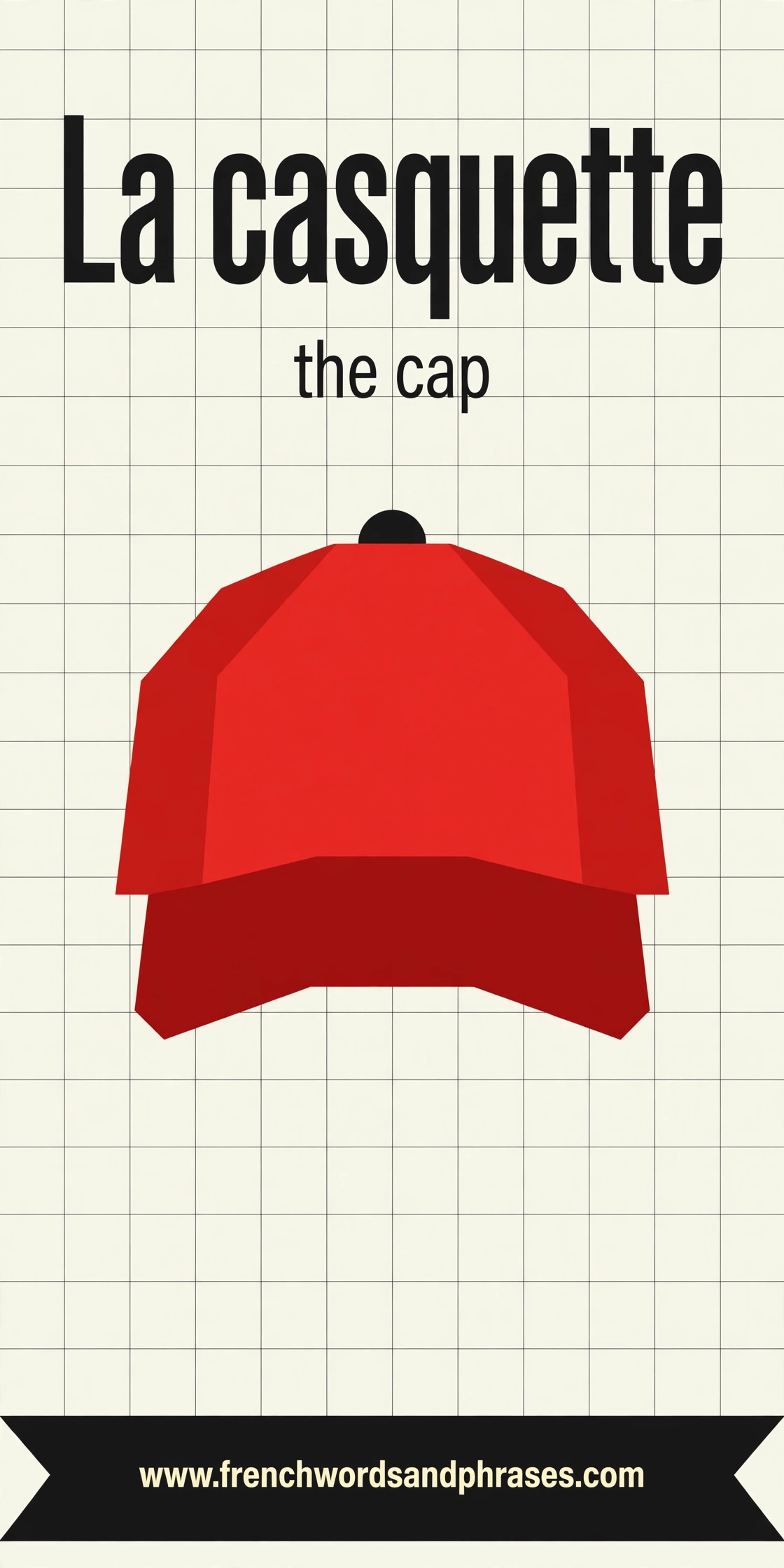
La casquette means the cap.
The sun is high, the cyclist squints, and out of the back pocket comes the folded, faithful shade against the glare: la casquette.
In this guide, you’ll learn what casquette means in English, how to use it with its articles, how to form its plural, and how it appears in everyday French. Explore French examples, English translations, and practice quizzes.
Understanding the French Noun Casquette
Casquette is a feminine French noun, learned with its article: la casquette, une casquette. It is the little sister of le casque (the helmet) with the diminutive ending -ette: a small, soft head-covering with a peak — la visière — at the front.
It means the cap — the soft cap with a stiff peak that shades your eyes: the baseball cap, the cyclist’s cap, the flat cap of a grandfather. It is not a hat: a hat, le chapeau, has a full brim all round, while the casquette has only its visière in front.
Gender: Feminine
Definite article: la — la casquette (the cap)
Indefinite article: une — une casquette (a cap)
Plural: les casquettes
Key part: la visière — the peak that shades the eyes
English equivalents: The cap; a baseball cap.
One important usage detail: the French say porter une casquette — to wear a cap — and the peak can turn: young wearers put la visière à l’envers, the peak backwards. For a woollen winter cap with no peak, the word is le bonnet, not casquette.
Experience the Word
Casquette is more than headwear. It is the uniform of summer — of cyclists in the Tour de France, of children at the beach, of grandfathers watching the world from a bench.
Imagine the market square at noon: every stallholder under a casquette, the peak pulled low, a hand raised now and then to tip it in greeting.
You have not just shaded your eyes. You have joined the summer crowd — la casquette, the little roof you carry everywhere.
How to Use Casquette in French: Complete Guide
Let’s explore how casquette works in French, beginning with its articles — la casquette, une casquette.
Casquette with the Definite Article (La, Les)
Used for the cap everyone in the conversation knows — the one on your head.
| Form | French |
|---|---|
| Feminine singular | la casquette |
| Plural | les casquettes |
Example
La casquette du cycliste est trempée de sueur après la montée.
The cyclist’s cap is soaked with sweat after the climb.
Casquette with the Indefinite Article (Une, Des)
Used for a cap in general — the one in the shop or at the market stall.
| Form | French |
|---|---|
| Feminine singular | une casquette |
| Plural | des casquettes |
Example
Il achète une casquette bleue pour protéger ses yeux du soleil.
He buys a blue cap to protect his eyes from the sun.
On Your Head: Words of Hats and Caps
Peaks, brims and helmets — the vocabulary that surrounds the casquette.
| French | In English |
|---|---|
| la visière | the peak, the visor |
| le chapeau | the hat (with a full brim) |
| le bonnet | the woollen hat, the beanie |
| le casque | the helmet |
| la tête | the head |
| porter | to wear |
Example
Elle porte sa casquette avec la visière à l’envers.
She wears her cap with the peak backwards.
Quick Quiz 1
What is the difference between une casquette and un chapeau?
Reveal the answer
The casquette has only a peak in front; the chapeau has a brim all round.
La casquette a une visière, le chapeau a un bord complet.
The cap has a peak; the hat has a full brim.
The Plural of Casquette
Casquette adds an -s in the plural — les casquettes, a whole rack of them at the market.
| Number | French |
|---|---|
| Singular | la casquette |
| Plural | les casquettes |
Example
Le marchand vend des casquettes de toutes les couleurs.
The stallholder sells caps in every colour.
Casquette with Possessive Adjectives (Ma, Ta, Sa…)
Possessives agree with the noun: casquette is feminine, so it takes ma, ta, sa.
| Owner | French |
|---|---|
| my | ma casquette |
| your (tu) | ta casquette |
| his / her | sa casquette |
| our | notre casquette |
| your (vous) | votre casquette |
| their | leur casquette |
Example
J’ai oublié ma casquette à la plage, je vais la chercher.
I left my cap at the beach; I’m going to fetch it.
Quick Quiz 2
Complete the sentence:
______ casquette est rouge, celle de Paul est noire. (Her)
Reveal the answer
Sa
Sa casquette est rouge, celle de Paul est noire.
Her cap is red; Paul’s is black — sa, because casquette is feminine.
Casquette with Demonstrative Adjectives (Cette, Ces)
Used to point: cette casquette, the one you are holding up in the shop.
| Form | French |
|---|---|
| Feminine singular | cette casquette |
| Plural | ces casquettes |
Example
Cette casquette te va très bien, prends-la !
This cap suits you very well — take it!
Casquette with Adjectives
Adjectives agree with the feminine noun: bleu stays bleu, noir becomes noire.
| Adjective | With Casquette |
|---|---|
| rouge (red) | une casquette rouge |
| noir (black) | une casquette noire |
| blanc (white) | une casquette blanche |
| vieux (old) | une casquette vieille |
| neuf (brand new) | une casquette neuve |
Example
Le coureur porte une casquette blanche sous le soleil.
The runner wears a white cap under the sun.
Quick Quiz 3
Complete the sentence:
Elle a une casquette toute ______. (brand new)
Reveal the answer
neuve
Elle a une casquette toute neuve.
She has a brand-new cap — neuve, the feminine of neuf.
Everyday Expressions with Casquette
Peaks forward, peaks backwards — the casquette phrases of daily life.
| Expression | In English |
|---|---|
| porter une casquette | to wear a cap |
| la visière à l’envers | the peak backwards |
| enlever sa casquette | to take off one’s cap |
| une casquette de cycliste | a cycling cap |
| une casquette de baseball | a baseball cap |
| se protéger du soleil | to protect oneself from the sun |
Example
En entrant dans la maison, il enlève sa casquette par politesse.
Coming into the house, he takes off his cap out of politeness.
Words from the Same Family as Casquette
Helmets, heads and hats — the words that travel with casquette.
| French | In English |
|---|---|
| le casque | the helmet |
| la casquette de bain | the swimming cap |
| le képi | the kepi (a soldier’s cap) |
| la tête | the head |
| le couvre-chef | headgear (formal, playful) |
| le soleil | the sun |
Example
Le soldat porte un képi, le cycliste une casquette légère.
The soldier wears a kepi; the cyclist, a light cap.
Quick Quiz 4
What is la visière?
Reveal the answer
The peak of the cap — the stiff part in front that shades the eyes.
La visière de sa casquette protège ses yeux.
The peak of his cap protects his eyes.
Casquette in Everyday French: Real-Life Examples
Now that you know the word, let’s see how casquette appears in everyday French.
Example 1 — At the beach
Les enfants portent une casquette pour jouer au soleil.
The children wear a cap to play in the sun.
Example 2 — At the market
Je cherche une casquette rouge pour l’été.
I’m looking for a red cap for the summer.
Example 3 — The cyclist
Le cycliste met sa casquette avant de partir.
The cyclist puts on his cap before setting off.
Example 4 — A compliment
Ta casquette bleue te va à merveille.
Your blue cap suits you wonderfully.
Example 5 — Lost and found
Quelqu’un a oublié une casquette sur le banc du parc.
Someone has left a cap on the park bench.
Example 6 — Grandfather
Mon grand-père ne sort jamais sans sa vieille casquette.
My grandfather never goes out without his old cap.
Beyond Translation: The Meaning of Casquette
The casquette has a double life in France. On the roads of the Tour de France it is the cyclist’s badge, flipped peak and all, handed out on podiums; in the villages it is the grandfather’s flat cap, worn at every hour and raised in greeting. The little word carries its history inside it: casquette is the diminutive of casque, the helmet — a soft, peaceful descendant of a piece of armour.
To say casquette is to name the smallest roof a person can own.
It evokes long summers and strong sun, market stalls and cycle races, and the simple gesture of pulling the peak down against the light.
How to Remember the French Noun Casquette
Remember it this way: Casquette is the cap — feminine, the little helmet in -ette: la casquette, with its visière in front.
- You see the cap — la casquette, la visière devant.
- You wear it — porter une casquette contre le soleil.
- You turn it — la visière à l’envers, peak backwards, for style.
The key idea is la casquette — the little helmet that became a cap.
Test Your Knowledge of Casquette
Let’s see how much you’ve learned. Try answering these questions before revealing the answers.
Question 1
Is casquette masculine or feminine?
Reveal the answer
Feminine — la casquette, une casquette.
Question 2
What is the peak of a cap called in French?
Reveal the answer
La visière — the stiff part in front that shades the eyes.
Question 3
Translate: He wears a black cap.
Reveal the answer
Il porte une casquette noire.
Question 4
What is le bonnet?
Reveal the answer
A woollen hat, a beanie — warm, with no peak, unlike the casquette.
Question 5
Complete the sentence:
Enlève ______ casquette à table, s’il te plaît.
Reveal the answer
ta
Enlève ta casquette à table, s’il te plaît.
Take off your cap at the table, please.
Your Final Challenge
Can You Use It?
How would you say this in French?
“The cyclist wears a white cap.”
Reveal the answer
Le cycliste porte une casquette blanche.
The cyclist wears a white cap.
A little French. A little curiosity. A richer everyday life.
LEARN FRENCH ONE WORD AT A TIME