A French Word to Live By
How to Conjugate Cartonner in French
/kaʁ.tɔ.ne/
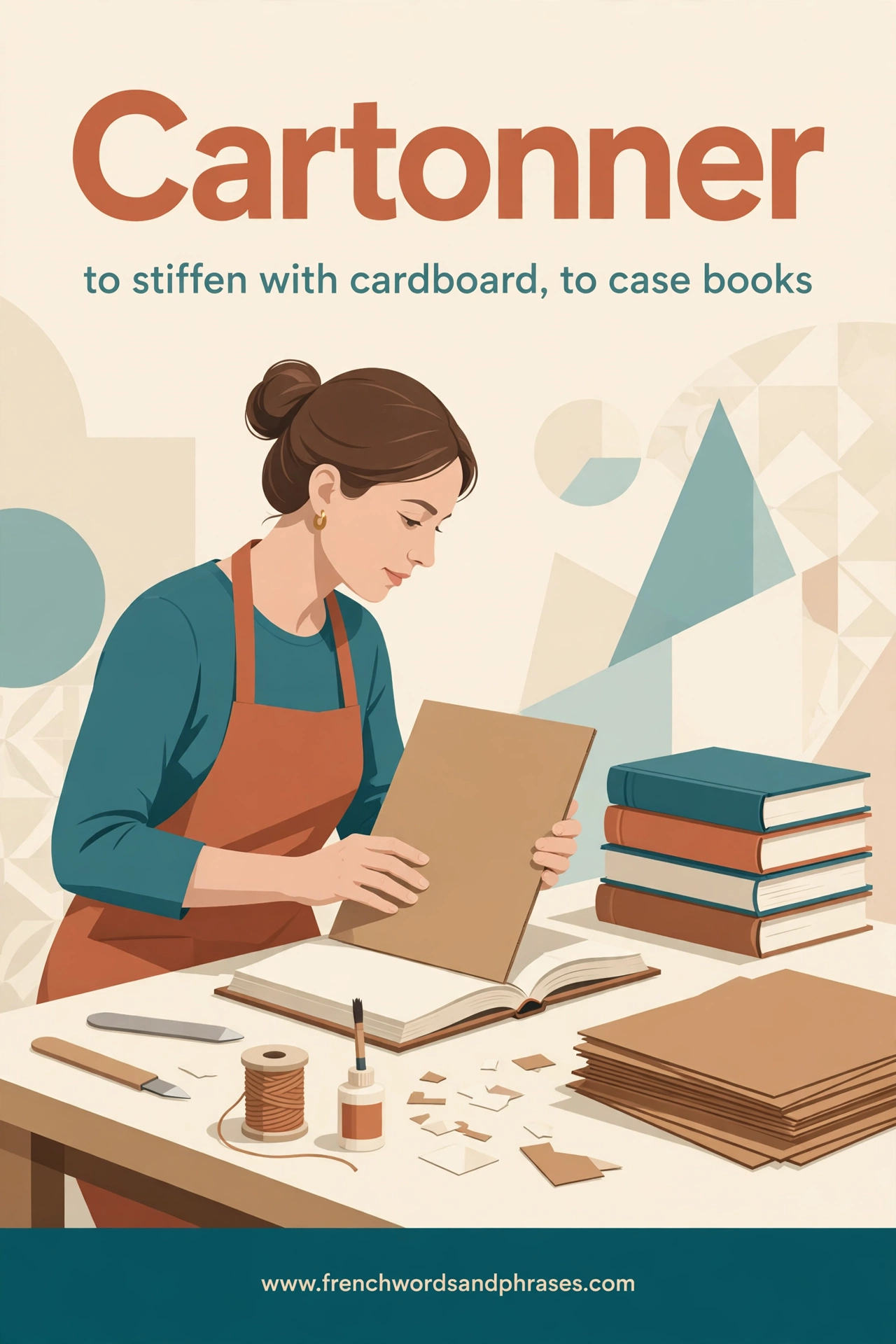
Cartonner means to stiffen with cardboard, to case books — to give paper and books a hard board cover.
A binder’s bench covered in grey board, glue and cloth, a stack of posters that must travel without bending — cartonner is the verb of making paper rigid: stiffening a sheet with cardboard, or casing a book between hard boards.
In this guide, you’ll learn how to conjugate cartonner in all the major French tenses and moods. Explore complete conjugation tables, French examples, English translations, and practice quizzes.
Understanding the French Verb Cartonner
Cartonner is a regular French verb belonging to the first group of verbs, those ending in-er.
It means to stiffen with cardboard, to case books. It is used by printers, framers and teachers for mounting and stiffening paper, and by publishers for case-binding; in very familiar modern speech you will also hear ça cartonne ! — it is a huge hit — a different life of the same word, from the idea of a full cardboard box of sales.
Verb classification: First group (-er)
Auxiliary verb: Avoir
Past participle: cartonné
Present participle: cartonnant
English equivalents: To stiffen with cardboard, to board; cartonner une affiche — to mount a poster on board; cartonner un livre — to case-bind a book, to put a book into boards; un livre cartonné — a hardback book; le cartonnage — board work, casing.
One important detail: cartonner is built on le carton, cardboard, and its double n never changes: je cartonne, nous cartonnons, past participle cartonné. In the book trade its product is a household word — un livre cartonné is a hardback, as opposed to un livre broché, a paperback. Stiffening and bookbinding are the same gesture: paper given a cardboard skeleton.
Experience the Word
Cartonner is the verb of paper growing a spine — soft sheets made stiff, straight and durable.
Imagine a village school before the fête. The teacher’s posters curl at the corners, so all afternoon the children glue, press and cartonner each drawing onto board; by evening the classroom walls hold a flat, proud exhibition that will survive the whole summer.
The drawings have not changed. They have been stiffened — cartonnées — and turned into something that lasts.
How to Conjugate Cartonner: Complete French Conjugation Guide
Let’s explore every major conjugation of cartonner, beginning with the indicative mood.
How to Conjugate Cartonner in the Indicative Mood
The indicative mood is used to express facts, observations, actions, and events.
How to Conjugate Cartonner in the Present Tense (Présent)
Used for actions happening now, habitual actions, and general truths.
| Subject | Conjugation |
|---|---|
| je | cartonne |
| tu | cartonnes |
| il / elle | cartonne |
| nous | cartonnons |
| vous | cartonnez |
| ils / elles | cartonnent |
Example
Le relieur cartonne les livres de la bibliothèque municipale.
The binder cases the books of the town library.
Quick Quiz 1
Complete the sentence:
Nous ______ les affiches du festival.
Reveal the answer
cartonnons
Nous cartonnons les affiches du festival.
We are mounting the festival posters on board.
How to Conjugate Cartonner in the Passé Composé
Used for completed actions in the past. Cartonner takes the auxiliary verb avoir.
| Subject | Conjugation |
|---|---|
| j’ | ai cartonné |
| tu | as cartonné |
| il / elle | a cartonné |
| nous | avons cartonné |
| vous | avez cartonné |
| ils / elles | ont cartonné |
Example
Elle a cartonné ses affiches pour les transporter sans les plier.
She mounted her posters on board to carry them without folding them.
How to Conjugate Cartonner in the Imparfait (Imperfect Tense)
Used for habitual past actions, descriptions, and ongoing situations in the past.
| Subject | Conjugation |
|---|---|
| je | cartonnais |
| tu | cartonnais |
| il / elle | cartonnait |
| nous | cartonnions |
| vous | cartonniez |
| ils / elles | cartonnaient |
Example
Autrefois, les écoliers cartonnaient eux-mêmes leurs cahiers.
In the old days, schoolchildren used to board their own exercise books.
Quick Quiz 2
Choose the correct form:
She mounted her posters on board.
Elle ______ ses affiches. (a cartonné / est cartonnée)
Reveal the answer
a cartonné
Elle a cartonné ses affiches.
Cartonner takes avoir.
How to Conjugate Cartonner in the Plus-que-parfait
Used to describe an action that had already been completed before another past event.
| Subject | Conjugation |
|---|---|
| j’ | avais cartonné |
| tu | avais cartonné |
| il / elle | avait cartonné |
| nous | avions cartonné |
| vous | aviez cartonné |
| ils / elles | avaient cartonné |
Example
L’imprimeur avait cartonné mille couvertures avant la rentrée.
The printer had boarded a thousand covers before the start of term.
How to Conjugate Cartonner in the Passé Simple
Primarily used in formal writing, literature, and historical narratives. It is rarely used in everyday conversation.
| Subject | Conjugation |
|---|---|
| je | cartonnai |
| tu | cartonnas |
| il / elle | cartonna |
| nous | cartonnâmes |
| vous | cartonnâtes |
| ils / elles | cartonnèrent |
Example
L’atelier cartonna les registres de la mairie en une semaine.
The workshop cased the town hall registers in a week.
How to Conjugate Cartonner in the Passé Antérieur
A literary tense used to express an action completed immediately before another past action, generally in the passé simple.
| Subject | Conjugation |
|---|---|
| j’ | eus cartonné |
| tu | eus cartonné |
| il / elle | eut cartonné |
| nous | eûmes cartonné |
| vous | eûtes cartonné |
| ils / elles | eurent cartonné |
Example
Quand elle eut cartonné le dernier dessin, elle accrocha l’exposition.
When she had mounted the last drawing on board, she hung the exhibition.
How to Conjugate Cartonner in the Future Tense (Futur Simple)
Used to describe actions that will take place in the future.
| Subject | Conjugation |
|---|---|
| je | cartonnerai |
| tu | cartonneras |
| il / elle | cartonnera |
| nous | cartonnerons |
| vous | cartonnerez |
| ils / elles | cartonneront |
Example
Demain, nous cartonnerons les couvertures du manuel.
Tomorrow, we will board the covers of the textbook.
How to Conjugate Cartonner in the Futur Antérieur (Future Perfect)
Used for an action that will have been completed before a particular point in the future.
| Subject | Conjugation |
|---|---|
| j’ | aurai cartonné |
| tu | auras cartonné |
| il / elle | aura cartonné |
| nous | aurons cartonné |
| vous | aurez cartonné |
| ils / elles | auront cartonné |
Example
À midi, ils auront cartonné toutes les affiches du festival.
By noon, they will have mounted all the festival posters on board.
How to Conjugate Cartonner in the Near Future (Futur Proche)
Used to describe something that is going to happen soon. Formed with aller + infinitive.
| Subject | Conjugation |
|---|---|
| je | vais cartonner |
| tu | vas cartonner |
| il / elle | va cartonner |
| nous | allons cartonner |
| vous | allez cartonner |
| ils / elles | vont cartonner |
Example
Je vais cartonner ce plan pour l’emporter sur le chantier.
I am going to stiffen this plan with board to take it to the site.
How to Conjugate Cartonner in the Conditional Mood
The conditional mood expresses what would happen under certain circumstances. It is also frequently used to make polite requests or express wishes.
How to Conjugate Cartonner in the Present Conditional
| Subject | Conjugation |
|---|---|
| je | cartonnerais |
| tu | cartonnerais |
| il / elle | cartonnerait |
| nous | cartonnerions |
| vous | cartonneriez |
| ils / elles | cartonneraient |
Example
Avec du carton plus épais, on cartonnerait mieux ces grandes cartes.
With thicker board, we would stiffen these large maps better.
How to Conjugate Cartonner in the Past Conditional
| Subject | Conjugation |
|---|---|
| j’ | aurais cartonné |
| tu | aurais cartonné |
| il / elle | aurait cartonné |
| nous | aurions cartonné |
| vous | auriez cartonné |
| ils / elles | auraient cartonné |
Example
Tu aurais cartonné le livre, il ne se serait pas abîmé.
If you had cased the book, it would not have got damaged.
Cartonner in the Literary Past Conditional Form
This less common literary form uses the imperfect subjunctive of avoir.
| Subject | Conjugation |
|---|---|
| j’ | eusse cartonné |
| tu | eusses cartonné |
| il / elle | eût cartonné |
| nous | eussions cartonné |
| vous | eussiez cartonné |
| ils / elles | eussent cartonné |
Example
Il eût cartonné lui-même les registres pour les sauver.
He would have cased the registers himself to save them.
How to Conjugate Cartonner in the Subjunctive Mood
The subjunctive is used to express wishes, emotions, doubts, necessity, and uncertainty. It frequently follows expressions such as il faut que (it is necessary that) or bien que (although).
How to Conjugate Cartonner in the Present Subjunctive
| Subject | Conjugation |
|---|---|
| que je | cartonne |
| que tu | cartonnes |
| qu’il / qu’elle | cartonne |
| que nous | cartonnions |
| que vous | cartonniez |
| qu’ils / qu’elles | cartonnent |
Example
Il faut que l’imprimeur cartonne les couvertures avant jeudi.
The printer must board the covers before Thursday.
Quick Quiz 3
Complete the sentence using the subjunctive:
Il faut que tu ______ ce plan avant de partir.
Reveal the answer
cartonnes
Il faut que tu cartonnes ce plan avant de partir.
You must stiffen this plan with board before leaving.
How to Conjugate Cartonner in the Imperfect Subjunctive
A literary tense, rarely encountered in modern spoken French.
| Subject | Conjugation |
|---|---|
| que je | cartonnasse |
| que tu | cartonnasses |
| qu’il / qu’elle | cartonnât |
| que nous | cartonnassions |
| que vous | cartonnassiez |
| qu’ils / qu’elles | cartonnassent |
Example
Le libraire souhaitait qu’on cartonnât les livres rares.
The bookseller wanted the rare books to be cased.
How to Conjugate Cartonner in the Pluperfect Subjunctive
A literary construction used to express an action completed before another past action.
| Subject | Conjugation |
|---|---|
| que j’ | eusse cartonné |
| que tu | eusses cartonné |
| qu’il / qu’elle | eût cartonné |
| que nous | eussions cartonné |
| que vous | eussiez cartonné |
| qu’ils / qu’elles | eussent cartonné |
Example
On racontait qu’il eût cartonné des centaines de volumes anciens.
People said he had cased hundreds of old volumes.
How to Conjugate Cartonner in the Past Subjunctive
| Subject | Conjugation |
|---|---|
| que j’ | aie cartonné |
| que tu | aies cartonné |
| qu’il / qu’elle | ait cartonné |
| que nous | ayons cartonné |
| que vous | ayez cartonné |
| qu’ils / qu’elles | aient cartonné |
Example
Je suis content qu’elle ait cartonné mes affiches.
I am glad she mounted my posters on board.
How to Conjugate Cartonner in the Imperative
The imperative is used to give commands, instructions, invitations, or suggestions. Subject pronouns are omitted.
How to Conjugate Cartonner in the Present Imperative
| Person | Conjugation |
|---|---|
| (tu) | cartonne |
| (nous) | cartonnons |
| (vous) | cartonnez |
Example
Cartonne ces affiches pour les protéger pendant le voyage !
Mount these posters on board to protect them during the journey!
Quick Quiz 4
How would you say Mount this poster on board (tu form)?
Reveal the answer
Cartonne cette affiche !
French Participles of Cartonner
Participles are verb forms that can be used in compound tenses and other grammatical constructions.
Present Participle of Cartonner
cartonnant
En cartonnant les cahiers, les enfants apprennent le soin.
By boarding their exercise books, the children learn carefulness.
Past Participle of Cartonner
cartonné
Cartonné avec soin, le vieux livre a retrouvé sa solidité.
Cased with care, the old book has regained its solidity.
Cartonner in Everyday French: Real-Life Examples
Now that you know the conjugations, let’s see how cartonner appears in everyday French.
Example 1 — Present
Le relieur cartonne les livres anciens.
The binder cases old books.
Example 2 — Passé composé
Elle a cartonné ses affiches pour le voyage.
She mounted her posters on board for the journey.
Example 3 — Imparfait
Les écoliers cartonnaient leurs cahiers.
Schoolchildren used to board their exercise books.
Example 4 — Future
Nous cartonnerons les couvertures demain.
We will board the covers tomorrow.
Example 5 — Conditional
On cartonnerait mieux avec du carton épais.
We would stiffen it better with thick board.
Example 6 — Imperative
Cartonne cette affiche pour la protéger !
Mount this poster on board to protect it!
Beyond Translation: The Meaning of Cartonner
English bookbinders say to case a book; French cartonner names the material instead — the carton, the board itself.
A hardback is simply a book that has been cartonné.
Every livre cartonné on a French shelf carries the verb in its description, and the same gesture protects school posters, maps and drawings wherever paper must stand up straight.
How to Remember the French Verb Cartonner
Remember it this way: Cartonner is about grey board, glue and cloth — paper given a spine.
- Le carton is cardboard; cartonner is to give paper a cardboard skeleton — stiffen a sheet, or case a book.
- Un livre cartonné = a hardback; un livre broché = a paperback.
- Regular -er with a double n throughout: je cartonne, nous cartonnons, past participle cartonné.
The key idea is grey board, glue and cloth — paper given a spine.
Test Your Knowledge of Cartonner
Let’s see how much you’ve learned. Try answering these questions before revealing the answers.
Question 1
What is un livre cartonné?
Reveal the answer
A hardback book — a book cased between hard boards, the product of cartonner.
Question 2
How do you say She mounted her posters on board in French?
Reveal the answer
Elle a cartonné ses affiches.
Question 3
Translate: The binder cases old books.
Reveal the answer
Le relieur cartonne les livres anciens.
Question 4
What is the past participle of cartonner?
Reveal the answer
Cartonné.
Question 5
Complete the sentence:
Il faut que l’imprimeur ______ les couvertures avant jeudi.
Reveal the answer
cartonne
Il faut que l’imprimeur cartonne les couvertures avant jeudi.
The printer must board the covers before Thursday.
Your Final Challenge
Can You Use It?
How would you say this in French?
She cases the old book, and there it is, ready for a hundred years of reading.
Reveal the answer
Elle cartonne le vieux livre, et le voilà prêt pour cent ans de lecture.
She cases the old book, and there it is, ready for a hundred years of reading.
A little French. A little curiosity. A richer everyday life.
LEARN FRENCH ONE WORD AT A TIME