
A French Word to Live By
How to Conjugate Carguer in French
/kaʁ.ɡe/
Carguer means to take in (sail) — to haul a sail up to its yard with ropes, gathering it in so the wind can no longer fill it.
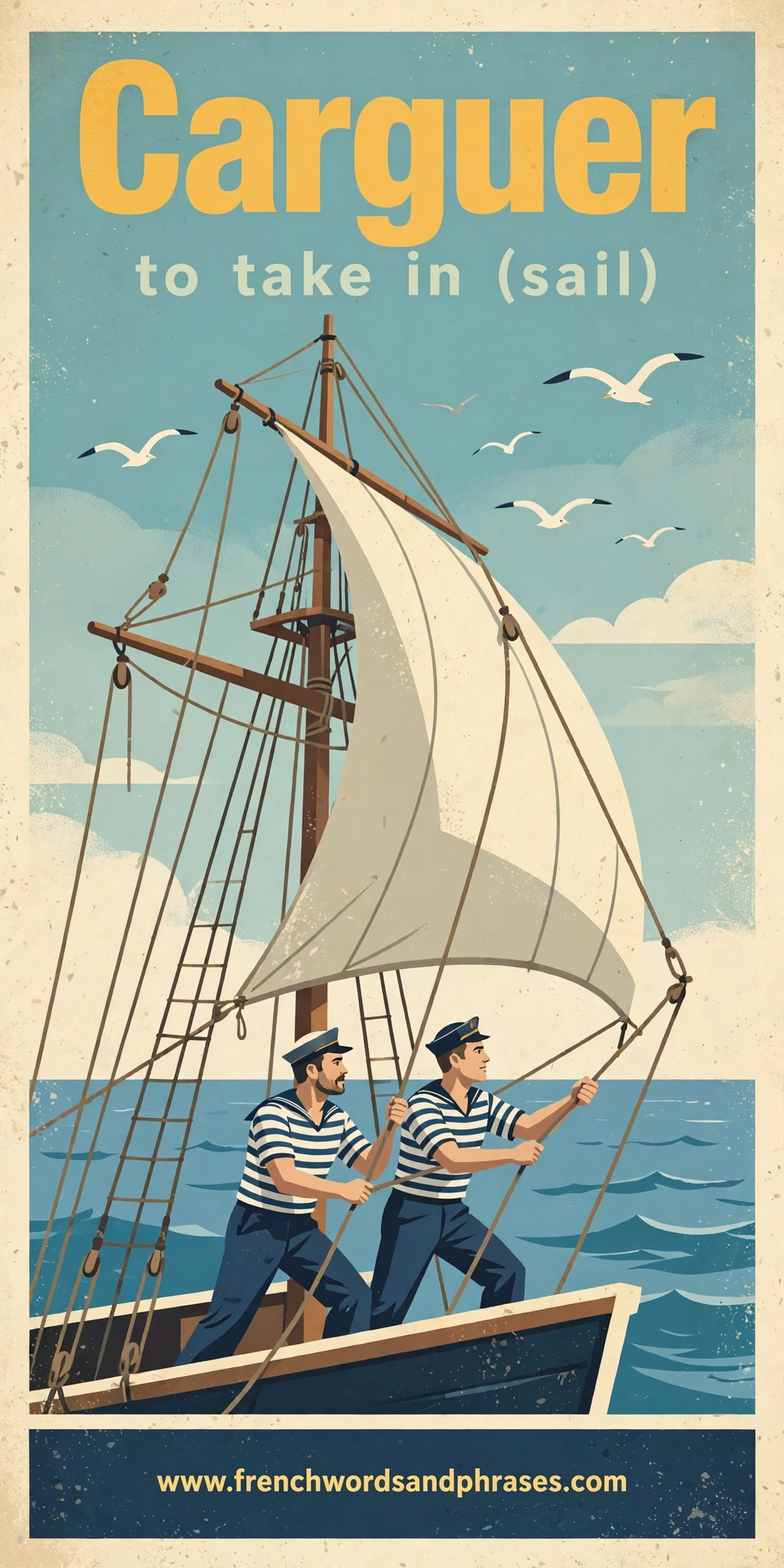
Dark clouds piling up on the horizon, the captain’s voice ringing across the deck — carguer is the sailor’s verb for gathering a sail in, bundle by bundle, before the squall arrives to do it for you.
In this guide, you’ll learn how to conjugate carguer in all the major French tenses and moods. Explore complete conjugation tables, French examples, English translations, and practice quizzes.
Understanding the French Verb Carguer
Carguer is a regular French verb belonging to the first group of verbs, those ending in-er.
It means to take in (sail). It is a technical verb of the age of sail, still used on traditional sailing ships and in sea literature: to carguer is not to lower a sail (that is amener) but to haul it up to the yard and bundle it, taking the wind out of it quickly when the weather turns.
Verb classification: First group (-er)
Auxiliary verb: Avoir
Past participle: cargué
Present participle: carguant
English equivalents: To take in (sail), to clew up; carguer les voiles — to take in the sails; carguer la grand-voile — to clew up the mainsail; carguer un hunier — to take in a topsail; les cargues — the clew-lines used for the job.
One important detail: carguer keeps its u after the g in every form, so the hard g sound never softens: je cargue, nous carguons, vous carguez, ils carguent, past participle cargué. The u is a guard letter, not a sound — exactly as in fatiguer or endiguer. The ropes that do the work are themselves called les cargues, and the order on deck is short and sharp: Carguez les voiles !
Experience the Word
Carguer is the verb of the race against the weather — hands hauling ropes together while the wind rises.
Imagine a three-masted ship in the Atlantic. The sky blackens to windward, the captain shouts his order, and twenty sailors haul together: ils carguent les voiles, the great sails climb, fold and are bundled against the yards, just as the first gust strikes.
The ship rides out the squall under bare poles. Her sails have been taken in — carguées, every one, in time.
How to Conjugate Carguer: Complete French Conjugation Guide
Let’s explore every major conjugation of carguer, beginning with the indicative mood.
How to Conjugate Carguer in the Indicative Mood
The indicative mood is used to express facts, observations, actions, and events.
How to Conjugate Carguer in the Present Tense (Présent)
Used for actions happening now, habitual actions, and general truths.
| Subject | Conjugation |
|---|---|
| je | cargue |
| tu | cargues |
| il / elle | cargue |
| nous | carguons |
| vous | carguez |
| ils / elles | carguent |
Example
Les marins carguent les voiles avant la tempête.
The sailors take in the sails before the storm.
Quick Quiz 1
Complete the sentence:
Nous ______ les voiles dès que le vent fraîchit.
Reveal the answer
carguons
Nous carguons les voiles dès que le vent fraîchit.
We take in the sails as soon as the wind freshens.
How to Conjugate Carguer in the Passé Composé
Used for completed actions in the past. Carguer takes the auxiliary verb avoir.
| Subject | Conjugation |
|---|---|
| j’ | ai cargué |
| tu | as cargué |
| il / elle | a cargué |
| nous | avons cargué |
| vous | avez cargué |
| ils / elles | ont cargué |
Example
L’équipage a cargué la grand-voile en cinq minutes.
The crew took in the mainsail in five minutes.
How to Conjugate Carguer in the Imparfait (Imperfect Tense)
Used for habitual past actions, descriptions, and ongoing situations in the past.
| Subject | Conjugation |
|---|---|
| je | carguais |
| tu | carguais |
| il / elle | carguait |
| nous | carguions |
| vous | carguiez |
| ils / elles | carguaient |
Example
Sur les vieux navires, on carguait les voiles à la force des bras.
On the old ships, they used to take in the sails by arm power.
Quick Quiz 2
Choose the correct form:
The crew took in the mainsail.
L’équipage ______ la grand-voile. (a cargué / est cargué)
Reveal the answer
a cargué
L’équipage a cargué la grand-voile.
Carguer takes avoir.
How to Conjugate Carguer in the Plus-que-parfait
Used to describe an action that had already been completed before another past event.
| Subject | Conjugation |
|---|---|
| j’ | avais cargué |
| tu | avais cargué |
| il / elle | avait cargué |
| nous | avions cargué |
| vous | aviez cargué |
| ils / elles | avaient cargué |
Example
Le capitaine avait cargué les huniers avant le grain.
The captain had taken in the topsails before the squall.
How to Conjugate Carguer in the Passé Simple
Primarily used in formal writing, literature, and historical narratives. It is rarely used in everyday conversation.
| Subject | Conjugation |
|---|---|
| je | carguai |
| tu | carguas |
| il / elle | cargua |
| nous | carguâmes |
| vous | carguâtes |
| ils / elles | carguèrent |
Example
Au signal, les matelots carguèrent toutes les voiles.
At the signal, the sailors took in all the sails.
How to Conjugate Carguer in the Passé Antérieur
A literary tense used to express an action completed immediately before another past action, generally in the passé simple.
| Subject | Conjugation |
|---|---|
| j’ | eus cargué |
| tu | eus cargué |
| il / elle | eut cargué |
| nous | eûmes cargué |
| vous | eûtes cargué |
| ils / elles | eurent cargué |
Example
Dès qu’ils eurent cargué les voiles, le navire ralentit.
As soon as they had taken in the sails, the ship slowed down.
How to Conjugate Carguer in the Future Tense (Futur Simple)
Used to describe actions that will take place in the future.
| Subject | Conjugation |
|---|---|
| je | carguerai |
| tu | cargueras |
| il / elle | carguera |
| nous | carguerons |
| vous | carguerez |
| ils / elles | cargueront |
Example
Vous carguerez les voiles dès que le vent fraîchira.
You will take in the sails as soon as the wind freshens.
How to Conjugate Carguer in the Futur Antérieur (Future Perfect)
Used for an action that will have been completed before a particular point in the future.
| Subject | Conjugation |
|---|---|
| j’ | aurai cargué |
| tu | auras cargué |
| il / elle | aura cargué |
| nous | aurons cargué |
| vous | aurez cargué |
| ils / elles | auront cargué |
Example
À la tombée de la nuit, ils auront cargué la misaine.
By nightfall, they will have taken in the foresail.
How to Conjugate Carguer in the Near Future (Futur Proche)
Used to describe something that is going to happen soon. Formed with aller + infinitive.
| Subject | Conjugation |
|---|---|
| je | vais carguer |
| tu | vas carguer |
| il / elle | va carguer |
| nous | allons carguer |
| vous | allez carguer |
| ils / elles | vont carguer |
Example
Le vent monte, on va carguer les voiles !
The wind is rising, we are going to take in the sails!
How to Conjugate Carguer in the Conditional Mood
The conditional mood expresses what would happen under certain circumstances. It is also frequently used to make polite requests or express wishes.
How to Conjugate Carguer in the Present Conditional
| Subject | Conjugation |
|---|---|
| je | carguerais |
| tu | carguerais |
| il / elle | carguerait |
| nous | carguerions |
| vous | cargueriez |
| ils / elles | cargueraient |
Example
Avec plus de bras, nous carguerions plus vite.
With more hands, we would take in sail faster.
How to Conjugate Carguer in the Past Conditional
| Subject | Conjugation |
|---|---|
| j’ | aurais cargué |
| tu | aurais cargué |
| il / elle | aurait cargué |
| nous | aurions cargué |
| vous | auriez cargué |
| ils / elles | auraient cargué |
Example
Ils auraient cargué les voiles si l’ordre était venu plus tôt.
They would have taken in the sails if the order had come sooner.
Carguer in the Literary Past Conditional Form
This less common literary form uses the imperfect subjunctive of avoir.
| Subject | Conjugation |
|---|---|
| j’ | eusse cargué |
| tu | eusses cargué |
| il / elle | eût cargué |
| nous | eussions cargué |
| vous | eussiez cargué |
| ils / elles | eussent cargué |
Example
Les matelots eussent cargué les huniers avant le grain.
The sailors would have taken in the topsails before the squall.
How to Conjugate Carguer in the Subjunctive Mood
The subjunctive is used to express wishes, emotions, doubts, necessity, and uncertainty. It frequently follows expressions such as il faut que (it is necessary that) or bien que (although).
How to Conjugate Carguer in the Present Subjunctive
| Subject | Conjugation |
|---|---|
| que je | cargue |
| que tu | cargues |
| qu’il / qu’elle | cargue |
| que nous | carguions |
| que vous | carguiez |
| qu’ils / qu’elles | carguent |
Example
Il faut que l’équipage cargue les voiles immédiatement.
The crew must take in the sails immediately.
Quick Quiz 3
Complete the sentence using the subjunctive:
Il faut que vous ______ les huniers avant le grain.
Reveal the answer
carguiez
Il faut que vous carguiez les huniers avant le grain.
You must take in the topsails before the squall.
How to Conjugate Carguer in the Imperfect Subjunctive
A literary tense, rarely encountered in modern spoken French.
| Subject | Conjugation |
|---|---|
| que je | carguasse |
| que tu | carguasses |
| qu’il / qu’elle | carguât |
| que nous | carguassions |
| que vous | carguassiez |
| qu’ils / qu’elles | carguassent |
Example
Le capitaine ordonna que l’on carguât la grand-voile.
The captain ordered the mainsail to be taken in.
How to Conjugate Carguer in the Pluperfect Subjunctive
A literary construction used to express an action completed before another past action.
| Subject | Conjugation |
|---|---|
| que j’ | eusse cargué |
| que tu | eusses cargué |
| qu’il / qu’elle | eût cargué |
| que nous | eussions cargué |
| que vous | eussiez cargué |
| qu’ils / qu’elles | eussent cargué |
Example
On racontait que les pirates eussent cargué leurs voiles avant l’attaque.
People said the pirates had taken in their sails before the attack.
How to Conjugate Carguer in the Past Subjunctive
| Subject | Conjugation |
|---|---|
| que j’ | aie cargué |
| que tu | aies cargué |
| qu’il / qu’elle | ait cargué |
| que nous | ayons cargué |
| que vous | ayez cargué |
| qu’ils / qu’elles | aient cargué |
Example
Je suis content que vous ayez cargué les voiles à temps.
I am glad you took in the sails in time.
How to Conjugate Carguer in the Imperative
The imperative is used to give commands, instructions, invitations, or suggestions. Subject pronouns are omitted.
How to Conjugate Carguer in the Present Imperative
| Person | Conjugation |
|---|---|
| (tu) | cargue |
| (nous) | carguons |
| (vous) | carguez |
Example
Carguez les voiles, et vite !
Take in the sails, and quickly!
Quick Quiz 4
How would you say Take in the sails (tu form)?
Reveal the answer
Cargue les voiles !
French Participles of Carguer
Participles are verb forms that can be used in compound tenses and other grammatical constructions.
Present Participle of Carguer
carguant
En carguant la voile, un matelot a glissé sur le pont.
While taking in the sail, a sailor slipped on the deck.
Past Participle of Carguer
cargué
Les voiles carguées, le navire attendit la fin du grain.
With the sails taken in, the ship waited for the squall to end.
Carguer in Everyday French: Real-Life Examples
Now that you know the conjugations, let’s see how carguer appears in everyday French.
Example 1 — Present
Les marins carguent les voiles.
The sailors take in the sails.
Example 2 — Passé composé
L’équipage a cargué la grand-voile.
The crew took in the mainsail.
Example 3 — Imparfait
On carguait les voiles à la main.
They used to take in the sails by hand.
Example 4 — Future
Vous carguerez les voiles avant le grain.
You will take in the sails before the squall.
Example 5 — Conditional
Nous carguerions plus vite avec plus de bras.
We would take in sail faster with more hands.
Example 6 — Imperative
Carguez les voiles !
Take in the sails!
Beyond Translation: The Meaning of Carguer
English sailing keeps the ropes but lost the verb — a cargue is a clew-line, and carguer is what the crew does with it.
It is the opposite of setting sail.
Where hisser sends the sail up to catch the wind, carguer gathers it in and silences it — the gesture every sailing novel reaches for when the sky turns black.
How to Remember the French Verb Carguer
Remember it this way: Carguer is about twenty sailors hauling together — the sail gathered in before the squall.
- The u guards the hard g everywhere: je cargue, nous carguons, ils carguent.
- Picture the crew hauling the clew-lines — les cargues — to bundle the sail against the yard.
- Regular -guer: past participle cargué, and the order is Carguez les voiles !
The key idea is twenty sailors hauling together — the sail gathered in before the squall.
Test Your Knowledge of Carguer
Let’s see how much you’ve learned. Try answering these questions before revealing the answers.
Question 1
Why does carguer keep a u after the g in nous carguons?
Reveal the answer
To keep the g hard — the u is a guard letter, as in fatiguer: je cargue, nous carguons.
Question 2
How do you say The sailors take in the sails in French?
Reveal the answer
Les marins carguent les voiles.
Question 3
Translate: The crew took in the mainsail.
Reveal the answer
L’équipage a cargué la grand-voile.
Question 4
What is the past participle of carguer?
Reveal the answer
Cargué.
Question 5
Complete the sentence:
Il faut que l’équipage ______ les voiles immédiatement.
Reveal the answer
cargue
Il faut que l’équipage cargue les voiles immédiatement.
The crew must take in the sails immediately.
Your Final Challenge
Can You Use It?
How would you say this in French?
The sky darkens, the captain shouts, and the sailors take in the sails before the squall breaks.
Reveal the answer
Le ciel noircit, le capitaine crie, et les marins carguent les voiles avant que le grain n’éclate.
The sky darkens, the captain shouts, and the sailors take in the sails before the squall breaks.
A little French. A little curiosity. A richer everyday life.
LEARN FRENCH ONE WORD AT A TIME




