A French Word to Live By
How to Conjugate Carcailler in French
/kaʁ.ka.je/
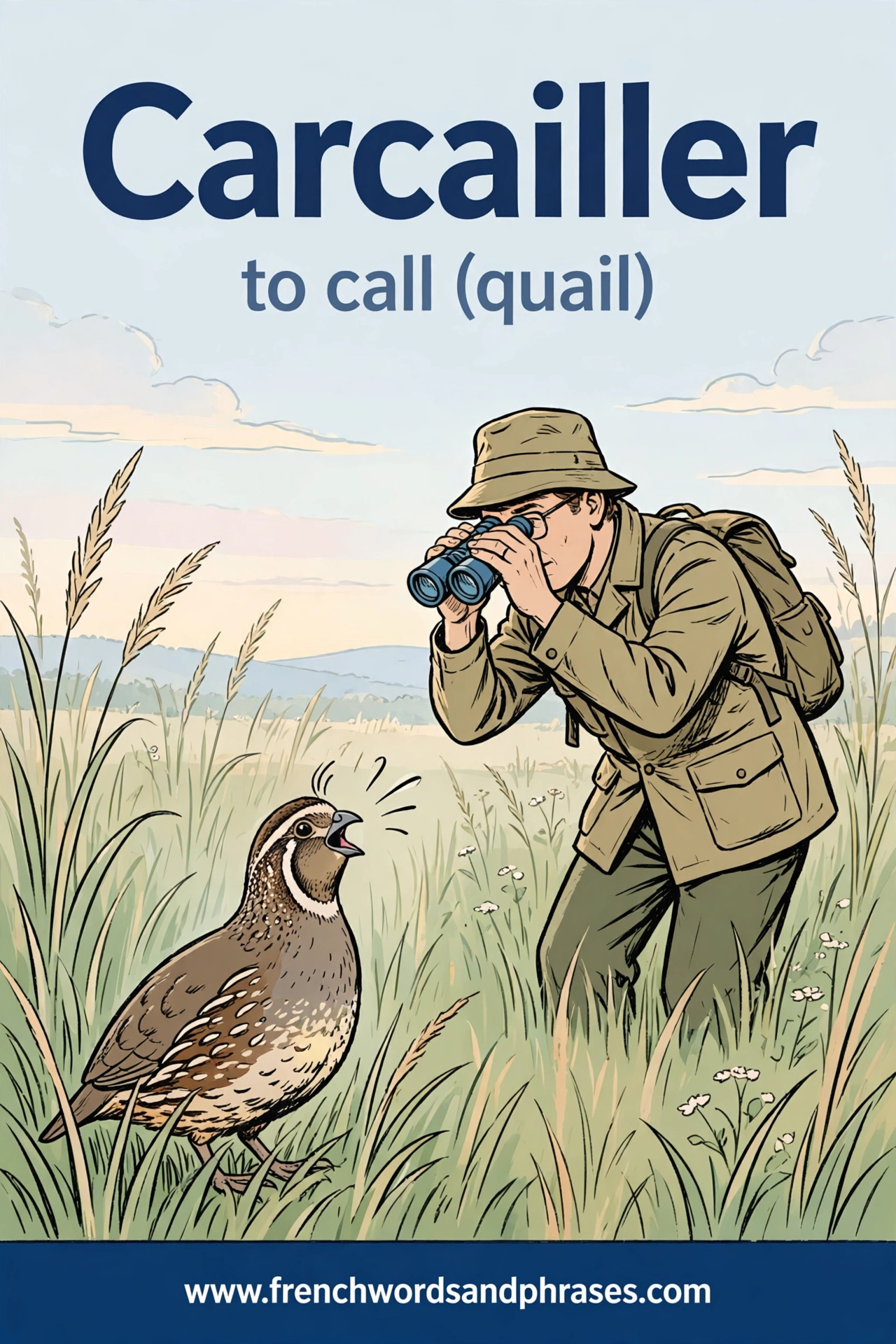
Carcailler means to call — said of the quail, whose sharp, rhythmic cry rings out from the wheat fields at dusk.
A summer evening, a wheat field turning gold, and from somewhere in the stubble a sharp three-note cry: car-ca-ye ! — carcailler is the specialist’s verb for the call of the quail, a small hidden bird with a very carrying voice.
In this guide, you’ll learn how to conjugate carcailler in all the major French tenses and moods. Explore complete conjugation tables, French examples, English translations, and practice quizzes.
Understanding the French Verb Carcailler
Carcailler is a regular French verb belonging to the first group of verbs, those ending in-er.
It means to call (quail). Outside ornithology you will rarely meet it, which is exactly its charm: French hunting and nature writing keeps a whole orchestra of these cry verbs — le coq coquerique, la poule caquette, la caille carcaille. If you read rural novels or nature columns, carcailler is a word you will be glad to recognise.
Verb classification: First group (-er)
Auxiliary verb: Avoir
Past participle: carcaillé
Present participle: carcaillant
English equivalents: To call (of the quail); la caille carcaille — the quail calls; carcailler au crépuscule — to call at dusk; le mâle carcaille dans les blés — the male calls in the wheat; on entend carcailler au loin — you can hear quails calling in the distance.
One important detail: carcailler belongs to the hunter’s and birdwatcher’s vocabulary — almost every French bird has its own cry verb, and the quail’s is carcailler. It is onomatopoeic: say it aloud and you hear the bird, car-ca-ye. The conjugation is a plain regular -er: la caille carcaille, les cailles carcaillent, past participle carcaillé, and the subject is essentially always the quail itself.
Experience the Word
Carcailler is a sound before it is a verb — three sharp notes thrown across a summer field by a bird you almost never see.
Imagine walking a farm track at dusk in June. The wheat is still, the air is warm, and suddenly, from ten metres away and yet invisible, une caille carcaille — car-ca-ye ! car-ca-ye ! — so close and so loud that you stop in your tracks, listening to a bird made entirely of voice.
You will not see her, but you will never forget her. That hidden cry is carcailler.
How to Conjugate Carcailler: Complete French Conjugation Guide
Let’s explore every major conjugation of carcailler, beginning with the indicative mood.
How to Conjugate Carcailler in the Indicative Mood
The indicative mood is used to express facts, observations, actions, and events.
How to Conjugate Carcailler in the Present Tense (Présent)
Used for actions happening now, habitual actions, and general truths.
| Subject | Conjugation |
|---|---|
| je | carcaille |
| tu | carcailles |
| il / elle | carcaille |
| nous | carcaillons |
| vous | carcaillez |
| ils / elles | carcaillent |
Example
La caille carcaille dans les blés au crépuscule.
The quail calls in the wheat at dusk.
Quick Quiz 1
Complete the sentence:
Nous écoutons les cailles qui ______ dans le champ.
Reveal the answer
carcaillent
Nous écoutons les cailles qui carcaillent dans le champ.
We are listening to the quails calling in the field.
How to Conjugate Carcailler in the Passé Composé
Used for completed actions in the past. Carcailler takes the auxiliary verb avoir.
| Subject | Conjugation |
|---|---|
| j’ | ai carcaillé |
| tu | as carcaillé |
| il / elle | a carcaillé |
| nous | avons carcaillé |
| vous | avez carcaillé |
| ils / elles | ont carcaillé |
Example
Ce soir, les cailles ont carcaillé près de la haie.
This evening, the quails called near the hedge.
How to Conjugate Carcailler in the Imparfait (Imperfect Tense)
Used for habitual past actions, descriptions, and ongoing situations in the past.
| Subject | Conjugation |
|---|---|
| je | carcaillais |
| tu | carcaillais |
| il / elle | carcaillait |
| nous | carcaillions |
| vous | carcailliez |
| ils / elles | carcaillaient |
Example
Autrefois, les cailles carcaillaient dans tous les champs.
In the old days, quails used to call in every field.
Quick Quiz 2
Choose the correct form:
The male called before daybreak.
Le mâle ______ avant l’aube. (a carcaillé / a carcaillée)
Reveal the answer
a carcaillé
Le mâle a carcaillé avant l’aube.
With avoir, the participle does not agree with the subject.
How to Conjugate Carcailler in the Plus-que-parfait
Used to describe an action that had already been completed before another past event.
| Subject | Conjugation |
|---|---|
| j’ | avais carcaillé |
| tu | avais carcaillé |
| il / elle | avait carcaillé |
| nous | avions carcaillé |
| vous | aviez carcaillé |
| ils / elles | avaient carcaillé |
Example
Le mâle avait carcaillé avant le lever du jour.
The male had called before daybreak.
How to Conjugate Carcailler in the Passé Simple
Primarily used in formal writing, literature, and historical narratives. It is rarely used in everyday conversation.
| Subject | Conjugation |
|---|---|
| je | carcaillai |
| tu | carcaillas |
| il / elle | carcailla |
| nous | carcaillâmes |
| vous | carcaillâtes |
| ils / elles | carcaillèrent |
Example
Soudain, une caille carcailla tout près du chemin.
Suddenly, a quail called very close to the path.
How to Conjugate Carcailler in the Passé Antérieur
A literary tense used to express an action completed immediately before another past action, generally in the passé simple.
| Subject | Conjugation |
|---|---|
| j’ | eus carcaillé |
| tu | eus carcaillé |
| il / elle | eut carcaillé |
| nous | eûmes carcaillé |
| vous | eûtes carcaillé |
| ils / elles | eurent carcaillé |
Example
Dès qu’une caille eut carcaillé, les autres répondirent.
As soon as one quail had called, the others answered.
How to Conjugate Carcailler in the Future Tense (Futur Simple)
Used to describe actions that will take place in the future.
| Subject | Conjugation |
|---|---|
| je | carcaillerai |
| tu | carcailleras |
| il / elle | carcaillera |
| nous | carcaillerons |
| vous | carcaillerez |
| ils / elles | carcailleront |
Example
En juin, les cailles carcailleront dans les champs de blé.
In June, the quails will call in the wheat fields.
How to Conjugate Carcailler in the Futur Antérieur (Future Perfect)
Used for an action that will have been completed before a particular point in the future.
| Subject | Conjugation |
|---|---|
| j’ | aurai carcaillé |
| tu | auras carcaillé |
| il / elle | aura carcaillé |
| nous | aurons carcaillé |
| vous | aurez carcaillé |
| ils / elles | auront carcaillé |
Example
Avant l’aube, le mâle aura carcaillé plusieurs fois.
Before dawn, the male will have called several times.
How to Conjugate Carcailler in the Near Future (Futur Proche)
Used to describe something that is going to happen soon. Formed with aller + infinitive.
| Subject | Conjugation |
|---|---|
| je | vais carcailler |
| tu | vas carcailler |
| il / elle | va carcailler |
| nous | allons carcailler |
| vous | allez carcailler |
| ils / elles | vont carcailler |
Example
Écoute, une caille va carcailler près de la haie.
Listen, a quail is going to call near the hedge.
How to Conjugate Carcailler in the Conditional Mood
The conditional mood expresses what would happen under certain circumstances. It is also frequently used to make polite requests or express wishes.
How to Conjugate Carcailler in the Present Conditional
| Subject | Conjugation |
|---|---|
| je | carcaillerais |
| tu | carcaillerais |
| il / elle | carcaillerait |
| nous | carcaillerions |
| vous | carcailleriez |
| ils / elles | carcailleraient |
Example
Sans le vent, on entendrait les cailles carcailler au loin.
Without the wind, you would hear the quails calling in the distance.
How to Conjugate Carcailler in the Past Conditional
| Subject | Conjugation |
|---|---|
| j’ | aurais carcaillé |
| tu | aurais carcaillé |
| il / elle | aurait carcaillé |
| nous | aurions carcaillé |
| vous | auriez carcaillé |
| ils / elles | auraient carcaillé |
Example
Le mâle aurait carcaillé davantage sans le chien.
The male would have called more without the dog.
Carcailler in the Literary Past Conditional Form
This less common literary form uses the imperfect subjunctive of avoir.
| Subject | Conjugation |
|---|---|
| j’ | eusse carcaillé |
| tu | eusses carcaillé |
| il / elle | eût carcaillé |
| nous | eussions carcaillé |
| vous | eussiez carcaillé |
| ils / elles | eussent carcaillé |
Example
La caille eût carcaillé dès l’aube dans les chaumes.
The quail would have called from dawn in the stubble.
How to Conjugate Carcailler in the Subjunctive Mood
The subjunctive is used to express wishes, emotions, doubts, necessity, and uncertainty. It frequently follows expressions such as il faut que (it is necessary that) or bien que (although).
How to Conjugate Carcailler in the Present Subjunctive
| Subject | Conjugation |
|---|---|
| que je | carcaille |
| que tu | carcailles |
| qu’il / qu’elle | carcaille |
| que nous | carcaillions |
| que vous | carcailliez |
| qu’ils / qu’elles | carcaillent |
Example
Il est rare qu’une caille carcaille en plein jour.
It is rare for a quail to call in broad daylight.
Quick Quiz 3
Complete the sentence using the subjunctive:
Il est rare que la caille ______ à midi.
Reveal the answer
carcaille
Il est rare que la caille carcaille à midi.
It is rare for the quail to call at midday.
How to Conjugate Carcailler in the Imperfect Subjunctive
A literary tense, rarely encountered in modern spoken French.
| Subject | Conjugation |
|---|---|
| que je | carcaillasse |
| que tu | carcaillasses |
| qu’il / qu’elle | carcaillât |
| que nous | carcaillassions |
| que vous | carcaillassiez |
| qu’ils / qu’elles | carcaillassent |
Example
Le silence était tel qu’on eût cru entendre les cailles carcailler partout.
The silence was such that you would have thought you heard quails calling everywhere.
How to Conjugate Carcailler in the Pluperfect Subjunctive
A literary construction used to express an action completed before another past action.
| Subject | Conjugation |
|---|---|
| que j’ | eusse carcaillé |
| que tu | eusses carcaillé |
| qu’il / qu’elle | eût carcaillé |
| que nous | eussions carcaillé |
| que vous | eussiez carcaillé |
| qu’ils / qu’elles | eussent carcaillé |
Example
Les chasseurs racontaient que les cailles eussent carcaillé toute la nuit.
The hunters said the quails had called all night.
How to Conjugate Carcailler in the Past Subjunctive
| Subject | Conjugation |
|---|---|
| que j’ | aie carcaillé |
| que tu | aies carcaillé |
| qu’il / qu’elle | ait carcaillé |
| que nous | ayons carcaillé |
| que vous | ayez carcaillé |
| qu’ils / qu’elles | aient carcaillé |
Example
Je suis content que les cailles aient carcaillé près de chez nous.
I am glad the quails called near our house.
How to Conjugate Carcailler in the Imperative
The imperative is used to give commands, instructions, invitations, or suggestions. Subject pronouns are omitted.
How to Conjugate Carcailler in the Present Imperative
| Person | Conjugation |
|---|---|
| (tu) | carcaille |
| (nous) | carcaillons |
| (vous) | carcaillez |
Example
Écoute : carcaille, petite caille, on t’entend à peine !
Call out, little quail, we can barely hear you!
Quick Quiz 4
How would you say Call out, little quail (tu form)?
Reveal the answer
Carcaille, petite caille !
French Participles of Carcailler
Participles are verb forms that can be used in compound tenses and other grammatical constructions.
Present Participle of Carcailler
carcaillant
En carcaillant, le mâle attire les femelles vers son territoire.
By calling, the male attracts the females to his territory.
Past Participle of Carcailler
carcaillé
Après avoir carcaillé un moment, la caille s’envola.
After calling for a while, the quail flew off.
Carcailler in Everyday French: Real-Life Examples
Now that you know the conjugations, let’s see how carcailler appears in everyday French.
Example 1 — Present
La caille carcaille dans les blés.
The quail calls in the wheat.
Example 2 — Passé composé
Les cailles ont carcaillé près de la haie.
The quails called near the hedge.
Example 3 — Imparfait
Les cailles carcaillaient dans tous les champs.
Quails used to call in every field.
Example 4 — Future
En juin, elles carcailleront au crépuscule.
In June, they will call at dusk.
Example 5 — Conditional
Sans le vent, on les entendrait carcailler au loin.
Without the wind, you would hear them calling in the distance.
Example 6 — Imperative
Carcaille, petite caille, réveille le champ !
Call out, little quail, wake up the field!
Beyond Translation: The Meaning of Carcailler
French keeps a whole bestiary of cry verbs — the hen caquette, the crow croasse, the owl hulule — and carcailler is the quail’s entry in that orchestra, its very syllables imitating the bird: car-ca-ye.
The image is a voice without a bird.
The quail is famously invisible in the crops; all summer long it exists for walkers only as a call — which is why its verb is pure onomatopoeia, a sound that became a word.
How to Remember the French Verb Carcailler
Remember it this way: Carcailler is about a hidden quail shouting car-ca-ye from the wheat.
- Say it aloud: car-ca-ye — the verb imitates the quail’s three-note call.
- The subject is the quail: la caille carcaille, les cailles carcaillent.
- Perfectly regular -er: past participle carcaillé, nothing changes anywhere.
The key idea is a hidden quail shouting car-ca-ye from the wheat.
Test Your Knowledge of Carcailler
Let’s see how much you’ve learned. Try answering these questions before revealing the answers.
Question 1
Which bird carcailler belongs to?
Reveal the answer
The quail — la caille; carcailler is its call.
Question 2
How do you say The quail calls in the wheat in French?
Reveal the answer
La caille carcaille dans les blés.
Question 3
Translate: The quails called near the hedge.
Reveal the answer
Les cailles ont carcaillé près de la haie.
Question 4
What is the past participle of carcailler?
Reveal the answer
Carcaillé — a regular -er participle.
Question 5
Complete the sentence:
Il est rare qu’une caille ______ en plein jour.
Reveal the answer
carcaille
Il est rare qu’une caille carcaille en plein jour.
It is rare for the quail to call in broad daylight.
Your Final Challenge
Can You Use It?
How would you say this in French?
At dusk, in the still-warm wheat, a quail called three times, then silence took back the field.
Reveal the answer
Au crépuscule, dans les blés encore chauds, une caille carcailla trois fois, puis le silence reprit le champ.
At dusk, in the still-warm wheat, a quail called three times, then silence took back the field.
A little French. A little curiosity. A richer everyday life.
LEARN FRENCH ONE WORD AT A TIME