
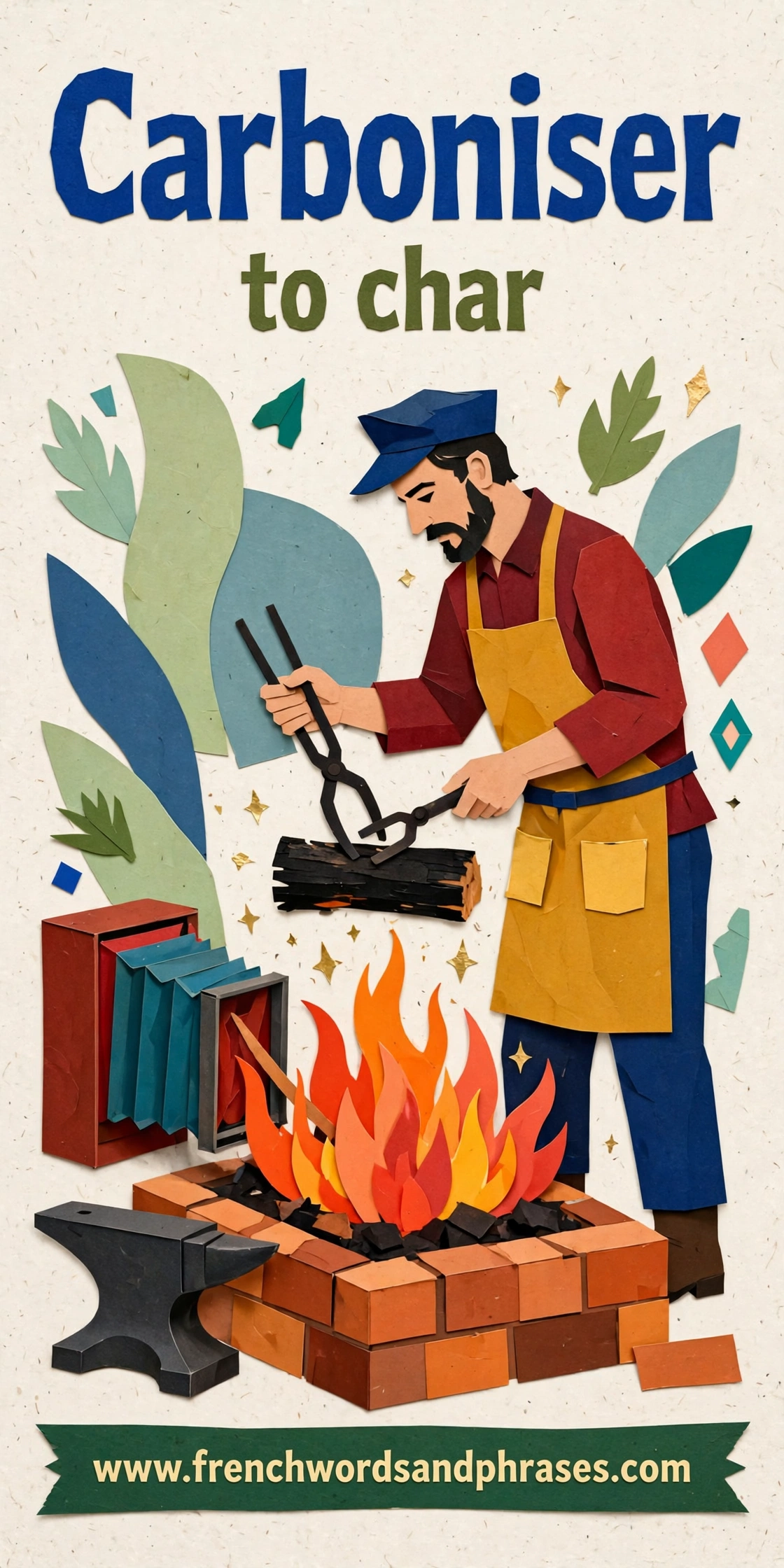
A French Word to Live By
How to Conjugate Carboniser in French
/kaʁ.bɔ.ni.ze/
Carboniser means to char, to carbonize — to burn something down to black carbon, whether it is firewood in a kiln or, less happily, the Sunday roast.
A log glowing in the charcoal-burner’s mound, slowly turning black without ever quite catching flame; a toast forgotten in the grill — carboniser is the verb of burning taken all the way to carbon: to char.
In this guide, you’ll learn how to conjugate carboniser in all the major French tenses and moods. Explore complete conjugation tables, French examples, English translations, and practice quizzes.
Understanding the French Verb Carboniser
Carboniser is a regular French verb belonging to the first group of verbs, those ending in-er.
It means to char, to carbonize. Its home ground is fire: charcoal burners carbonisent wood on purpose, cooks carbonisent a roast by accident, and fires carbonisent whatever they touch. The familiar figurative sense — je suis carbonisé after a brutal week — is now just as common in conversation.
Verb classification: First group (-er)
Auxiliary verb: Avoir
Past participle: carbonisé
Present participle: carbonisant
English equivalents: To char, to carbonize, to burn to a cinder; carboniser du bois — to char wood (to make charcoal); un rôti carbonisé — a roast burnt to a cinder; être carbonisé — to be burnt out (fam.); le feu a tout carbonisé — the fire charred everything.
One important detail: carboniser is a regular -er verb — je carbonise, nous carbonisons, ils carbonisent, past participle carbonisé — but watch its twin: carbonater means to carbonate a drink, while carboniser means to burn something black. In familiar speech, être carbonisé also describes a person who is completely burnt out and exhausted — a figurative charring, not a literal one.
Experience the Word
Carboniser is burning with the colour removed — everything the fire touches ends up the same deep black.
Imagine the charcoal burner’s mound in the forest, smoking gently for a week. Inside, away from the air, le bois se transforme lentement : la chaleur le carbonise, and when the mound is opened it holds not ash but charcoal, light as cork and black as night.
The wood never flamed, yet nothing of it remains but carbon. That slow blackening is carboniser.
How to Conjugate Carboniser: Complete French Conjugation Guide
Let’s explore every major conjugation of carboniser, beginning with the indicative mood.
How to Conjugate Carboniser in the Indicative Mood
The indicative mood is used to express facts, observations, actions, and events.
How to Conjugate Carboniser in the Present Tense (Présent)
Used for actions happening now, habitual actions, and general truths.
| Subject | Conjugation |
|---|---|
| je | carbonise |
| tu | carbonises |
| il / elle | carbonise |
| nous | carbonisons |
| vous | carbonisez |
| ils / elles | carbonisent |
Example
La chaleur carbonise lentement le bois dans la meule.
The heat slowly chars the wood in the kiln.
Quick Quiz 1
Complete the sentence:
Nous ______ le bois pour faire du charbon.
Reveal the answer
carbonisons
Nous carbonisons le bois pour faire du charbon.
We char the wood to make charcoal.
How to Conjugate Carboniser in the Passé Composé
Used for completed actions in the past. Carboniser takes the auxiliary verb avoir.
| Subject | Conjugation |
|---|---|
| j’ | ai carbonisé |
| tu | as carbonisé |
| il / elle | a carbonisé |
| nous | avons carbonisé |
| vous | avez carbonisé |
| ils / elles | ont carbonisé |
Example
Le feu a carbonisé toute la charpente.
The fire charred the whole roof frame.
How to Conjugate Carboniser in the Imparfait (Imperfect Tense)
Used for habitual past actions, descriptions, and ongoing situations in the past.
| Subject | Conjugation |
|---|---|
| je | carbonisais |
| tu | carbonisais |
| il / elle | carbonisait |
| nous | carbonisions |
| vous | carbonisiez |
| ils / elles | carbonisaient |
Example
Autrefois, les charbonniers carbonisaient le bois en forêt.
In the old days, charcoal burners used to char wood in the forest.
Quick Quiz 2
Choose the correct form:
The fire has charred the door.
Le feu ______ la porte. (a carbonisé / a carbonisée)
Reveal the answer
a carbonisé
Le feu a carbonisé la porte.
With avoir, the participle does not agree with the subject.
How to Conjugate Carboniser in the Plus-que-parfait
Used to describe an action that had already been completed before another past event.
| Subject | Conjugation |
|---|---|
| j’ | avais carbonisé |
| tu | avais carbonisé |
| il / elle | avait carbonisé |
| nous | avions carbonisé |
| vous | aviez carbonisé |
| ils / elles | avaient carbonisé |
Example
L’incendie avait carbonisé les poutres avant l’arrivée des pompiers.
The fire had charred the beams before the firefighters arrived.
How to Conjugate Carboniser in the Passé Simple
Primarily used in formal writing, literature, and historical narratives. It is rarely used in everyday conversation.
| Subject | Conjugation |
|---|---|
| je | carbonisai |
| tu | carbonisas |
| il / elle | carbonisa |
| nous | carbonisâmes |
| vous | carbonisâtes |
| ils / elles | carbonisèrent |
Example
La foudre carbonisa le vieux chêne en une seconde.
The lightning charred the old oak in a second.
How to Conjugate Carboniser in the Passé Antérieur
A literary tense used to express an action completed immediately before another past action, generally in the passé simple.
| Subject | Conjugation |
|---|---|
| j’ | eus carbonisé |
| tu | eus carbonisé |
| il / elle | eut carbonisé |
| nous | eûmes carbonisé |
| vous | eûtes carbonisé |
| ils / elles | eurent carbonisé |
Example
Quand le feu eut carbonisé la porte, il s’arrêta faute d’air.
When the fire had charred the door, it stopped for lack of air.
How to Conjugate Carboniser in the Future Tense (Futur Simple)
Used to describe actions that will take place in the future.
| Subject | Conjugation |
|---|---|
| je | carboniserai |
| tu | carboniseras |
| il / elle | carbonisera |
| nous | carboniserons |
| vous | carboniserez |
| ils / elles | carboniseront |
Example
Ce soleil carbonisera la peinture de la façade.
This sun will scorch the paint on the façade black.
How to Conjugate Carboniser in the Futur Antérieur (Future Perfect)
Used for an action that will have been completed before a particular point in the future.
| Subject | Conjugation |
|---|---|
| j’ | aurai carbonisé |
| tu | auras carbonisé |
| il / elle | aura carbonisé |
| nous | aurons carbonisé |
| vous | aurez carbonisé |
| ils / elles | auront carbonisé |
Example
À la fin de la cuisson, la chaleur aura carbonisé la croûte.
By the end of cooking, the heat will have charred the crust.
How to Conjugate Carboniser in the Near Future (Futur Proche)
Used to describe something that is going to happen soon. Formed with aller + infinitive.
| Subject | Conjugation |
|---|---|
| je | vais carboniser |
| tu | vas carboniser |
| il / elle | va carboniser |
| nous | allons carboniser |
| vous | allez carboniser |
| ils / elles | vont carboniser |
Example
Attention, le gril va carboniser les saucisses !
Careful, the grill is going to burn the sausages to a cinder!
How to Conjugate Carboniser in the Conditional Mood
The conditional mood expresses what would happen under certain circumstances. It is also frequently used to make polite requests or express wishes.
How to Conjugate Carboniser in the Present Conditional
| Subject | Conjugation |
|---|---|
| je | carboniserais |
| tu | carboniserais |
| il / elle | carboniserait |
| nous | carboniserions |
| vous | carboniseriez |
| ils / elles | carboniseraient |
Example
Sans surveillance, le feu carboniserait tout le rôti.
Unwatched, the fire would char the whole roast.
How to Conjugate Carboniser in the Past Conditional
| Subject | Conjugation |
|---|---|
| j’ | aurais carbonisé |
| tu | aurais carbonisé |
| il / elle | aurait carbonisé |
| nous | aurions carbonisé |
| vous | auriez carbonisé |
| ils / elles | auraient carbonisé |
Example
Tu aurais carbonisé le pain sans le minuteur.
You would have burnt the bread to a cinder without the timer.
Carboniser in the Literary Past Conditional Form
This less common literary form uses the imperfect subjunctive of avoir.
| Subject | Conjugation |
|---|---|
| j’ | eusse carbonisé |
| tu | eusses carbonisé |
| il / elle | eût carbonisé |
| nous | eussions carbonisé |
| vous | eussiez carbonisé |
| ils / elles | eussent carbonisé |
Example
La foudre eût carbonisé l’arbre entier.
The lightning would have charred the whole tree.
How to Conjugate Carboniser in the Subjunctive Mood
The subjunctive is used to express wishes, emotions, doubts, necessity, and uncertainty. It frequently follows expressions such as il faut que (it is necessary that) or bien que (although).
How to Conjugate Carboniser in the Present Subjunctive
| Subject | Conjugation |
|---|---|
| que je | carbonise |
| que tu | carbonises |
| qu’il / qu’elle | carbonise |
| que nous | carbonisions |
| que vous | carbonisiez |
| qu’ils / qu’elles | carbonisent |
Example
Il est dommage que la chaleur carbonise la viande si vite.
It is a pity the heat chars the meat so quickly.
Quick Quiz 3
Complete the sentence using the subjunctive:
Il est dommage que la chaleur ______ la viande si vite.
Reveal the answer
carbonise
Il est dommage que la chaleur carbonise la viande si vite.
It is a pity the heat chars the meat so quickly.
How to Conjugate Carboniser in the Imperfect Subjunctive
A literary tense, rarely encountered in modern spoken French.
| Subject | Conjugation |
|---|---|
| que je | carbonisasse |
| que tu | carbonisasses |
| qu’il / qu’elle | carbonisât |
| que nous | carbonisassions |
| que vous | carbonisassiez |
| qu’ils / qu’elles | carbonisassent |
Example
Le charbonnier veillait pour que le bois carbonisât sans brûler.
The charcoal burner kept watch so the wood would char without burning away.
How to Conjugate Carboniser in the Pluperfect Subjunctive
A literary construction used to express an action completed before another past action.
| Subject | Conjugation |
|---|---|
| que j’ | eusse carbonisé |
| que tu | eusses carbonisé |
| qu’il / qu’elle | eût carbonisé |
| que nous | eussions carbonisé |
| que vous | eussiez carbonisé |
| qu’ils / qu’elles | eussent carbonisé |
Example
On racontait que l’incendie eût carbonisé la moitié du village.
People said the fire had charred half the village.
How to Conjugate Carboniser in the Past Subjunctive
| Subject | Conjugation |
|---|---|
| que j’ | aie carbonisé |
| que tu | aies carbonisé |
| qu’il / qu’elle | ait carbonisé |
| que nous | ayons carbonisé |
| que vous | ayez carbonisé |
| qu’ils / qu’elles | aient carbonisé |
Example
Je regrette que le gril ait carbonisé les brochettes.
I am sorry the grill burnt the kebabs to a cinder.
How to Conjugate Carboniser in the Imperative
The imperative is used to give commands, instructions, invitations, or suggestions. Subject pronouns are omitted.
How to Conjugate Carboniser in the Present Imperative
| Person | Conjugation |
|---|---|
| (tu) | carbonise |
| (nous) | carbonisons |
| (vous) | carbonisez |
Example
Ne carbonise pas le pain, baisse le feu !
Do not burn the bread to a cinder, turn the heat down!
Quick Quiz 4
How would you say Do not burn the toast to a cinder (tu form)?
Reveal the answer
Ne carbonise pas le toast !
French Participles of Carboniser
Participles are verb forms that can be used in compound tenses and other grammatical constructions.
Present Participle of Carboniser
carbonisant
En carbonisant le bois, on obtient du charbon léger.
By charring wood, you obtain light charcoal.
Past Participle of Carboniser
carbonisé
Carbonisé par les flammes, le meuble n’était plus reconnaissable.
Charred by the flames, the piece of furniture was unrecognisable.
Carboniser in Everyday French: Real-Life Examples
Now that you know the conjugations, let’s see how carboniser appears in everyday French.
Example 1 — Present
La chaleur carbonise le bois lentement.
The heat slowly chars the wood.
Example 2 — Passé composé
Le feu a carbonisé la charpente.
The fire charred the roof frame.
Example 3 — Imparfait
Les charbonniers carbonisaient le bois en forêt.
The charcoal burners used to char wood in the forest.
Example 4 — Future
Le gril carbonisera les saucisses si tu pars.
The grill will burn the sausages to a cinder if you walk away.
Example 5 — Conditional
Sans surveillance, le feu carboniserait le rôti.
Unwatched, the fire would char the roast.
Example 6 — Imperative
Ne carbonisez pas le pain, baissez le feu !
Do not burn the bread to a cinder, turn the heat down!
Beyond Translation: The Meaning of Carboniser
English carbonize and French carboniser both descend from Latin carbo, charcoal — the word names its own result: to turn something into carbo.
The image is the charcoal burner’s mound.
Between the deliberate craft of the charbonnier and the familiar groan je suis carbonisé — burnt out — the verb covers every shade of black that fire, sun or exhaustion can produce.
How to Remember the French Verb Carboniser
Remember it this way: Carboniser is about the charcoal burner’s mound smoking in the forest.
- Carboniser = fire and blackening; carbonater = gas and bubbles — the twins must not swap jobs.
- Perfectly regular -er: je carbonise, nous carbonisons, past participle carbonisé.
- Être carbonisé (fam.) means to be completely burnt out — figuratively charred.
The key idea is the charcoal burner’s mound smoking in the forest.
Test Your Knowledge of Carboniser
Let’s see how much you’ve learned. Try answering these questions before revealing the answers.
Question 1
What is the difference between carboniser and carbonater?
Reveal the answer
Carboniser means to char, to burn black; carbonater means to carbonate, to charge with gas.
Question 2
How do you say The fire charred the beams in French?
Reveal the answer
Le feu a carbonisé les poutres.
Question 3
Translate: Do not burn the bread to a cinder.
Reveal the answer
Ne carbonise pas le pain.
Question 4
What is the past participle of carboniser?
Reveal the answer
Carbonisé — a regular -er participle.
Question 5
Complete the sentence:
Il est dommage que le gril ______ les brochettes.
Reveal the answer
ait carbonisé
Il est dommage que le gril ait carbonisé les brochettes.
It is a pity the grill burnt the kebabs to a cinder.
Your Final Challenge
Can You Use It?
How would you say this in French?
The lightning struck the old oak and charred it in a second, a black sentinel in the middle of the green meadow.
Reveal the answer
La foudre frappa le vieux chêne et le carbonisa en une seconde, noir sentinelle au milieu du pré vert.
The lightning struck the old oak and charred it in a second, a black sentinel in the middle of the green meadow.
A little French. A little curiosity. A richer everyday life.
LEARN FRENCH ONE WORD AT A TIME




