
A French Word to Live By
How to Conjugate Caracoler in French
/ka.ʁa.kɔ.le/
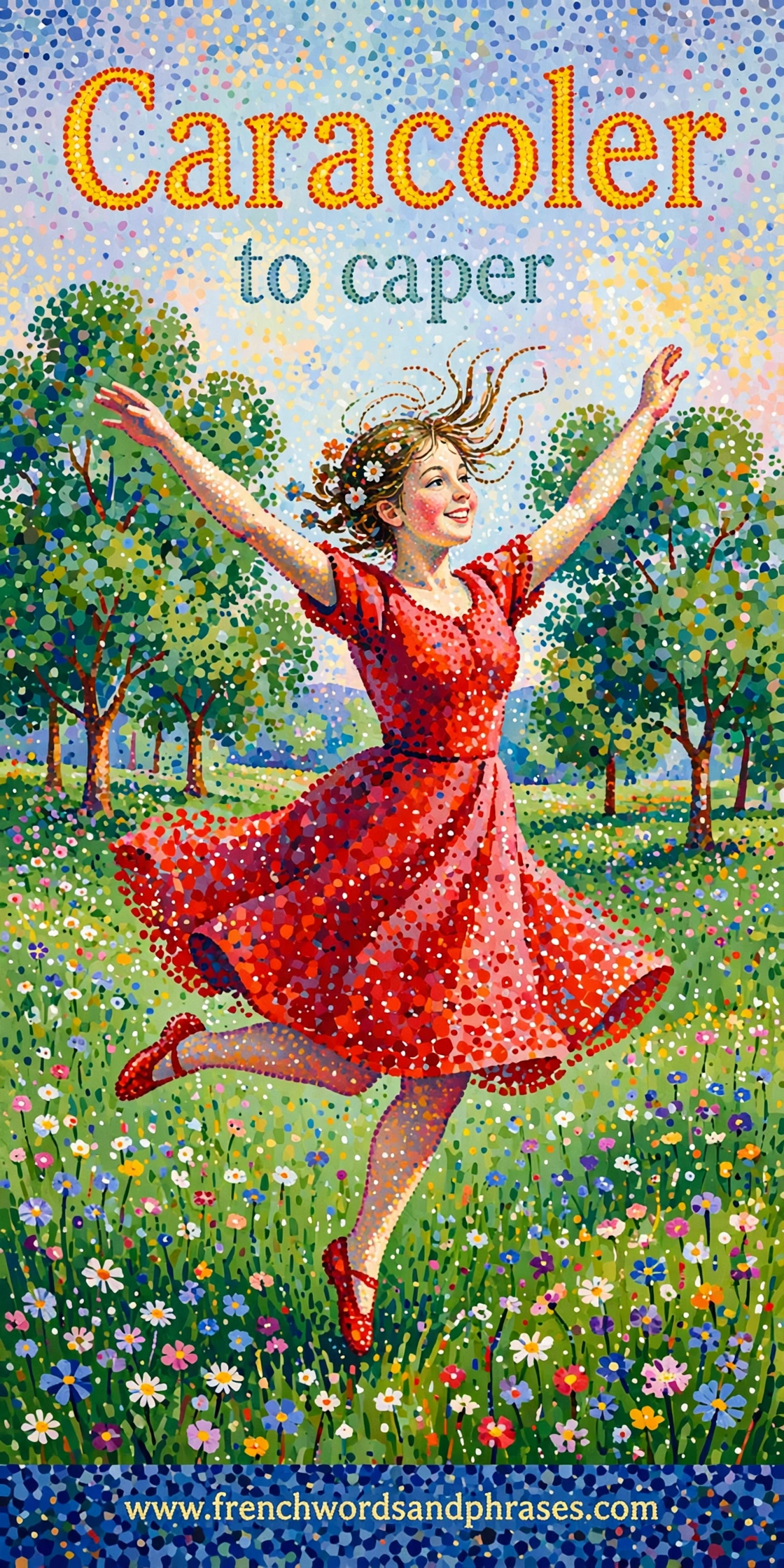
Caracoler means to caper — to prance and bound about with showy, joyful energy, the way a spirited horse dances sideways or children skip around a fairground.
A white horse at the fairground, neck arched, hooves barely touching the ground as it prances in a half-circle; children wheeling around a maypole, unable to keep still — caracoler is the verb of that showy, springy, look-at-me movement.
In this guide, you’ll learn how to conjugate caracoler in all the major French tenses and moods. Explore complete conjugation tables, French examples, English translations, and practice quizzes.
Understanding the French Verb Caracoler
Caracoler is a regular French verb belonging to the first group of verbs, those ending in-er.
It means to caper. It is used first of horses prancing and curvetting, then by extension of riders, dancers, children and anyone moving with bouncy, ostentatious delight. In racing reports you will also meet it for a horse or rider well clear at the front: caracoler en tête, to be cruising along in the lead.
Verb classification: First group (-er)
Auxiliary verb: Avoir
Past participle: caracolé
Present participle: caracolant
English equivalents: To caper, to prance, to frisk about; le cheval caracole — the horse prances; caracoler de joie — to caper with joy; les enfants caracolent dans la cour — the children are capering in the yard; caracoler en tête — to prance along at the head of the procession.
One important detail: caracoler comes from the riding school — a caracole was the half-turn a horseman made his mount perform to show off its training. The verb is a perfectly regular -er verb: je caracole, nous caracolons, ils caracolent, past participle caracolé. It is intransitive: the subject does the prancing, so it is the horse, the rider on it, or anyone bounding about who caracole — you cannot caracoler something else.
Experience the Word
Caracoler is the verb of joyful showing off on the move — half dance, half parade, all springs in the legs.
Imagine the village fête at noon. The drum sounds, and the mayor’s white mare comes down the lane with her neck arched and her hooves striking sparks, turning this way and that while her young rider beams. Elle caracole, and the whole street applauds.
She is not galloping anywhere. She is simply capering — caracolant, for the pure pleasure of being watched.
How to Conjugate Caracoler: Complete French Conjugation Guide
Let’s explore every major conjugation of caracoler, beginning with the indicative mood.
How to Conjugate Caracoler in the Indicative Mood
The indicative mood is used to express facts, observations, actions, and events.
How to Conjugate Caracoler in the Present Tense (Présent)
Used for actions happening now, habitual actions, and general truths.
| Subject | Conjugation |
|---|---|
| je | caracole |
| tu | caracoles |
| il / elle | caracole |
| nous | caracolons |
| vous | caracolez |
| ils / elles | caracolent |
Example
Le cheval caracole fièrement devant les spectateurs.
The horse prances proudly in front of the spectators.
Quick Quiz 1
Complete the sentence:
Nous regardons les chevaux qui ______ sur la piste.
Reveal the answer
caracolent
Nous regardons les chevaux qui caracolent sur la piste.
We are watching the horses prancing on the track.
How to Conjugate Caracoler in the Passé Composé
Used for completed actions in the past. Caracoler takes the auxiliary verb avoir.
| Subject | Conjugation |
|---|---|
| j’ | ai caracolé |
| tu | as caracolé |
| il / elle | a caracolé |
| nous | avons caracolé |
| vous | avez caracolé |
| ils / elles | ont caracolé |
Example
Les enfants ont caracolé autour du manège toute la matinée.
The children capered around the merry-go-round all morning.
How to Conjugate Caracoler in the Imparfait (Imperfect Tense)
Used for habitual past actions, descriptions, and ongoing situations in the past.
| Subject | Conjugation |
|---|---|
| je | caracolais |
| tu | caracolais |
| il / elle | caracolait |
| nous | caracolions |
| vous | caracoliez |
| ils / elles | caracolaient |
Example
Le poney caracolait sur la place du village.
The pony used to prance about on the village square.
Quick Quiz 2
Choose the correct form:
The children capered with joy.
Les enfants ______ de joie. (ont caracolé / ont caracolés)
Reveal the answer
ont caracolé
Les enfants ont caracolé de joie.
With avoir, the participle does not agree with the subject.
How to Conjugate Caracoler in the Plus-que-parfait
Used to describe an action that had already been completed before another past event.
| Subject | Conjugation |
|---|---|
| j’ | avais caracolé |
| tu | avais caracolé |
| il / elle | avait caracolé |
| nous | avions caracolé |
| vous | aviez caracolé |
| ils / elles | avaient caracolé |
Example
Le cavalier avait caracolé devant le jury avant la compétition.
The rider had pranced in front of the judges before the competition.
How to Conjugate Caracoler in the Passé Simple
Primarily used in formal writing, literature, and historical narratives. It is rarely used in everyday conversation.
| Subject | Conjugation |
|---|---|
| je | caracolai |
| tu | caracolas |
| il / elle | caracola |
| nous | caracolâmes |
| vous | caracolâtes |
| ils / elles | caracolèrent |
Example
Le cheval caracola en tête du cortège.
The horse pranced at the head of the procession.
How to Conjugate Caracoler in the Passé Antérieur
A literary tense used to express an action completed immediately before another past action, generally in the passé simple.
| Subject | Conjugation |
|---|---|
| j’ | eus caracolé |
| tu | eus caracolé |
| il / elle | eut caracolé |
| nous | eûmes caracolé |
| vous | eûtes caracolé |
| ils / elles | eurent caracolé |
Example
Quand le cheval eut caracolé un moment, le cavalier le calma.
When the horse had pranced for a while, the rider calmed it down.
How to Conjugate Caracoler in the Future Tense (Futur Simple)
Used to describe actions that will take place in the future.
| Subject | Conjugation |
|---|---|
| je | caracolerai |
| tu | caracoleras |
| il / elle | caracolera |
| nous | caracolerons |
| vous | caracolerez |
| ils / elles | caracoleront |
Example
Demain, les chevaux caracoleront sur la piste du cirque.
Tomorrow, the horses will prance on the circus ring.
How to Conjugate Caracoler in the Futur Antérieur (Future Perfect)
Used for an action that will have been completed before a particular point in the future.
| Subject | Conjugation |
|---|---|
| j’ | aurai caracolé |
| tu | auras caracolé |
| il / elle | aura caracolé |
| nous | aurons caracolé |
| vous | aurez caracolé |
| ils / elles | auront caracolé |
Example
Les enfants auront caracolé de joie avant même l’ouverture des cadeaux.
The children will have capered with joy even before the presents are opened.
How to Conjugate Caracoler in the Near Future (Futur Proche)
Used to describe something that is going to happen soon. Formed with aller + infinitive.
| Subject | Conjugation |
|---|---|
| je | vais caracoler |
| tu | vas caracoler |
| il / elle | va caracoler |
| nous | allons caracoler |
| vous | allez caracoler |
| ils / elles | vont caracoler |
Example
Regarde, le poney va caracoler dès qu’il entendra la musique.
Look, the pony is going to prance as soon as it hears the music.
How to Conjugate Caracoler in the Conditional Mood
The conditional mood expresses what would happen under certain circumstances. It is also frequently used to make polite requests or express wishes.
How to Conjugate Caracoler in the Present Conditional
| Subject | Conjugation |
|---|---|
| je | caracolerais |
| tu | caracolerais |
| il / elle | caracolerait |
| nous | caracolerions |
| vous | caracoleriez |
| ils / elles | caracoleraient |
Example
Sans sa bride, le cheval caracolerait dans tout le pré.
Without its bridle, the horse would prance all over the meadow.
How to Conjugate Caracoler in the Past Conditional
| Subject | Conjugation |
|---|---|
| j’ | aurais caracolé |
| tu | aurais caracolé |
| il / elle | aurait caracolé |
| nous | aurions caracolé |
| vous | auriez caracolé |
| ils / elles | auraient caracolé |
Example
Les enfants auraient caracolé davantage sans la pluie.
The children would have capered more without the rain.
Caracoler in the Literary Past Conditional Form
This less common literary form uses the imperfect subjunctive of avoir.
| Subject | Conjugation |
|---|---|
| j’ | eusse caracolé |
| tu | eusses caracolé |
| il / elle | eût caracolé |
| nous | eussions caracolé |
| vous | eussiez caracolé |
| ils / elles | eussent caracolé |
Example
Le cheval eût caracolé devant le roi lui-même.
The horse would have pranced before the king himself.
How to Conjugate Caracoler in the Subjunctive Mood
The subjunctive is used to express wishes, emotions, doubts, necessity, and uncertainty. It frequently follows expressions such as il faut que (it is necessary that) or bien que (although).
How to Conjugate Caracoler in the Present Subjunctive
| Subject | Conjugation |
|---|---|
| que je | caracole |
| que tu | caracoles |
| qu’il / qu’elle | caracole |
| que nous | caracolions |
| que vous | caracoliez |
| qu’ils / qu’elles | caracolent |
Example
Il est amusant que le vieux cheval caracole encore.
It is delightful that the old horse still prances.
Quick Quiz 3
Complete the sentence using the subjunctive:
Il est amusant que le poney ______ encore à son âge.
Reveal the answer
caracole
Il est amusant que le poney caracole encore à son âge.
It is delightful that the pony still prances at its age.
How to Conjugate Caracoler in the Imperfect Subjunctive
A literary tense, rarely encountered in modern spoken French.
| Subject | Conjugation |
|---|---|
| que je | caracolasse |
| que tu | caracolasses |
| qu’il / qu’elle | caracolât |
| que nous | caracolassions |
| que vous | caracolassiez |
| qu’ils / qu’elles | caracolassent |
Example
Le public applaudit comme si le poney caracolât pour lui seul.
The audience applauded as if the pony were prancing for it alone.
How to Conjugate Caracoler in the Pluperfect Subjunctive
A literary construction used to express an action completed before another past action.
| Subject | Conjugation |
|---|---|
| que j’ | eusse caracolé |
| que tu | eusses caracolé |
| qu’il / qu’elle | eût caracolé |
| que nous | eussions caracolé |
| que vous | eussiez caracolé |
| qu’ils / qu’elles | eussent caracolé |
Example
On racontait que le cheval eût caracolé devant la reine.
People said the horse had pranced before the queen.
How to Conjugate Caracoler in the Past Subjunctive
| Subject | Conjugation |
|---|---|
| que j’ | aie caracolé |
| que tu | aies caracolé |
| qu’il / qu’elle | ait caracolé |
| que nous | ayons caracolé |
| que vous | ayez caracolé |
| qu’ils / qu’elles | aient caracolé |
Example
Je suis ravi que les enfants aient caracolé de joie à la fête.
I am delighted the children capered with joy at the fair.
How to Conjugate Caracoler in the Imperative
The imperative is used to give commands, instructions, invitations, or suggestions. Subject pronouns are omitted.
How to Conjugate Caracoler in the Present Imperative
| Person | Conjugation |
|---|---|
| (tu) | caracole |
| (nous) | caracolons |
| (vous) | caracolez |
Example
Caracole, mon beau, montre-leur comme tu es fier !
Prance, my beauty, show them how proud you are!
Quick Quiz 4
How would you say Prance, my beauty (tu form)?
Reveal the answer
Caracole, mon beau !
French Participles of Caracoler
Participles are verb forms that can be used in compound tenses and other grammatical constructions.
Present Participle of Caracoler
caracolant
En caracolant, le cheval faisait voler la poussière.
Prancing, the horse sent the dust flying.
Past Participle of Caracoler
caracolé
Après avoir caracolé une heure, le poney s’est calmé.
After prancing for an hour, the pony calmed down.
Caracoler in Everyday French: Real-Life Examples
Now that you know the conjugations, let’s see how caracoler appears in everyday French.
Example 1 — Present
Le cheval caracole devant les enfants.
The horse prances in front of the children.
Example 2 — Passé composé
Les enfants ont caracolé de joie.
The children capered with joy.
Example 3 — Imparfait
Le poney caracolait sur la place.
The pony used to prance on the square.
Example 4 — Future
Les chevaux caracoleront au cirque ce soir.
The horses will prance at the circus tonight.
Example 5 — Conditional
Elle caracolerait en tête sans sa blessure.
She would be prancing in the lead without her injury.
Example 6 — Imperative
Caracolez, mes beaux, c’est la fête !
Prance, my beauties, it is a celebration!
Beyond Translation: The Meaning of Caracoler
English caper and French caracoler are cousins in spirit rather than in blood: caracoler comes from Spanish caracol, a snail — because the horseman’s showy half-turns wound round like a snail’s shell.
The image is a spiral of pure display.
The horse is going nowhere in particular; the whole point of caracoler is the flourish of the movement itself, which is why French uses it for anyone — child, dancer, race leader — moving with bouncy, ostentatious delight.
How to Remember the French Verb Caracoler
Remember it this way: Caracoler is about the white horse prancing in spirals at the fair.
- Think of the fairground horse: caracoler is prancing in showy half-turns, not plain running.
- Perfectly regular -er: je caracole, nous caracolons, past participle caracolé.
- Intransitive — the prancer is the subject: le cheval caracole, les enfants caracolent.
The key idea is the white horse prancing in spirals at the fair.
Test Your Knowledge of Caracoler
Let’s see how much you’ve learned. Try answering these questions before revealing the answers.
Question 1
What does caracoler originally describe?
Reveal the answer
A horse prancing in showy half-turns — the riding-school caracole.
Question 2
How do you say The horse prances in French?
Reveal the answer
Le cheval caracole.
Question 3
Translate: The children capered with joy.
Reveal the answer
Les enfants ont caracolé de joie.
Question 4
What is the past participle of caracoler?
Reveal the answer
Caracolé — a regular -er participle.
Question 5
Complete the sentence:
Il est charmant que le vieux poney ______ encore devant les enfants.
Reveal the answer
caracole
Il est charmant que le vieux poney caracole encore devant les enfants.
It is charming that the old pony still prances in front of the children.
Your Final Challenge
Can You Use It?
How would you say this in French?
At the sound of the brass band, the white horse pranced across the square, and the whole village held its breath.
Reveal the answer
Au son de la fanfare, le cheval blanc caracola sur la place, et tout le village retint son souffle.
At the sound of the brass band, the white horse pranced across the square, and the whole village held its breath.
A little French. A little curiosity. A richer everyday life.
LEARN FRENCH ONE WORD AT A TIME




