A French Word to Live By
Translate Capot to English
/ka.po/
Le capot means the bonnet.
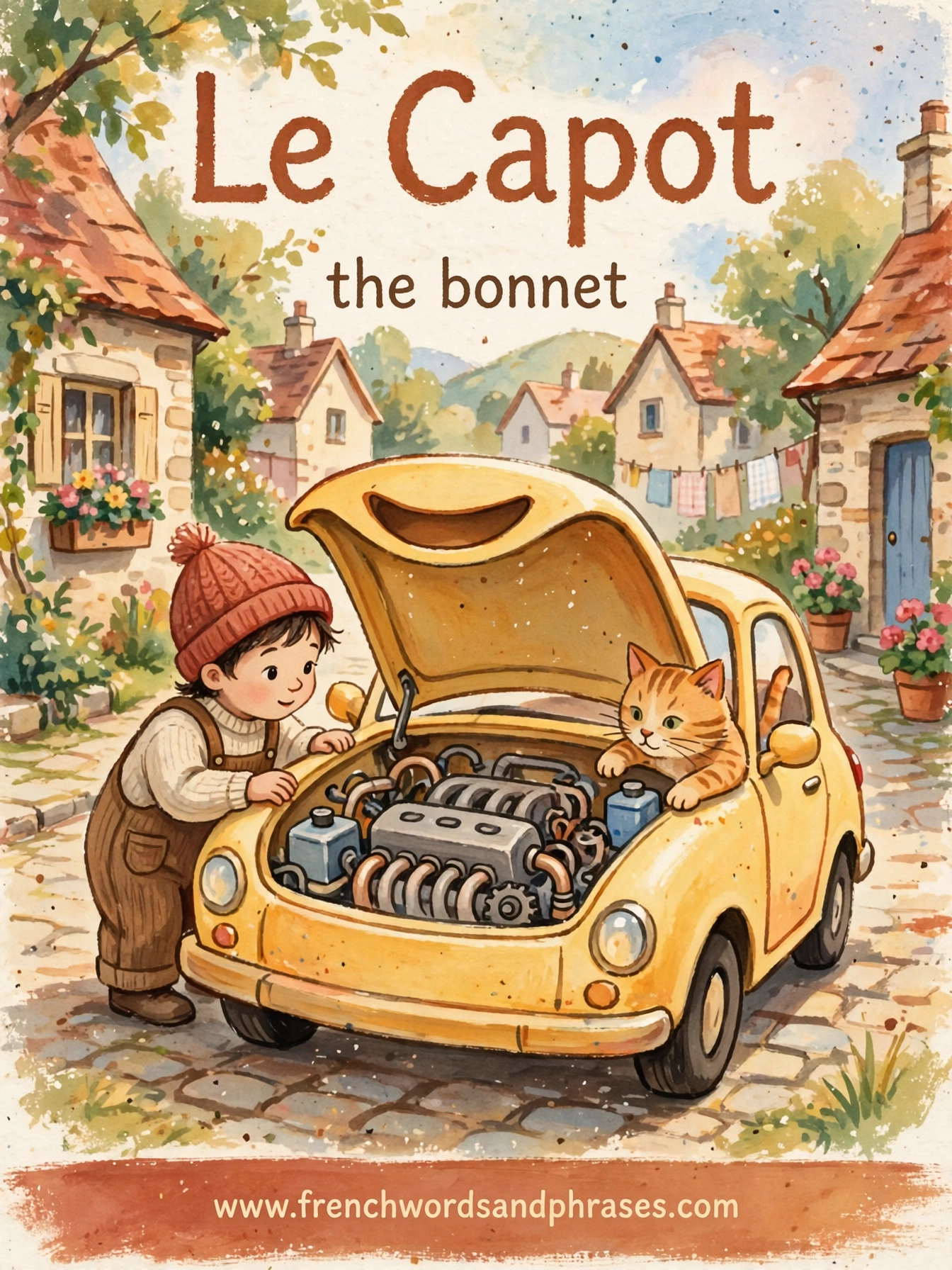
A smell of hot oil at the traffic lights, a wisp of steam — the driver pulls over, walks to the front of the car and lifts the long metal lid over the engine — le capot, the bonnet, the engine’s own roof.
In this guide, you’ll learn what capot means in English, how to use it with its articles, how to form its plural, and how it appears in everyday French. Explore French examples, English translations, and practice quizzes.
Understanding the French Noun Capot
Capot is a masculine French noun. It is learned together with its article: le capot, un capot. It names the hinged metal cover over the engine at the front of the car. Under it lives the machinery — and in French, almost everything interesting about a breakdown is described as happening sous le capot, under the bonnet.
It means the bonnet — the car’s front lid, opened with ouvrir le capot or soulever le capot to reach the engine, the battery and the levels to check: oil, coolant, washer fluid. A capot that will not close properly, or that flies up, is a serious matter; a capot steaming at the roadside is the universal portrait of a breakdown.
Gender: Masculine
Definite article: le — le capot (the bonnet)
Indefinite article: un — un capot (a bonnet)
Plural: les capots
English equivalents: The bonnet (British), the hood (American).
One important usage detail: the great dividing line of the car runs between its two lids — le capot at the front, over the engine, and le coffre at the back, for the luggage. To look at the engine you soulèves le capot and hold it with its rod, la béquille; when you are done, you let it fall shut with a good clunk — refermer le capot.
Experience the Word
Capot is more than a car part. It is the lid on the car’s secrets — beneath it, the engine; above it, the clean line the designer drew.
Imagine the Sunday-morning check: capot up, dipstick out, oil golden on the cloth, the engine cool and quiet in the driveway before the week’s journeys begin again.
You have not just opened a lid. You have lifted le capot — and looked the machine in the face.
How to Use Capot in French: Complete Guide
Let’s explore how capot works in French, beginning with its articles.
Capot with the Definite Article (Le, Les)
Used for the bonnet everyone in the conversation knows — the one steaming at the roadside.
| Number | French |
|---|---|
| Singular | le capot |
| Plural | les capots |
Example
Le capot est chaud, le moteur a travaillé dur.
The bonnet is hot, the engine has worked hard.
Capot with the Indefinite Article (Un, Des)
Used for a bonnet in general — a dented one, a new one, one at the scrapyard.
| Number | French |
|---|---|
| Singular | un capot |
| Plural | des capots |
Example
Après l’accrochage, il faut un capot neuf.
After the bump, a new bonnet is needed.
Capot with the Partitive Article (Du, Des)
The partitive du meets capot in phrases of surface and place — le bord du capot, the edge of the bonnet — rather than for a quantity of bonnet.
| Number | French |
|---|---|
| Singular | du capot |
| Plural | des capots |
Example
La peinture du capot s’écaille près du bord.
The paint of the bonnet is flaking near the edge.
Quick Quiz 1
Capot or coffre: where does the engine live?
Reveal the answer
Sous le capot — the bonnet covers the engine at the front; le coffre, at the back, is for luggage.
Le moteur est sous le capot, les valises sont dans le coffre.
The engine is under the bonnet, the suitcases are in the boot.
The Plural of Capot
Capot adds an -s in the plural — les capots, a row of them at the breaker’s yard.
| Number | French |
|---|---|
| Singular | le capot |
| Plural | les capots |
Example
À la casse, des capots de toutes les couleurs attendent.
At the scrapyard, bonnets of every colour are waiting.
Capot with Possessive Adjectives (Mon, Ton, Son…)
Possessives agree with the noun, not with the owner — and capot is masculine, so it takes mon, ton, son.
| Owner | French |
|---|---|
| my | mon capot |
| your (tu) | ton capot |
| his / her | son capot |
| our | notre capot |
| your (vous) | votre capot |
| their | leur capot |
Example
Ouvre ton capot, je vais regarder le moteur.
Open your bonnet, I am going to look at the engine.
Quick Quiz 2
Complete the sentence:
Soulève ______ capot et tiens-le bien. (your)
Reveal the answer
ton
Soulève ton capot et tiens-le bien.
Lift your bonnet and hold it properly.
Capot with Demonstrative Adjectives (Ce, Ces)
Used to point: this bonnet here, those bonnets there.
| Number | French |
|---|---|
| Singular | ce capot |
| Plural | ces capots |
Example
Ce capot ne ferme plus correctement depuis l’accident.
This bonnet has not closed properly since the accident.
Capot with Adjectives
Adjectives agree with capot, masculine — ouvert, rayé, chaud.
| Adjective | With Capot |
|---|---|
| ouvert (open) | un capot ouvert |
| rayé (scratched) | un capot rayé |
| chaud (hot) | un capot chaud |
| long (long) | un capot long |
| bombé (curved, domed) | un capot bombé |
Example
Un capot rayé se remarque tout de suite au soleil.
A scratched bonnet is noticed at once in the sun.
Quick Quiz 3
Complete the sentence:
Ne touche pas le capot, il est ______. (hot)
Reveal the answer
chaud
Ne touche pas le capot, il est chaud.
Do not touch the bonnet, it is hot.
Everyday Expressions with Capot
Lifting, checking and steaming — the capot phrases of daily life.
| Expression | In English |
|---|---|
| ouvrir le capot | to open the bonnet |
| soulever le capot | to lift the bonnet |
| sous le capot | under the bonnet |
| refermer le capot | to close the bonnet again |
| vérifier les niveaux | to check the levels (oil, water…) |
| un capot qui fume | a bonnet with steam coming out (overheating) |
Example
Ouvre le capot, on va vérifier les niveaux avant le départ.
Open the bonnet, we will check the levels before leaving.
Words from the Same Family as Capot
Engines, lids and bodywork — the words that travel with capot.
| French | In English |
|---|---|
| le moteur | the engine |
| la carrosserie | the bodywork |
| le coffre | the boot (trunk) |
| la béquille | the prop rod (that holds the bonnet up) |
| l’huile | the oil |
| la batterie | the battery |
Example
Sous le capot, le moteur, la batterie et les niveaux à vérifier.
Under the bonnet: the engine, the battery and the levels to check.
Quick Quiz 4
Steam is rising around the edges of the bonnet. In French, what is the car doing?
Reveal the answer
It is overheating — le capot fume: stop, switch off, and let the engine cool before opening it.
Arrête-toi, le capot fume, le moteur surchauffe !
Stop, the bonnet is steaming, the engine is overheating!
Capot in Everyday French: Real-Life Examples
Now that you know the word, let’s see how capot appears in everyday French.
Example 1 — The Sunday check
Il soulève le capot et vérifie l’huile chaque dimanche.
He lifts the bonnet and checks the oil every Sunday.
Example 2 — A breakdown
De la vapeur sort du capot : elle s’arrête sur le bas-côté.
Steam is coming from the bonnet: she pulls over onto the verge.
Example 3 — At the garage
Le mécanicien ouvre le capot et écoute le moteur.
The mechanic opens the bonnet and listens to the engine.
Example 4 — Closing it
Referme le capot d’un coup sec, il doit claquer.
Close the bonnet with one firm drop, it should clunk shut.
Example 5 — Front or back?
Les valises dans le coffre, le moteur sous le capot.
The suitcases in the boot, the engine under the bonnet.
Example 6 — A dent
Le capot est rayé depuis le parking du supermarché.
The bonnet has been scratched since the supermarket car park.
See le capot in a story: The Car: French Vocabulary (La Voiture) — a family road trip.
Beyond Translation: The Meaning of Capot
Every language draws the same map of the car, but French draws its front lid with a word that also covered prams and engines of an earlier age — le capot, the hood, the cover. To lift it is a small ceremony of French driving life: the release clicked from inside, the lid rising on its rod, and the whole hidden machinery — moteur, batterie, niveaux — suddenly open to the sky.
To say capot is to open the car up.
It evokes the Sunday oil check, the roadside steam, and the satisfying clunk of a bonnet closing properly at last.
How to Remember the French Noun Capot
Remember it this way: Capot is the bonnet — masculine, with le and un, the lid over the engine at the front of the car.
- You lift it — soulever le capot to see the engine, masculine with le.
- You keep it apart — le capot in front for the engine, le coffre behind for the bags.
- You watch it — un capot qui fume means stop now.
The key idea is le capot in front — le coffre at the back.
Test Your Knowledge of Capot
Let’s see how much you’ve learned. Try answering these questions before revealing the answers.
Question 1
Is capot masculine or feminine?
Reveal the answer
Masculine — le capot, un capot.
Question 2
What is under le capot?
Reveal the answer
The engine — le moteur, at the front of the car. The luggage goes in le coffre, at the back.
Question 3
Translate: Open the bonnet, we will check the levels.
Reveal the answer
Ouvre le capot, on va vérifier les niveaux.
Question 4
What does un capot qui fume signal?
Reveal the answer
Overheating — steam escaping means the engine is too hot: stop and let it cool.
Question 5
Complete the sentence:
Soulève ______ capot et regarde le moteur. (your)
Reveal the answer
ton
Soulève ton capot et regarde le moteur.
Lift your bonnet and look at the engine.
Your Final Challenge
Can You Use It?
How would you say this in French?
“He lifts the bonnet and checks the oil every Sunday.”
Reveal the answer
Il soulève le capot et vérifie l’huile chaque dimanche.
He lifts the bonnet and checks the oil every Sunday.
A little French. A little curiosity. A richer everyday life.
LEARN FRENCH ONE WORD AT A TIME