A French Word to Live By
How to Conjugate Canarder in French
/ka.naʁ.de/
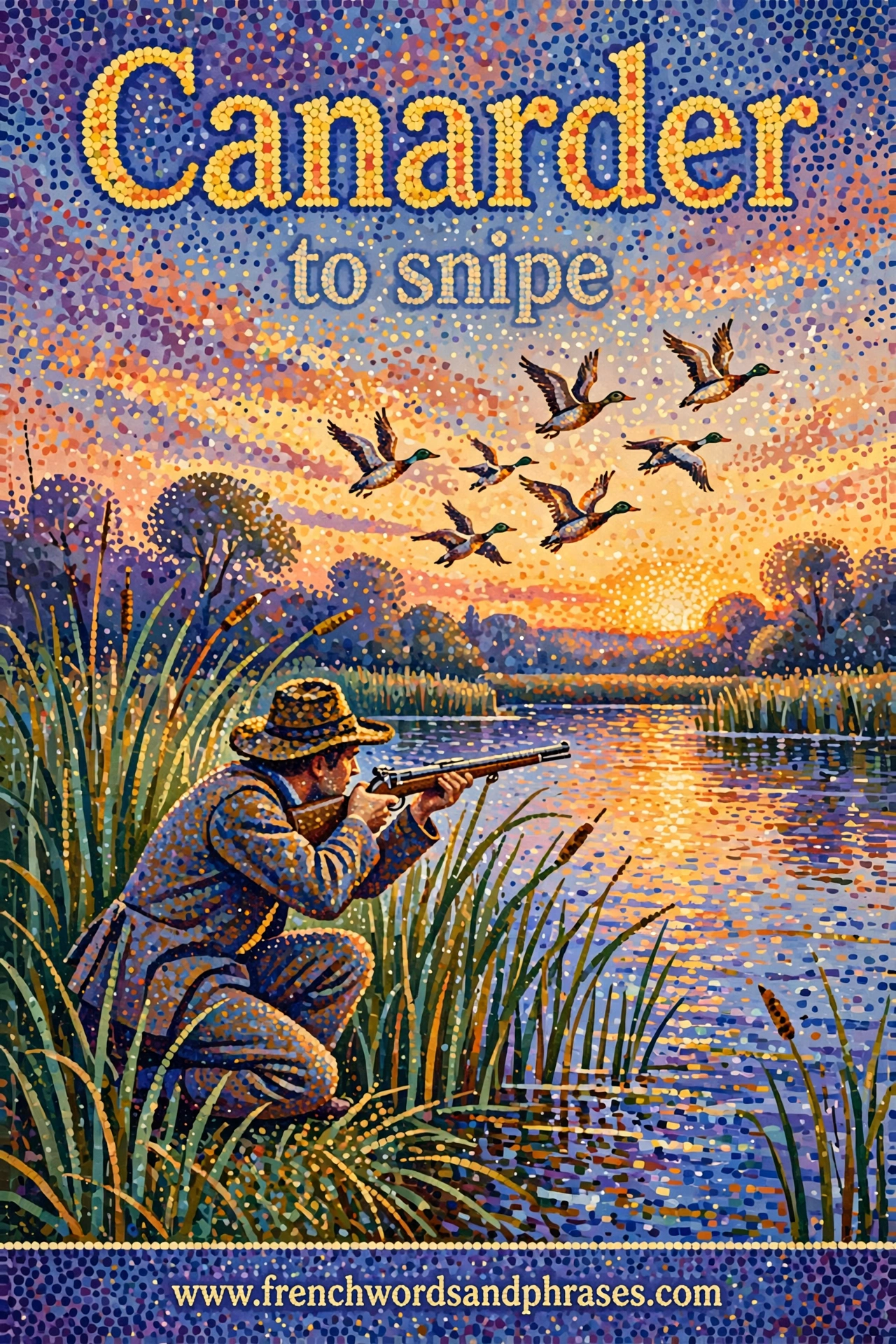
Canarder means to snipe — to fire at someone from cover, shot after shot, the way a hunter picks off ducks from a hide.
A soldier pinned down behind a wall while shots crack from a rooftop, a hunter in a reed bed at dawn — canarder is the verb of shooting from hiding: the target is exposed, the shooter is not, and the shots keep coming.
In this guide, you’ll learn how to conjugate canarder in all the major French tenses and moods. Explore complete conjugation tables, French examples, English translations, and practice quizzes.
Understanding the French Verb Canarder
Canarder is a regular French verb belonging to the first group of verbs, those ending in-er.
It means to snipe. It belongs to hunting and war reporting, and journalists use it for any position under repeated fire. By extension, in lively speech, a speaker or a minister can se faire canarder by questions or criticism — shot at from every side without being able to reply.
Verb classification: First group (-er)
Auxiliary verb: Avoir
Past participle: canardé
Present participle: canardant
English equivalents: To snipe at, to pick off, to pepper with shots; canarder l’ennemi — to snipe at the enemy; se faire canarder — to get sniped at, to come under fire; canarder depuis un toit — to snipe from a rooftop; canarder les passants — to take potshots at passers-by.
One important detail: canarder is built on le canard, the duck — its first picture is the duck hunt, shooting birds from a hide, and the military sense grew straight out of it. It is perfectly regular: je canarde, nous canardons, ils canardent, past participle canardé. The useful frame is se faire canarder, to get oneself shot at: les soldats se sont fait canarder à la sortie du village.
Experience the Word
Canarder is the verb of the hidden rifle — you hear the shots, you see the dust jump, but the shooter stays invisible.
Imagine a patrol entering a deserted village street at noon. From a rooftop somewhere ahead, a first shot cracks; the men flatten against the walls while the invisible marksman canarde la patrouille, calmly, one careful shot at a time.
Nobody is duelling here. One side is hidden and shooting — canardant — the other is simply trying to stay alive.
How to Conjugate Canarder: Complete French Conjugation Guide
Let’s explore every major conjugation of canarder, beginning with the indicative mood.
How to Conjugate Canarder in the Indicative Mood
The indicative mood is used to express facts, observations, actions, and events.
How to Conjugate Canarder in the Present Tense (Présent)
Used for actions happening now, habitual actions, and general truths.
| Subject | Conjugation |
|---|---|
| je | canarde |
| tu | canardes |
| il / elle | canarde |
| nous | canardons |
| vous | canardez |
| ils / elles | canardent |
Example
Le tireur canarde les soldats depuis le toit de l’école.
The marksman is sniping at the soldiers from the school roof.
Quick Quiz 1
Complete the sentence:
Nous ______ les canards depuis la cabane de chasse.
Reveal the answer
canardons
Nous canardons les canards depuis la cabane de chasse.
We are shooting at the ducks from the hunting hide.
How to Conjugate Canarder in the Passé Composé
Used for completed actions in the past. Canarder takes the auxiliary verb avoir.
| Subject | Conjugation |
|---|---|
| j’ | ai canardé |
| tu | as canardé |
| il / elle | a canardé |
| nous | avons canardé |
| vous | avez canardé |
| ils / elles | ont canardé |
Example
Les chasseurs ont canardé les canards toute la matinée.
The hunters shot at the ducks all morning.
How to Conjugate Canarder in the Imparfait (Imperfect Tense)
Used for habitual past actions, descriptions, and ongoing situations in the past.
| Subject | Conjugation |
|---|---|
| je | canardais |
| tu | canardais |
| il / elle | canardait |
| nous | canardions |
| vous | canardiez |
| ils / elles | canardaient |
Example
Un franc-tireur canardait les convois depuis la colline.
A sniper used to pick off the convoys from the hill.
Quick Quiz 2
Choose the correct form:
The hunters shot at the ducks.
Les chasseurs ______ les canards. (ont canardé / sont canardés)
Reveal the answer
ont canardé
Les chasseurs ont canardé les canards.
Canarder takes avoir.
How to Conjugate Canarder in the Plus-que-parfait
Used to describe an action that had already been completed before another past event.
| Subject | Conjugation |
|---|---|
| j’ | avais canardé |
| tu | avais canardé |
| il / elle | avait canardé |
| nous | avions canardé |
| vous | aviez canardé |
| ils / elles | avaient canardé |
Example
L’ennemi avait canardé la position avant l’aube.
The enemy had sniped at the position before dawn.
How to Conjugate Canarder in the Passé Simple
Primarily used in formal writing, literature, and historical narratives. It is rarely used in everyday conversation.
| Subject | Conjugation |
|---|---|
| je | canardai |
| tu | canardas |
| il / elle | canarda |
| nous | canardâmes |
| vous | canardâtes |
| ils / elles | canardèrent |
Example
Les défenseurs canardèrent les assaillants depuis les remparts.
The defenders sniped at the attackers from the ramparts.
How to Conjugate Canarder in the Passé Antérieur
A literary tense used to express an action completed immediately before another past action, generally in the passé simple.
| Subject | Conjugation |
|---|---|
| j’ | eus canardé |
| tu | eus canardé |
| il / elle | eut canardé |
| nous | eûmes canardé |
| vous | eûtes canardé |
| ils / elles | eurent canardé |
Example
Quand le tireur eut canardé la patrouille, le silence revint.
When the marksman had sniped at the patrol, silence returned.
How to Conjugate Canarder in the Future Tense (Futur Simple)
Used to describe actions that will take place in the future.
| Subject | Conjugation |
|---|---|
| je | canarderai |
| tu | canarderas |
| il / elle | canardera |
| nous | canarderons |
| vous | canarderez |
| ils / elles | canarderont |
Example
Demain, ils canarderont les bateaux depuis la falaise.
Tomorrow, they will snipe at the boats from the cliff.
How to Conjugate Canarder in the Futur Antérieur (Future Perfect)
Used for an action that will have been completed before a particular point in the future.
| Subject | Conjugation |
|---|---|
| j’ | aurai canardé |
| tu | auras canardé |
| il / elle | aura canardé |
| nous | aurons canardé |
| vous | aurez canardé |
| ils / elles | auront canardé |
Example
À midi, le tireur aura canardé trois convois entiers.
By noon, the marksman will have sniped at three whole convoys.
How to Conjugate Canarder in the Near Future (Futur Proche)
Used to describe something that is going to happen soon. Formed with aller + infinitive.
| Subject | Conjugation |
|---|---|
| je | vais canarder |
| tu | vas canarder |
| il / elle | va canarder |
| nous | allons canarder |
| vous | allez canarder |
| ils / elles | vont canarder |
Example
Attention, quelqu’un va canarder la place depuis les toits.
Careful, someone is going to snipe at the square from the rooftops.
How to Conjugate Canarder in the Conditional Mood
The conditional mood expresses what would happen under certain circumstances. It is also frequently used to make polite requests or express wishes.
How to Conjugate Canarder in the Present Conditional
| Subject | Conjugation |
|---|---|
| je | canarderais |
| tu | canarderais |
| il / elle | canarderait |
| nous | canarderions |
| vous | canarderiez |
| ils / elles | canarderaient |
Example
Sans son abri, le soldat se ferait canarder en dix secondes.
Without his shelter, the soldier would get sniped at within ten seconds.
How to Conjugate Canarder in the Past Conditional
| Subject | Conjugation |
|---|---|
| j’ | aurais canardé |
| tu | aurais canardé |
| il / elle | aurait canardé |
| nous | aurions canardé |
| vous | auriez canardé |
| ils / elles | auraient canardé |
Example
Le convoi aurait été canardé s’il avait pris la route du nord.
The convoy would have been sniped at if it had taken the northern road.
Canarder in the Literary Past Conditional Form
This less common literary form uses the imperfect subjunctive of avoir.
| Subject | Conjugation |
|---|---|
| j’ | eusse canardé |
| tu | eusses canardé |
| il / elle | eût canardé |
| nous | eussions canardé |
| vous | eussiez canardé |
| ils / elles | eussent canardé |
Example
Les archers eussent canardé la plaine depuis la tour.
The archers would have picked off the plain from the tower.
How to Conjugate Canarder in the Subjunctive Mood
The subjunctive is used to express wishes, emotions, doubts, necessity, and uncertainty. It frequently follows expressions such as il faut que (it is necessary that) or bien que (although).
How to Conjugate Canarder in the Present Subjunctive
| Subject | Conjugation |
|---|---|
| que je | canarde |
| que tu | canardes |
| qu’il / qu’elle | canarde |
| que nous | canardions |
| que vous | canardiez |
| qu’ils / qu’elles | canardent |
Example
Je crains que l’ennemi ne canarde le pont cette nuit.
I fear the enemy may snipe at the bridge tonight.
Quick Quiz 3
Complete the sentence using the subjunctive:
Le capitaine redoute que des tireurs ______ la colonne.
Reveal the answer
canardent
Le capitaine redoute que des tireurs canardent la colonne.
The captain fears marksmen may snipe at the column.
How to Conjugate Canarder in the Imperfect Subjunctive
A literary tense, rarely encountered in modern spoken French.
| Subject | Conjugation |
|---|---|
| que je | canardasse |
| que tu | canardasses |
| qu’il / qu’elle | canardât |
| que nous | canardassions |
| que vous | canardassiez |
| qu’ils / qu’elles | canardassent |
Example
Le capitaine redoutait que des tireurs canardassent la colonne.
The captain feared marksmen might snipe at the column.
How to Conjugate Canarder in the Pluperfect Subjunctive
A literary construction used to express an action completed before another past action.
| Subject | Conjugation |
|---|---|
| que j’ | eusse canardé |
| que tu | eusses canardé |
| qu’il / qu’elle | eût canardé |
| que nous | eussions canardé |
| que vous | eussiez canardé |
| qu’ils / qu’elles | eussent canardé |
Example
On racontait que les francs-tireurs eussent canardé le général lui-même.
People said the snipers had taken shots at the general himself.
How to Conjugate Canarder in the Past Subjunctive
| Subject | Conjugation |
|---|---|
| que j’ | aie canardé |
| que tu | aies canardé |
| qu’il / qu’elle | ait canardé |
| que nous | ayons canardé |
| que vous | ayez canardé |
| qu’ils / qu’elles | aient canardé |
Example
Il est honteux que l’on ait canardé des civils sans défense.
It is shameful that defenceless civilians were sniped at.
How to Conjugate Canarder in the Imperative
The imperative is used to give commands, instructions, invitations, or suggestions. Subject pronouns are omitted.
How to Conjugate Canarder in the Present Imperative
| Person | Conjugation |
|---|---|
| (tu) | canarde |
| (nous) | canardons |
| (vous) | canardez |
Example
Canardez les tireurs sur le toit, pas les fenêtres !
Snipe at the marksmen on the roof, not the windows!
Quick Quiz 4
How would you say Snipe at the marksmen (vous form)?
Reveal the answer
Canardez les tireurs !
French Participles of Canarder
Participles are verb forms that can be used in compound tenses and other grammatical constructions.
Present Participle of Canarder
canardant
En canardant la patrouille, le tireur a révélé sa position.
By sniping at the patrol, the marksman revealed his position.
Past Participle of Canarder
canardé
Canardée de toutes parts, la patrouille se réfugia dans une grange.
Sniped at from all sides, the patrol took refuge in a barn.
Canarder in Everyday French: Real-Life Examples
Now that you know the conjugations, let’s see how canarder appears in everyday French.
Example 1 — Present
Le tireur canarde les soldats depuis le toit.
The marksman is sniping at the soldiers from the roof.
Example 2 — Passé composé
Les chasseurs ont canardé les canards ce matin.
The hunters shot at the ducks this morning.
Example 3 — Imparfait
Un franc-tireur canardait les convois.
A sniper used to pick off the convoys.
Example 4 — Future
Ils canarderont les bateaux depuis la falaise.
They will snipe at the boats from the cliff.
Example 5 — Conditional
Le convoi serait canardé sur cette route.
The convoy would be sniped at on that road.
Example 6 — Imperative
Canardez les tireurs sur le toit !
Snipe at the marksmen on the roof!
Beyond Translation: The Meaning of Canarder
English snipe names a bird too — the elusive marsh bird only a fine shot could hit — and French canarder does the same with the duck, le canard.
Both verbs were born in the hunting hide.
French canard has other famous children: a canard is also a hoax or false news story — the duck that flies from newspaper to newspaper, shot at by every fact-checker in sight.
How to Remember the French Verb Canarder
Remember it this way: Canarder is about the hidden hunter picking off ducks — then soldiers.
- Le canard is the duck: canarder starts as shooting ducks from a hide, then sniping at anything.
- The useful passive frame: se faire canarder — to get sniped at, to come under fire.
- Regular -er: je canarde, nous canardons, past participle canardé.
The key idea is the hidden hunter picking off ducks — then soldiers.
Test Your Knowledge of Canarder
Let’s see how much you’ve learned. Try answering these questions before revealing the answers.
Question 1
What animal hides inside canarder?
Reveal the answer
Le canard — the duck: the verb began with shooting ducks from a hide.
Question 2
How do you say The marksman is sniping at the soldiers in French?
Reveal the answer
Le tireur canarde les soldats.
Question 3
Translate: The patrol was sniped at from all sides.
Reveal the answer
La patrouille a été canardée de toutes parts.
Question 4
What is the past participle of canarder?
Reveal the answer
Canardé.
Question 5
Complete the sentence:
Je crains que l’ennemi ne ______ le pont cette nuit.
Reveal the answer
canarde
Je crains que l’ennemi ne canarde le pont cette nuit.
I fear the enemy may snipe at the bridge tonight.
Your Final Challenge
Can You Use It?
How would you say this in French?
From his rooftop, the marksman snipes at the deserted street, and even the shadows no longer dare move.
Reveal the answer
Depuis son toit, le tireur canarde la rue déserte, et même les ombres n’osent plus bouger.
From his rooftop, the marksman snipes at the deserted street, and even the shadows no longer dare move.
A little French. A little curiosity. A richer everyday life.
LEARN FRENCH ONE WORD AT A TIME