A French Word to Live By
How to Conjugate Camper in French
/kɑ̃.pe/
Camper means to camp, to pitch camp.
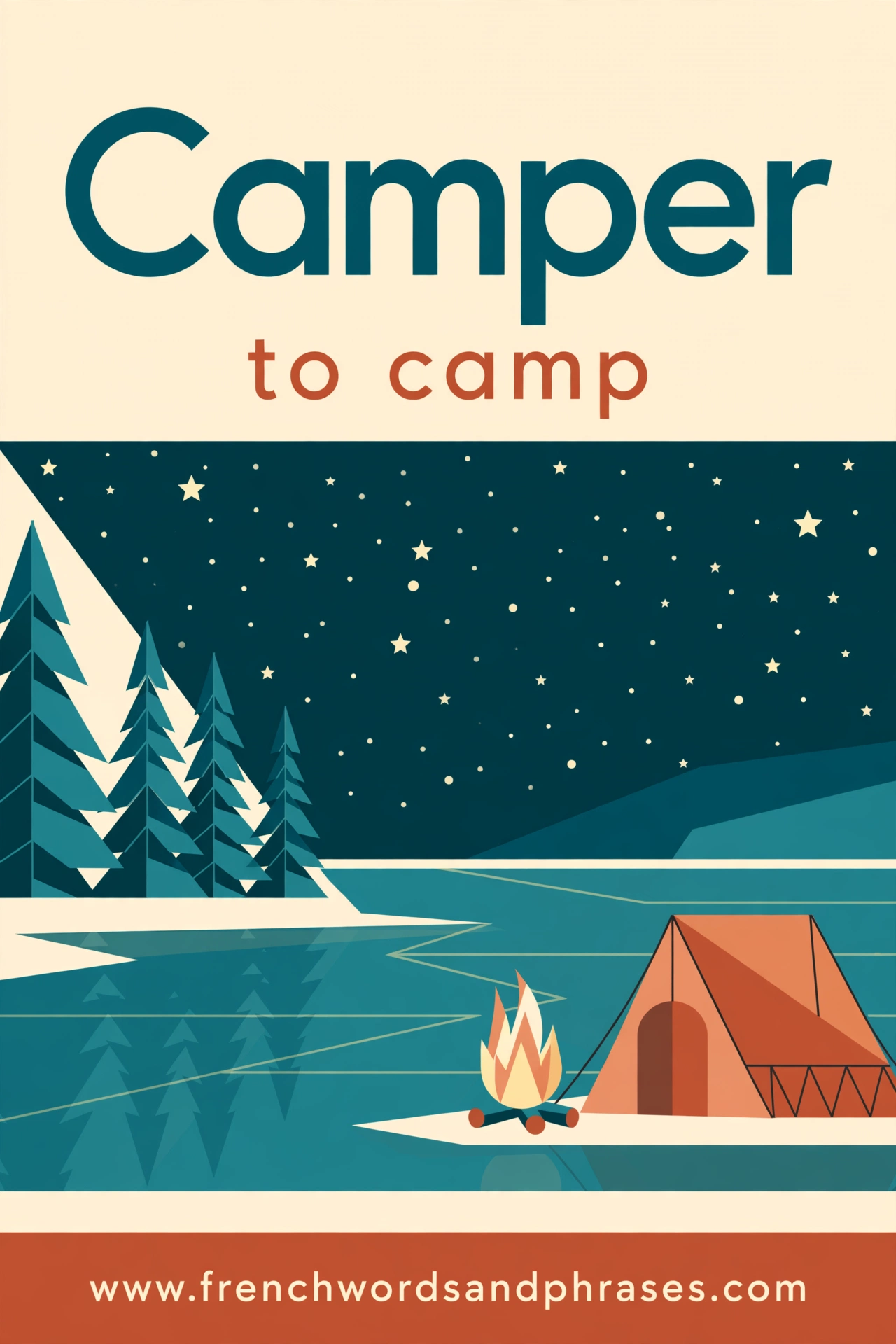
A tent, a fire, and the stars overhead. You pitch camp at the edge of a lake, or in the mountains, or in your own garden. In French, sleeping out under the open sky is camper.
In this guide, you’ll learn how to conjugate camper in all the major French tenses and moods. Explore complete conjugation tables, French examples, English translations, and practice quizzes.
Understanding the French Verb Camper
Camper is a regular French verb belonging to the first group of verbs, those ending in -er.
It means to camp, to pitch camp. It is commonly used for sleeping outdoors in a tent, for armies setting up camp, and figuratively for staying put somewhere and refusing to budge.
Verb classification: First group (-er)
Auxiliary verb: Avoir or être, depending on the construction
Past participle: campé
Present participle: campant
English equivalents: To camp, to pitch camp, to stay put.
One important detail: camper takes avoir for the act of camping — nous avons campé dans les montagnes (we camped in the mountains). Être appears when the camp is seen as a state, people settled in place — les scouts sont campés près du lac depuis lundi (the scouts have been camped by the lake since Monday). The tables on this page use avoir.
Experience the Word
Camper is the verb of the open air — the tent pegs, the campfire smoke, the night sounds outside thin canvas walls.
Imagine a summer evening by a mountain lake. You pitch the tent, light a small fire, and cook dinner as the sun goes down behind the peaks.
You have not just slept outside. You have camped.
How to Conjugate Camper: Complete French Conjugation Guide
Let’s explore every major conjugation of camper, beginning with the indicative mood.
How to Conjugate Camper in the Indicative Mood
The indicative mood is used to express facts, observations, actions, and events.
How to Conjugate Camper in the Present Tense (Présent)
Used for actions happening now, habitual actions, and general truths.
| Subject | Conjugation |
|---|---|
| je | campe |
| tu | campes |
| il / elle | campe |
| nous | campons |
| vous | campez |
| ils / elles | campent |
Example
Nous campons près du lac chaque été.
We camp by the lake every summer.
Quick Quiz 1
Complete the sentence:
Nous ______ près de la rivière.
Reveal the answer
campons
Nous campons près de la rivière.
We are camping by the river.
How to Conjugate Camper in the Passé Composé
Used for completed actions in the past. Camper takes the auxiliary verb avoir or être, depending on the construction.
| Subject | Conjugation |
|---|---|
| j’ | ai campé |
| tu | as campé |
| il / elle | a campé |
| nous | avons campé |
| vous | avez campé |
| ils / elles | ont campé |
Example
Nous avons campé dans les montagnes l’été dernier.
We camped in the mountains last summer.
How to Conjugate Camper in the Imparfait (Imperfect Tense)
Used for habitual past actions, descriptions, and ongoing situations in the past.
| Subject | Conjugation |
|---|---|
| je | campais |
| tu | campais |
| il / elle | campait |
| nous | campions |
| vous | campiez |
| ils / elles | campaient |
Example
Quand j’étais scout, je campais souvent en forêt.
When I was a scout, I often used to camp in the forest.
Quick Quiz 2
Choose the correct form:
We camped in Corsica last year.
Nous ______ en Corse l’an dernier. (avons campé / sommes campés)
Reveal the answer
avons campé
Nous avons campé en Corse l’an dernier.
Camper takes avoir for the act of camping.
How to Conjugate Camper in the Plus-que-parfait
Used to describe an action that had already been completed before another past event.
| Subject | Conjugation |
|---|---|
| j’ | avais campé |
| tu | avais campé |
| il / elle | avait campé |
| nous | avions campé |
| vous | aviez campé |
| ils / elles | avaient campé |
Example
Nous avions déjà campé ici une fois.
We had already camped here once.
How to Conjugate Camper in the Passé Simple
Primarily used in formal writing, literature, and historical narratives. It is rarely used in everyday conversation.
| Subject | Conjugation |
|---|---|
| je | campai |
| tu | campas |
| il / elle | campa |
| nous | campâmes |
| vous | campâtes |
| ils / elles | campèrent |
Example
Ils campèrent au bord de la rivière.
They camped on the riverbank.
How to Conjugate Camper in the Passé Antérieur
A literary tense used to express an action completed immediately before another past action, generally in the passé simple.
| Subject | Conjugation |
|---|---|
| j’ | eus campé |
| tu | eus campé |
| il / elle | eut campé |
| nous | eûmes campé |
| vous | eûtes campé |
| ils / elles | eurent campé |
Example
Dès qu’ils eurent campé, ils allumèrent un feu.
As soon as they had camped, they lit a fire.
How to Conjugate Camper in the Future Tense (Futur Simple)
Used to describe actions that will take place in the future.
| Subject | Conjugation |
|---|---|
| je | camperai |
| tu | camperas |
| il / elle | campera |
| nous | camperons |
| vous | camperez |
| ils / elles | camperont |
Example
Demain, nous camperons près de la mer.
Tomorrow, we will camp by the sea.
How to Conjugate Camper in the Futur Antérieur (Future Perfect)
Used for an action that will have been completed before a particular point in the future.
| Subject | Conjugation |
|---|---|
| j’ | aurai campé |
| tu | auras campé |
| il / elle | aura campé |
| nous | aurons campé |
| vous | aurez campé |
| ils / elles | auront campé |
Example
À minuit, nous aurons déjà campé sous les étoiles.
By midnight, we will already have camped under the stars.
How to Conjugate Camper in the Near Future (Futur Proche)
Used to describe something that is going to happen soon. Formed with aller + infinitive.
| Subject | Conjugation |
|---|---|
| je | vais camper |
| tu | vas camper |
| il / elle | va camper |
| nous | allons camper |
| vous | allez camper |
| ils / elles | vont camper |
Example
Je vais camper dans le jardin ce soir.
I am going to camp in the garden tonight.
How to Conjugate Camper in the Conditional Mood
The conditional mood expresses what would happen under certain circumstances. It is also frequently used to make polite requests or express wishes.
How to Conjugate Camper in the Present Conditional
| Subject | Conjugation |
|---|---|
| je | camperais |
| tu | camperais |
| il / elle | camperait |
| nous | camperions |
| vous | camperiez |
| ils / elles | camperaient |
Example
Je camperais volontiers en Provence.
I would gladly camp in Provence.
How to Conjugate Camper in the Past Conditional
| Subject | Conjugation |
|---|---|
| j’ | aurais campé |
| tu | aurais campé |
| il / elle | aurait campé |
| nous | aurions campé |
| vous | auriez campé |
| ils / elles | auraient campé |
Example
Nous aurions campé plus longtemps sans la pluie.
We would have camped longer without the rain.
Camper in the Literary Past Conditional Form
This less common literary form uses the imperfect subjunctive of avoir or être, depending on the construction.
| Subject | Conjugation |
|---|---|
| j’ | eusse campé |
| tu | eusses campé |
| il / elle | eût campé |
| nous | eussions campé |
| vous | eussiez campé |
| ils / elles | eussent campé |
Example
Il eût campé plus longtemps s’il avait pu.
He would have camped longer if he had been able to.
How to Conjugate Camper in the Subjunctive Mood
The subjunctive is used to express wishes, emotions, doubts, necessity, and uncertainty. It frequently follows expressions such as il faut que (it is necessary that) or bien que (although).
How to Conjugate Camper in the Present Subjunctive
| Subject | Conjugation |
|---|---|
| que je | campe |
| que tu | campes |
| qu’il / qu’elle | campe |
| que nous | campions |
| que vous | campiez |
| qu’ils / qu’elles | campent |
Example
Il faut que nous campions près de l’eau.
We need to camp near the water.
Quick Quiz 3
Complete the sentence using the subjunctive:
Il faut que vous ______ près de l’eau.
Reveal the answer
campiez
Il faut que vous campiez près de l’eau.
You need to camp near the water.
How to Conjugate Camper in the Imperfect Subjunctive
A literary tense, rarely encountered in modern spoken French.
| Subject | Conjugation |
|---|---|
| que je | campasse |
| que tu | campasses |
| qu’il / qu’elle | campât |
| que nous | campassions |
| que vous | campassiez |
| qu’ils / qu’elles | campassent |
Example
Il souhaitait qu’ils campassent à l’abri du vent.
He wished that they would camp sheltered from the wind.
How to Conjugate Camper in the Pluperfect Subjunctive
A literary construction used to express an action completed before another past action.
| Subject | Conjugation |
|---|---|
| que j’ | eusse campé |
| que tu | eusses campé |
| qu’il / qu’elle | eût campé |
| que nous | eussions campé |
| que vous | eussiez campé |
| qu’ils / qu’elles | eussent campé |
Example
Il regrettait que nous eussions campé si loin du village.
He regretted that we had camped so far from the village.
How to Conjugate Camper in the Past Subjunctive
| Subject | Conjugation |
|---|---|
| que j’ | aie campé |
| que tu | aies campé |
| qu’il / qu’elle | ait campé |
| que nous | ayons campé |
| que vous | ayez campé |
| qu’ils / qu’elles | aient campé |
Example
Je suis content que vous ayez campé près du lac.
I am glad you camped by the lake.
How to Conjugate Camper in the Imperative
The imperative is used to give commands, instructions, invitations, or suggestions. Subject pronouns are omitted.
How to Conjugate Camper in the Present Imperative
| Person | Conjugation |
|---|---|
| (tu) | campe |
| (nous) | campons |
| (vous) | campez |
Example
Campez ici, la vue est magnifique !
Camp here, the view is magnificent!
Quick Quiz 4
How would you say Camp here, using the tu form?
Reveal the answer
Campe ici !
French Participles of Camper
Participles are verb forms that can be used in compound tenses and other grammatical constructions.
Present Participle of Camper
campant
En campant dans les bois, nous avons entendu un hibou.
While camping in the woods, we heard an owl.
Past Participle of Camper
campé
Les scouts sont campés près du lac depuis lundi.
The scouts have been camped by the lake since Monday.
Camper in Everyday French: Real-Life Examples
Now that you know the conjugations, let’s see how camper appears in everyday French.
Example 1 — Present
Ils campent dans le jardin.
They are camping in the garden.
Example 2 — Passé composé — avoir
Nous avons campé en Corse l’an dernier.
We camped in Corsica last year.
Example 3 — Passé composé — être
Les scouts sont campés près du lac.
The scouts are camped by the lake.
Example 4 — Imparfait
Elle campait souvent avec ses amis.
She used to camp often with her friends.
Example 5 — Future
Ils camperont dans les Alpes cet été.
They will camp in the Alps this summer.
Example 6 — Conditional
Je camperais bien au bord de la mer.
I would happily camp by the sea.
Beyond Translation: The Meaning of Camper
English has one word, camp, for the meaning of camper, but the French word also lives figuratively — camper sur ses positions means to stand your ground and refuse to budge.
And camper carries its famous lesson with it.
It is one of the verbs where the old rule still shows: avoir for the act of camping, être for the camped state. In modern French, nous avons campé does almost all the work.
How to Remember the French Verb Camper
Remember it this way: Camper is about camping — avoir for the act of camping, être for the camped state.
- Avoir for the act of camping — nous avons campé dans les montagnes.
- Être for the camped state — les scouts sont campés près du lac.
- Figuratively, camper sur ses positions means to stand your ground and refuse to move.
The key idea is camping — avoir for the act of camping, être for the camped state.
Test Your Knowledge of Camper
Let’s see how much you’ve learned. Try answering these questions before revealing the answers.
Question 1
When does camper take avoir, and when does it take être?
Reveal the answer
Avoir is the auxiliary for the act of camping — nous avons campé dans les montagnes. Être appears when the camp is seen as a state, people settled in place — les scouts sont campés près du lac depuis lundi.
Question 2
How do you say We will camp in French?
Reveal the answer
Nous camperons.
Question 3
Translate: We camped in the mountains last summer.
Reveal the answer
Nous avons campé dans les montagnes l’été dernier.
Question 4
What is the present participle of camper?
Reveal the answer
Campant.
Question 5
Complete the sentence:
Si le temps était beau, nous ______ au bord du lac.
Reveal the answer
camperions
Si le temps était beau, nous camperions au bord du lac.
If the weather were fine, we would camp by the lake.
Your Final Challenge
Can You Use It?
How would you say this in French?
Tomorrow, I want to camp by the lake.
Reveal the answer
Demain, je veux camper au bord du lac.
Tomorrow, I want to camp by the lake.
A little French. A little curiosity. A richer everyday life.
LEARN FRENCH ONE WORD AT A TIME