
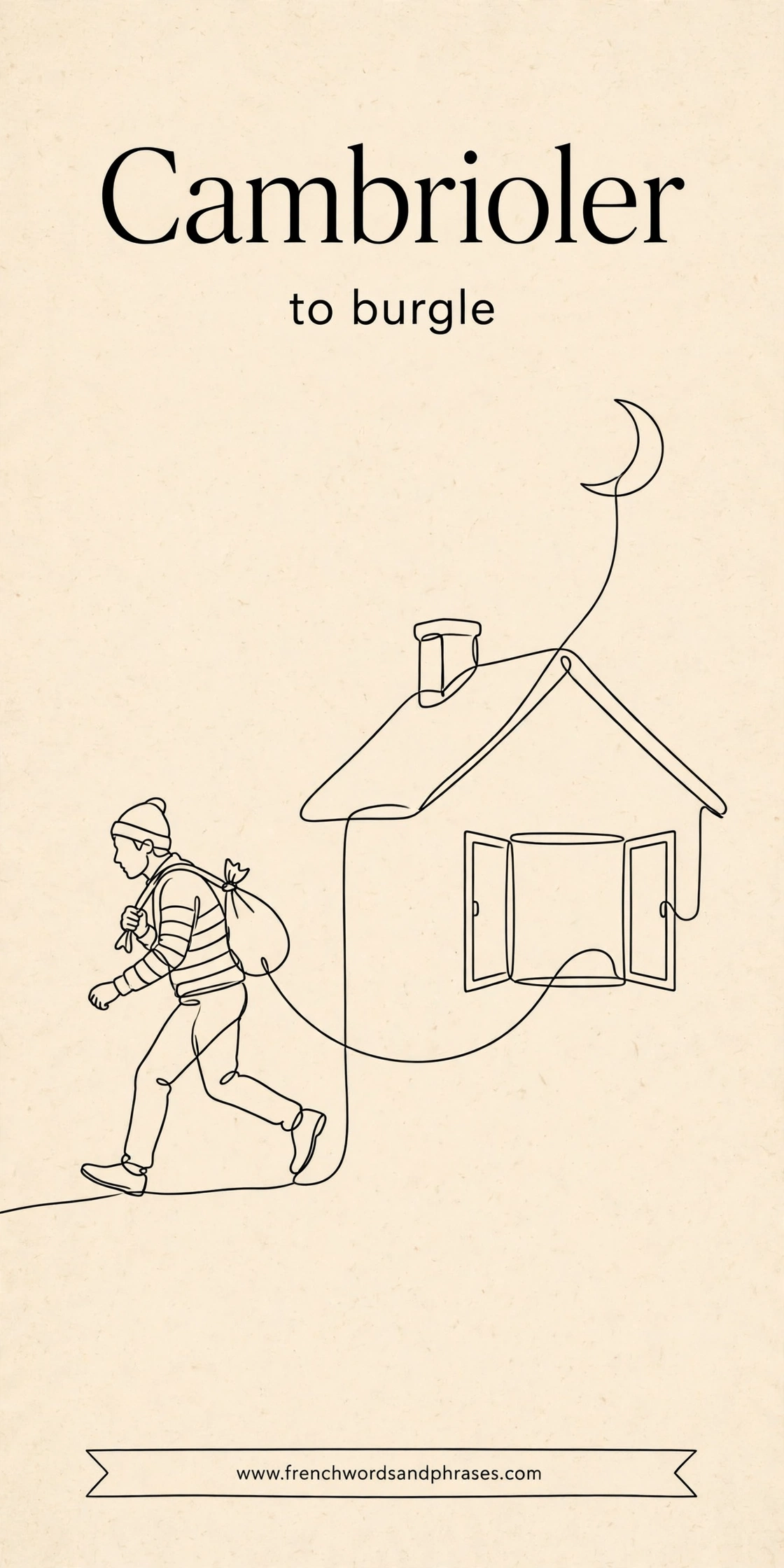
A French Word to Live By
How to Conjugate Cambrioler in French
/kɑ̃.bʁi.jɔ.le/
Cambrioler means to burgle, to break into — to enter a home or shop by force or stealth and steal what is inside.
A window forced in the night, a holiday apartment emptied while the family is at the beach — cambrioler is the verb of the break-in, the crime every locked door is meant to prevent.
In this guide, you’ll learn how to conjugate cambrioler in all the major French tenses and moods. Explore complete conjugation tables, French examples, English translations, and practice quizzes.
Understanding the French Verb Cambrioler
Cambrioler is a regular French verb belonging to the first group of verbs, those ending in-er.
It means to burgle, to break into. Cambrioler is used of homes, shops and cars entered to steal — the French equivalent of burgle and break into in one word. Voler names the stealing itself; cambrioler names the breaking in, which is why victims say se faire cambrioler even when little was taken.
Verb classification: First group (-er)
Auxiliary verb: Avoir
Past participle: cambriolé
Present participle: cambriolant
English equivalents: To burgle, to break into; cambrioler un appartement — to burgle a flat; cambrioler une maison — to break into a house; se faire cambrioler — to be burgled; un cambriolage — a burglary; un cambrioleur — a burglar.
One important detail: cambrioler is a plain regular -er verb — je cambriole, nous cambriolons, ils cambriolent, past participle cambriolé. Its family does the everyday work: the criminal is un cambrioleur, the crime is un cambriolage, and the victim’s phrase is se faire cambrioler — on s’est fait cambrioler pendant les vacances, we got burgled during the holidays.
Experience the Word
Cambrioler is the verb of the forced window — the break-in discovered on coming home.
Imagine a family returning from two weeks at the sea. The front door stands oddly ajar; inside, drawers hang open like mouths and the television is gone. Ils se sont fait cambrioler — someone chose their empty house, entered by the garden window, and left with the summer’s savings.
Nothing they owned was worth a fortune. But their home had been burgled — cambriolé, entered and searched by a stranger’s hands.
How to Conjugate Cambrioler: Complete French Conjugation Guide
Let’s explore every major conjugation of cambrioler, beginning with the indicative mood.
How to Conjugate Cambrioler in the Indicative Mood
The indicative mood is used to express facts, observations, actions, and events.
How to Conjugate Cambrioler in the Present Tense (Présent)
Used for actions happening now, habitual actions, and general truths.
| Subject | Conjugation |
|---|---|
| je | cambriole |
| tu | cambrioles |
| il / elle | cambriole |
| nous | cambriolons |
| vous | cambriolez |
| ils / elles | cambriolent |
Example
Des voleurs cambriolent les maisons vides en été.
Thieves burgle empty houses in summer.
Quick Quiz 1
Complete the sentence:
Les voleurs ______ les maisons vides.
Reveal the answer
cambriolent
Les voleurs cambriolent les maisons vides.
Thieves burgle empty houses.
How to Conjugate Cambrioler in the Passé Composé
Used for completed actions in the past. Cambrioler takes the auxiliary verb avoir.
| Subject | Conjugation |
|---|---|
| j’ | ai cambriolé |
| tu | as cambriolé |
| il / elle | a cambriolé |
| nous | avons cambriolé |
| vous | avez cambriolé |
| ils / elles | ont cambriolé |
Example
On a cambriolé notre appartement pendant les vacances.
Our flat was burgled during the holidays.
How to Conjugate Cambrioler in the Imparfait (Imperfect Tense)
Used for habitual past actions, descriptions, and ongoing situations in the past.
| Subject | Conjugation |
|---|---|
| je | cambriolais |
| tu | cambriolais |
| il / elle | cambriolait |
| nous | cambriolions |
| vous | cambrioliez |
| ils / elles | cambriolaient |
Example
Autrefois, une bande cambriolait toutes les villas du quartier.
In the old days, a gang used to burgle all the villas in the neighbourhood.
Quick Quiz 2
Choose the correct form:
Our flat was burgled.
On ______ notre appartement. (a cambriolé / est cambriolé)
Reveal the answer
a cambriolé
On a cambriolé notre appartement.
Cambrioler takes avoir; the passive sense comes from on.
How to Conjugate Cambrioler in the Plus-que-parfait
Used to describe an action that had already been completed before another past event.
| Subject | Conjugation |
|---|---|
| j’ | avais cambriolé |
| tu | avais cambriolé |
| il / elle | avait cambriolé |
| nous | avions cambriolé |
| vous | aviez cambriolé |
| ils / elles | avaient cambriolé |
Example
Les voleurs avaient cambriolé trois maisons avant leur arrestation.
The thieves had burgled three houses before their arrest.
How to Conjugate Cambrioler in the Passé Simple
Primarily used in formal writing, literature, and historical narratives. It is rarely used in everyday conversation.
| Subject | Conjugation |
|---|---|
| je | cambriolai |
| tu | cambriolas |
| il / elle | cambriola |
| nous | cambriolâmes |
| vous | cambriolâtes |
| ils / elles | cambriolèrent |
Example
La bande cambriola la bijouterie en pleine nuit.
The gang broke into the jeweller’s in the middle of the night.
How to Conjugate Cambrioler in the Passé Antérieur
A literary tense used to express an action completed immediately before another past action, generally in the passé simple.
| Subject | Conjugation |
|---|---|
| j’ | eus cambriolé |
| tu | eus cambriolé |
| il / elle | eut cambriolé |
| nous | eûmes cambriolé |
| vous | eûtes cambriolé |
| ils / elles | eurent cambriolé |
Example
Quand ils eurent cambriolé la maison, ils disparurent dans la nuit.
When they had burgled the house, they vanished into the night.
How to Conjugate Cambrioler in the Future Tense (Futur Simple)
Used to describe actions that will take place in the future.
| Subject | Conjugation |
|---|---|
| je | cambriolerai |
| tu | cambrioleras |
| il / elle | cambriolera |
| nous | cambriolerons |
| vous | cambriolerez |
| ils / elles | cambrioleront |
Example
Sans alarme, ils cambrioleront la maison voisine.
Without an alarm, they will burgle the house next door.
How to Conjugate Cambrioler in the Futur Antérieur (Future Perfect)
Used for an action that will have been completed before a particular point in the future.
| Subject | Conjugation |
|---|---|
| j’ | aurai cambriolé |
| tu | auras cambriolé |
| il / elle | aura cambriolé |
| nous | aurons cambriolé |
| vous | aurez cambriolé |
| ils / elles | auront cambriolé |
Example
À la fin de l’été, la bande aura cambriolé dix villas.
By the end of the summer, the gang will have burgled ten villas.
How to Conjugate Cambrioler in the Near Future (Futur Proche)
Used to describe something that is going to happen soon. Formed with aller + infinitive.
| Subject | Conjugation |
|---|---|
| je | vais cambrioler |
| tu | vas cambrioler |
| il / elle | va cambrioler |
| nous | allons cambrioler |
| vous | allez cambrioler |
| ils / elles | vont cambrioler |
Example
Attention, ce quartier va encore se faire cambrioler.
Careful, this neighbourhood is going to get burgled again.
How to Conjugate Cambrioler in the Conditional Mood
The conditional mood expresses what would happen under certain circumstances. It is also frequently used to make polite requests or express wishes.
How to Conjugate Cambrioler in the Present Conditional
| Subject | Conjugation |
|---|---|
| je | cambriolerais |
| tu | cambriolerais |
| il / elle | cambriolerait |
| nous | cambriolerions |
| vous | cambrioleriez |
| ils / elles | cambrioleraient |
Example
Personne ne cambriolerait une maison occupée.
Nobody would burgle an occupied house.
How to Conjugate Cambrioler in the Past Conditional
| Subject | Conjugation |
|---|---|
| j’ | aurais cambriolé |
| tu | aurais cambriolé |
| il / elle | aurait cambriolé |
| nous | aurions cambriolé |
| vous | auriez cambriolé |
| ils / elles | auraient cambriolé |
Example
Sans le chien, ils auraient cambriolé toute la maison.
Without the dog, they would have burgled the whole house.
Cambrioler in the Literary Past Conditional Form
This less common literary form uses the imperfect subjunctive of avoir.
| Subject | Conjugation |
|---|---|
| j’ | eusse cambriolé |
| tu | eusses cambriolé |
| il / elle | eût cambriolé |
| nous | eussions cambriolé |
| vous | eussiez cambriolé |
| ils / elles | eussent cambriolé |
Example
La bande eût cambriolé la bijouterie sans l’alarme silencieuse.
The gang would have broken into the jeweller’s without the silent alarm.
How to Conjugate Cambrioler in the Subjunctive Mood
The subjunctive is used to express wishes, emotions, doubts, necessity, and uncertainty. It frequently follows expressions such as il faut que (it is necessary that) or bien que (although).
How to Conjugate Cambrioler in the Present Subjunctive
| Subject | Conjugation |
|---|---|
| que je | cambriole |
| que tu | cambrioles |
| qu’il / qu’elle | cambriole |
| que nous | cambriolions |
| que vous | cambrioliez |
| qu’ils / qu’elles | cambriolent |
Example
Je crains que des voleurs cambriolent les maisons vides.
I fear thieves may burgle the empty houses.
Quick Quiz 3
Complete the sentence using the subjunctive:
Je crains que la bande ______ d’autres villas.
Reveal the answer
cambriole
Je crains que la bande cambriole d’autres villas.
I fear the gang may burgle other villas.
How to Conjugate Cambrioler in the Imperfect Subjunctive
A literary tense, rarely encountered in modern spoken French.
| Subject | Conjugation |
|---|---|
| que je | cambriolasse |
| que tu | cambriolasses |
| qu’il / qu’elle | cambriolât |
| que nous | cambriolassions |
| que vous | cambriolassiez |
| qu’ils / qu’elles | cambriolassent |
Example
Il fallait empêcher que la bande cambriolât d’autres villas.
The gang had to be stopped from burgling other villas.
How to Conjugate Cambrioler in the Pluperfect Subjunctive
A literary construction used to express an action completed before another past action.
| Subject | Conjugation |
|---|---|
| que j’ | eusse cambriolé |
| que tu | eusses cambriolé |
| qu’il / qu’elle | eût cambriolé |
| que nous | eussions cambriolé |
| que vous | eussiez cambriolé |
| qu’ils / qu’elles | eussent cambriolé |
Example
On prouva que la bande eût cambriolé la banque du village.
It was proved that the gang had broken into the village bank.
How to Conjugate Cambrioler in the Past Subjunctive
| Subject | Conjugation |
|---|---|
| que j’ | aie cambriolé |
| que tu | aies cambriolé |
| qu’il / qu’elle | ait cambriolé |
| que nous | ayons cambriolé |
| que vous | ayez cambriolé |
| qu’ils / qu’elles | aient cambriolé |
Example
Je suis désolé que vous ayez été cambriolés.
I am sorry you were burgled.
How to Conjugate Cambrioler in the Imperative
The imperative is used to give commands, instructions, invitations, or suggestions. Subject pronouns are omitted.
How to Conjugate Cambrioler in the Present Imperative
| Person | Conjugation |
|---|---|
| (tu) | cambriole |
| (nous) | cambriolons |
| (vous) | cambriolez |
Example
Ne cambriolez jamais une maison, la prison vous attend !
Never burgle a house, prison awaits you!
Quick Quiz 4
How would you say Never burgle a house (tu form)?
Reveal the answer
Ne cambriole jamais une maison !
French Participles of Cambrioler
Participles are verb forms that can be used in compound tenses and other grammatical constructions.
Present Participle of Cambrioler
cambriolant
En cambriolant la villa, ils ont déclenché l’alarme.
By breaking into the villa, they set off the alarm.
Past Participle of Cambrioler
cambriolé
Cambriolé deux fois, le magasin a installé des volets en fer.
Burgled twice, the shop installed iron shutters.
Cambrioler in Everyday French: Real-Life Examples
Now that you know the conjugations, let’s see how cambrioler appears in everyday French.
Example 1 — Present
Des voleurs cambriolent les maisons vides.
Thieves burgle empty houses.
Example 2 — Passé composé
On a cambriolé notre appartement.
Our flat was burgled.
Example 3 — Imparfait
Une bande cambriolait les villas du quartier.
A gang used to burgle the neighbourhood villas.
Example 4 — Future
Ils cambrioleront la maison voisine.
They will burgle the house next door.
Example 5 — Conditional
Personne ne cambriolerait une maison occupée.
Nobody would burgle an occupied house.
Example 6 — Imperative
Ne cambriolez jamais une maison !
Never burgle a house!
Beyond Translation: The Meaning of Cambrioler
English splits the crime in two — burgle and break into; French cambrioler does both, and its family is everywhere in the news: un cambriolage, a burglary, un cambrioleur, a burglar.
The victim’s own phrase is the one to learn.
Se faire cambrioler — literally to get oneself burgled — is how France reports the misfortune, and the little word cambriole in old slang even meant the room itself, the burglar’s workplace.
How to Remember the French Verb Cambrioler
Remember it this way: Cambrioler is about a forced window and drawers hanging open.
- Learn the family together: cambrioler, un cambriolage, un cambrioleur.
- The victim says se faire cambrioler — on s’est fait cambrioler pendant les vacances.
- Plain regular -er: je cambriole, nous cambriolons, past participle cambriolé.
The key idea is a forced window and drawers hanging open.
Test Your Knowledge of Cambrioler
Let’s see how much you’ve learned. Try answering these questions before revealing the answers.
Question 1
How does a victim say We got burgled in French?
Reveal the answer
On s’est fait cambrioler — literally, we got ourselves burgled.
Question 2
How do you say Thieves burgle empty houses in French?
Reveal the answer
Des voleurs cambriolent les maisons vides.
Question 3
Translate: Our flat was burgled during the holidays.
Reveal the answer
On a cambriolé notre appartement pendant les vacances.
Question 4
What is the past participle of cambrioler?
Reveal the answer
Cambriolé.
Question 5
Complete the sentence:
Je crains que des voleurs ______ les maisons vides.
Reveal the answer
cambriolent
Je crains que des voleurs cambriolent les maisons vides.
I fear thieves may burgle the empty houses.
Your Final Challenge
Can You Use It?
How would you say this in French?
Burgled during the holidays, the little house waited for its owners, windows shut and heart heavy.
Reveal the answer
Cambriolée pendant les vacances, la petite maison attendait ses maîtres, fenêtres closes et cœur serré.
Burgled during the holidays, the little house waited for its owners, windows shut and heart heavy.
A little French. A little curiosity. A richer everyday life.
LEARN FRENCH ONE WORD AT A TIME




