A French Word to Live By
Translate Calme to English
/kalm/
Calme means calm.
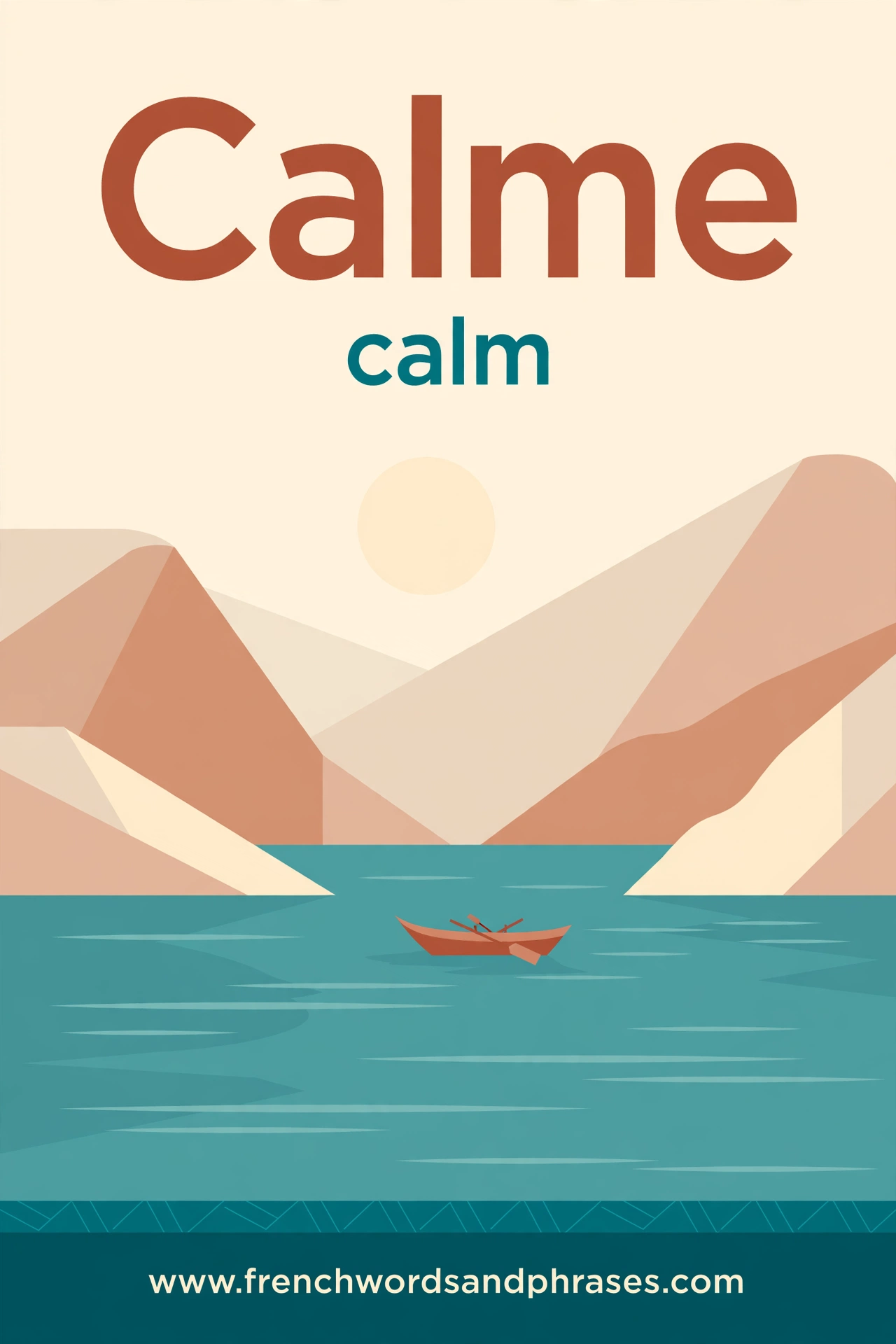
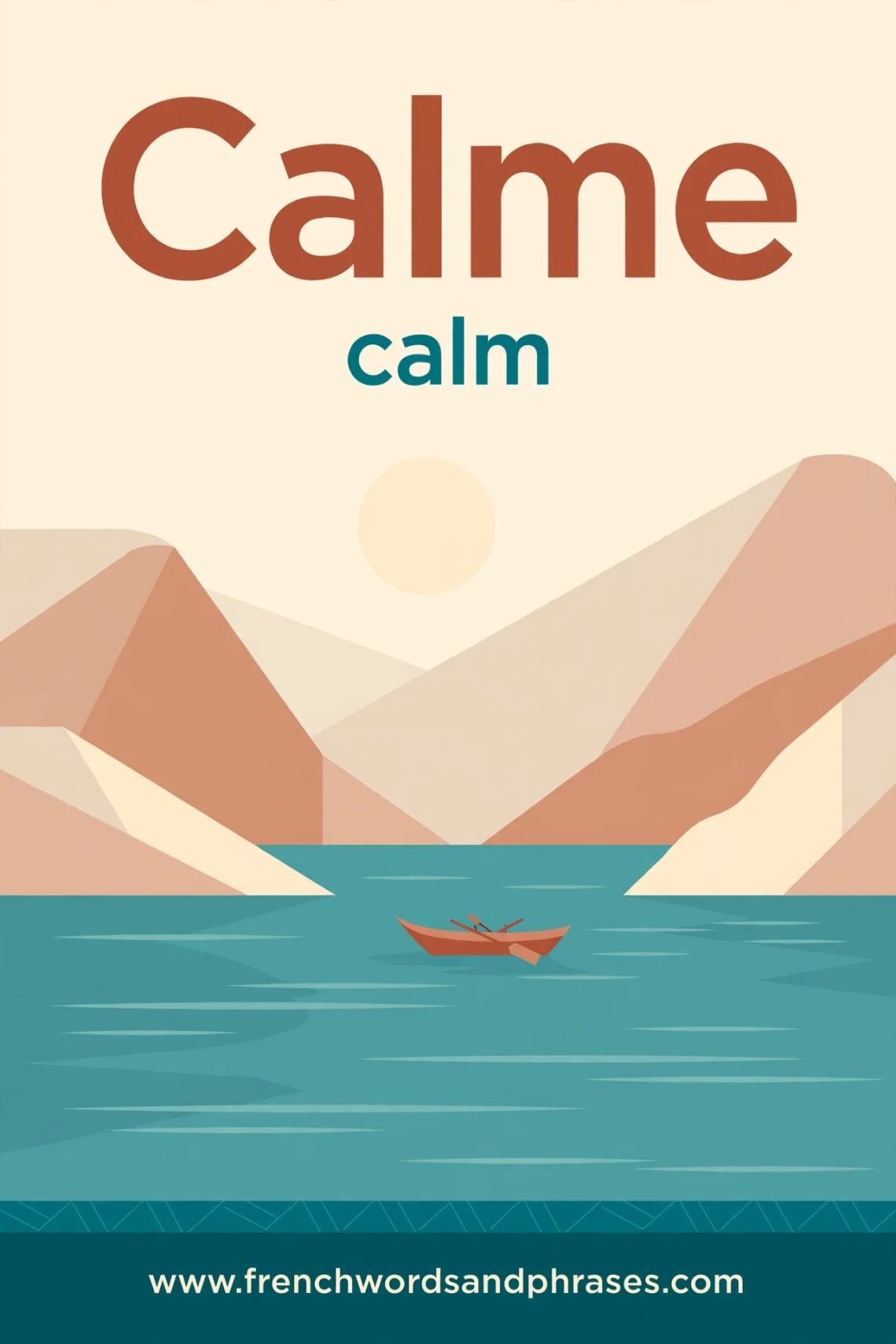
Dawn on a lake in the mountains: a thin mist on the water, a fisherman motionless in a small boat, and not one ripple anywhere. The whole world seems to be holding its breath — and French has one quiet word for the whole picture: calme.
In this guide, you’ll learn what calme means in English, why it never changes between masculine and feminine, where it stands in the sentence, and the phrases the French use to ask the world to slow down. Explore French examples, English translations, and practice quizzes.
Understanding the French Adjective Calme
Calme is a French adjective of quality — the adjective of stillness. It already ends in -e, so masculine and feminine are identical: only the plural adds an s. Un homme calme, une femme calme, des enfants calmes — one form does almost all the work.
It means calm — and also quiet, still and peaceful. It describes people (un enfant calme), places (une rue calme), the sea (la mer est calme) and voices (une voix calme). Wherever nothing is rushing, nothing is shouting and nothing is about to break, calme is at home.
Type: Adjective of quality — calm and quiet
Answers the question: What is it like? — calm
Changes form: Only in the plural — calme / calmes, the same for masculine and feminine
English equivalents: Calm; quiet; still; peaceful.
One important usage detail: calme stands AFTER the noun — une mer calme, un lac calme. And keep the family apart: calme is the adjective, le calme is the noun (the calm), and se calmer is the verb (to calm down).
Experience the Word
Calme is the adjective of early Sunday morning — shutters still closed, one café opening, the street belonging to the pigeons.
Imagine the lake again an hour later: the mist gone, the water like glass, the fisherman rowing home so slowly the boat barely seems to move. Nothing has happened, and that is exactly the point.
You have not just described a quiet place. You have protected a moment from being hurried.
How to Use Calme in French: Complete Guide
Let’s explore how calme works in French, beginning with the whole word on one card.
Calme at a Glance
Before the details, here is the whole word on one card.
The Whole Word on One Card
Meaning, type, position and forms — calme in four lines.
| Point | Calme |
|---|---|
| Meaning | calm |
| Type | adjective of quality — calm and quiet |
| Usual position | after the noun — une rue calme |
| Form | calme for everyone — calmes in the plural |
Example
C’est un quartier calme.
It’s a quiet neighbourhood.
The Four Forms of Calme
Here is the easiest agreement in French: calme already ends in -e, so the feminine changes nothing. Only the plural adds an s.
| Form | Calme | Example |
|---|---|---|
| Masculine singular | calme | un lac calme — a calm lake |
| Feminine singular | calme | une mer calme — a calm sea |
| Masculine plural | calmes | des enfants calmes — calm children |
| Feminine plural | calmes | des rues calmes — quiet streets |
Example
Les enfants sont calmes et la maison est calme.
The children are calm and the house is quiet.
Quick Quiz 1
Does calme change for a feminine noun?
Reveal the answer
No
Un homme calme, une femme calme — the form is identical.
A calm man, a calm woman.
The Feminine of Calme: Nothing Changes
Most adjectives build their feminine by adding an e. Calme was born with one, so the feminine has nothing to add — a small holiday for learners.
| Situation | Example |
|---|---|
| Masculine | un homme calme — a calm man |
| Feminine | une femme calme — identical |
| Why | calme already ends in -e, so the feminine adds nothing |
| The plural | add s — des voix calmes, calm voices |
Example
Elle reste calme dans toutes les situations.
She stays calm in every situation.
Where Calme Goes: After the Noun
Calme follows the noun it describes, like most French adjectives, and it sits comfortably after être. Adverbs slide in front of it without moving it.
| Pattern | Example |
|---|---|
| After the noun | une nuit calme — a calm night |
| After être | le lac est calme — the lake is calm |
| With an adverb | un enfant très calme — a very calm child |
| Before the noun | une calme nuit — not in everyday French |
Example
Après la pluie, la mer est calme et claire.
After the rain, the sea is calm and clear.
Quick Quiz 2
How do you say ‘a calm lake’ — un calme lac or un lac calme?
Reveal the answer
un lac calme
Calme stands after the noun.
A calm lake.
Calmer Still: Comparing with Calme
Calme compares the regular way, with plus, moins and aussi — and the superlative agrees as usual: le plus calme, la plus calme.
| Degree | Example |
|---|---|
| As calm as | aussi calme que — as calm as |
| Calmer | plus calme — calmer |
| Less calm | moins calme — less calm |
| The calmest (masc.) | le plus calme — le plus calme des frères |
| The calmest (fem.) | la plus calme — la plus calme des sœurs |
Example
Le matin est le moment le plus calme de la journée.
Morning is the calmest moment of the day.
Everyday Expressions with Calme
Calme is the word French reaches for when the temperature of a room rises — and sailors have their own version for a sea without a single wave.
| Expression | In English |
|---|---|
| rester calme | to stay calm |
| garder son calme | to keep one’s cool, to stay composed |
| du calme ! | calm down! steady on! |
| calme plat | dead calm — a sea without a breath of wind |
| un calme olympien | complete composure (an olympian calm) |
| retrouver le calme | for calm to return, to settle down again |
Example
Du calme, tout va bien se passer.
Calm down, everything will be fine.
Quick Quiz 3
What does du calme ! mean?
Reveal the answer
Calm down!
Du calme, le médecin arrive.
Calm down, the doctor is coming.
Calme and Its Neighbours
Calme shares its quiet corner with tranquille and paisible; at the other end of the room, agité and bruyant are making all the noise.
| French | In English |
|---|---|
| tranquille | quiet, peaceful, undisturbed |
| paisible | peaceful — of places and moments |
| silencieux | silent, quiet by making no sound |
| agité | agitated, restless — the opposite for people and seas |
| nerveux | nervous, on edge |
| bruyant | noisy — the opposite for places |
Example
Le village est tranquille et paisible le soir.
The village is quiet and peaceful in the evening.
Watch Out: The Traps Around Calme
The traps here are about family confusion: the noun, the verb, and an English phrase that does not translate word for word.
| Trap | The truth |
|---|---|
| le calme | with the article, calme becomes a noun — le calme de la nuit, the calm of the night |
| se calmer | the verb is reflexive — il se calme, he is calming down |
| calm down | never ‘calme bas’ — say du calme ! or calmez-vous |
| Agreement | do not add a second e — une femme calme, never ‘calmée’ |
Example
Calmez-vous, le médecin arrive dans cinq minutes.
Calm down, the doctor is arriving in five minutes.
Quick Quiz 4
How do you say ‘a calm sea’ — une calme mer or une mer calme?
Reveal the answer
une mer calme
Calme follows the noun.
A calm sea.
Calme in Everyday French: Real-Life Examples
Now that you know the word, let’s see how calme appears in everyday French.
Example 1 — By the lake
Le lac est calme ce matin, pas un souffle de vent.
The lake is calm this morning, not a breath of wind.
Example 2 — At home
Les enfants sont calmes, ils lisent dans le salon.
The children are calm, they’re reading in the living room.
Example 3 — In the street
C’est une rue calme, on entend les oiseaux.
It’s a quiet street, you can hear the birds.
Example 4 — At work
Reste calme, la réunion va bien se passer.
Stay calm, the meeting will go well.
Example 5 — The weather
Après l’orage, la mer est calme et le ciel est clair.
After the storm, the sea is calm and the sky is clear.
Example 6 — A compliment
Elle a une voix calme, tout le monde l’écoute.
She has a calm voice, everyone listens to her.
Beyond Translation: The Meaning of Calme
English says calm for the meaning of calme — but calme in French is also a philosophy of the day: the shuttered house at noon in the south, the café that does not hurry you, the fisherman who rows slowly because the lake is not going anywhere.
To call a moment calme is to say that nothing needs to happen next.
It is no accident that the word serves for the sea, for children and for voices alike — French uses one word for every kind of stillness worth keeping.
How to Remember the French Adjective Calme
Remember it this way: Calme is the restful adjective — one form for him and her, an s for the plural, and its place quietly behind the noun.
- You see one form for everyone — un homme calme, une femme calme.
- You add only an s in the plural — des rues calmes, des enfants calmes.
- You put it after the noun — une mer calme, un lac calme.
The key idea is calme never changes except in the plural, and it stands after the noun.
Test Your Knowledge of Calme
Let’s see how much you’ve learned. Try answering these questions before revealing the answers.
Question 1
What does calme mean?
Reveal the answer
Calm — also quiet, still and peaceful.
Question 2
What is the feminine of calme?
Reveal the answer
calme — identical. The word already ends in -e.
Question 3
Translate: a quiet street.
Reveal the answer
Une rue calme.
Question 4
Complete the sentence:
Du ______ ! Tout va bien se passer.
Reveal the answer
calme
Du calme ! Tout va bien se passer.
Calm down! Everything will be fine.
Question 5
What is the plural of calme?
Reveal the answer
calmes — just add an s.
Your Final Challenge
Can You Use It?
How would you say this in French?
“Stay calm, the sea is calm this morning.”
Reveal the answer
Reste calme, la mer est calme ce matin.
Stay calm, the sea is calm this morning.
A little French. A little curiosity. A richer everyday life.
LEARN FRENCH ONE WORD AT A TIME