A French Word to Live By
Translate Bon to English
/bɔ̃/
Bon means good.
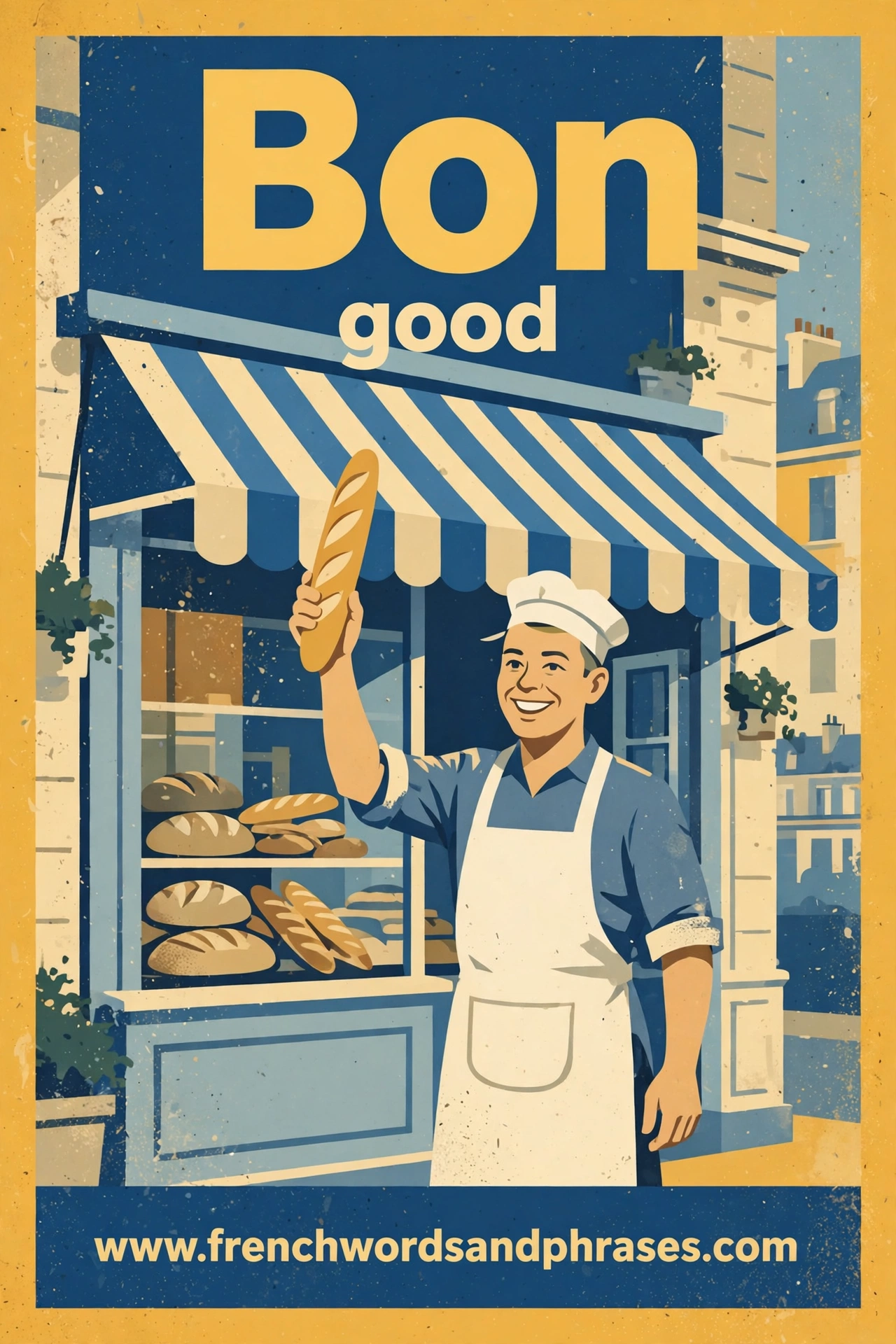
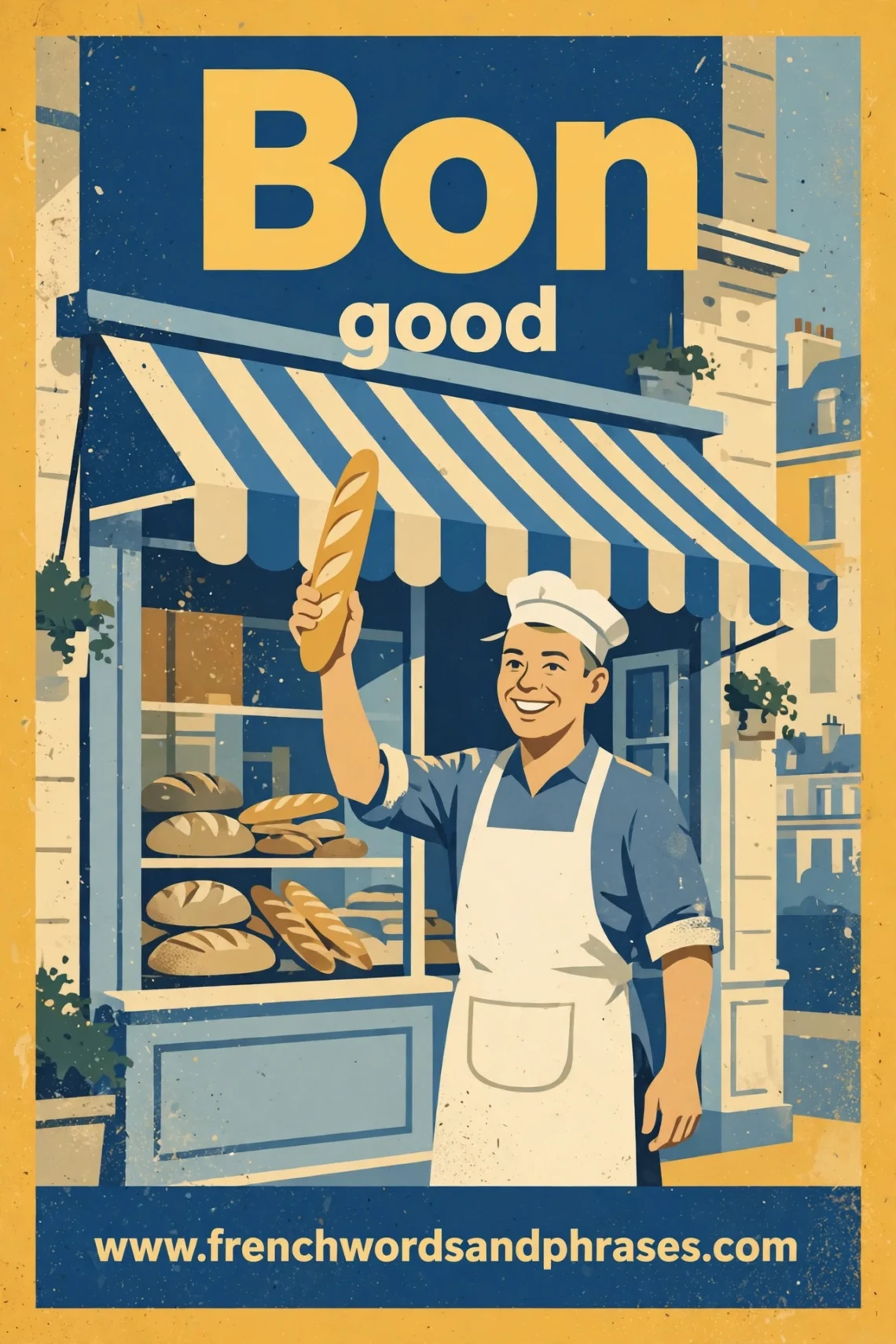
Six in the morning in a French bakery: the shutters rattle up, the first baguettes come out of the oven, and the baker taps a crust, listens, and nods. He is not checking a recipe. He is waiting for one small verdict — c’est bon.
In this guide, you’ll learn what bon means in English, why its feminine doubles the n, why it stands in front of the noun, and why its comparative is the irregular meilleur and never plus bon. Explore French examples, English translations, and practice quizzes.
Understanding the French Adjective Bon
Bon is a French adjective of quality — the adjective of goodness itself. Like every French adjective, it agrees with the noun it describes: bon, bonne, bons, bonnes. It is probably the first adjective every French child learns, usually at the dinner table.
It means good — good in quality, good in taste, and good in the sense of right or correct: un bon repas, a good meal; une bonne idée, a good idea; la bonne réponse, the right answer. If a thing pleases you, serves you, or suits you, bon is the word that says so.
Type: Adjective of quality — goodness
Answers the question: What is it like? — good
Changes form: Yes — bon, bonne, bons, bonnes
English equivalents: Good; tasty; right, correct.
One important usage detail: bon stands BEFORE the noun — un bon repas, une bonne idée — and its comparative is irregular. For quality, French never says plus bon: better is meilleur, and the best is le meilleur.
Experience the Word
Bon is the adjective of the kitchen door swinging open — the spoon offered, the taste taken, the small silence before the verdict.
Imagine a grandmother setting down a soup she has made a thousand times. She watches one face, not the pot. She is waiting for the two words that pay a cook better than money: « c’est bon ».
You have not just judged a dish. You have told someone their work is good.
How to Use Bon in French: Complete Guide
Let’s explore how bon works in French, beginning with the whole word on one card.
Bon at a Glance
Before the details, here is the whole word on one card.
The Whole Word on One Card
Meaning, type, position and forms — bon in four lines.
| Point | Bon |
|---|---|
| Meaning | good |
| Type | adjective of quality — goodness and taste |
| Usual position | before the noun — un bon repas |
| Form | bon / bonne / bons / bonnes |
Example
C’est un bon restaurant.
It’s a good restaurant.
The Four Forms of Bon
Bon agrees with the noun it describes. Watch the feminine: the n doubles, and suddenly you can hear it.
| Form | Bon | Example |
|---|---|---|
| Masculine singular | bon | un bon film — a good film |
| Feminine singular | bonne | une bonne idée — a good idea |
| Masculine plural | bons | de bons amis — good friends |
| Feminine plural | bonnes | de bonnes nouvelles — good news |
Example
Elle a de bons amis et toujours de bonnes idées.
She has good friends and always good ideas.
Quick Quiz 1
Which form of bon goes with idée (feminine)?
Reveal the answer
bonne
Une bonne idée.
A good idea.
Bonne: The Feminine with a Double N
The feminine of bon is not formed by simply adding an e. The n doubles — bon becomes bonne — and the sound changes with it: in bonne, the n is fully pronounced.
| Situation | Example |
|---|---|
| The rule | double the n and add e — bon → bonne |
| The sound | in bonne you hear the n: /bɔn/ |
| Masculine plural | bons — de bons films |
| Feminine plural | bonnes — de bonnes idées |
Example
Quelle bonne surprise de te voir ici !
What a lovely surprise to see you here!
Where Bon Goes: In Front of the Noun
Bon belongs to the small group of everyday adjectives that lead the noun instead of following it. After the noun it survives only in one special sense: a kind heart.
| Pattern | Example |
|---|---|
| bon + noun | un bon café — a good coffee |
| With an adverb | un très bon vin — a very good wine |
| After the noun (= kind-hearted) | un homme bon — a kind man |
| In comparisons | le meilleur repas — the best meal |
Example
Un bon repas commence par de bons produits.
A good meal starts with good ingredients.
Quick Quiz 2
Where does bon stand — before or after the noun?
Reveal the answer
Before
Un bon repas, une bonne idée.
A good meal, a good idea.
Better: Meilleur, Not Plus Bon
Bon has a famous irregularity: when it compares quality, it changes its word completely. Better is meilleur, and the best is le meilleur — plus bon is a mistake French children are corrected for too.
| Degree | Example |
|---|---|
| As good as | aussi bon que — as good as |
| Better | meilleur — never plus bon for quality |
| Less good | moins bon — less good |
| The best (masc.) | le meilleur — le meilleur café de la ville |
| The best (fem.) | la meilleure — la meilleure soupe du village |
Example
Ce fromage est meilleur que l’autre.
This cheese is better than the other one.
Everyday Expressions with Bon
French wishes are built out of bon. Birthdays, journeys, meals and nights all receive the same small blessing — and bon marché hides a surprise: it means cheap.
| Expression | In English |
|---|---|
| bon appétit | enjoy your meal |
| bon voyage | have a good trip |
| bon anniversaire | happy birthday |
| bonne nuit | good night |
| bonne chance | good luck |
| bon marché | cheap, good value (literally, a good market) |
Example
Bon voyage, et écris-nous en arrivant !
Have a good trip, and write to us when you arrive!
Quick Quiz 3
What do you say to someone who is about to eat?
Reveal the answer
Bon appétit !
Bon appétit, la soupe est bonne et chaude.
Enjoy your meal, the soup is good and hot.
Bon and Its Neighbours
Bon is the everyday judgement; its neighbours sharpen the praise or reverse it. Mauvais is the opposite waiting at the other end of the table.
| French | In English |
|---|---|
| excellent | excellent — stronger than bon |
| délicieux | delicious — for food and drink |
| parfait | perfect |
| correct | right, correct — for answers |
| médiocre | mediocre, so-so |
| mauvais | bad — the opposite |
Example
Le pain est excellent ici, jamais mauvais.
The bread is excellent here, never bad.
Watch Out: The Traps Around Bon
Three traps catch learners: the forbidden plus bon, the confusion with bien, and the forgotten double n in the feminine plural.
| Trap | The truth |
|---|---|
| plus bon | for quality, French says meilleur — ce vin est meilleur |
| bon vs bien | bon is the adjective (un bon film); bien is the adverb (il chante bien) |
| Agreement | idées is feminine plural: de bonnes idées, with a double n |
| bon marché | means cheap, not ‘good’ — un vélo bon marché, a cheap bike |
Example
C’est le meilleur café de la ville, et il n’est pas cher.
It’s the best coffee in town, and it isn’t expensive.
Quick Quiz 4
How do you say ‘better’ — plus bon or meilleur?
Reveal the answer
meilleur
Ce pain est meilleur que l’autre.
This bread is better than the other one.
Bon in Everyday French: Real-Life Examples
Now that you know the word, let’s see how bon appears in everyday French.
Example 1 — At the bakery
Ce pain est très bon, je reviendrai demain.
This bread is very good, I’ll come back tomorrow.
Example 2 — At the cinema
C’est un bon film, les acteurs sont excellents.
It’s a good film, the actors are excellent.
Example 3 — Good news
Bonne nouvelle : le train est à l’heure !
Good news: the train is on time!
Example 4 — At the table
Bon appétit ! La soupe est bonne et chaude.
Enjoy your meal! The soup is good and hot.
Example 5 — A wish
Bonne chance pour ton examen demain !
Good luck with your exam tomorrow!
Example 6 — At the market
Ces pommes sont bonnes et pas chères.
These apples are good and not expensive.
Beyond Translation: The Meaning of Bon
English says good for the meaning of bon — but bon is also the word French reaches for when it blesses. Bonne nuit, bonne chance, bon voyage, bon anniversaire: a whole day can be wrapped in it, from the first coffee to the last goodnight.
To say bon in French is to approve of the world, one small thing at a time.
And at the table it becomes a ceremony of its own: the cook waits, the guest tastes, and « c’est bon » closes the question like a signature.
How to Remember the French Adjective Bon
Remember it this way: Bon is the little word of approval — it leads the noun, doubles its n for her, and changes its name completely when it compares.
- You see the family together — bon, bonne, bons, bonnes — with a double n in the feminine.
- You put it in front, always — un bon repas, une bonne idée.
- You never say plus bon — better is meilleur, the best is le meilleur.
The key idea is bon stands before the noun, doubles its n in bonne, and becomes meilleur when it compares.
Test Your Knowledge of Bon
Let’s see how much you’ve learned. Try answering these questions before revealing the answers.
Question 1
What does bon mean?
Reveal the answer
Good — in quality, in taste, and in the sense of right or correct.
Question 2
What are the forms of bon?
Reveal the answer
bon, bonne, bons, bonnes — the feminine doubles the n.
Question 3
Translate: a good idea.
Reveal the answer
Une bonne idée.
Question 4
How do you say ‘better’ with bon?
Reveal the answer
meilleur
Ce vin est meilleur.
This wine is better.
Question 5
Complete the wish:
______ appétit !
Reveal the answer
Bon
Bon appétit !
Enjoy your meal!
Your Final Challenge
Can You Use It?
How would you say this in French?
“This soup is very good. Enjoy your meal!”
Reveal the answer
Cette soupe est très bonne. Bon appétit !
This soup is very good. Enjoy your meal!
A little French. A little curiosity. A richer everyday life.
LEARN FRENCH ONE WORD AT A TIME