
A French Word to Live By
How to Conjugate Calfeutrer in French
/kal.fø.tʁe/
Calfeutrer means to make draught-proof, to block up — to stuff every crack and gap around a window or door so the cold air stays outside.
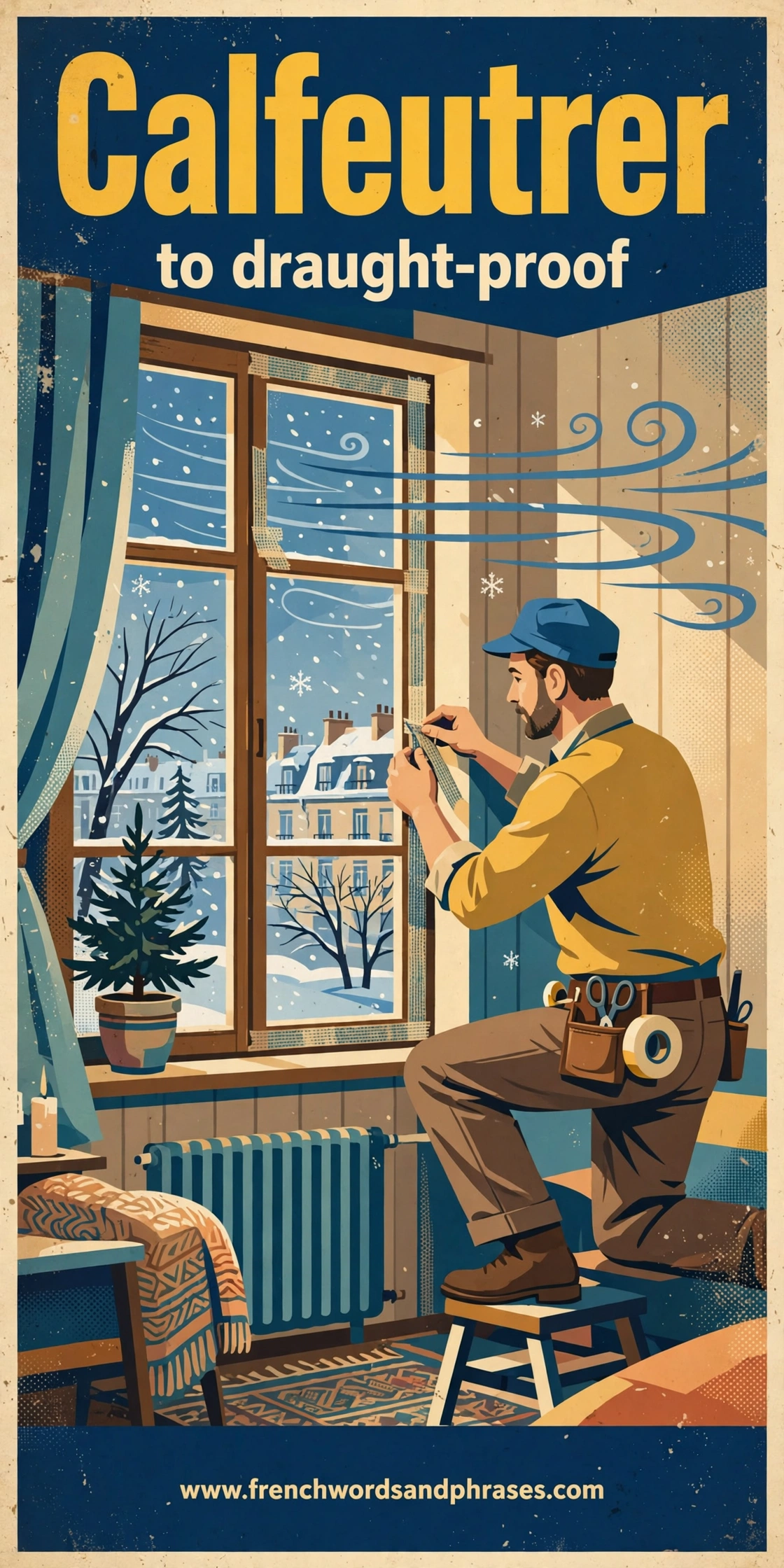
November wind whistling under a door, an old blanket rolled against the draught, foam strips pressed along a window frame — calfeutrer is the autumn verb of the sealed house: every gap stuffed, every crack blocked, the warmth kept in.
In this guide, you’ll learn how to conjugate calfeutrer in all the major French tenses and moods. Explore complete conjugation tables, French examples, English translations, and practice quizzes.
Understanding the French Verb Calfeutrer
Calfeutrer is a regular French verb belonging to the first group of verbs, those ending in-er.
It means to make draught-proof, to block up. It is used of windows, doors, cracks and whole houses made proof against wind and cold, usually before winter. The material has modernised — foam tape, silicone, draught excluders — but the verb has not changed since the days of felt.
Verb classification: First group (-er)
Auxiliary verb: Avoir
Past participle: calfeutré
Present participle: calfeutrant
English equivalents: To draught-proof, to block up, to seal up; calfeutrer une fenêtre — to draught-proof a window; calfeutrer une porte — to seal a door; calfeutrer les fissures — to block up the cracks; une maison bien calfeutrée — a well-sealed house.
One important detail: calfeutrer is built on le feutre, felt — the original draught-proofing was literally felt stuffed into cracks, and the word still carries that picture of soft material pressed into every gap. The verb is a perfectly regular -er: je calfeutre, nous calfeutrons, ils calfeutrent, past participle calfeutré. Its reflexive twin se calfeutrer takes the picture indoors: to shut yourself up snugly at home, sealed in like the house itself.
Experience the Word
Calfeutrer is the verb of the last gap — when the final crack is stuffed, the house stops breathing cold air and winter stays outside.
Imagine a grandmother in an old stone house in the Auvergne, the first Sunday of November. Window by window, door by door, elle calfeutre tout: felt strips here, a rolled blanket there, until not one draught dares cross the threshold. Dehors, le vent peut hurler — inside, the soup is hot and the cat approves.
Every gap filled by hand. The house is calfeutrée — sealed like a letter against the winter.
How to Conjugate Calfeutrer: Complete French Conjugation Guide
Let’s explore every major conjugation of calfeutrer, beginning with the indicative mood.
How to Conjugate Calfeutrer in the Indicative Mood
The indicative mood is used to express facts, observations, actions, and events.
How to Conjugate Calfeutrer in the Present Tense (Présent)
Used for actions happening now, habitual actions, and general truths.
| Subject | Conjugation |
|---|---|
| je | calfeutre |
| tu | calfeutres |
| il / elle | calfeutre |
| nous | calfeutrons |
| vous | calfeutrez |
| ils / elles | calfeutrent |
Example
On calfeutre les fenêtres avant l’arrivée de l’hiver.
We draught-proof the windows before winter arrives.
Quick Quiz 1
Complete the sentence:
Nous ______ les fissures du mur ce matin.
Reveal the answer
calfeutrons
Nous calfeutrons les fissures du mur ce matin.
We are blocking up the cracks in the wall this morning.
How to Conjugate Calfeutrer in the Passé Composé
Used for completed actions in the past. Calfeutrer takes the auxiliary verb avoir.
| Subject | Conjugation |
|---|---|
| j’ | ai calfeutré |
| tu | as calfeutré |
| il / elle | a calfeutré |
| nous | avons calfeutré |
| vous | avez calfeutré |
| ils / elles | ont calfeutré |
Example
Il a calfeutré la porte du grenier avec du feutre.
He sealed the attic door with felt.
How to Conjugate Calfeutrer in the Imparfait (Imperfect Tense)
Used for habitual past actions, descriptions, and ongoing situations in the past.
| Subject | Conjugation |
|---|---|
| je | calfeutrais |
| tu | calfeutrais |
| il / elle | calfeutrait |
| nous | calfeutrions |
| vous | calfeutriez |
| ils / elles | calfeutraient |
Example
Ma grand-mère calfeutrait chaque fenêtre au mois de novembre.
My grandmother used to draught-proof every window in November.
Quick Quiz 2
Choose the correct form:
He sealed the attic door.
Il ______ la porte du grenier. (a calfeutré / est calfeutré)
Reveal the answer
a calfeutré
Il a calfeutré la porte du grenier.
Calfeutrer takes avoir.
How to Conjugate Calfeutrer in the Plus-que-parfait
Used to describe an action that had already been completed before another past event.
| Subject | Conjugation |
|---|---|
| j’ | avais calfeutré |
| tu | avais calfeutré |
| il / elle | avait calfeutré |
| nous | avions calfeutré |
| vous | aviez calfeutré |
| ils / elles | avaient calfeutré |
Example
Ils avaient calfeutré toutes les fissures avant la tempête.
They had blocked up all the cracks before the storm.
How to Conjugate Calfeutrer in the Passé Simple
Primarily used in formal writing, literature, and historical narratives. It is rarely used in everyday conversation.
| Subject | Conjugation |
|---|---|
| je | calfeutrai |
| tu | calfeutras |
| il / elle | calfeutra |
| nous | calfeutrâmes |
| vous | calfeutrâtes |
| ils / elles | calfeutrèrent |
Example
Le gardien calfeutra les fenêtres du phare avant la nuit.
The keeper sealed the lighthouse windows before nightfall.
How to Conjugate Calfeutrer in the Passé Antérieur
A literary tense used to express an action completed immediately before another past action, generally in the passé simple.
| Subject | Conjugation |
|---|---|
| j’ | eus calfeutré |
| tu | eus calfeutré |
| il / elle | eut calfeutré |
| nous | eûmes calfeutré |
| vous | eûtes calfeutré |
| ils / elles | eurent calfeutré |
Example
Quand elle eut calfeutré la dernière porte, la maison devint silencieuse.
When she had sealed the last door, the house fell silent.
How to Conjugate Calfeutrer in the Future Tense (Futur Simple)
Used to describe actions that will take place in the future.
| Subject | Conjugation |
|---|---|
| je | calfeutrerai |
| tu | calfeutreras |
| il / elle | calfeutrera |
| nous | calfeutrerons |
| vous | calfeutrerez |
| ils / elles | calfeutreront |
Example
Ce week-end, nous calfeutrerons le bas de toutes les portes.
This weekend, we will draught-proof the bottom of all the doors.
How to Conjugate Calfeutrer in the Futur Antérieur (Future Perfect)
Used for an action that will have been completed before a particular point in the future.
| Subject | Conjugation |
|---|---|
| j’ | aurai calfeutré |
| tu | auras calfeutré |
| il / elle | aura calfeutré |
| nous | aurons calfeutré |
| vous | aurez calfeutré |
| ils / elles | auront calfeutré |
Example
À la fin du mois, il aura calfeutré toute la maison.
By the end of the month, he will have sealed the whole house.
How to Conjugate Calfeutrer in the Near Future (Futur Proche)
Used to describe something that is going to happen soon. Formed with aller + infinitive.
| Subject | Conjugation |
|---|---|
| je | vais calfeutrer |
| tu | vas calfeutrer |
| il / elle | va calfeutrer |
| nous | allons calfeutrer |
| vous | allez calfeutrer |
| ils / elles | vont calfeutrer |
Example
Je vais calfeutrer la fenêtre de la cuisine, il y a un courant d’air.
I am going to draught-proof the kitchen window, there is a draught.
How to Conjugate Calfeutrer in the Conditional Mood
The conditional mood expresses what would happen under certain circumstances. It is also frequently used to make polite requests or express wishes.
How to Conjugate Calfeutrer in the Present Conditional
| Subject | Conjugation |
|---|---|
| je | calfeutrerais |
| tu | calfeutrerais |
| il / elle | calfeutrerait |
| nous | calfeutrerions |
| vous | calfeutreriez |
| ils / elles | calfeutreraient |
Example
Avec de bons joints, on calfeutrerait la maison en une heure.
With good seals, we would draught-proof the house in an hour.
How to Conjugate Calfeutrer in the Past Conditional
| Subject | Conjugation |
|---|---|
| j’ | aurais calfeutré |
| tu | aurais calfeutré |
| il / elle | aurait calfeutré |
| nous | aurions calfeutré |
| vous | auriez calfeutré |
| ils / elles | auraient calfeutré |
Example
Tu aurais calfeutré la porte si tu avais senti le vent.
You would have sealed the door if you had felt the wind.
Calfeutrer in the Literary Past Conditional Form
This less common literary form uses the imperfect subjunctive of avoir.
| Subject | Conjugation |
|---|---|
| j’ | eusse calfeutré |
| tu | eusses calfeutré |
| il / elle | eût calfeutré |
| nous | eussions calfeutré |
| vous | eussiez calfeutré |
| ils / elles | eussent calfeutré |
Example
Elle eût calfeutré les fenêtres avant la première neige.
She would have sealed the windows before the first snow.
How to Conjugate Calfeutrer in the Subjunctive Mood
The subjunctive is used to express wishes, emotions, doubts, necessity, and uncertainty. It frequently follows expressions such as il faut que (it is necessary that) or bien que (although).
How to Conjugate Calfeutrer in the Present Subjunctive
| Subject | Conjugation |
|---|---|
| que je | calfeutre |
| que tu | calfeutres |
| qu’il / qu’elle | calfeutre |
| que nous | calfeutrions |
| que vous | calfeutriez |
| qu’ils / qu’elles | calfeutrent |
Example
Il faut que tu calfeutres la porte d’entrée cette semaine.
You must draught-proof the front door this week.
Quick Quiz 3
Complete the sentence using the subjunctive:
Je voulais qu’il ______ les fissures du mur.
Reveal the answer
calfeutrât
Je voulais qu’il calfeutrât les fissures du mur.
I wanted him to block up the cracks in the wall.
How to Conjugate Calfeutrer in the Imperfect Subjunctive
A literary tense, rarely encountered in modern spoken French.
| Subject | Conjugation |
|---|---|
| que je | calfeutrasse |
| que tu | calfeutrasses |
| qu’il / qu’elle | calfeutrât |
| que nous | calfeutrassions |
| que vous | calfeutrassiez |
| qu’ils / qu’elles | calfeutrassent |
Example
Je voulais qu’il calfeutrât les fissures du mur.
I wanted him to block up the cracks in the wall.
How to Conjugate Calfeutrer in the Pluperfect Subjunctive
A literary construction used to express an action completed before another past action.
| Subject | Conjugation |
|---|---|
| que j’ | eusse calfeutré |
| que tu | eusses calfeutré |
| qu’il / qu’elle | eût calfeutré |
| que nous | eussions calfeutré |
| que vous | eussiez calfeutré |
| qu’ils / qu’elles | eussent calfeutré |
Example
On admirait qu’elle eût calfeutré la vieille maison si bien.
People admired that she had sealed the old house so well.
How to Conjugate Calfeutrer in the Past Subjunctive
| Subject | Conjugation |
|---|---|
| que j’ | aie calfeutré |
| que tu | aies calfeutré |
| qu’il / qu’elle | ait calfeutré |
| que nous | ayons calfeutré |
| que vous | ayez calfeutré |
| qu’ils / qu’elles | aient calfeutré |
Example
Je suis content que vous ayez calfeutré les fenêtres à temps.
I am glad you draught-proofed the windows in time.
How to Conjugate Calfeutrer in the Imperative
The imperative is used to give commands, instructions, invitations, or suggestions. Subject pronouns are omitted.
How to Conjugate Calfeutrer in the Present Imperative
| Person | Conjugation |
|---|---|
| (tu) | calfeutre |
| (nous) | calfeutrons |
| (vous) | calfeutrez |
Example
Calfeutre bien le bas de la porte, le vent passe dessous !
Seal the bottom of the door well, the wind gets underneath!
Quick Quiz 4
How would you say Seal the bottom of the door well (tu form)?
Reveal the answer
Calfeutre bien le bas de la porte !
French Participles of Calfeutrer
Participles are verb forms that can be used in compound tenses and other grammatical constructions.
Present Participle of Calfeutrer
calfeutrant
En calfeutrant les fenêtres, elle écoutait la radio.
While draught-proofing the windows, she listened to the radio.
Past Participle of Calfeutrer
calfeutré
Calfeutrée contre le vent, la cabane restait chaude toute la nuit.
Sealed against the wind, the cabin stayed warm all night.
Calfeutrer in Everyday French: Real-Life Examples
Now that you know the conjugations, let’s see how calfeutrer appears in everyday French.
Example 1 — Present
On calfeutre les fenêtres avant l’hiver.
We draught-proof the windows before winter.
Example 2 — Passé composé
Il a calfeutré la porte du grenier.
He sealed the attic door.
Example 3 — Imparfait
Ma grand-mère calfeutrait chaque fenêtre en novembre.
My grandmother used to seal every window in November.
Example 4 — Future
Nous calfeutrerons le bas des portes ce week-end.
We will draught-proof the door bottoms this weekend.
Example 5 — Conditional
On calfeutrerait la maison en une heure avec de bons joints.
We would seal the house in an hour with good seals.
Example 6 — Imperative
Calfeutre bien le bas de la porte !
Seal the bottom of the door well!
Beyond Translation: The Meaning of Calfeutrer
English needs the compound draught-proof; French calfeutrer names the material instead — le feutre, felt, the stuff our great-grandparents pressed into every crack.
It is a word with the winter kept out by hand.
Foam tape and silicone have replaced the felt, but the verb still smells of November afternoons, rolled blankets and grandmothers who refused, on principle, to heat the street.
How to Remember the French Verb Calfeutrer
Remember it this way: Calfeutrer is about the grandmother sealing every window with felt before the first winter wind.
- Le feutre is felt: calfeutrer is to stuff the gaps — fenêtres, portes, fissures — against the draught.
- The season is November: calfeutrer la maison avant l’hiver.
- Regular -er: je calfeutre, nous calfeutrons, past participle calfeutré.
The key idea is the grandmother sealing every window with felt before the first winter wind.
Test Your Knowledge of Calfeutrer
Let’s see how much you’ve learned. Try answering these questions before revealing the answers.
Question 1
What material gives calfeutrer its name?
Reveal the answer
Le feutre — felt, once stuffed into every crack around windows and doors.
Question 2
How do you say We draught-proof the windows before winter arrives in French?
Reveal the answer
On calfeutre les fenêtres avant l’arrivée de l’hiver.
Question 3
Translate: You must draught-proof the front door this week.
Reveal the answer
Il faut que tu calfeutres la porte d’entrée cette semaine.
Question 4
What is the past participle of calfeutrer?
Reveal the answer
Calfeutré.
Question 5
Complete the sentence:
Ce week-end, nous ______ le bas de toutes les portes.
Reveal the answer
calfeutrerons
Ce week-end, nous calfeutrerons le bas de toutes les portes.
This weekend, we will draught-proof the bottom of all the doors.
Your Final Challenge
Can You Use It?
How would you say this in French?
She seals the last window, and the whole house seems to sigh with warmth.
Reveal the answer
Elle calfeutre la dernière fenêtre, et la maison entière semble soupirer de chaleur.
She seals the last window, and the whole house seems to sigh with warmth.
A little French. A little curiosity. A richer everyday life.
LEARN FRENCH ONE WORD AT A TIME




