A French Word to Live By
Translate Café to English
/ka.fe/
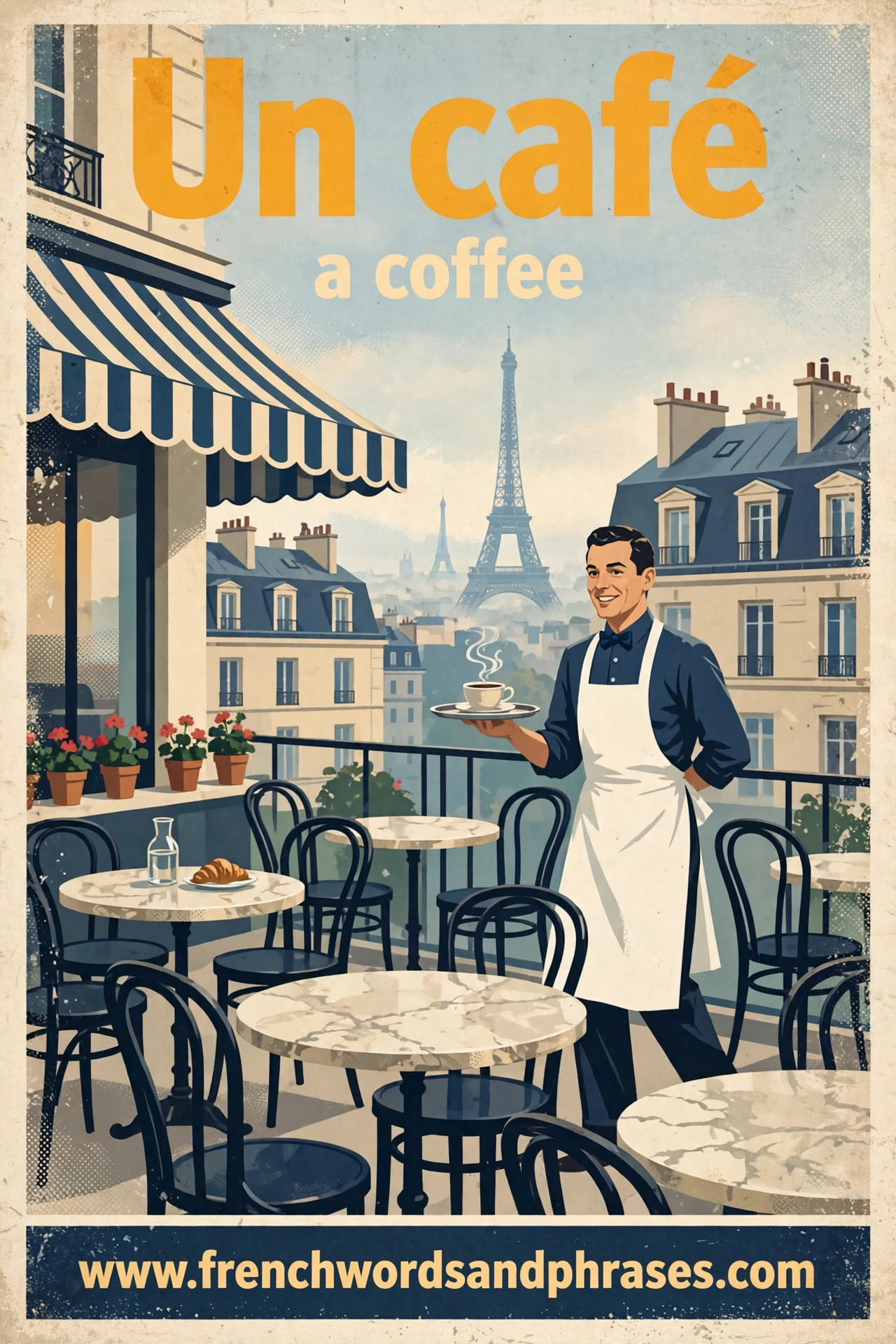
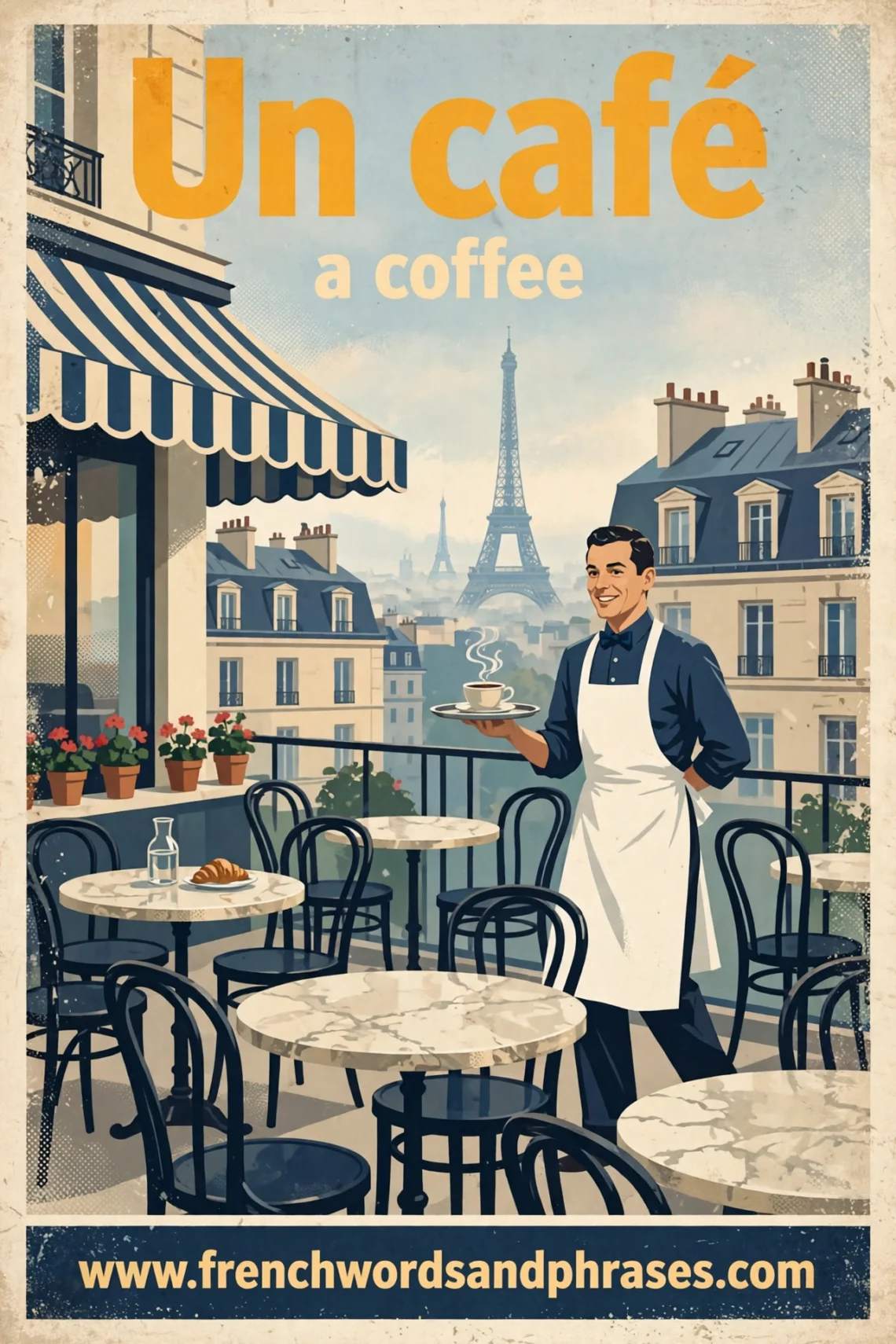
Le café means a coffee, a café.
The bell above the door rings, the machine hisses, and the smell of fresh coffee rolls out onto the pavement. A zinc counter, two tiny cups, a conversation that lasts all morning — that is un café.
In this guide, you’ll learn what café means in English, how to use it with its articles, how to form its plural, and how it appears in everyday French. Explore French examples, English translations, and practice quizzes.
Understanding the French Noun Café
Café is a masculine French noun. It is learned together with its article: le café, un café.
It means a coffee — and it also means a café, the place where you drink it. One word does both jobs: je bois un café (I am drinking a coffee) and rendez-vous au café (let’s meet at the café). As a drink, café is the coffee itself, usually a small strong espresso; as a place, it is the beating heart of every French neighbourhood.
Gender: Masculine
Definite article: le — le café (the coffee, the café)
Indefinite article: un — un café (a coffee, a café)
Partitive article: du — du café (some coffee)
Plural: les cafés
English equivalents: A coffee; a café.
One important usage detail: the same word names the drink and the place, and the article tells you which you mean. Du café is coffee as a substance (some coffee); un café is one coffee, a cup — or one café, a place. Context and the little word in front do all the work.
Experience the Word
Café is more than a drink in France. It is a pause in the day, a table that is yours for an hour, a front-row seat on the life of the street.
Imagine the morning ritual: the counter, the cup, the croissant still warm, the newspaper folded in three, and the whole village passing through the door before nine o’clock.
You have not just ordered a drink. You have taken your place in the café.
How to Use Café in French: Complete Guide
Let’s explore how café works in French, beginning with its articles.
Café with the Definite Article (Le, Les)
Used for coffee in general, or for the café both speakers know — the usual one, on the corner.
| Number | French |
|---|---|
| Singular | le café |
| Plural | les cafés |
Example
Le café du village ouvre dès sept heures.
The village café opens at seven o’clock.
Café with the Indefinite Article (Un, Des)
Used to order one coffee, or to talk about cafés in general.
| Number | French |
|---|---|
| Singular | un café |
| Plural | des cafés |
Example
Elle commande un café et un croissant.
She orders a coffee and a croissant.
Café with the Partitive Article (Du — Some Coffee)
Used for coffee as a substance — an amount you drink, not a cup you count.
| Meaning | French |
|---|---|
| some coffee | du café |
| no coffee (after a negative) | de café |
Example
Le matin, je bois du café avant de partir.
In the morning, I drink coffee before leaving.
Quick Quiz 1
How do you say some coffee in French?
Reveal the answer
du café
Tu bois du café ?
Do you drink coffee?
The Plural of Café
Café simply adds an -s in the plural — a letter you write, but do not hear.
| Number | French |
|---|---|
| Singular | le café |
| Plural | les cafés |
Example
Nous avons pris deux cafés sur la terrasse.
We had two coffees on the terrace.
Café with Possessive Adjectives (Mon, Ton, Son…)
Possessives agree with the noun, not with the owner — and café is masculine, so it takes mon, ton, son.
| Owner | French |
|---|---|
| my | mon café |
| your (tu) | ton café |
| his / her | son café |
| our | notre café |
| your (vous) | votre café |
| their | leur café |
Example
Il prend son café sans sucre, toujours.
He takes his coffee without sugar, always.
Quick Quiz 2
Complete the sentence:
Nous avons pris deux ______ sur la terrasse.
Reveal the answer
cafés
Nous avons pris deux cafés sur la terrasse.
We had two coffees on the terrace.
Café with Demonstrative Adjectives (Ce, Ces)
Used to point: this coffee here, those cafés there.
| Number | French |
|---|---|
| Singular | ce café |
| Plural | ces cafés |
Example
Ce café est le meilleur du quartier.
This café is the best in the neighbourhood.
Café with Adjectives
Most adjectives come after the noun — and café stays masculine: un café noir, un café chaud.
| Adjective | With Café |
|---|---|
| noir (black) | un café noir |
| serré (strong, short) | un café serré |
| allongé (long, weaker) | un café allongé |
| chaud (hot) | un café chaud |
| glacé (iced) | un café glacé |
| sucré (sweetened) | un café sucré |
Example
Je préfère un café serré, sans sucre.
I prefer a strong coffee, without sugar.
Quick Quiz 3
Complete the sentence:
Je voudrais un café ______, s’il vous plaît. (with milk)
Reveal the answer
au lait
Je voudrais un café au lait, s’il vous plaît.
I would like a coffee with milk, please.
Everyday Expressions with Café
Café runs through French daily life — at the counter, these are the phrases you will hear and use.
| Expression | In English |
|---|---|
| un café au lait | a coffee with milk (a latte) |
| un café crème | a coffee with cream or steamed milk |
| prendre un café | to have a coffee |
| au café | at the café |
| le café du matin | morning coffee |
| un café de quartier | a neighbourhood café |
Example
On se retrouve au café du coin à midi ?
Shall we meet at the café on the corner at noon?
Words from the Same Family as Café
Learn these together and the whole coffee counter falls into place.
| French | In English |
|---|---|
| la cafetière | the coffee pot, the coffee maker |
| le grain de café | the coffee bean |
| la caféine | caffeine |
| un déca (un café décaféiné) | a decaf coffee |
| le caféier | the coffee plant |
| la torréfaction | coffee roasting |
Example
Elle prépare le café dans une vieille cafetière.
She makes the coffee in an old coffee pot.
Quick Quiz 4
What does prendre un café mean?
Reveal the answer
To have a coffee
On prend un café ensemble ?
Shall we have a coffee together?
Café in Everyday French: Real-Life Examples
Now that you know the word, let’s see how café appears in everyday French.
Example 1 — Ordering
Je voudrais un café crème, s’il vous plaît.
I would like a coffee with cream, please.
Example 2 — Meeting a friend
On se donne rendez-vous au café à midi.
We arrange to meet at the café at noon.
Example 3 — In the morning
Je prends un café avant de partir travailler.
I have a coffee before leaving for work.
Example 4 — At the counter
Un café serré, s’il vous plaît !
A strong coffee, please!
Example 5 — Talking about yesterday
Hier, nous avons pris un café sur la terrasse.
Yesterday, we had a coffee on the terrace.
Example 6 — Coffee as a substance
Je ne bois jamais de café le soir.
I never drink coffee in the evening.
Beyond Translation: The Meaning of Café
English borrows the word café for the place, but French keeps one word for the place and the drink, because in France the two are inseparable: the café is where the coffee happens, and the coffee is why the café exists.
To say café is to say the pause at the heart of the French day.
It evokes the zinc counter, the tiny cup, the waiter who knows your order — a small, daily ceremony of standing still while the street rushes past.
How to Remember the French Noun Café
Remember it this way: Café is the drink and the place in one word, masculine, with le for the coffee and un for a cup.
- You order at the counter — un café, s’il vous plaît.
- You talk about the drink itself — je bois du café le matin.
- You meet a friend — on se retrouve au café du coin.
The key idea is le café for the drink in general, un café for a cup — or the place.
Test Your Knowledge of Café
Let’s see how much you’ve learned. Try answering these questions before revealing the answers.
Question 1
Is café masculine or feminine?
Reveal the answer
Masculine — le café, un café.
Question 2
How do you say some coffee in French?
Reveal the answer
Du café.
Question 3
Translate: I would like a coffee with milk, please.
Reveal the answer
Je voudrais un café au lait, s’il vous plaît.
Question 4
What are the two meanings of café?
Reveal the answer
A coffee (the drink) and a café (the place where you drink it).
Question 5
Complete the sentence:
Le matin, je bois ______ café avant de partir.
Reveal the answer
du
Le matin, je bois du café avant de partir.
In the morning, I drink coffee before leaving.
Your Final Challenge
Can You Use It?
How would you say this in French?
“Every morning, I drink a coffee at the café.”
Reveal the answer
Chaque matin, je bois un café au café.
Every morning, I drink a coffee at the café.
A little French. A little curiosity. A richer everyday life.
LEARN FRENCH ONE WORD AT A TIME