
A French Word to Live By
How to Conjugate Cabrioler in French
/ka.bʁi.jɔ.le/
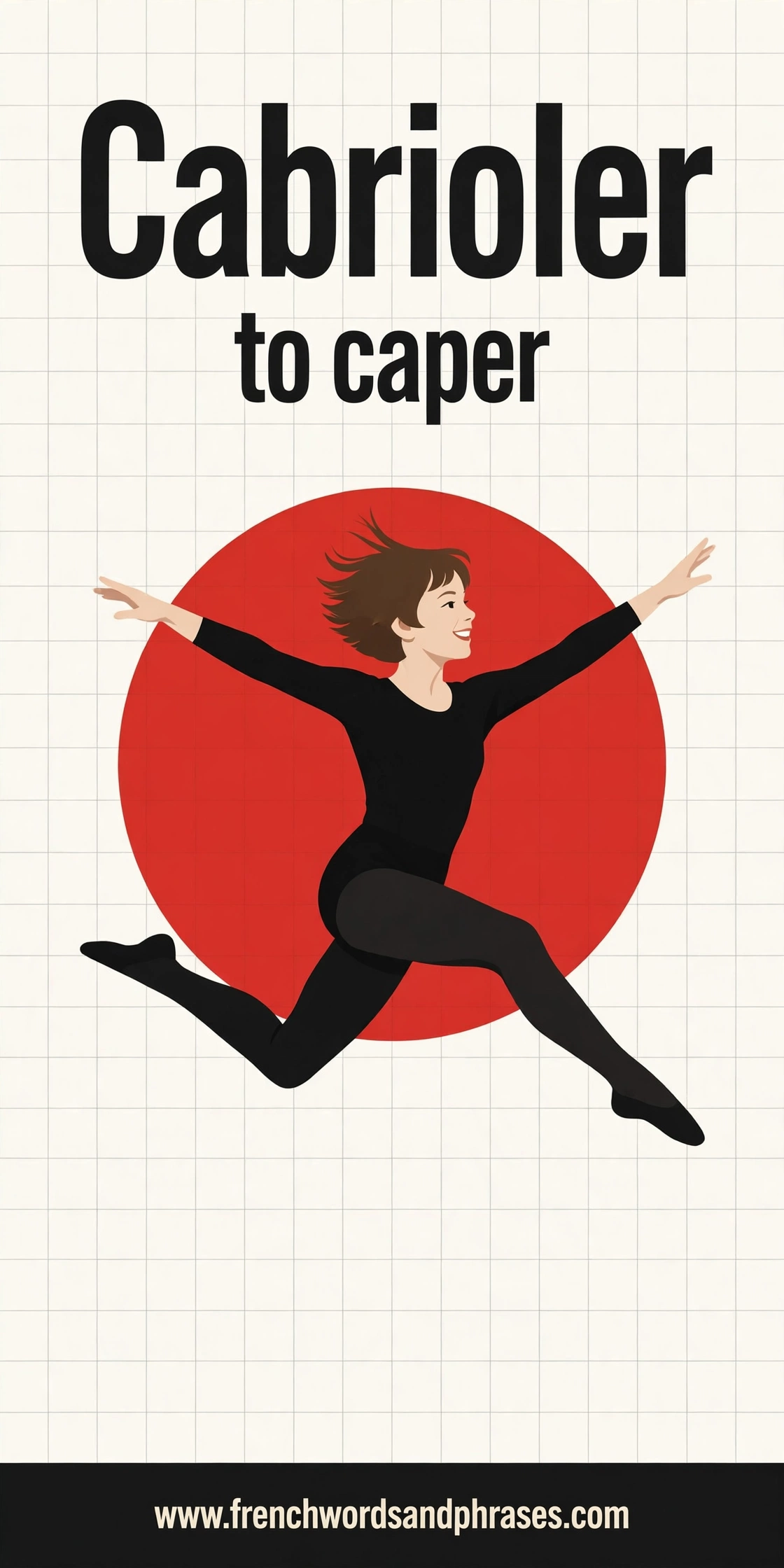
Cabrioler means to caper, to cut capers — to leap and frolic about like a young goat, full of spring and mischief.
Kids in a playground at break time, lambs bouncing sideways across a spring field — cabrioler is the joyful verb of the caper: leaping, skipping and gambolling for the pure pleasure of moving.
In this guide, you’ll learn how to conjugate cabrioler in all the major French tenses and moods. Explore complete conjugation tables, French examples, English translations, and practice quizzes.
Understanding the French Verb Cabrioler
Cabrioler is a regular French verb belonging to the first group of verbs, those ending in-er.
It means to caper, to cut capers. It is used of children, lambs, goats and anyone leaping about in high spirits — playful, physical joy rather than skilled acrobatics. Dancers and gymnasts perform une cabriole; children in a field simply cabriolent, and the word always carries a smile.
Verb classification: First group (-er)
Auxiliary verb: Avoir
Past participle: cabriolé
Present participle: cabriolant
English equivalents: To caper, to frolic, to gambol; cabrioler comme un cabri — to caper like a young goat; les enfants cabriolent dans la cour — the children are frolicking in the yard; faire cabrioler — to make someone dance about; une cabriole — a caper, a somersault.
One important detail: cabrioler is built on le cabri, the young goat — the animal that gives French la cabriole, the caper or somersault of dancers and gymnasts. The verb is perfectly regular: je cabriole, nous cabriolons, ils cabriolent, past participle cabriolé. Keep the i of cabri- in every form: it is the goat, still bouncing inside the word.
Experience the Word
Cabrioler is the verb of spring in the legs — the leap that has no destination and needs none.
Imagine the first warm day of April in a mountain pasture. The young goats are let out of the barn, and within seconds they are everywhere at once — cabriolant sideways, backwards, straight up into the air — as if the ground itself had become too joyful to stand on.
They are going nowhere at all. They are simply capering — cabriolant — because the sun is out and they are alive.
How to Conjugate Cabrioler: Complete French Conjugation Guide
Let’s explore every major conjugation of cabrioler, beginning with the indicative mood.
How to Conjugate Cabrioler in the Indicative Mood
The indicative mood is used to express facts, observations, actions, and events.
How to Conjugate Cabrioler in the Present Tense (Présent)
Used for actions happening now, habitual actions, and general truths.
| Subject | Conjugation |
|---|---|
| je | cabriole |
| tu | cabrioles |
| il / elle | cabriole |
| nous | cabriolons |
| vous | cabriolez |
| ils / elles | cabriolent |
Example
Les enfants cabriolent dans la cour de récréation.
The children are frolicking in the playground.
Quick Quiz 1
Complete the sentence:
Nous regardons les agneaux qui ______ dans le pré.
Reveal the answer
cabriolent
Nous regardons les agneaux qui cabriolent dans le pré.
We are watching the lambs capering in the meadow.
How to Conjugate Cabrioler in the Passé Composé
Used for completed actions in the past. Cabrioler takes the auxiliary verb avoir.
| Subject | Conjugation |
|---|---|
| j’ | ai cabriolé |
| tu | as cabriolé |
| il / elle | a cabriolé |
| nous | avons cabriolé |
| vous | avez cabriolé |
| ils / elles | ont cabriolé |
Example
Les agneaux ont cabriolé toute la matinée dans le pré.
The lambs capered all morning in the meadow.
How to Conjugate Cabrioler in the Imparfait (Imperfect Tense)
Used for habitual past actions, descriptions, and ongoing situations in the past.
| Subject | Conjugation |
|---|---|
| je | cabriolais |
| tu | cabriolais |
| il / elle | cabriolait |
| nous | cabriolions |
| vous | cabrioliez |
| ils / elles | cabriolaient |
Example
Petit, il cabriolait partout comme un vrai cabri.
As a little boy, he used to caper everywhere like a real young goat.
Quick Quiz 2
Choose the correct form:
The children frolicked outside.
Les enfants ______ dehors. (ont cabriolé / sont cabriolés)
Reveal the answer
ont cabriolé
Les enfants ont cabriolé dehors.
Cabrioler takes avoir.
How to Conjugate Cabrioler in the Plus-que-parfait
Used to describe an action that had already been completed before another past event.
| Subject | Conjugation |
|---|---|
| j’ | avais cabriolé |
| tu | avais cabriolé |
| il / elle | avait cabriolé |
| nous | avions cabriolé |
| vous | aviez cabriolé |
| ils / elles | avaient cabriolé |
Example
Elle avait cabriolé sur la plage avant l’arrivée de la pluie.
She had frolicked on the beach before the rain arrived.
How to Conjugate Cabrioler in the Passé Simple
Primarily used in formal writing, literature, and historical narratives. It is rarely used in everyday conversation.
| Subject | Conjugation |
|---|---|
| je | cabriolai |
| tu | cabriolas |
| il / elle | cabriola |
| nous | cabriolâmes |
| vous | cabriolâtes |
| ils / elles | cabriolèrent |
Example
Le cabri cabriola par-dessus la barrière et disparut.
The young goat capered over the fence and disappeared.
How to Conjugate Cabrioler in the Passé Antérieur
A literary tense used to express an action completed immediately before another past action, generally in the passé simple.
| Subject | Conjugation |
|---|---|
| j’ | eus cabriolé |
| tu | eus cabriolé |
| il / elle | eut cabriolé |
| nous | eûmes cabriolé |
| vous | eûtes cabriolé |
| ils / elles | eurent cabriolé |
Example
Quand les enfants eurent cabriolé assez longtemps, ils s’endormirent dans l’herbe.
When the children had capered long enough, they fell asleep in the grass.
How to Conjugate Cabrioler in the Future Tense (Futur Simple)
Used to describe actions that will take place in the future.
| Subject | Conjugation |
|---|---|
| je | cabriolerai |
| tu | cabrioleras |
| il / elle | cabriolera |
| nous | cabriolerons |
| vous | cabriolerez |
| ils / elles | cabrioleront |
Example
Demain, les enfants cabrioleront dans le jardin toute la journée.
Tomorrow, the children will frolic in the garden all day.
How to Conjugate Cabrioler in the Futur Antérieur (Future Perfect)
Used for an action that will have been completed before a particular point in the future.
| Subject | Conjugation |
|---|---|
| j’ | aurai cabriolé |
| tu | auras cabriolé |
| il / elle | aura cabriolé |
| nous | aurons cabriolé |
| vous | aurez cabriolé |
| ils / elles | auront cabriolé |
Example
À la fin de la journée, les agneaux auront cabriolé jusqu’à l’épuisement.
By the end of the day, the lambs will have capered to exhaustion.
How to Conjugate Cabrioler in the Near Future (Futur Proche)
Used to describe something that is going to happen soon. Formed with aller + infinitive.
| Subject | Conjugation |
|---|---|
| je | vais cabrioler |
| tu | vas cabrioler |
| il / elle | va cabrioler |
| nous | allons cabrioler |
| vous | allez cabrioler |
| ils / elles | vont cabrioler |
Example
Regarde ces chevreaux, ils vont cabrioler dès qu’on ouvrira la porte.
Look at those kids, they are going to caper as soon as we open the gate.
How to Conjugate Cabrioler in the Conditional Mood
The conditional mood expresses what would happen under certain circumstances. It is also frequently used to make polite requests or express wishes.
How to Conjugate Cabrioler in the Present Conditional
| Subject | Conjugation |
|---|---|
| je | cabriolerais |
| tu | cabriolerais |
| il / elle | cabriolerait |
| nous | cabriolerions |
| vous | cabrioleriez |
| ils / elles | cabrioleraient |
Example
Avec un pré aussi vert, les agneaux cabrioleraient encore plus.
With such a green meadow, the lambs would caper even more.
How to Conjugate Cabrioler in the Past Conditional
| Subject | Conjugation |
|---|---|
| j’ | aurais cabriolé |
| tu | aurais cabriolé |
| il / elle | aurait cabriolé |
| nous | aurions cabriolé |
| vous | auriez cabriolé |
| ils / elles | auraient cabriolé |
Example
Il aurait cabriolé de joie en apprenant la nouvelle.
He would have capered with joy on hearing the news.
Cabrioler in the Literary Past Conditional Form
This less common literary form uses the imperfect subjunctive of avoir.
| Subject | Conjugation |
|---|---|
| j’ | eusse cabriolé |
| tu | eusses cabriolé |
| il / elle | eût cabriolé |
| nous | eussions cabriolé |
| vous | eussiez cabriolé |
| ils / elles | eussent cabriolé |
Example
Le cabri eût cabriolé par-dessus les rochers.
The young goat would have capered over the rocks.
How to Conjugate Cabrioler in the Subjunctive Mood
The subjunctive is used to express wishes, emotions, doubts, necessity, and uncertainty. It frequently follows expressions such as il faut que (it is necessary that) or bien que (although).
How to Conjugate Cabrioler in the Present Subjunctive
| Subject | Conjugation |
|---|---|
| que je | cabriole |
| que tu | cabrioles |
| qu’il / qu’elle | cabriole |
| que nous | cabriolions |
| que vous | cabrioliez |
| qu’ils / qu’elles | cabriolent |
Example
Il est bon que les enfants cabriolent au grand air.
It is good for the children to frolic in the fresh air.
Quick Quiz 3
Complete the sentence using the subjunctive:
Je suis content que les enfants ______ dehors aujourd’hui.
Reveal the answer
aient cabriolé
Je suis content que les enfants aient cabriolé dehors aujourd’hui.
I am glad the children frolicked outside today.
How to Conjugate Cabrioler in the Imperfect Subjunctive
A literary tense, rarely encountered in modern spoken French.
| Subject | Conjugation |
|---|---|
| que je | cabriolasse |
| que tu | cabriolasses |
| qu’il / qu’elle | cabriolât |
| que nous | cabriolassions |
| que vous | cabriolassiez |
| qu’ils / qu’elles | cabriolassent |
Example
On souriait, bien qu’il cabriolât comme un enfant à son âge.
People smiled, although he capered like a child at his age.
How to Conjugate Cabrioler in the Pluperfect Subjunctive
A literary construction used to express an action completed before another past action.
| Subject | Conjugation |
|---|---|
| que j’ | eusse cabriolé |
| que tu | eusses cabriolé |
| qu’il / qu’elle | eût cabriolé |
| que nous | eussions cabriolé |
| que vous | eussiez cabriolé |
| qu’ils / qu’elles | eussent cabriolé |
Example
On racontait que les agneaux eussent cabriolé dès l’aube.
People said the lambs had capered from dawn.
How to Conjugate Cabrioler in the Past Subjunctive
| Subject | Conjugation |
|---|---|
| que j’ | aie cabriolé |
| que tu | aies cabriolé |
| qu’il / qu’elle | ait cabriolé |
| que nous | ayons cabriolé |
| que vous | ayez cabriolé |
| qu’ils / qu’elles | aient cabriolé |
Example
Je suis content que les enfants aient cabriolé dehors plutôt que devant un écran.
I am glad the children frolicked outside rather than in front of a screen.
How to Conjugate Cabrioler in the Imperative
The imperative is used to give commands, instructions, invitations, or suggestions. Subject pronouns are omitted.
How to Conjugate Cabrioler in the Present Imperative
| Person | Conjugation |
|---|---|
| (tu) | cabriole |
| (nous) | cabriolons |
| (vous) | cabriolez |
Example
Cabriolez dans le jardin, pas dans le salon !
Frolic in the garden, not in the living room!
Quick Quiz 4
How would you say Frolic in the garden (vous form)?
Reveal the answer
Cabriolez dans le jardin !
French Participles of Cabrioler
Participles are verb forms that can be used in compound tenses and other grammatical constructions.
Present Participle of Cabrioler
cabriolant
En cabriolant, le chevreau a renversé le seau de lait.
In capering about, the kid knocked over the bucket of milk.
Past Participle of Cabrioler
cabriolé
Cabriolé tout l’après-midi, le petit cabri s’est endormi debout.
Having capered all afternoon, the little goat fell asleep standing up.
Cabrioler in Everyday French: Real-Life Examples
Now that you know the conjugations, let’s see how cabrioler appears in everyday French.
Example 1 — Present
Les enfants cabriolent dans la cour.
The children are frolicking in the yard.
Example 2 — Passé composé
Les agneaux ont cabriolé toute la matinée.
The lambs capered all morning.
Example 3 — Imparfait
Il cabriolait comme un vrai cabri.
He used to caper like a real young goat.
Example 4 — Future
Les enfants cabrioleront dans le jardin.
The children will frolic in the garden.
Example 5 — Conditional
Il cabriolerait de joie à cette nouvelle.
He would caper with joy at the news.
Example 6 — Imperative
Cabriolez dans le jardin !
Frolic in the garden!
Beyond Translation: The Meaning of Cabrioler
English caper and French cabrioler are cousins — both come from the goat, Latin caper, the original caperer of the Mediterranean hills.
The goat is still inside the word.
That is why cabrioler never sounds like exercise or sport: it is the bounce of an animal that leaps because leaping is what young goats are for — and French children, in the playground, do exactly the same.
How to Remember the French Verb Cabrioler
Remember it this way: Cabrioler is about young goats bouncing sideways across a spring pasture.
- Le cabri is a young goat: cabrioler is to bounce about like one.
- La cabriole is the dancer’s caper or somersault — same goat, same bounce.
- Regular -er: je cabriole, nous cabriolons, past participle cabriolé.
The key idea is young goats bouncing sideways across a spring pasture.
Test Your Knowledge of Cabrioler
Let’s see how much you’ve learned. Try answering these questions before revealing the answers.
Question 1
Which animal gives cabrioler its name?
Reveal the answer
Le cabri — the young goat, famous for bouncing sideways into the air.
Question 2
How do you say The children are frolicking in the playground in French?
Reveal the answer
Les enfants cabriolent dans la cour de récréation.
Question 3
Translate: The lambs capered all morning in the meadow.
Reveal the answer
Les agneaux ont cabriolé toute la matinée dans le pré.
Question 4
What is the past participle of cabrioler?
Reveal the answer
Cabriolé.
Question 5
Complete the sentence:
Il est bon que les enfants ______ au grand air.
Reveal the answer
cabriolent
Il est bon que les enfants cabriolent au grand air.
It is good for the children to frolic in the fresh air.
Your Final Challenge
Can You Use It?
How would you say this in French?
At the first April sun, the kids caper in the meadow as if spring belonged to them.
Reveal the answer
Au premier soleil d’avril, les chevreaux cabriolent dans le pré comme si le printemps leur appartenait.
At the first April sun, the kids caper in the meadow as if spring belonged to them.
A little French. A little curiosity. A richer everyday life.
LEARN FRENCH ONE WORD AT A TIME




