A French Word to Live By
How to Conjugate Cabaner in French
/ka.ba.ne/
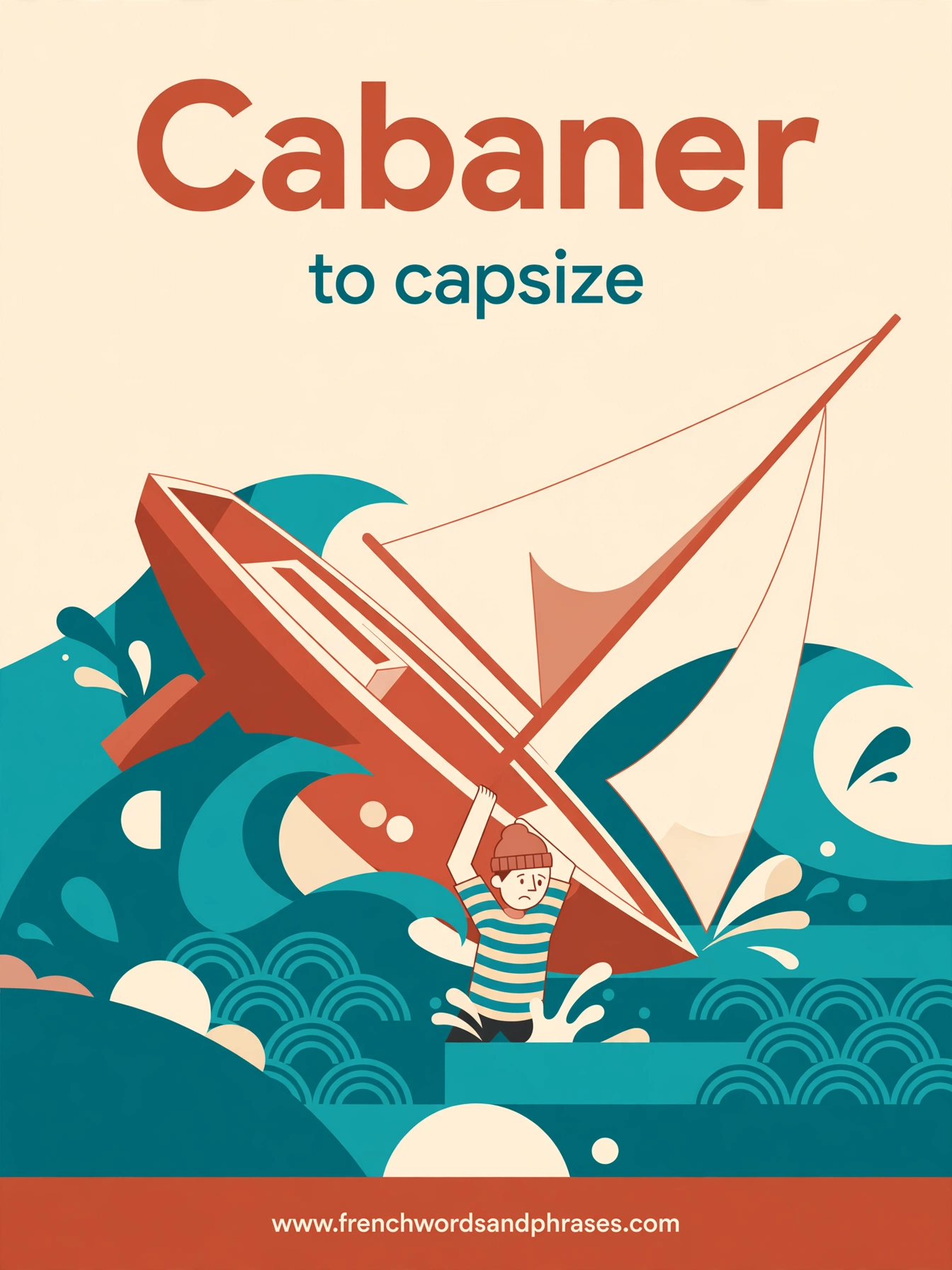
Cabaner means to capsize — said of a boat that tips over onto its side or turns right over in the water.
A small sailing boat caught by a sudden gust, a canoe rolling over in the rapids — cabaner is a nautical verb for the moment a boat gives up its balance and turns over.
In this guide, you’ll learn how to conjugate cabaner in all the major French tenses and moods. Explore complete conjugation tables, French examples, English translations, and practice quizzes.
Understanding the French Verb Cabaner
Cabaner is a regular French verb belonging to the first group of verbs, those ending in-er.
It means to capsize (boat). It is used of small boats — dinghies, canoes, little sailing boats — that roll over in a gust, a wave or a clumsy manoeuvre. Large ships chavirent or sombrent; cabaner belongs to the world of small craft, beaches and harbours, whether the capsize is an accident or a deliberate beaching for repairs.
Verb classification: First group (-er)
Auxiliary verb: Avoir
Past participle: cabané
Present participle: cabanant
English equivalents: To capsize, to turn over (of a boat); le bateau cabane — the boat is capsizing; faire cabaner un canot — to capsize a dinghy; le voilier a cabané dans la rafale — the sailing boat capsized in the gust; cabaner sur la plage — to haul a boat over on the beach (to clean its hull).
One important detail: cabaner is a sailor’s word, cousin of la cabane, the hut — picture the boat tipping over like a little hut blown onto its side. It is perfectly regular: le bateau cabane, nous cabanons, ils cabanent, past participle cabané. On shore it has a second, calmer use: fishermen cabanent a boat on purpose, hauling it over on the beach to scrape and repair the hull.
Experience the Word
Cabaner is the verb of the lost balance — one gust too many, and the little boat lies on its side.
Imagine two boys in a sailing dinghy on a bright, windy lake. The gust arrives without warning, the sail slams flat — et le bateau cabane, slowly, almost gently, tipping them both into the cold water with a splash and a shout of laughter.
Nobody is hurt and nothing is broken. The boat has simply capsized — cabané — and the afternoon becomes a story.
How to Conjugate Cabaner: Complete French Conjugation Guide
Let’s explore every major conjugation of cabaner, beginning with the indicative mood.
How to Conjugate Cabaner in the Indicative Mood
The indicative mood is used to express facts, observations, actions, and events.
How to Conjugate Cabaner in the Present Tense (Présent)
Used for actions happening now, habitual actions, and general truths.
| Subject | Conjugation |
|---|---|
| je | cabane |
| tu | cabanes |
| il / elle | cabane |
| nous | cabanons |
| vous | cabanez |
| ils / elles | cabanent |
Example
Le petit voilier cabane dès que le vent se lève.
The little sailing boat capsizes as soon as the wind picks up.
Quick Quiz 1
Complete the sentence:
Sur ce lac, les canots ______ au moindre coup de vent.
Reveal the answer
cabanent
Sur ce lac, les canots cabanent au moindre coup de vent.
On this lake, the dinghies capsize at the slightest gust of wind.
How to Conjugate Cabaner in the Passé Composé
Used for completed actions in the past. Cabaner takes the auxiliary verb avoir.
| Subject | Conjugation |
|---|---|
| j’ | ai cabané |
| tu | as cabané |
| il / elle | a cabané |
| nous | avons cabané |
| vous | avez cabané |
| ils / elles | ont cabané |
Example
Le canot a cabané dans la dernière rafale.
The dinghy capsized in the last gust.
How to Conjugate Cabaner in the Imparfait (Imperfect Tense)
Used for habitual past actions, descriptions, and ongoing situations in the past.
| Subject | Conjugation |
|---|---|
| je | cabanais |
| tu | cabanais |
| il / elle | cabanait |
| nous | cabanions |
| vous | cabaniez |
| ils / elles | cabanaient |
Example
Autrefois, ces bateaux cabanaient au moindre coup de vent.
In the old days, these boats used to capsize at the slightest gust of wind.
Quick Quiz 2
Choose the correct form:
The boat capsized near the rocks.
Le bateau ______ près des rochers. (a cabané / est cabané)
Reveal the answer
a cabané
Le bateau a cabané près des rochers.
Cabaner takes avoir.
How to Conjugate Cabaner in the Plus-que-parfait
Used to describe an action that had already been completed before another past event.
| Subject | Conjugation |
|---|---|
| j’ | avais cabané |
| tu | avais cabané |
| il / elle | avait cabané |
| nous | avions cabané |
| vous | aviez cabané |
| ils / elles | avaient cabané |
Example
La barque avait cabané avant même l’arrivée de l’orage.
The boat had capsized even before the storm arrived.
How to Conjugate Cabaner in the Passé Simple
Primarily used in formal writing, literature, and historical narratives. It is rarely used in everyday conversation.
| Subject | Conjugation |
|---|---|
| je | cabanai |
| tu | cabanas |
| il / elle | cabana |
| nous | cabanâmes |
| vous | cabanâtes |
| ils / elles | cabanèrent |
Example
Le voilier cabana dans une rafale et les marins nagèrent jusqu’à la rive.
The sailing boat capsized in a gust and the sailors swam to the shore.
How to Conjugate Cabaner in the Passé Antérieur
A literary tense used to express an action completed immediately before another past action, generally in the passé simple.
| Subject | Conjugation |
|---|---|
| j’ | eus cabané |
| tu | eus cabané |
| il / elle | eut cabané |
| nous | eûmes cabané |
| vous | eûtes cabané |
| ils / elles | eurent cabané |
Example
Quand le bateau eut cabané, les pêcheurs le remirent à flot.
When the boat had capsized, the fishermen set it afloat again.
How to Conjugate Cabaner in the Future Tense (Futur Simple)
Used to describe actions that will take place in the future.
| Subject | Conjugation |
|---|---|
| je | cabanerai |
| tu | cabaneras |
| il / elle | cabanera |
| nous | cabanerons |
| vous | cabanerez |
| ils / elles | cabaneront |
Example
Si le vent forcit, le canot cabanera près des rochers.
If the wind strengthens, the dinghy will capsize near the rocks.
How to Conjugate Cabaner in the Futur Antérieur (Future Perfect)
Used for an action that will have been completed before a particular point in the future.
| Subject | Conjugation |
|---|---|
| j’ | aurai cabané |
| tu | auras cabané |
| il / elle | aura cabané |
| nous | aurons cabané |
| vous | aurez cabané |
| ils / elles | auront cabané |
Example
À la marée basse, ils auront cabané la barque pour la réparer.
At low tide, they will have hauled the boat over to repair it.
How to Conjugate Cabaner in the Near Future (Futur Proche)
Used to describe something that is going to happen soon. Formed with aller + infinitive.
| Subject | Conjugation |
|---|---|
| je | vais cabaner |
| tu | vas cabaner |
| il / elle | va cabaner |
| nous | allons cabaner |
| vous | allez cabaner |
| ils / elles | vont cabaner |
Example
Attention, le bateau va cabaner !
Careful, the boat is going to capsize!
How to Conjugate Cabaner in the Conditional Mood
The conditional mood expresses what would happen under certain circumstances. It is also frequently used to make polite requests or express wishes.
How to Conjugate Cabaner in the Present Conditional
| Subject | Conjugation |
|---|---|
| je | cabanerais |
| tu | cabanerais |
| il / elle | cabanerait |
| nous | cabanerions |
| vous | cabaneriez |
| ils / elles | cabaneraient |
Example
Avec un lest plus lourd, le voilier cabanerait moins vite.
With heavier ballast, the sailing boat would capsize less quickly.
How to Conjugate Cabaner in the Past Conditional
| Subject | Conjugation |
|---|---|
| j’ | aurais cabané |
| tu | aurais cabané |
| il / elle | aurait cabané |
| nous | aurions cabané |
| vous | auriez cabané |
| ils / elles | auraient cabané |
Example
Le canot aurait cabané sans l’expérience du vieux marin.
The dinghy would have capsized without the old sailor’s experience.
Cabaner in the Literary Past Conditional Form
This less common literary form uses the imperfect subjunctive of avoir.
| Subject | Conjugation |
|---|---|
| j’ | eusse cabané |
| tu | eusses cabané |
| il / elle | eût cabané |
| nous | eussions cabané |
| vous | eussiez cabané |
| ils / elles | eussent cabané |
Example
Le bateau eût cabané dans la tempête sans son lest.
The boat would have capsized in the storm without its ballast.
How to Conjugate Cabaner in the Subjunctive Mood
The subjunctive is used to express wishes, emotions, doubts, necessity, and uncertainty. It frequently follows expressions such as il faut que (it is necessary that) or bien que (although).
How to Conjugate Cabaner in the Present Subjunctive
| Subject | Conjugation |
|---|---|
| que je | cabane |
| que tu | cabanes |
| qu’il / qu’elle | cabane |
| que nous | cabanions |
| que vous | cabaniez |
| qu’ils / qu’elles | cabanent |
Example
Il faut éviter que le voilier cabane dans le port.
We must stop the sailing boat capsizing in the harbour.
Quick Quiz 3
Complete the sentence using the subjunctive:
Je craignais que la barque ______ sous les vagues.
Reveal the answer
cabanât
Je craignais que la barque cabanât sous les vagues.
I feared the boat might capsize under the waves.
How to Conjugate Cabaner in the Imperfect Subjunctive
A literary tense, rarely encountered in modern spoken French.
| Subject | Conjugation |
|---|---|
| que je | cabanasse |
| que tu | cabanasses |
| qu’il / qu’elle | cabanât |
| que nous | cabanassions |
| que vous | cabanassiez |
| qu’ils / qu’elles | cabanassent |
Example
Je craignais que la barque cabanât sous les vagues.
I feared the boat might capsize under the waves.
How to Conjugate Cabaner in the Pluperfect Subjunctive
A literary construction used to express an action completed before another past action.
| Subject | Conjugation |
|---|---|
| que j’ | eusse cabané |
| que tu | eusses cabané |
| qu’il / qu’elle | eût cabané |
| que nous | eussions cabané |
| que vous | eussiez cabané |
| qu’ils / qu’elles | eussent cabané |
Example
On racontait que le canot eût cabané deux fois dans la journée.
People said the dinghy had capsized twice in the day.
How to Conjugate Cabaner in the Past Subjunctive
| Subject | Conjugation |
|---|---|
| que j’ | aie cabané |
| que tu | aies cabané |
| qu’il / qu’elle | ait cabané |
| que nous | ayons cabané |
| que vous | ayez cabané |
| qu’ils / qu’elles | aient cabané |
Example
Je suis étonné que le bateau ait cabané par un si beau temps.
I am amazed the boat capsized in such fine weather.
How to Conjugate Cabaner in the Imperative
The imperative is used to give commands, instructions, invitations, or suggestions. Subject pronouns are omitted.
How to Conjugate Cabaner in the Present Imperative
| Person | Conjugation |
|---|---|
| (tu) | cabane |
| (nous) | cabanons |
| (vous) | cabanez |
Example
Ne cabanez pas le canot en montant tous du même côté !
Do not capsize the dinghy by all climbing in on the same side!
Quick Quiz 4
How would you say Do not capsize the dinghy (vous form)?
Reveal the answer
Ne cabanez pas le canot !
French Participles of Cabaner
Participles are verb forms that can be used in compound tenses and other grammatical constructions.
Present Participle of Cabaner
cabanant
En cabanant, le voilier a perdu son mât.
In capsizing, the sailing boat lost its mast.
Past Participle of Cabaner
cabané
Cabané sur la plage, le bateau attendait sa réparation.
Hauled over on the beach, the boat was waiting for its repair.
Cabaner in Everyday French: Real-Life Examples
Now that you know the conjugations, let’s see how cabaner appears in everyday French.
Example 1 — Present
Le voilier cabane dans les rafales.
The sailing boat capsizes in the gusts.
Example 2 — Passé composé
Le canot a cabané près du bord.
The dinghy capsized near the shore.
Example 3 — Imparfait
Ces bateaux cabanaient facilement autrefois.
These boats used to capsize easily in the old days.
Example 4 — Future
Le bateau cabanera si le vent forcit.
The boat will capsize if the wind strengthens.
Example 5 — Conditional
Le voilier cabanerait moins avec un lest plus lourd.
The sailing boat would capsize less with heavier ballast.
Example 6 — Imperative
Ne cabanez pas le canot !
Do not capsize the dinghy!
Beyond Translation: The Meaning of Cabaner
English capsize covers every boat; French cabaner is the small-boat word, smelling of beaches and harbours — big ships in French chavirent, little boats cabanent.
And on the beach, the accident becomes a technique.
To cabaner a fishing boat deliberately at low tide — hull up, ready for scraping and tar — is part of the working life of small ports, where the same verb names both the mishap and the repair.
How to Remember the French Verb Cabaner
Remember it this way: Cabaner is about the little boat tipping over in the gust like a hut in the wind.
- A sailor’s verb for small boats: le bateau cabane — it tips over onto its side.
- Deliberate on the beach: cabaner une barque, to haul it over for repairs.
- Regular -er: je cabane, nous cabanons, past participle cabané.
The key idea is the little boat tipping over in the gust like a hut in the wind.
Test Your Knowledge of Cabaner
Let’s see how much you’ve learned. Try answering these questions before revealing the answers.
Question 1
What size of boat does cabaner usually describe?
Reveal the answer
Small craft — dinghies, canoes and little sailing boats; large ships chavirent.
Question 2
How do you say The dinghy capsized in the last gust in French?
Reveal the answer
Le canot a cabané dans la dernière rafale.
Question 3
Translate: Careful, the boat is going to capsize!
Reveal the answer
Attention, le bateau va cabaner !
Question 4
What is the past participle of cabaner?
Reveal the answer
Cabané.
Question 5
Complete the sentence:
Il faut éviter que le voilier ______ dans le port.
Reveal the answer
cabane
Il faut éviter que le voilier cabane dans le port.
We must stop the sailing boat capsizing in the harbour.
Your Final Challenge
Can You Use It?
How would you say this in French?
The little sailing boat capsized in a gust, and the two boys swam back laughing.
Reveal the answer
Le petit voilier a cabané dans une rafale, et les deux garçons sont revenus à la nage en riant.
The little sailing boat capsized in a gust, and the two boys swam back laughing.
A little French. A little curiosity. A richer everyday life.
LEARN FRENCH ONE WORD AT A TIME