
A French Word to Live By
Translate Ça y est to English
/sa jɛ/
Ça y est means that’s it / done!.
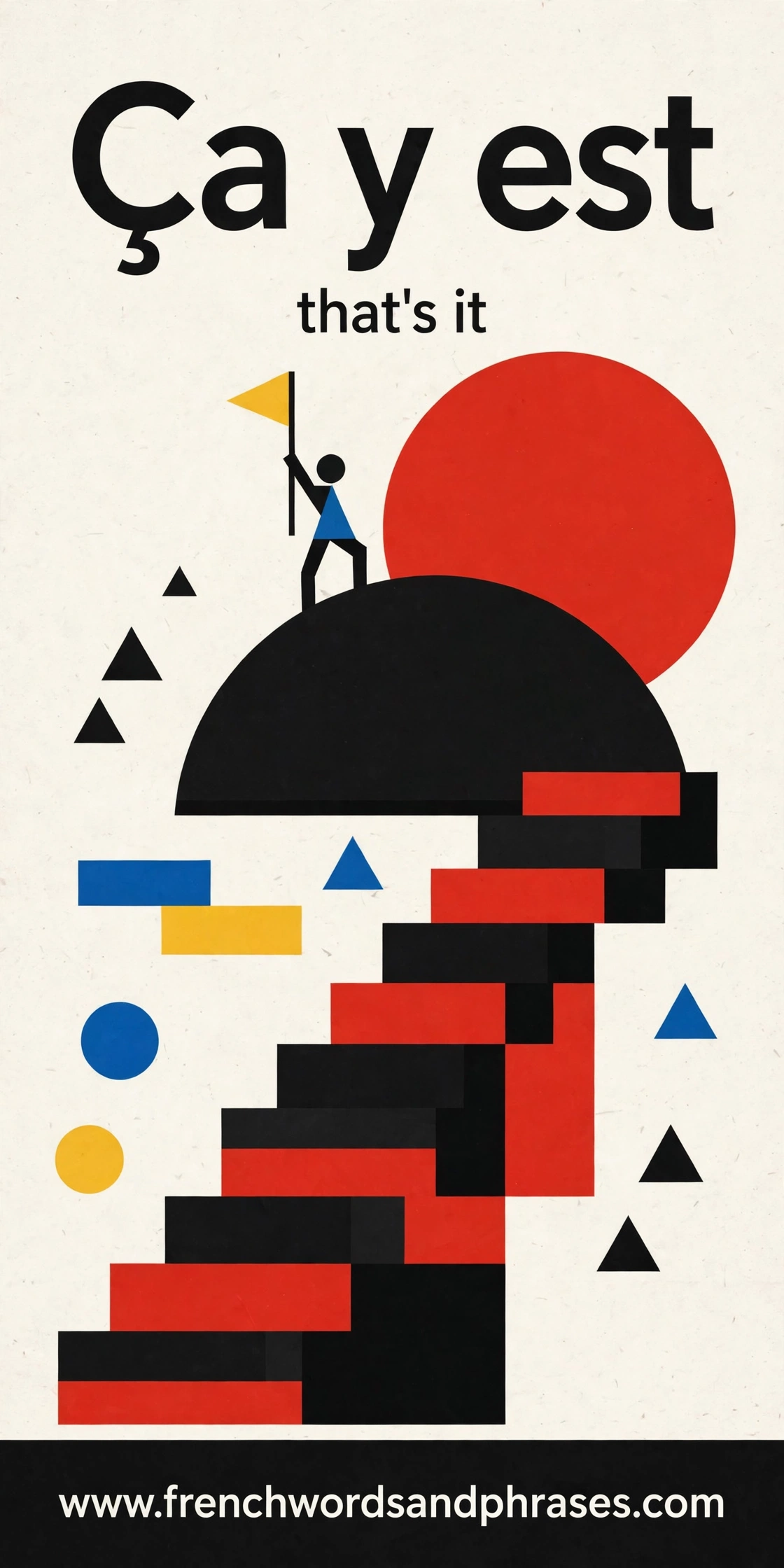
A father and his daughter have spent the whole afternoon on a flat-pack bookshelf — forty screws, three arguments, one mysterious leftover panel. She slides the last book into place, steps back and grins: « Ça y est ! Elle est finie ! » That’s it! It is finished! Ça y est is the little flag the French plant on the summit of any finished job, large or small.
Let’s explore how ça y est works in French, beginning with the whole reaction on one card.
Understanding the French Interjection Ça y est
Ça y est is a fixed phrase — ça (that) + y (there) + est (is) — that works as an interjection of completion and arrival. It announces that something long-awaited is finally done, ready, or here. The y points at no real place; the phrase is a single unbreakable block.
It means that’s it — done, ready, or finally here. The thing you were waiting for, building, cooking or travelling towards has arrived at its finish line, and ça y est plants the flag. It can crown an hour of work or the end of a nine-month wait with the same three words.
Type: Interjection — completion (fixed phrase: ça + y + est)
Answers the need: Announcing that something is finally done, ready or arrived
Register: Neutral and joyful — safe everywhere, from nurseries to boardrooms
Strength: Bright and triumphant — scales with the size of the job
One important usage detail: ça y est very often introduces the proof, in the past tense — « Ça y est, j’ai fini ! » (That’s it, I have finished!). The interjection makes the announcement; the clause that follows shows the finished thing.
Experience the Word
Ça y est is the pop of the cork — the moment effort turns into result.
Imagine the train finally rolling into the little station after a long delay, and the whole platform murmuring « ça y est » as bags are lifted and children wave.
You have not described the work at all. You have declared the waiting over.
How to Use Ça y est in French: Complete Guide
Let’s explore how ça y est works in French, beginning with the whole reaction on one card.
Ça y est at a Glance
The Whole Reaction on One Card
Meaning, job, register and strength — ça y est in four lines.
| Point | Ça y est |
|---|---|
| Meaning | that’s it — done, ready, finally here |
| Job | announces the completion or arrival of something awaited |
| Register | neutral and joyful — fits any age and any setting |
| Strength | bright and triumphant; add enfin for long waits |
Example
Ça y est, le dîner est prêt !
That’s it, dinner is ready!
When You Say It: The Trigger Moments
Ça y est fires at finish lines — the moment the waiting stops.
| Situation | Example |
|---|---|
| A task is finished | ça y est, j’ai fini mes devoirs — that’s it, I have finished my homework |
| Something arrives at last | ça y est, le train arrive — that’s it, the train is coming |
| A long project ends | ça y est, la maison est vendue — that’s it, the house is sold |
| You finally understand | ça y est, je comprends ! — that’s it, I understand! |
| A baby, a result, a letter | ça y est, les résultats sont là — that’s it, the results are here |
Example
Ça y est, on est arrivés !
That’s it, we have arrived!
Quick Quiz 1
What moment does ça y est announce?
Reveal the answer
The finish line — something awaited is done, ready or finally here.
Ça y est, tout est prêt.
That’s it, everything is ready.
The Reaction Question: The Triumphant Landing
Ça y est rises with the effort and lands with the result — a small musical arc of relief.
| Delivery | What it does |
|---|---|
| Rising then falling tone + ! | triumph — the classic finish-line cry |
| With a long sigh | relief after a hard or tedious job |
| With enfin added: ça y est, enfin ! | the wait was long — at last! |
| Softer version: voilà, c’est fait | quieter satisfaction, same completion |
| Flat, ironic tone | here we go again — something unwelcome has started (see Watch Out) |
Example
Ça y est, enfin, les vacances commencent !
That’s it, at last, the holidays are starting!
Where It Goes: The Announcement and Its Proof
Ça y est stands first like a headline; the finished thing follows as the story.
| Position / pattern | Example |
|---|---|
| Standalone | ça y est ! — the announcement needs nothing else |
| + past-tense proof | ça y est, j’ai envoyé le message — that’s it, I have sent the message |
| + arrival clause | ça y est, elle est née ! — that’s it, she is born! |
| Paired with enfin | ça y est, enfin, on peut partir — that’s it, at last, we can leave |
Example
Ça y est, j’ai réparé le vélo.
That’s it, I have fixed the bike.
Quick Quiz 2
What tense usually follows ça y est in the proof clause?
Reveal the answer
The past tense — the proof is a finished action.
Ça y est, j’ai terminé.
That’s it, I have finished.
Everyday Expressions with Ça y est
Ça y est headlines these everyday announcements of completion and arrival.
| Expression | In English |
|---|---|
| ça y est, c’est fini | that’s it, it is over |
| ça y est, on y est | that’s it, we are here (arrival) |
| ça y est, ça marche | that’s it, it works |
| ça y est, c’est parti | that’s it, off we go (something starts) |
| ça y est, je te tiens | got you! (catching someone or something) |
Example
Ça y est, ça marche, l’ordinateur répond !
That’s it, it works, the computer is responding!
Close Cousins: The Finish-Line Family
French finishes things in several ways — ça y est is the announcer.
| Word | The difference |
|---|---|
| ça y est | that’s it — announces completion or arrival |
| voilà | there you go — presents the finished thing |
| c’est fait | it is done — plain statement, less fanfare |
| enfin | finally, at last — stresses the long wait |
| terminé | finished — flat and final, sometimes cold |
Example
Voilà, c’est fait, tu peux partir.
There you go, it is done, you can leave.
Quick Quiz 3
Which cousin simply states “it is done” with the least fanfare — ça y est or c’est fait?
Reveal the answer
c’est fait — a plain statement; ça y est is the celebration.
C’est fait, passons à autre chose.
It is done, let’s move on to something else.
Ça y est and Its Neighbours
The reaction shelf around ça y est, from starting cries to finish lines.
| French | In English |
|---|---|
| allez ! | come on! (get started) |
| super ! | awesome! (delight) |
| ça y est ! | that’s it! (finished, arrived) |
| enfin ! | finally! (the wait ends) |
| pas encore | not yet (still waiting) |
Example
Allez, encore un effort… ça y est !
Come on, one more effort… that’s it!
Watch Out: The Traps Around Ça y est
The traps: the ironic twin, the spelling, and the untranslatable y.
| Trap | The truth |
|---|---|
| missing the ironic use | flatly said, ça y est can mean ‘here we go again’: ça y est, il pleut — oh great, it’s raining |
| writing sa y est | it is ça with a cedilla — sa means ‘his/her’ and makes no sense here |
| translating the y | the y is a fossil — do not hunt for the place it points to |
| using it before you start | ça y est announces the end of waiting; for starting, use c’est parti or allez |
Example
Ça y est, il est encore en retard.
Here we go again, he is late again.
Quick Quiz 4
True or false: said flatly, ça y est can mean “here we go again”.
Reveal the answer
True — the ironic twin announces something unwelcome starting.
Ça y est, le bébé pleure encore.
Here we go again, the baby is crying again.
Ça y est in Everyday French: Real-Life Examples
Now that you know the word, let’s see how ça y est appears in everyday French.
Example Example 1 — Homework
Ça y est, j’ai fini tous mes exercices.
That’s it, I have finished all my exercises.
Example Example 2 — Travel
Ça y est, l’avion décolle !
That’s it, the plane is taking off!
Example Example 3 — Cooking
Ça y est, le gâteau est cuit.
That’s it, the cake is baked.
Example Example 4 — Good news
Ça y est, ils ont trouvé un appartement !
That’s it, they have found a flat!
Example Example 5 — Understanding
Ça y est, je vois comment ça marche.
That’s it, I see how it works.
Example Example 6 — Ironic
Ça y est, le voisin met encore sa musique.
Here we go again, the neighbour is playing his music again.
Beyond Translation: The Meaning of Ça y est
Most languages state that a thing is finished. French ça y est does something warmer: it turns the finish into a small ceremony, a flag planted and a breath let out.
To say ça y est is to declare the waiting officially over.
And its ironic twin — the flat ça y est of here-we-go-again — shows the same phrase from the other side: sometimes what has ‘arrived’ is exactly what you were dreading.
How to Remember the French Interjection Ça y est
Remember it this way: Remember it this way: Ça y est is the flag on the summit — the waiting is over.
- You say it at finish lines — done, ready, arrived.
- You add the proof in the past tense — ça y est, j’ai fini.
- You watch the tone — flat means here we go again.
The key idea is ça y est means that’s it and done, it announces completion, and flatly said it turns ironic.
Test Your Knowledge of Ça y est
Let’s see how much you’ve learned. Try answering these questions before revealing the answers.
Question 1
What does ça y est mean?
Reveal the answer
That’s it — done, ready, finally here. It announces the end of waiting.
Question 2
What usually follows ça y est?
Reveal the answer
A proof clause in the past tense — ça y est, j’ai fini (that’s it, I have finished).
Question 3
Translate: That’s it, we have arrived!
Reveal the answer
Ça y est, on est arrivés !
Question 4
How can ça y est be used ironically?
Reveal the answer
Said flatly, it means here we go again — announcing something unwelcome: ça y est, il pleut.
Question 5
Complete the sentence:
______ , le repas est prêt ! (That’s it, the meal is ready!)
Reveal the answer
Ça y est
Ça y est, le repas est prêt !
That’s it, the meal is ready!
Your Final Challenge
Can You Use It?
How would you say this in French?
“How would you say this in French?”
Reveal the answer
Ça y est, tout est prêt pour la fête.
That’s it, everything is ready for the party.
A little French. A little curiosity. A richer everyday life.
LEARN FRENCH ONE WORD AT A TIME




