A French Word to Live By
Translate Brun to English
/bʁœ̃/
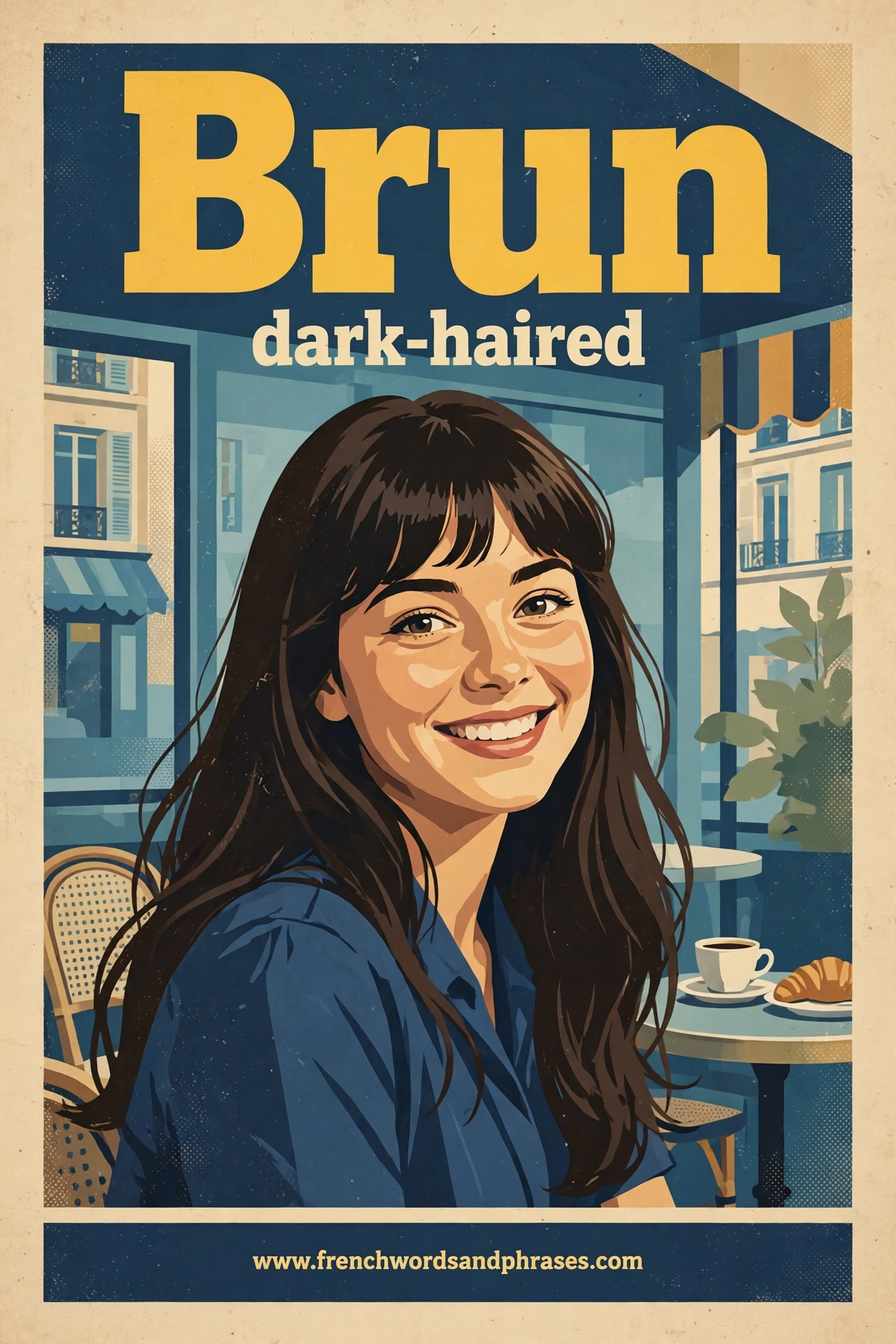
Brun means dark-haired.
High in the Pyrenees, a ranger points her binoculars at a slope of pine trees, where something large and chocolate-dark is ambling between the trunks. It is the animal French schoolchildren meet in their very first nature books — un ours brun, the brown bear.
In this guide, you’ll learn what brun means in English, why its feminine changes its sound completely, where it stands in the sentence, and the one place French refuses to use it — eyes, which prefer marron. Explore French examples, English translations, and practice quizzes.
Understanding the French Adjective Brun
Brun is a French adjective of quality — the adjective of dark brown. It agrees with the noun it describes: brun, brune, bruns, brunes. It describes hair above all, but also bears, beer and autumn evenings.
For people, it means dark-haired, brown-haired: un homme brun, a dark-haired man; une femme brune, a dark-haired woman. For things and animals, it means brown: un ours brun, a brown bear; une bière brune, a dark beer. It is the deep, warm end of the colour shelf.
Type: Adjective of quality — dark brown, dark hair
Answers the question: What is it like? — dark-haired, brown
Changes form: Yes — brun, brune, bruns, brunes
English equivalents: Dark-haired; brown.
One important usage detail: brun stands AFTER the noun — des cheveux bruns. But for eyes, everyday French switches word entirely: les yeux marron, with marron invariable. Hair is brun; eyes are marron.
Experience the Word
Brun is the adjective of the forest at dusk — of bears and pine bark, of hair the colour of chestnuts straight from the fire.
Imagine a portrait painter choosing between two tubes of paint for a sitter’s hair. One is the flat brown of a cardboard box. The other is deep, warm, almost black at the edges — that is brun, a brown with a life inside it.
You have not just named a colour. You have described darkness with warmth in it.
How to Use Brun in French: Complete Guide
Let’s explore how brun works in French, beginning with the whole word on one card.
Brun at a Glance
Before the details, here is the whole word on one card.
The Whole Word on One Card
Meaning, type, position and forms — brun in four lines.
| Point | Brun |
|---|---|
| Meaning | dark-haired |
| Type | adjective of quality — dark brown |
| Usual position | after the noun — des cheveux bruns |
| Form | brun / brune / bruns / brunes |
Example
C’est un ours brun énorme.
It’s an enormous brown bear.
The Four Forms of Brun
Brun agrees with the noun it describes. Watch the feminine: brune keeps one n, adds an e, and changes its vowel sound completely.
| Form | Brun | Example |
|---|---|---|
| Masculine singular | brun | un homme brun — a dark-haired man |
| Feminine singular | brune | une femme brune — a dark-haired woman |
| Masculine plural | bruns | des cheveux bruns — dark hair |
| Feminine plural | brunes | des bières brunes — dark beers |
Example
Il est brun et sa sœur est brune aussi.
He is dark-haired and his sister is dark-haired too.
Quick Quiz 1
Which form of brun goes with femme (feminine)?
Reveal the answer
brune
Une femme brune.
A dark-haired woman.
Brune: The Feminine with a New Sound
The feminine of brun adds an e — but your ear hears far more than your eye sees. The nasal vowel of brun opens into the clear /y/ of brune: same letters at the start, a different music at the end.
| Situation | Example |
|---|---|
| The rule | just add -e — brun → brune |
| The sound | brun is /bʁœ̃/, but brune is /bʁyn/ — the vowel changes completely |
| Masculine plural | bruns — des ours bruns |
| Feminine plural | brunes — des femmes brunes |
Example
Une femme brune chante près de la fenêtre.
A dark-haired woman is singing near the window.
Where Brun Goes: After the Noun
Brun follows the noun, like the other colour and hair adjectives, and it lives inside the classic hair formula: avoir les cheveux bruns.
| Pattern | Example |
|---|---|
| After the noun | un ours brun — a brown bear |
| The hair formula | il a les cheveux bruns — he has dark hair |
| After être | elle est brune — she is dark-haired |
| Before the noun | un brun ours — not in everyday French |
Example
Le petit garçon a les cheveux bruns et les yeux marron.
The little boy has dark hair and brown eyes.
Quick Quiz 2
How do you say ‘he has dark hair’?
Reveal the answer
Il a les cheveux bruns
Cheveux is masculine plural, so brun takes an s.
He has dark hair.
Darker Still: Comparing with Brun
Brun compares the regular way, with plus, moins and aussi — and the superlative keeps the agreement: le plus brun, la plus brune.
| Degree | Example |
|---|---|
| As dark as | aussi brun que — as dark as |
| Darker | plus brun — darker, more dark-haired |
| Less dark | moins brun — less dark |
| The darkest (masc.) | le plus brun — le plus brun des frères |
| The darkest (fem.) | la plus brune — la plus brune des sœurs |
Example
Son frère est plus brun que lui.
His brother is darker-haired than he is.
Everyday Expressions with Brun
Brun walks from the mountain forest to the café table: it names the great bear of the Pyrenees, pours a dark beer, and even marks the fall of evening in old-fashioned French.
| Expression | In English |
|---|---|
| un ours brun | a brown bear |
| des cheveux bruns | dark hair, brown hair |
| une bière brune | a dark beer, a stout |
| un brun, une brune | a dark-haired man, a dark-haired woman — the word as a noun |
| à la brune | at dusk, at nightfall (literary) |
| un teint brun | a dark, tanned complexion |
Example
L’ours brun vit dans les montagnes des Pyrénées.
The brown bear lives in the Pyrenees mountains.
Quick Quiz 3
What animal is un ours brun?
Reveal the answer
A brown bear
L’ours brun cherche des baies dans la forêt.
The brown bear is looking for berries in the forest.
Brun and Its Neighbours
Brun stands at the dark end of the hair-colour shelf; its neighbours divide the browns between them, and marron takes over for most objects.
| French | In English |
|---|---|
| marron | brown — for objects and eyes; never changes form |
| châtain | chestnut-brown — lighter than brun, for hair |
| noir | black — darker still |
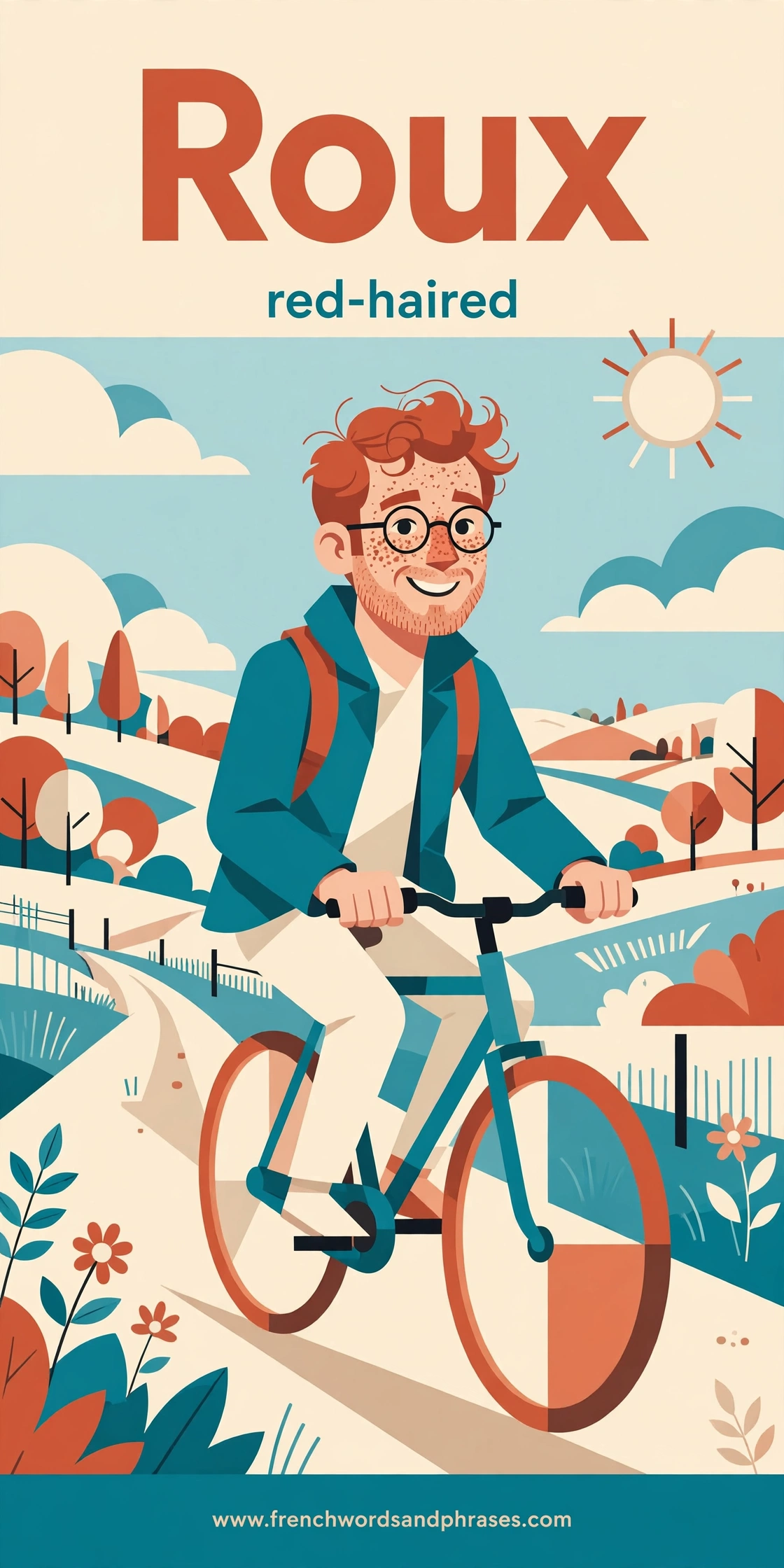
| roux | red-haired — the warm neighbour |
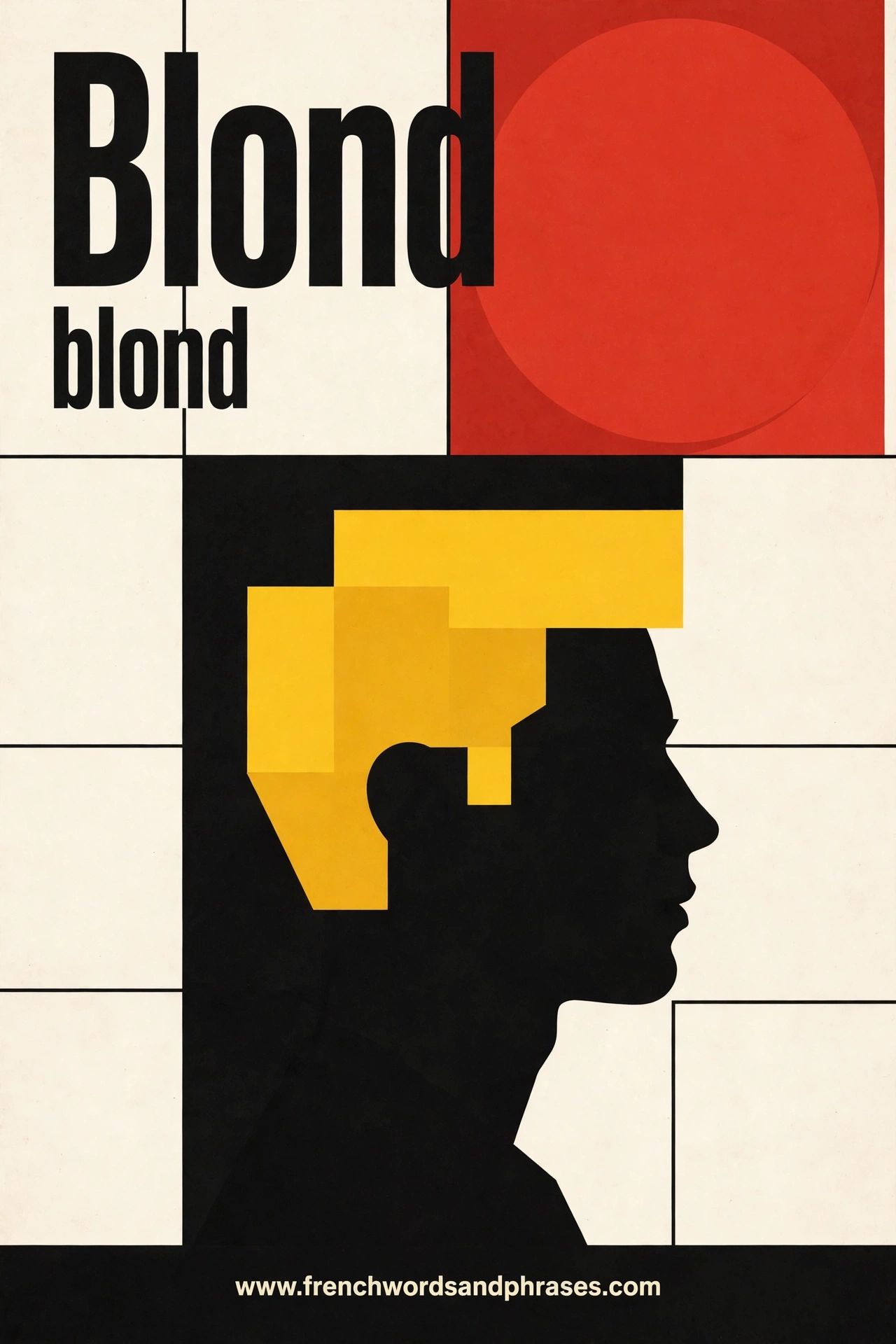
| blond | blond — the opposite end of the shelf |
Example
Elle a les cheveux châtain foncé, presque bruns.
She has dark chestnut hair, almost brown.
Watch Out: The Traps Around Brun
The traps here are famous: eyes that refuse the word, a vowel that changes its tune, and a bear that must not become a colour of boxes.
| Trap | The truth |
|---|---|
| Eyes | everyday French says les yeux marron — brun is for hair, marron for eyes |
| Objects | a brown bag is un sac marron, not ‘brun’ — brun belongs to hair, animals and beer |
| The sound | brun /bʁœ̃/ and brune /bʁyn/ do not rhyme — the feminine changes the vowel |
| Agreement | cheveux is masculine plural — les cheveux bruns, even for a woman |
Example
Elle a les cheveux bruns et les yeux marron.
She has dark hair and brown eyes.
Quick Quiz 4
How do you say ‘brown eyes’ — les yeux bruns or les yeux marron?
Reveal the answer
les yeux marron
Marron never changes form.
Brown eyes.
Brun in Everyday French: Real-Life Examples
Now that you know the word, let’s see how brun appears in everyday French.
Example 1 — In the mountains
L’ours brun cherche des baies près de la rivière.
The brown bear is looking for berries near the river.
Example 2 — Describing family
Mon père est brun, comme son père avant lui.
My father is dark-haired, like his father before him.
Example 3 — At the café
Je préfère la bière brune, elle a plus de goût.
I prefer dark beer, it has more flavour.
Example 4 — Portraits
La femme brune sur la photo est ma grand-mère.
The dark-haired woman in the photo is my grandmother.
Example 5 — Hair
Il a les cheveux bruns et une petite barbe.
He has dark hair and a small beard.
Example 6 — Autumn
À la brune, les chasseurs rentrent au village.
At dusk, the hunters return to the village.
Beyond Translation: The Meaning of Brun
English says brown for almost everything, but French divides the labour with care: brun for the living browns — hair, bears, beer and skin — and marron for the browns of leather, wood and eyes. Brun is the warm brown, the one with blood in it.
To call hair brun in French is to give it the colour of chestnuts and forest earth.
It is a word that prefers people to objects — which is why a French portrait always begins with it, and a French shopping list almost never does.
How to Remember the French Adjective Brun
Remember it this way: Brun is the warm dark adjective — it follows the noun, changes its music for her, and leaves eyes and objects to marron.
- You see the family together — brun, brune, bruns, brunes — with a new vowel in the feminine.
- You give hair its formula — avoir les cheveux bruns, always masculine plural.
- You keep it for living browns — un ours brun, but les yeux marron.
The key idea is brun stands after the noun, its feminine brune changes the vowel sound, and eyes take marron instead.
Test Your Knowledge of Brun
Let’s see how much you’ve learned. Try answering these questions before revealing the answers.
Question 1
What does brun mean?
Reveal the answer
Dark-haired — and brown, for animals and living colours.
Question 2
What are the forms of brun?
Reveal the answer
brun, brune, bruns, brunes — the feminine sounds completely different: /bʁyn/.
Question 3
Translate: a brown bear.
Reveal the answer
Un ours brun.
Question 4
How do you say ‘brown eyes’?
Reveal the answer
Les yeux marron — marron never changes.
Question 5
Complete the sentence:
Ma sœur est ______ .
Reveal the answer
brune
Ma sœur est brune.
My sister is dark-haired.
Your Final Challenge
Can You Use It?
How would you say this in French?
“My sister is dark-haired.”
Reveal the answer
Ma sœur est brune.
My sister is dark-haired.
A little French. A little curiosity. A richer everyday life.
LEARN FRENCH ONE WORD AT A TIME