A French Word to Live By
Translate Blond to English
/blɔ̃/
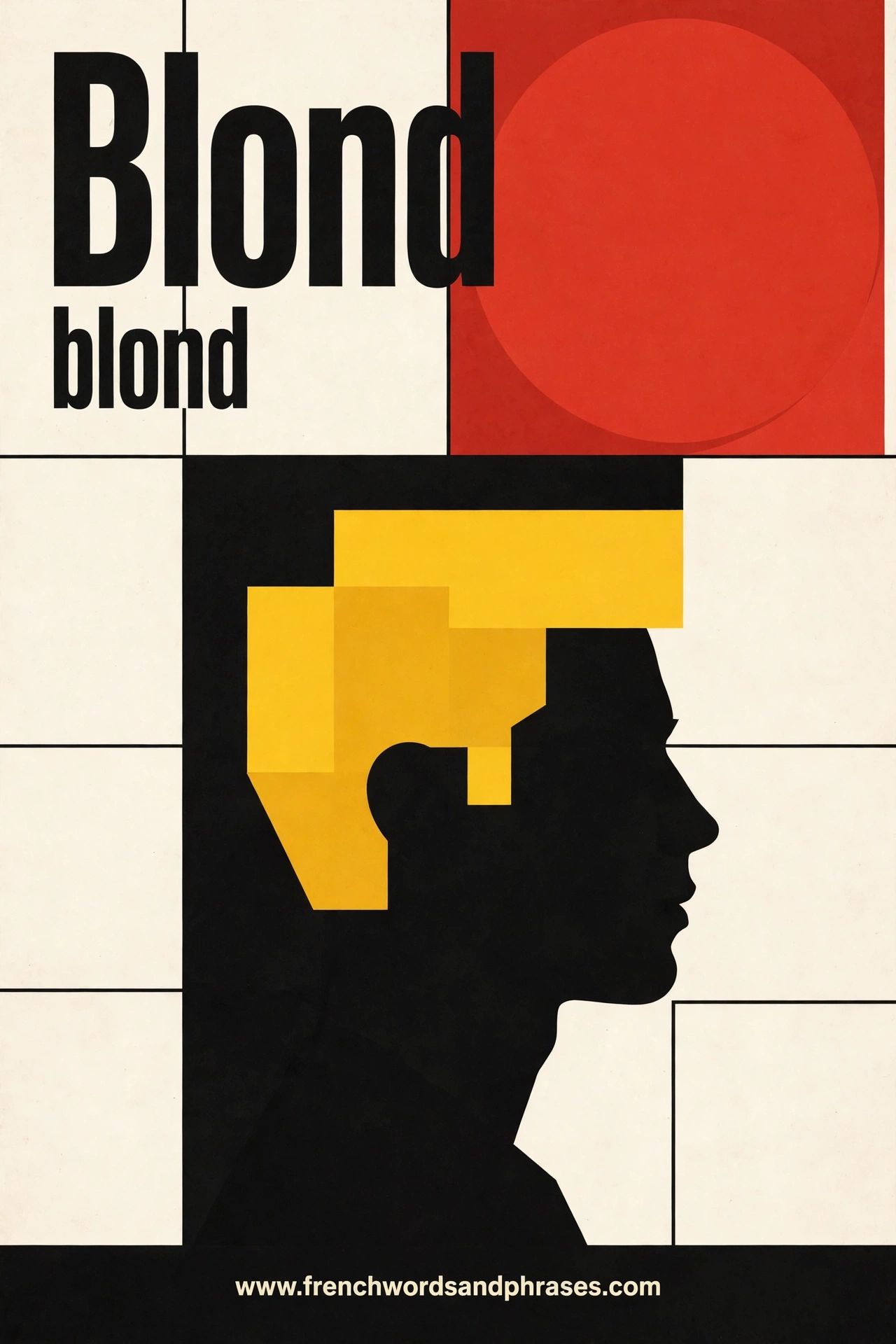
Blond means blond.
In late June, the wheat fields of the Beauce roll to the horizon like a pale gold sea, and a little girl runs through them with her hair exactly the colour of the harvest. Her grandmother, watching from the farmhouse door, uses the word the whole countryside uses: blonde — blonde comme les blés.
In this guide, you’ll learn what blond means in English, how its feminine wakes up the silent d, where it stands in the sentence, and why the same word orders a beer and, in Québec, names a girlfriend. Explore French examples, English translations, and practice quizzes.
Understanding the French Adjective Blond
Blond is a French adjective of quality — the adjective of fair hair. It agrees like any adjective: blond, blonde, blonds, blondes. It also lives a double life as a noun: un blond, une blonde — a blond man, a blond woman.
It means blond — fair, golden hair above all: des cheveux blonds, blond hair; un enfant blond, a blond child. The word also colours a beer (une bière blonde, a pale lager) and pale tobacco. Wherever gold is diluted to its lightest shade, blond is the word.
Type: Adjective of quality — hair colour
Answers the question: What is it like? — blond
Changes form: Yes — blond, blonde, blonds, blondes
English equivalents: Blond, fair-haired.
One important usage detail: blond stands AFTER the noun — des cheveux blonds, une fille blonde. Remember that cheveux is masculine plural, so blond hair on anyone at all is des cheveux blonds.
Experience the Word
Blond is the adjective of the wheat in June — the colour of a whole landscape at its lightest and warmest.
Imagine a painter mixing colours for a portrait of a child in summer. White is too cold, yellow too loud. He is hunting for the exact pale gold that French simply calls blond, the colour of hair the sun has been working on all season.
You have not just named a colour. You have described hair the way summer leaves it.
How to Use Blond in French: Complete Guide
Let’s explore how blond works in French, beginning with the whole word on one card.
Blond at a Glance
Before the details, here is the whole word on one card.
The Whole Word on One Card
Meaning, type, position and forms — blond in four lines.
| Point | Blond |
|---|---|
| Meaning | blond |
| Type | adjective of quality — hair colour |
| Usual position | after the noun — des cheveux blonds |
| Form | blond / blonde / blonds / blondes |
Example
Elle a des cheveux blonds magnifiques.
She has magnificent blond hair.
The Four Forms of Blond
Blond agrees with the noun it describes. Watch the feminine: the silent d of blond wakes up in blonde, and you can hear it at the end of the word.
| Form | Blond | Example |
|---|---|---|
| Masculine singular | blond | un garçon blond — a blond boy |
| Feminine singular | blonde | une fille blonde — a blond girl |
| Masculine plural | blonds | des cheveux blonds — blond hair |
| Feminine plural | blondes | des filles blondes — blond girls |
Example
Le garçon est blond et sa sœur est blonde aussi.
The boy is blond and his sister is blond too.
Quick Quiz 1
Which form of blond goes with cheveux (masculine plural)?
Reveal the answer
blonds
Des cheveux blonds.
Blond hair.
Blonde: The Feminine Where the D Wakes Up
The feminine of blond is formed by adding an e, but the spelling hides a sound: the d, silent in blond, is pronounced in blonde. Your ear hears the difference even when the change looks small.
| Situation | Example |
|---|---|
| The rule | just add -e — blond → blonde |
| The sound | the d is silent in blond, but you hear it in blonde: /blɔ̃d/ |
| Masculine plural | blonds — des garçons blonds |
| Feminine plural | blondes — des femmes blondes |
Example
Une femme blonde monte dans le train.
A blond woman is getting on the train.
Where Blond Goes: After the Noun
Blond follows the noun, like the other colour and hair adjectives, and it is perfectly at home after avoir for the classic French hair formula: avoir les cheveux blonds.
| Pattern | Example |
|---|---|
| After the noun | une actrice blonde — a blond actress |
| The hair formula | elle a les cheveux blonds — she has blond hair |
| After être | il est blond — he is blond |
| Before the noun | un blond garçon — not in everyday French |
Example
Le petit garçon a les cheveux blonds et les yeux bleus.
The little boy has blond hair and blue eyes.
Quick Quiz 2
How do you say ‘she has blond hair’?
Reveal the answer
Elle a les cheveux blonds
Cheveux is masculine plural, so blond takes an s.
She has blond hair.
Blonder Still: Comparing with Blond
Blond compares the regular way, with plus, moins and aussi — and the superlative keeps the agreement: le plus blond, la plus blonde.
| Degree | Example |
|---|---|
| As blond as | aussi blond que — as blond as |
| Blonder | plus blond — blonder, fairer |
| Less blond | moins blond — less blond |
| The blondest (masc.) | le plus blond — le plus blond des frères |
| The blondest (fem.) | la plus blonde — la plus blonde des sœurs |
Example
En été, elle devient plus blonde au soleil.
In summer, she becomes blonder in the sun.
Everyday Expressions with Blond
Blond pours drinks as well as describing hair: it names the pale beer of every French café, and poetry compares it to ripe wheat.
| Expression | In English |
|---|---|
| des cheveux blonds | blond hair |
| blond comme les blés | blond as wheat — a poetic comparison |
| une bière blonde | a pale lager, a blond beer |
| un blond vénitien | strawberry blond (literally, Venetian blond) |
| un blond platine | platinum blond |
| un blond, une blonde | a blond man, a blond woman — the word as a noun |
Example
Au café, il commande une bière blonde bien fraîche.
At the café, he orders a nice cold lager.
Quick Quiz 3
What is une bière blonde?
Reveal the answer
A pale lager
Une bière blonde et un café, s’il vous plaît.
A lager and a coffee, please.
Blond and Its Neighbours
Blond stands at the light end of the hair-colour shelf; its neighbours walk the shades down through chestnut to black.
| French | In English |
|---|---|
| châtain clair | light chestnut — between blond and brown |
| roux | red-haired, ginger |
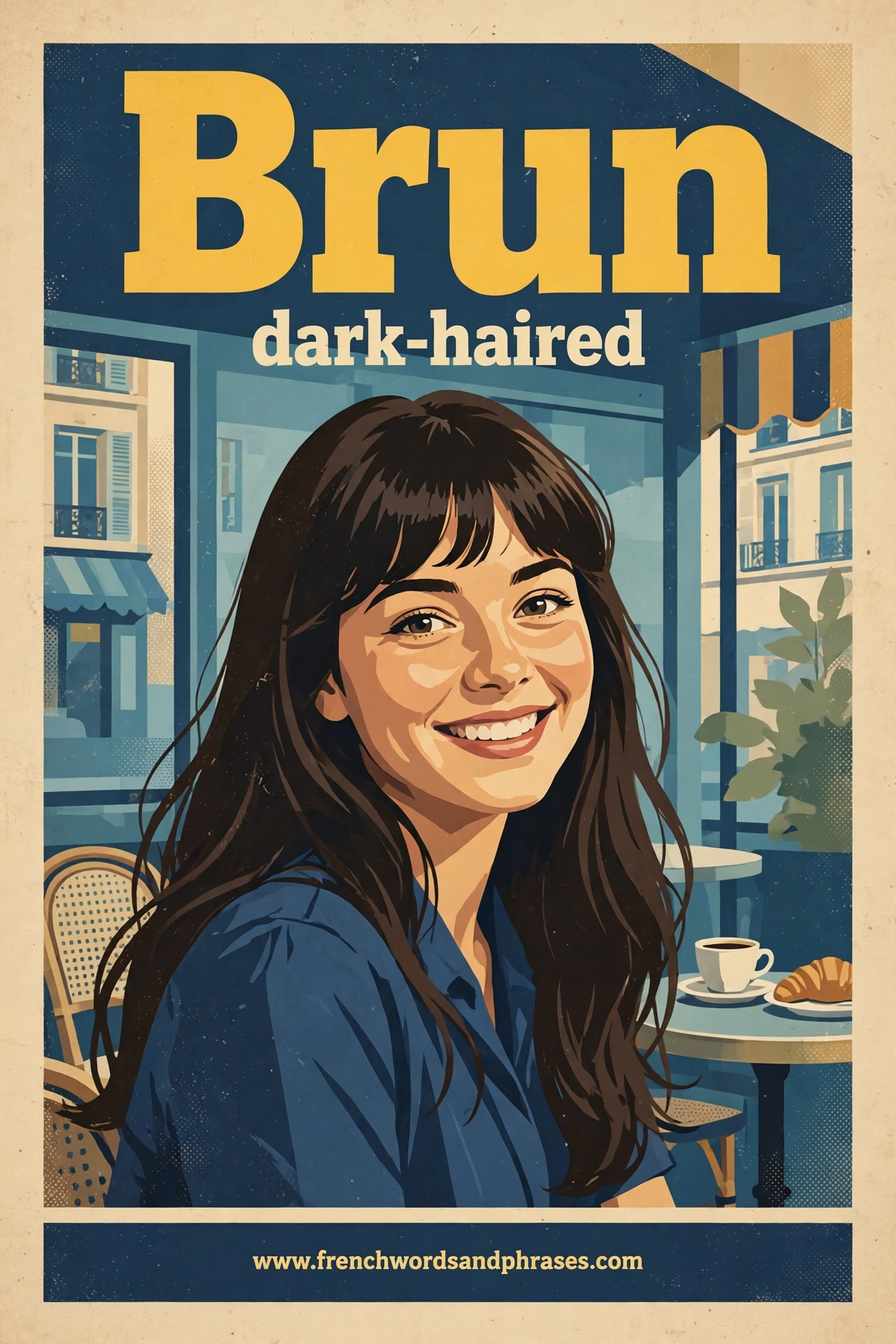
| brun | dark-haired, brown — the opposite end |
| clair | light, pale — for shades in general |
| foncé | dark — the opposite for colours |
Example
Elle hésite entre le blond et le châtain clair.
She is hesitating between blond and light chestnut.
Watch Out: The Traps Around Blond
The traps here are an agreement with cheveux, a beer order, and a Québec surprise that has delighted learners for generations.
| Trap | The truth |
|---|---|
| Agreement | cheveux is masculine plural — les cheveux blonds, even for a woman |
| The d | silent in blond, pronounced in blonde — spelling follows the sound |
| In Québec | ma blonde means my girlfriend — rien à voir avec la couleur des cheveux |
| As a noun | une blonde can be a woman or a beer; le contexte décide |
Example
À Montréal, il présente sa blonde à ses amis.
In Montreal, he introduces his girlfriend to his friends.
Quick Quiz 4
In Québec, what does ma blonde usually mean?
Reveal the answer
My girlfriend
Il invite sa blonde au restaurant.
He is taking his girlfriend to a restaurant.
Blond in Everyday French: Real-Life Examples
Now that you know the word, let’s see how blond appears in everyday French.
Example 1 — Describing family
Ma sœur est blonde, comme notre mère.
My sister is blond, like our mother.
Example 2 — At the café
Je voudrais une bière blonde, s’il vous plaît.
I’d like a lager, please.
Example 3 — Children
Le petit garçon blond joue dans le jardin.
The little blond boy is playing in the garden.
Example 4 — At the hairdresser’s
Elle veut devenir plus blonde pour l’été.
She wants to go blonder for the summer.
Example 5 — Portraits
Sur la photo, la femme blonde sourit.
In the photo, the blond woman is smiling.
Example 6 — In the fields
En juin, les champs sont blonds comme les cheveux d’un enfant.
In June, the fields are as blond as a child’s hair.
Beyond Translation: The Meaning of Blond
English says blond for the meaning of blond — a word English borrowed from French in the first place. French keeps it close to the land: blond is the colour of wheat at harvest, of pale beer in a tall glass, of hair at the end of August.
To say blond in French is to name the lightest gold the year can make.
And the word travels well: it crossed the Atlantic, settled in Québec, and came home with a second job — there, une blonde is not a colour at all, but the girl you are taking to dinner.
How to Remember the French Adjective Blond
Remember it this way: Blond is the harvest adjective — it follows the noun, wakes its d up for her, and colours everything from wheat fields to café orders.
- You see the family together — blond, blonde, blonds, blondes — with the d heard only in the feminine.
- You give hair its formula — avoir les cheveux blonds, always masculine plural.
- You put it after the noun — une fille blonde, une bière blonde.
The key idea is blond stands after the noun, its d wakes up in blonde, and cheveux blonds is always masculine plural.
Test Your Knowledge of Blond
Let’s see how much you’ve learned. Try answering these questions before revealing the answers.
Question 1
What does blond mean?
Reveal the answer
Blond — fair and golden, above all of hair.
Question 2
What are the forms of blond?
Reveal the answer
blond, blonde, blonds, blondes — the d is heard only in the feminine.
Question 3
Translate: she has blond hair.
Reveal the answer
Elle a les cheveux blonds.
Question 4
What is une bière blonde?
Reveal the answer
A pale lager — the blond beer of every French café.
Question 5
Complete the sentence:
La petite fille est ______ .
Reveal the answer
blonde
La petite fille est blonde.
The little girl is blond.
Your Final Challenge
Can You Use It?
How would you say this in French?
“She has blond hair and blue eyes.”
Reveal the answer
Elle a les cheveux blonds et les yeux bleus.
She has blond hair and blue eyes.
A little French. A little curiosity. A richer everyday life.
LEARN FRENCH ONE WORD AT A TIME