A French Word to Live By
How to Conjugate Brûler in French
/bʁy.le/
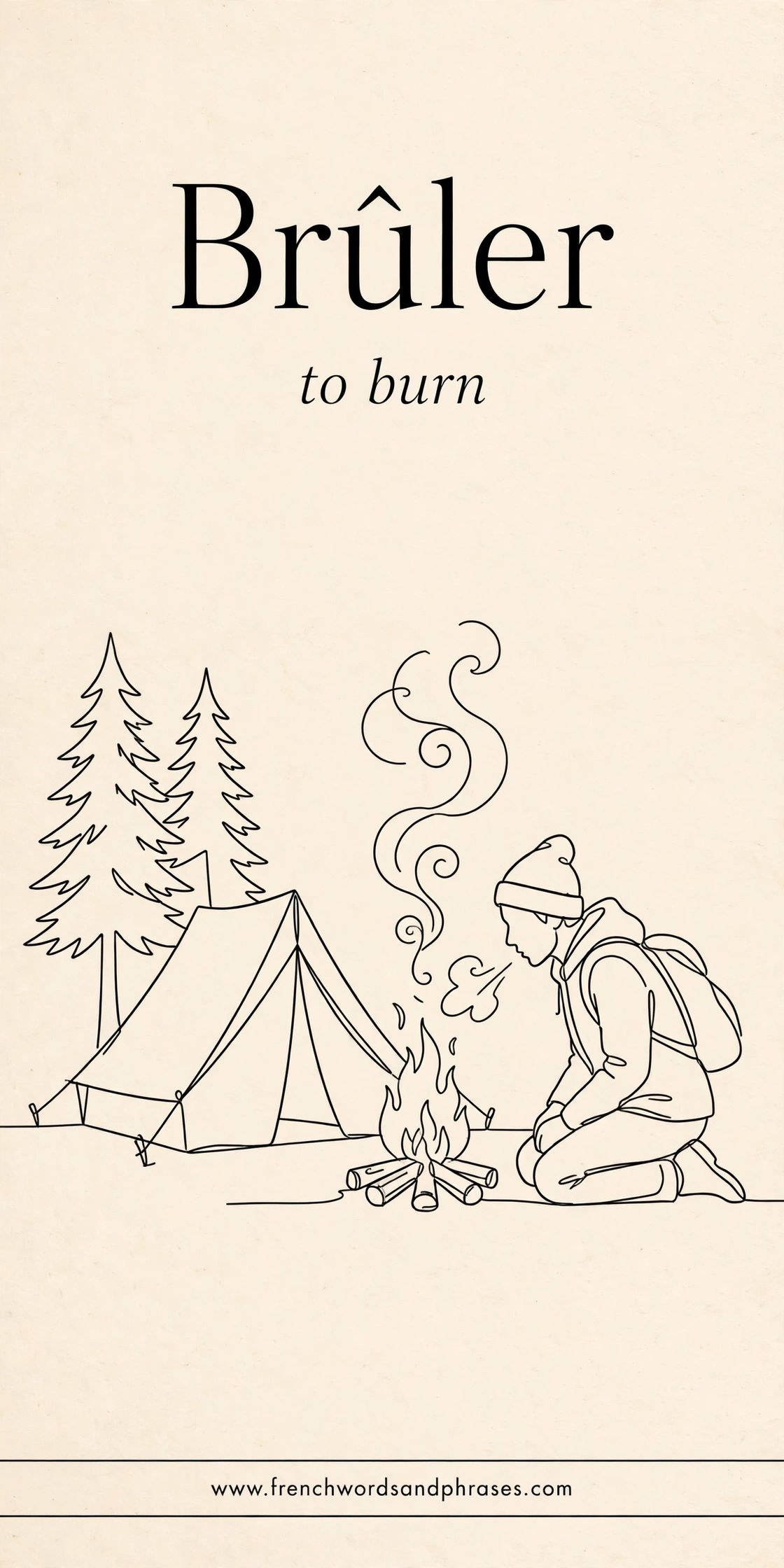
Brûler means to burn — to be on fire, to set fire to something, or to feel a fire inside, as in brûler d’envie, to burn with longing.
A log catching in the fireplace, a sauce forgotten on the stove, a forehead hot with fever, a driver shooting through a red light — brûler is the verb of fire in all its forms: flames, heat, haste and desire.
In this guide, you’ll learn how to conjugate brûler in all the major French tenses and moods. Explore complete conjugation tables, French examples, English translations, and practice quizzes.
Understanding the French Verb Brûler
Brûler is a regular French verb belonging to the first group of verbs, those ending in-er.
It means to burn. It is commonly used for fires and cooking accidents, for skin and tongues meeting hot things, for fever and sunburn, and figuratively for desire (brûler d’amour, brûler d’envie), for haste (brûler les étapes) and for the point of no return (brûler ses vaisseaux).
Verb classification: First group (-er)
Auxiliary verb: Avoir
Past participle: brûlé
Present participle: brûlant
English equivalents: To burn, to be on fire, to burn down; brûler du bois — to burn wood; brûler d’envie de faire quelque chose — to be dying to do something; brûler les étapes — to skip stages, to rush ahead; brûler un feu rouge — to run a red light; brûler ses vaisseaux — to burn one’s boats (no way back).
One important detail: the circumflex in brûler is the tombstone of a lost s — Old French wrote brusler — and it stays on the û through the whole conjugation: je brûle, nous brûlons, ils brûlent. The verb works both ways: transitively (elle brûle les lettres, she burns the letters) and intransitively (la maison brûle, the house is burning). Followed by de plus an infinitive it stops meaning fire and starts meaning longing: je brûle de partir — I am dying to leave. And take care with se brûler, the reflexive cousin: je me suis brûlé la main, I burned my hand.
Experience the Word
Brûler is the verb of fire — real fire in the grate, and the invisible fire of wanting something too much.
Imagine a winter evening in a stone cottage. The wood catches, the room warms, the soup simmers — and in one careless minute the toast brûle, the cook waves away the smoke, and everyone laughs: fire gives the heat and takes the dinner.
The fire has done its double work. It has warmed — brûlé utile — and it has burned the toast.
How to Conjugate Brûler: Complete French Conjugation Guide
Let’s explore every major conjugation of brûler, beginning with the indicative mood.
How to Conjugate Brûler in the Indicative Mood
The indicative mood is used to express facts, observations, actions, and events.
How to Conjugate Brûler in the Present Tense (Présent)
Used for actions happening now, habitual actions, and general truths.
| Subject | Conjugation |
|---|---|
| je | brûle |
| tu | brûles |
| il / elle | brûle |
| nous | brûlons |
| vous | brûlez |
| ils / elles | brûlent |
Example
Le bois sec brûle vite dans la cheminée.
Dry wood burns fast in the fireplace.
Quick Quiz 1
Complete the sentence:
Nous ______ du bois dans le poêle.
Reveal the answer
brûlons
Nous brûlons du bois dans le poêle.
We burn wood in the stove.
How to Conjugate Brûler in the Passé Composé
Used for completed actions in the past. Brûler takes the auxiliary verb avoir.
| Subject | Conjugation |
|---|---|
| j’ | ai brûlé |
| tu | as brûlé |
| il / elle | a brûlé |
| nous | avons brûlé |
| vous | avez brûlé |
| ils / elles | ont brûlé |
Example
Elle a brûlé les toasts encore une fois.
She has burned the toast again.
How to Conjugate Brûler in the Imparfait (Imperfect Tense)
Used for habitual past actions, descriptions, and ongoing situations in the past.
| Subject | Conjugation |
|---|---|
| je | brûlais |
| tu | brûlais |
| il / elle | brûlait |
| nous | brûlions |
| vous | brûliez |
| ils / elles | brûlaient |
Example
Les bougies brûlaient doucement sur la table.
The candles were burning softly on the table.
Quick Quiz 2
Choose the correct form:
She burned the letters.
Elle ______ les lettres. (a brûlé / est brûlée)
Reveal the answer
a brûlé
Elle a brûlé les lettres.
Brûler takes avoir.
How to Conjugate Brûler in the Plus-que-parfait
Used to describe an action that had already been completed before another past event.
| Subject | Conjugation |
|---|---|
| j’ | avais brûlé |
| tu | avais brûlé |
| il / elle | avait brûlé |
| nous | avions brûlé |
| vous | aviez brûlé |
| ils / elles | avaient brûlé |
Example
Il avait brûlé toutes ses lettres avant de partir.
He had burned all his letters before leaving.
How to Conjugate Brûler in the Passé Simple
Primarily used in formal writing, literature, and historical narratives. It is rarely used in everyday conversation.
| Subject | Conjugation |
|---|---|
| je | brûlai |
| tu | brûlas |
| il / elle | brûla |
| nous | brûlâmes |
| vous | brûlâtes |
| ils / elles | brûlèrent |
Example
La forêt brûla pendant trois jours.
The forest burned for three days.
How to Conjugate Brûler in the Passé Antérieur
A literary tense used to express an action completed immediately before another past action, generally in the passé simple.
| Subject | Conjugation |
|---|---|
| j’ | eus brûlé |
| tu | eus brûlé |
| il / elle | eut brûlé |
| nous | eûmes brûlé |
| vous | eûtes brûlé |
| ils / elles | eurent brûlé |
Example
Quand le feu eut brûlé la grange, les pompiers arrivèrent enfin.
When the fire had burned the barn, the firefighters finally arrived.
How to Conjugate Brûler in the Future Tense (Futur Simple)
Used to describe actions that will take place in the future.
| Subject | Conjugation |
|---|---|
| je | brûlerai |
| tu | brûleras |
| il / elle | brûlera |
| nous | brûlerons |
| vous | brûlerez |
| ils / elles | brûleront |
Example
Ce papier brûlera en quelques secondes.
This paper will burn in a few seconds.
How to Conjugate Brûler in the Futur Antérieur (Future Perfect)
Used for an action that will have been completed before a particular point in the future.
| Subject | Conjugation |
|---|---|
| j’ | aurai brûlé |
| tu | auras brûlé |
| il / elle | aura brûlé |
| nous | aurons brûlé |
| vous | aurez brûlé |
| ils / elles | auront brûlé |
Example
À ce rythme, nous aurons brûlé tout le bois avant Noël.
At this rate, we will have burned all the wood before Christmas.
How to Conjugate Brûler in the Near Future (Futur Proche)
Used to describe something that is going to happen soon. Formed with aller + infinitive.
| Subject | Conjugation |
|---|---|
| je | vais brûler |
| tu | vas brûler |
| il / elle | va brûler |
| nous | allons brûler |
| vous | allez brûler |
| ils / elles | vont brûler |
Example
Attention, ce café va brûler ta langue !
Careful, this coffee is going to burn your tongue!
How to Conjugate Brûler in the Conditional Mood
The conditional mood expresses what would happen under certain circumstances. It is also frequently used to make polite requests or express wishes.
How to Conjugate Brûler in the Present Conditional
| Subject | Conjugation |
|---|---|
| je | brûlerais |
| tu | brûlerais |
| il / elle | brûlerait |
| nous | brûlerions |
| vous | brûleriez |
| ils / elles | brûleraient |
Example
Sans eau, la maison brûlerait jusqu’aux fondations.
Without water, the house would burn down to its foundations.
How to Conjugate Brûler in the Past Conditional
| Subject | Conjugation |
|---|---|
| j’ | aurais brûlé |
| tu | aurais brûlé |
| il / elle | aurait brûlé |
| nous | aurions brûlé |
| vous | auriez brûlé |
| ils / elles | auraient brûlé |
Example
Elle aurait brûlé d’envie de tout raconter.
She would have been dying to tell everything.
Brûler in the Literary Past Conditional Form
This less common literary form uses the imperfect subjunctive of avoir.
| Subject | Conjugation |
|---|---|
| j’ | eusse brûlé |
| tu | eusses brûlé |
| il / elle | eût brûlé |
| nous | eussions brûlé |
| vous | eussiez brûlé |
| ils / elles | eussent brûlé |
Example
Il eût brûlé ses vaisseaux plutôt que de reculer.
He would have burned his boats rather than retreat.
How to Conjugate Brûler in the Subjunctive Mood
The subjunctive is used to express wishes, emotions, doubts, necessity, and uncertainty. It frequently follows expressions such as il faut que (it is necessary that) or bien que (although).
How to Conjugate Brûler in the Present Subjunctive
| Subject | Conjugation |
|---|---|
| que je | brûle |
| que tu | brûles |
| qu’il / qu’elle | brûle |
| que nous | brûlions |
| que vous | brûliez |
| qu’ils / qu’elles | brûlent |
Example
Je crains que le rôti ne brûle dans le four.
I am afraid the roast will burn in the oven.
Quick Quiz 3
Complete the sentence using the subjunctive:
Je crains que le lait ne ______.
Reveal the answer
brûle
Je crains que le lait ne brûle.
I am afraid the milk will burn.
How to Conjugate Brûler in the Imperfect Subjunctive
A literary tense, rarely encountered in modern spoken French.
| Subject | Conjugation |
|---|---|
| que je | brûlasse |
| que tu | brûlasses |
| qu’il / qu’elle | brûlât |
| que nous | brûlassions |
| que vous | brûlassiez |
| qu’ils / qu’elles | brûlassent |
Example
Elle surveillait la casserole de peur que le lait ne brûlât.
She watched the saucepan for fear the milk would burn.
How to Conjugate Brûler in the Pluperfect Subjunctive
A literary construction used to express an action completed before another past action.
| Subject | Conjugation |
|---|---|
| que j’ | eusse brûlé |
| que tu | eusses brûlé |
| qu’il / qu’elle | eût brûlé |
| que nous | eussions brûlé |
| que vous | eussiez brûlé |
| qu’ils / qu’elles | eussent brûlé |
Example
Les voisins craignaient que le hangar n’eût brûlé pendant la nuit.
The neighbours feared the shed had burned during the night.
How to Conjugate Brûler in the Past Subjunctive
| Subject | Conjugation |
|---|---|
| que j’ | aie brûlé |
| que tu | aies brûlé |
| qu’il / qu’elle | ait brûlé |
| que nous | ayons brûlé |
| que vous | ayez brûlé |
| qu’ils / qu’elles | aient brûlé |
Example
Je regrette qu’elle ait brûlé la sauce.
I am sorry she burned the sauce.
How to Conjugate Brûler in the Imperative
The imperative is used to give commands, instructions, invitations, or suggestions. Subject pronouns are omitted.
How to Conjugate Brûler in the Present Imperative
| Person | Conjugation |
|---|---|
| (tu) | brûle |
| (nous) | brûlons |
| (vous) | brûlez |
Example
Brûle ces vieux papiers dans la cour !
Burn those old papers in the yard!
Quick Quiz 4
How would you say Burn those old papers (tu form)?
Reveal the answer
Brûle ces vieux papiers !
French Participles of Brûler
Participles are verb forms that can be used in compound tenses and other grammatical constructions.
Present Participle of Brûler
brûlant
En brûlant trop vite, le bois fait beaucoup de fumée.
By burning too fast, the wood makes a lot of smoke.
Past Participle of Brûler
brûlé
Brûlées par le soleil, les feuilles sont tombées tôt.
Burned by the sun, the leaves fell early.
Brûler in Everyday French: Real-Life Examples
Now that you know the conjugations, let’s see how brûler appears in everyday French.
Example 1 — Present
Le bois brûle dans la cheminée.
The wood is burning in the fireplace.
Example 2 — Passé composé
Elle a brûlé les toasts.
She burned the toast.
Example 3 — Imparfait
Les bougies brûlaient sur la table.
The candles were burning on the table.
Example 4 — Future
Ce papier brûlera en quelques secondes.
This paper will burn in a few seconds.
Example 5 — Conditional
Sans eau, la maison brûlerait entièrement.
Without water, the house would burn completely.
Example 6 — Imperative
Brûle ces vieux papiers !
Burn those old papers!
Beyond Translation: The Meaning of Brûler
English burn and French brûler are not cousins by blood, but they share a whole world of metaphors: both burn with desire, burn bridges and burn the midnight oil — French says brûler la chandelle par les deux bouts, to burn the candle at both ends.
Fire is the oldest metaphor of urgency.
That is why brûler runs red lights (brûler un feu rouge), skips the queue of life (brûler les étapes) and, in brûler ses vaisseaux, repeats the gesture of conquerors who burned their own ships so that retreat became impossible.
How to Remember the French Verb Brûler
Remember it this way: Brûler is about fire in the grate — and the fire of wanting.
- The û never loses its hat: je brûle, nous brûlons, ils brûlent, brûlé.
- Two directions: la maison brûle (it is on fire) and elle brûle les lettres (she burns them).
- Brûler de + infinitive = to be dying to: je brûle de partir, I am burning to leave.
The key idea is fire in the grate — and the fire of wanting.
Test Your Knowledge of Brûler
Let’s see how much you’ve learned. Try answering these questions before revealing the answers.
Question 1
How do you say The house is burning in French?
Reveal the answer
La maison brûle.
Question 2
What does je brûle de partir mean?
Reveal the answer
I am dying to leave — brûler de + infinitive expresses burning desire, not fire.
Question 3
Translate: She burned the toast again.
Reveal the answer
Elle a brûlé les toasts encore une fois.
Question 4
What is the past participle of brûler?
Reveal the answer
Brûlé — agreeing: brûlée, brûlés, brûlées.
Question 5
Complete the sentence:
Je crains que le rôti ne ______ dans le four.
Reveal the answer
brûle
Je crains que le rôti ne brûle dans le four.
I am afraid the roast will burn in the oven.
Your Final Challenge
Can You Use It?
How would you say this in French?
The fire burns in the fireplace, and the whole house breathes at last.
Reveal the answer
Le feu brûle dans la cheminée, et toute la maison respire enfin.
The fire burns in the fireplace, and the whole house breathes at last.
A little French. A little curiosity. A richer everyday life.
LEARN FRENCH ONE WORD AT A TIME