A French Word to Live By
How to Conjugate Broyer in French
/bʁwa.je/
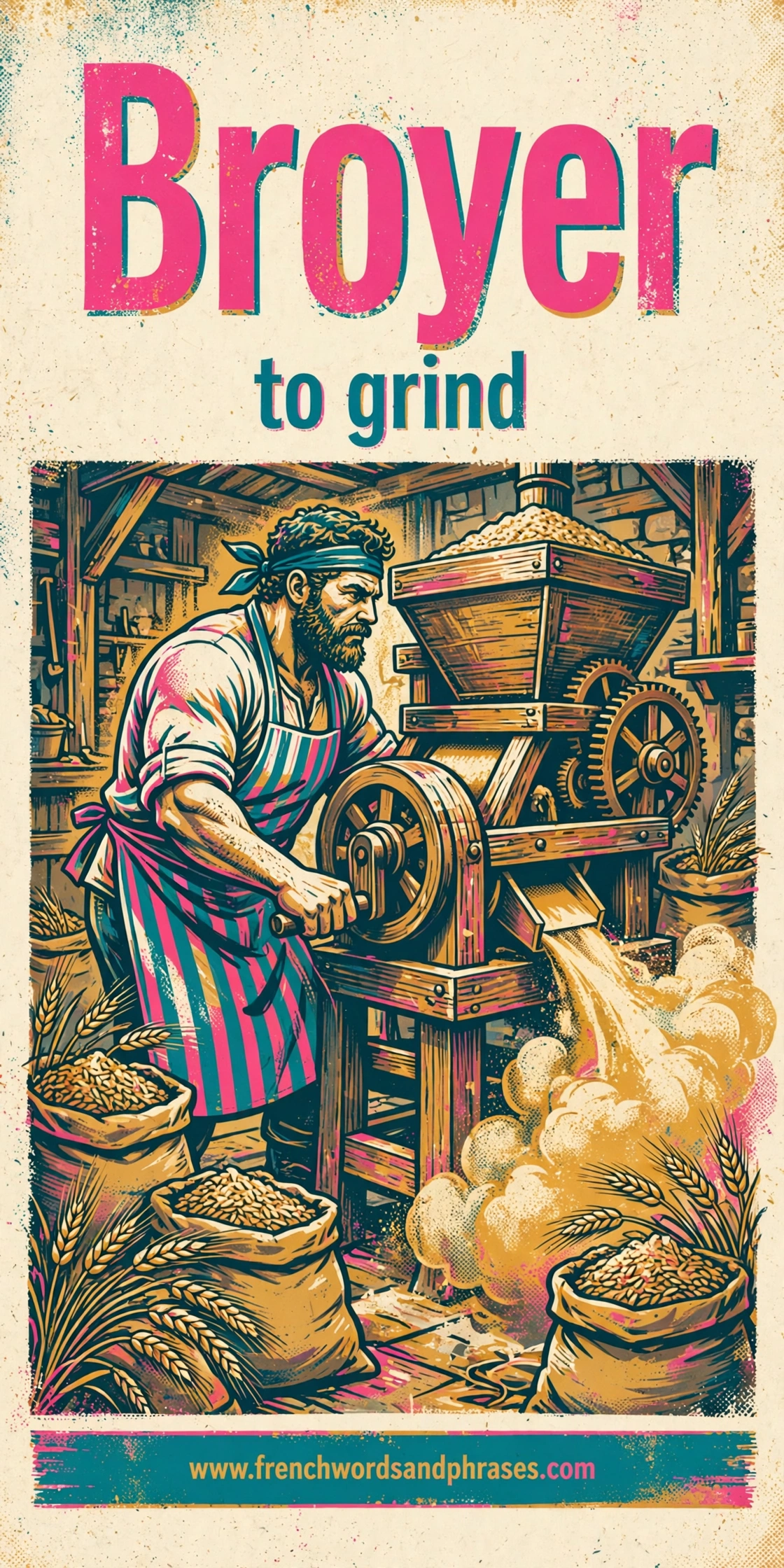
Broyer means to grind — to crush something into powder or paste between stones, teeth or rollers.
Millstones crushing wheat, a coffee grinder growling at dawn, jaws working through crusty bread — broyer is the heavy verb of grinding and crushing, and French keeps it for dark thoughts too: broyer du noir, to brood.
In this guide, you’ll learn how to conjugate broyer in all the major French tenses and moods. Explore complete conjugation tables, French examples, English translations, and practice quizzes.
Understanding the French Verb Broyer
Broyer is a regular French verb belonging to the first group of verbs, those ending in-er.
It means to grind. It is commonly used in mills, kitchens and workshops for grain, coffee, spices and pigments, and in industry for crushing stone and shredding branches; its figurative star is broyer du noir — literally grinding black pigment, like a painter alone with his darkest colour — which is the standard French picture of brooding.
Verb classification: First group (-er)
Auxiliary verb: Avoir
Past participle: broyé
Present participle: broyant
English equivalents: To grind, to crush, to mill; broyer du café — to grind coffee; broyer des couleurs — to grind pigments; broyer des amandes — to grind almonds; broyer du noir — to brood, to be down in the dumps (literally, to grind black); un broyeur — a grinder, a crusher.
One important detail: broyer is an -oyer verb, so its y turns to i wherever the next syllable is mute: je broie, tu broies, il broie, ils broient, through the whole future and conditional — je broierai, je broierais — and in the tu imperative, broie ! The y survives wherever the ending is sounded: nous broyons, vous broyez, je broyais, en broyant, and in the infinitive and the participle, broyer, broyé. The subjunctive splits along the same line: que je broie, but que nous broyions.
Experience the Word
Broyer is the verb of slow, heavy pressure — nothing it touches survives in its original shape.
Imagine the village mill at six in the morning. The wheel turns, the great stone turns with it, and a sack of hard wheat goes in whole and comes out as soft white flour — broyer has done in an hour what no hand could do in a day.
The grain has not been cut or broken. It has been ground — broyé, crushed between stones until it became something new.
How to Conjugate Broyer: Complete French Conjugation Guide
Let’s explore every major conjugation of broyer, beginning with the indicative mood.
How to Conjugate Broyer in the Indicative Mood
The indicative mood is used to express facts, observations, actions, and events.
How to Conjugate Broyer in the Present Tense (Présent)
Used for actions happening now, habitual actions, and general truths.
| Subject | Conjugation |
|---|---|
| je | broie |
| tu | broies |
| il / elle | broie |
| nous | broyons |
| vous | broyez |
| ils / elles | broient |
Example
Le moulin broie le grain jour et nuit.
The mill grinds the grain day and night.
Quick Quiz 1
Complete the sentence:
Nous ______ le grain au moulin.
Reveal the answer
broyons
Nous broyons le grain au moulin.
We grind the grain at the mill.
How to Conjugate Broyer in the Passé Composé
Used for completed actions in the past. Broyer takes the auxiliary verb avoir.
| Subject | Conjugation |
|---|---|
| j’ | ai broyé |
| tu | as broyé |
| il / elle | a broyé |
| nous | avons broyé |
| vous | avez broyé |
| ils / elles | ont broyé |
Example
Elle a broyé les amandes en poudre fine.
She ground the almonds into a fine powder.
How to Conjugate Broyer in the Imparfait (Imperfect Tense)
Used for habitual past actions, descriptions, and ongoing situations in the past.
| Subject | Conjugation |
|---|---|
| je | broyais |
| tu | broyais |
| il / elle | broyait |
| nous | broyions |
| vous | broyiez |
| ils / elles | broyaient |
Example
Autrefois, on broyait le café à la main.
In the old days, coffee was ground by hand.
Quick Quiz 2
Choose the correct form:
He has been brooding for weeks.
Il ______ du noir depuis des semaines. (a broyé / est broyé)
Reveal the answer
a broyé
Il a broyé du noir depuis des semaines.
Broyer takes avoir.
How to Conjugate Broyer in the Plus-que-parfait
Used to describe an action that had already been completed before another past event.
| Subject | Conjugation |
|---|---|
| j’ | avais broyé |
| tu | avais broyé |
| il / elle | avait broyé |
| nous | avions broyé |
| vous | aviez broyé |
| ils / elles | avaient broyé |
Example
Il avait broyé du noir pendant des semaines.
He had been brooding for weeks.
How to Conjugate Broyer in the Passé Simple
Primarily used in formal writing, literature, and historical narratives. It is rarely used in everyday conversation.
| Subject | Conjugation |
|---|---|
| je | broyai |
| tu | broyas |
| il / elle | broya |
| nous | broyâmes |
| vous | broyâtes |
| ils / elles | broyèrent |
Example
La meule broya le blé en une farine blanche.
The millstone ground the wheat into white flour.
How to Conjugate Broyer in the Passé Antérieur
A literary tense used to express an action completed immediately before another past action, generally in the passé simple.
| Subject | Conjugation |
|---|---|
| j’ | eus broyé |
| tu | eus broyé |
| il / elle | eut broyé |
| nous | eûmes broyé |
| vous | eûtes broyé |
| ils / elles | eurent broyé |
Example
Quand elle eut broyé les épices, elle commença la sauce.
When she had ground the spices, she began the sauce.
How to Conjugate Broyer in the Future Tense (Futur Simple)
Used to describe actions that will take place in the future.
| Subject | Conjugation |
|---|---|
| je | broierai |
| tu | broieras |
| il / elle | broiera |
| nous | broierons |
| vous | broierez |
| ils / elles | broieront |
Example
Demain, la machine broiera les branches du jardin.
Tomorrow, the machine will shred the garden branches.
How to Conjugate Broyer in the Futur Antérieur (Future Perfect)
Used for an action that will have been completed before a particular point in the future.
| Subject | Conjugation |
|---|---|
| j’ | aurai broyé |
| tu | auras broyé |
| il / elle | aura broyé |
| nous | aurons broyé |
| vous | aurez broyé |
| ils / elles | auront broyé |
Example
À midi, le moulin aura broyé tout le blé du village.
By noon, the mill will have ground all the village’s wheat.
How to Conjugate Broyer in the Near Future (Futur Proche)
Used to describe something that is going to happen soon. Formed with aller + infinitive.
| Subject | Conjugation |
|---|---|
| je | vais broyer |
| tu | vas broyer |
| il / elle | va broyer |
| nous | allons broyer |
| vous | allez broyer |
| ils / elles | vont broyer |
Example
Je vais broyer le café, réveille-toi !
I am going to grind the coffee, wake up!
How to Conjugate Broyer in the Conditional Mood
The conditional mood expresses what would happen under certain circumstances. It is also frequently used to make polite requests or express wishes.
How to Conjugate Broyer in the Present Conditional
| Subject | Conjugation |
|---|---|
| je | broierais |
| tu | broierais |
| il / elle | broierait |
| nous | broierions |
| vous | broieriez |
| ils / elles | broieraient |
Example
Avec une meule neuve, le moulin broierait plus fin.
With a new millstone, the mill would grind finer.
How to Conjugate Broyer in the Past Conditional
| Subject | Conjugation |
|---|---|
| j’ | aurais broyé |
| tu | aurais broyé |
| il / elle | aurait broyé |
| nous | aurions broyé |
| vous | auriez broyé |
| ils / elles | auraient broyé |
Example
Il aurait broyé du noir sans la visite de son ami.
He would have brooded without his friend’s visit.
Broyer in the Literary Past Conditional Form
This less common literary form uses the imperfect subjunctive of avoir.
| Subject | Conjugation |
|---|---|
| j’ | eusse broyé |
| tu | eusses broyé |
| il / elle | eût broyé |
| nous | eussions broyé |
| vous | eussiez broyé |
| ils / elles | eussent broyé |
Example
Elle eût broyé les couleurs plutôt que de les acheter toutes prêtes.
She would have ground her pigments rather than buy them ready-made.
How to Conjugate Broyer in the Subjunctive Mood
The subjunctive is used to express wishes, emotions, doubts, necessity, and uncertainty. It frequently follows expressions such as il faut que (it is necessary that) or bien que (although).
How to Conjugate Broyer in the Present Subjunctive
| Subject | Conjugation |
|---|---|
| que je | broie |
| que tu | broies |
| qu’il / qu’elle | broie |
| que nous | broyions |
| que vous | broyiez |
| qu’ils / qu’elles | broient |
Example
Il faut que tu broies le café plus fin.
You must grind the coffee finer.
Quick Quiz 3
Complete the sentence using the subjunctive:
Il faut que vous ______ les épices.
Reveal the answer
broyiez
Il faut que vous broyiez les épices.
You must grind the spices.
How to Conjugate Broyer in the Imperfect Subjunctive
A literary tense, rarely encountered in modern spoken French.
| Subject | Conjugation |
|---|---|
| que je | broyasse |
| que tu | broyasses |
| qu’il / qu’elle | broyât |
| que nous | broyassions |
| que vous | broyassiez |
| qu’ils / qu’elles | broyassent |
Example
On voulait que le moulin broyât aussi le seigle.
People wanted the mill to grind the rye too.
How to Conjugate Broyer in the Pluperfect Subjunctive
A literary construction used to express an action completed before another past action.
| Subject | Conjugation |
|---|---|
| que j’ | eusse broyé |
| que tu | eusses broyé |
| qu’il / qu’elle | eût broyé |
| que nous | eussions broyé |
| que vous | eussiez broyé |
| qu’ils / qu’elles | eussent broyé |
Example
On racontait qu’il eût broyé du noir tout l’hiver.
People said he had brooded all winter.
How to Conjugate Broyer in the Past Subjunctive
| Subject | Conjugation |
|---|---|
| que j’ | aie broyé |
| que tu | aies broyé |
| qu’il / qu’elle | ait broyé |
| que nous | ayons broyé |
| que vous | ayez broyé |
| qu’ils / qu’elles | aient broyé |
Example
Je suis content qu’elle ait broyé les épices à la main.
I am glad she ground the spices by hand.
How to Conjugate Broyer in the Imperative
The imperative is used to give commands, instructions, invitations, or suggestions. Subject pronouns are omitted.
How to Conjugate Broyer in the Present Imperative
| Person | Conjugation |
|---|---|
| (tu) | broie |
| (nous) | broyons |
| (vous) | broyez |
Example
Broie les amandes jusqu’à la poudre !
Grind the almonds to a powder!
Quick Quiz 4
How would you say Grind the coffee (tu form)?
Reveal the answer
Broie le café !
French Participles of Broyer
Participles are verb forms that can be used in compound tenses and other grammatical constructions.
Present Participle of Broyer
broyant
En broyant du noir, il ne vit pas passer le printemps.
Brooding, he did not notice spring go by.
Past Participle of Broyer
broyé
Broyé finement, le café libère tout son parfum.
Ground finely, the coffee releases all its aroma.
Broyer in Everyday French: Real-Life Examples
Now that you know the conjugations, let’s see how broyer appears in everyday French.
Example 1 — Present
Le moulin broie le grain.
The mill grinds the grain.
Example 2 — Passé composé
Elle a broyé les amandes.
She ground the almonds.
Example 3 — Imparfait
On broyait le café à la main.
Coffee used to be ground by hand.
Example 4 — Future
La machine broiera les branches.
The machine will shred the branches.
Example 5 — Conditional
Il broierait du noir sans ses amis.
He would brood without his friends.
Example 6 — Imperative
Broie le café plus fin !
Grind the coffee finer!
Beyond Translation: The Meaning of Broyer
English to grind is the close equivalent of broyer, though French divides the labour: moudre is the miller’s traditional verb for grain and coffee, while broyer crushes more broadly — stone, spices, pigments, branches.
Its darkest phrase comes from the painter’s studio.
Painters once ground their own pigments, and the black took longest; to spend your days grinding black — broyer du noir — became the perfect image of brooding, and it is now the everyday French way to say someone is down in the dumps.
How to Remember the French Verb Broyer
Remember it this way: Broyer is about the millstone turning — and the painter grinding black.
- An -oyer verb: the y turns to i before a mute e — je broie, ils broient — but stays in nous broyons.
- Its famous dark phrase: broyer du noir, to grind black — to brood, to be down in the dumps.
- Past participle broyé: le café broyé finement, finely ground coffee.
The key idea is the millstone turning — and the painter grinding black.
Test Your Knowledge of Broyer
Let’s see how much you’ve learned. Try answering these questions before revealing the answers.
Question 1
Why does je broie have an i but nous broyons a y?
Reveal the answer
The -oyer rule — y becomes i before a mute syllable (je broie), and stays y where the ending is sounded (nous broyons).
Question 2
How do you say The mill grinds the grain in French?
Reveal the answer
Le moulin broie le grain.
Question 3
Translate: She ground the almonds.
Reveal the answer
Elle a broyé les amandes.
Question 4
What is the past participle of broyer?
Reveal the answer
Broyé.
Question 5
Complete the sentence:
Il faut que tu ______ le café plus fin.
Reveal the answer
broies
Il faut que tu broies le café plus fin.
You must grind the coffee finer.
Your Final Challenge
Can You Use It?
How would you say this in French?
The mill has been grinding the grain since dawn, and the whole village can already smell bread.
Reveal the answer
Le moulin broie le grain depuis l’aube, et tout le village sent déjà le pain.
The mill has been grinding the grain since dawn, and the whole village can already smell bread.
A little French. A little curiosity. A richer everyday life.
LEARN FRENCH ONE WORD AT A TIME