A French Word to Live By
How to Conjugate Boulotter in French
/bu.lɔ.te/
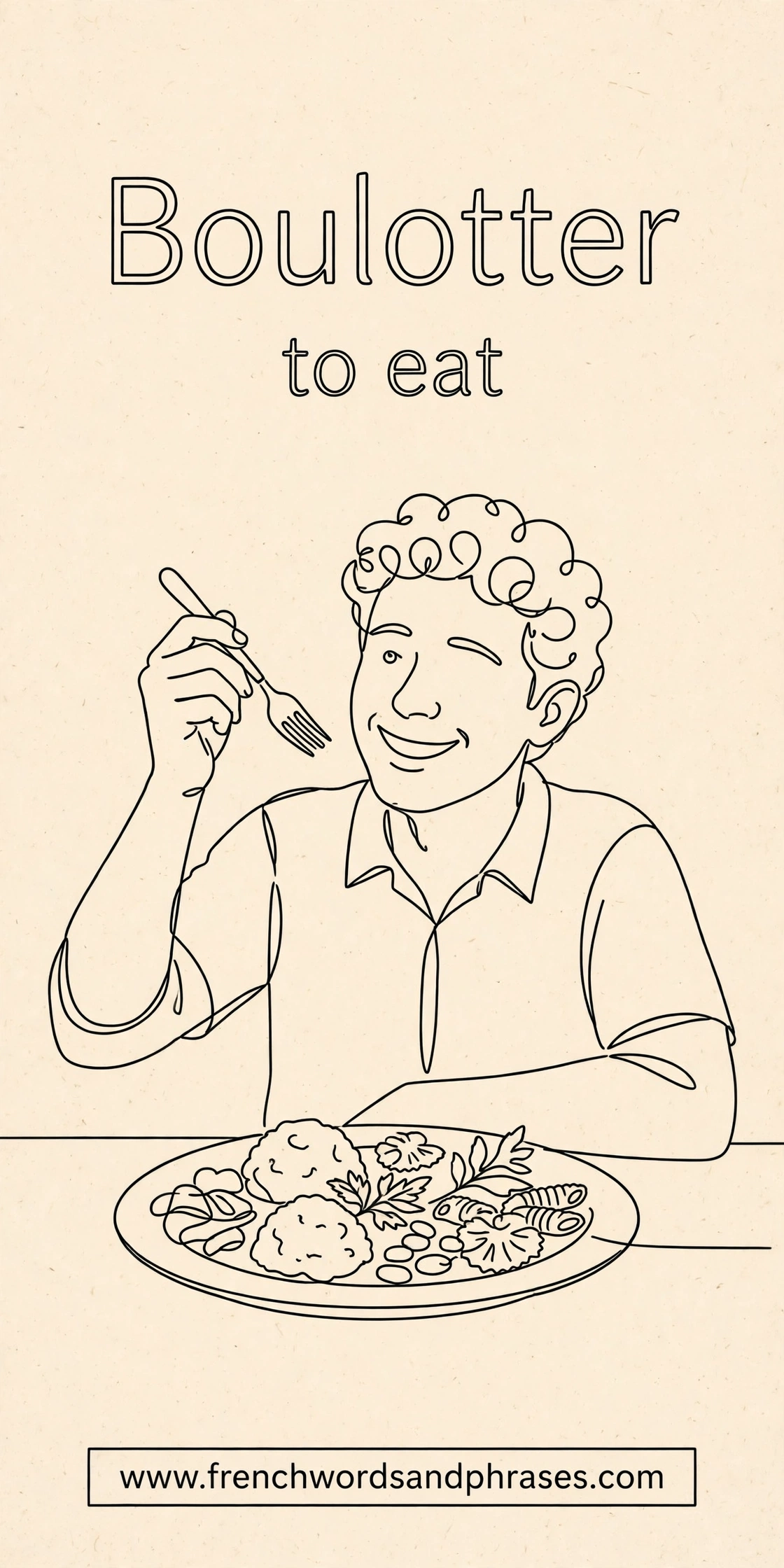
Boulotter means to eat — in the familiar, cheerful sense of munching, noshing and tucking in.
A packet of crisps that never reaches the table, a child with a biscuit in each hand, friends passing a pizza box around in front of a match — boulotter is eating as a pastime: informal, greedy and completely unbothered by table manners.
In this guide, you’ll learn how to conjugate boulotter in all the major French tenses and moods. Explore complete conjugation tables, French examples, English translations, and practice quizzes.
Understanding the French Verb Boulotter
Boulotter is a regular French verb belonging to the first group of verbs, those ending in-er.
It means to eat. It is the verb of snacking and grazing rather than of proper meals — one boulotte crisps in front of the television, biscuits at the office, a sandwich on the train — and it often carries a wink of gentle reproach: il boulotte toute la journée, he munches all day long.
Verb classification: First group (-er)
Auxiliary verb: Avoir
Past participle: boulotté
Present participle: boulottant
English equivalents: To eat (familiar), to munch, to nosh, to tuck into; boulotter un sandwich — to munch a sandwich; boulotter des biscuits — to nibble biscuits; boulotter entre les repas — to snack between meals; un boulotteur — a hearty eater.
One important detail: boulotter is a familiar register verb — the slangy cousin of manger. It suggests eating with appetite and without ceremony: snacks, sandwiches, crisps, whole cakes if nobody is watching. The spelling itself holds no trap: the stem already carries its double t everywhere — je boulotte, nous boulottons, ils boulottent — and the past participle is boulotté. Use it with friends and family; in a formal report, write manger.
Experience the Word
Boulotter is eating with the ceremony removed — hands busy, mouth full, and no plate in sight.
Imagine a train crossing France at lunchtime. Across the aisle, a schoolboy opens his rucksack and starts on a sandwich, then crisps, then a chocolate bar, then an apple, watching the fields roll past — il boulotte, peacefully, for two hundred kilometres.
He is not dining or tasting. He is munching — boulottant — his way across the country.
How to Conjugate Boulotter: Complete French Conjugation Guide
Let’s explore every major conjugation of boulotter, beginning with the indicative mood.
How to Conjugate Boulotter in the Indicative Mood
The indicative mood is used to express facts, observations, actions, and events.
How to Conjugate Boulotter in the Present Tense (Présent)
Used for actions happening now, habitual actions, and general truths.
| Subject | Conjugation |
|---|---|
| je | boulotte |
| tu | boulottes |
| il / elle | boulotte |
| nous | boulottons |
| vous | boulottez |
| ils / elles | boulottent |
Example
Les enfants boulottent des biscuits en regardant la télé.
The children are munching biscuits in front of the TV.
Quick Quiz 1
Complete the sentence:
Les enfants ______ des biscuits devant la télé.
Reveal the answer
boulottent
Les enfants boulottent des biscuits devant la télé.
The children are munching biscuits in front of the TV.
How to Conjugate Boulotter in the Passé Composé
Used for completed actions in the past. Boulotter takes the auxiliary verb avoir.
| Subject | Conjugation |
|---|---|
| j’ | ai boulotté |
| tu | as boulotté |
| il / elle | a boulotté |
| nous | avons boulotté |
| vous | avez boulotté |
| ils / elles | ont boulotté |
Example
Il a boulotté tout le paquet de chips avant le dîner.
He munched the whole packet of crisps before dinner.
How to Conjugate Boulotter in the Imparfait (Imperfect Tense)
Used for habitual past actions, descriptions, and ongoing situations in the past.
| Subject | Conjugation |
|---|---|
| je | boulottais |
| tu | boulottais |
| il / elle | boulottait |
| nous | boulottions |
| vous | boulottiez |
| ils / elles | boulottaient |
Example
Le dimanche, nous boulottions des croissants en lisant le journal.
On Sundays, we used to nibble croissants while reading the paper.
Quick Quiz 2
Choose the correct form:
She munched the whole cake.
Elle ______ tout le gâteau. (a boulotté / est boulottée)
Reveal the answer
a boulotté
Elle a boulotté tout le gâteau.
Boulotter takes avoir.
How to Conjugate Boulotter in the Plus-que-parfait
Used to describe an action that had already been completed before another past event.
| Subject | Conjugation |
|---|---|
| j’ | avais boulotté |
| tu | avais boulotté |
| il / elle | avait boulotté |
| nous | avions boulotté |
| vous | aviez boulotté |
| ils / elles | avaient boulotté |
Example
Elle avait boulotté la moitié du gâteau avant l’arrivée des invités.
She had eaten half the cake before the guests arrived.
How to Conjugate Boulotter in the Passé Simple
Primarily used in formal writing, literature, and historical narratives. It is rarely used in everyday conversation.
| Subject | Conjugation |
|---|---|
| je | boulottai |
| tu | boulottas |
| il / elle | boulotta |
| nous | boulottâmes |
| vous | boulottâtes |
| ils / elles | boulottèrent |
Example
Ils boulottèrent en silence, puis repartirent travailler.
They munched in silence, then went back to work.
How to Conjugate Boulotter in the Passé Antérieur
A literary tense used to express an action completed immediately before another past action, generally in the passé simple.
| Subject | Conjugation |
|---|---|
| j’ | eus boulotté |
| tu | eus boulotté |
| il / elle | eut boulotté |
| nous | eûmes boulotté |
| vous | eûtes boulotté |
| ils / elles | eurent boulotté |
Example
Quand il eut boulotté son sandwich, il se remit au travail.
When he had munched his sandwich, he got back to work.
How to Conjugate Boulotter in the Future Tense (Futur Simple)
Used to describe actions that will take place in the future.
| Subject | Conjugation |
|---|---|
| je | boulotterai |
| tu | boulotteras |
| il / elle | boulottera |
| nous | boulotterons |
| vous | boulotterez |
| ils / elles | boulotteront |
Example
Ce soir, nous boulotterons des pizzas devant le match.
Tonight, we will munch pizzas in front of the match.
How to Conjugate Boulotter in the Futur Antérieur (Future Perfect)
Used for an action that will have been completed before a particular point in the future.
| Subject | Conjugation |
|---|---|
| j’ | aurai boulotté |
| tu | auras boulotté |
| il / elle | aura boulotté |
| nous | aurons boulotté |
| vous | aurez boulotté |
| ils / elles | auront boulotté |
Example
À huit heures, les enfants auront boulotté tout le goûter.
By eight o’clock, the children will have eaten all the snack.
How to Conjugate Boulotter in the Near Future (Futur Proche)
Used to describe something that is going to happen soon. Formed with aller + infinitive.
| Subject | Conjugation |
|---|---|
| je | vais boulotter |
| tu | vas boulotter |
| il / elle | va boulotter |
| nous | allons boulotter |
| vous | allez boulotter |
| ils / elles | vont boulotter |
Example
Tu vas encore boulotter des bonbons ?
Are you going to munch sweets again?
How to Conjugate Boulotter in the Conditional Mood
The conditional mood expresses what would happen under certain circumstances. It is also frequently used to make polite requests or express wishes.
How to Conjugate Boulotter in the Present Conditional
| Subject | Conjugation |
|---|---|
| je | boulotterais |
| tu | boulotterais |
| il / elle | boulotterait |
| nous | boulotterions |
| vous | boulotteriez |
| ils / elles | boulotteraient |
Example
Avec un peu de fromage, je boulotterais tout le pain.
With a bit of cheese, I would munch the whole loaf.
How to Conjugate Boulotter in the Past Conditional
| Subject | Conjugation |
|---|---|
| j’ | aurais boulotté |
| tu | aurais boulotté |
| il / elle | aurait boulotté |
| nous | aurions boulotté |
| vous | auriez boulotté |
| ils / elles | auraient boulotté |
Example
Il aurait boulotté le fromage si on ne l’avait pas caché.
He would have eaten the cheese if we had not hidden it.
Boulotter in the Literary Past Conditional Form
This less common literary form uses the imperfect subjunctive of avoir.
| Subject | Conjugation |
|---|---|
| j’ | eusse boulotté |
| tu | eusses boulotté |
| il / elle | eût boulotté |
| nous | eussions boulotté |
| vous | eussiez boulotté |
| ils / elles | eussent boulotté |
Example
Elle eût boulotté tout le garde-manger sans la visite surprise.
She would have munched the whole pantry without the surprise visit.
How to Conjugate Boulotter in the Subjunctive Mood
The subjunctive is used to express wishes, emotions, doubts, necessity, and uncertainty. It frequently follows expressions such as il faut que (it is necessary that) or bien que (although).
How to Conjugate Boulotter in the Present Subjunctive
| Subject | Conjugation |
|---|---|
| que je | boulotte |
| que tu | boulottes |
| qu’il / qu’elle | boulotte |
| que nous | boulottions |
| que vous | boulottiez |
| qu’ils / qu’elles | boulottent |
Example
Il ne faut pas que les enfants boulottent avant le repas.
The children must not snack before the meal.
Quick Quiz 3
Complete the sentence using the subjunctive:
Il ne faut pas que tu ______ entre les repas.
Reveal the answer
boulottes
Il ne faut pas que tu boulottes entre les repas.
You must not snack between meals.
How to Conjugate Boulotter in the Imperfect Subjunctive
A literary tense, rarely encountered in modern spoken French.
| Subject | Conjugation |
|---|---|
| que je | boulottasse |
| que tu | boulottasses |
| qu’il / qu’elle | boulottât |
| que nous | boulottassions |
| que vous | boulottassiez |
| qu’ils / qu’elles | boulottassent |
Example
Je ne voulais pas qu’il boulottât entre les repas.
I did not want him snacking between meals.
How to Conjugate Boulotter in the Pluperfect Subjunctive
A literary construction used to express an action completed before another past action.
| Subject | Conjugation |
|---|---|
| que j’ | eusse boulotté |
| que tu | eusses boulotté |
| qu’il / qu’elle | eût boulotté |
| que nous | eussions boulotté |
| que vous | eussiez boulotté |
| qu’ils / qu’elles | eussent boulotté |
Example
On racontait qu’elle eût boulotté tous les chocolats.
People said she had eaten all the chocolates.
How to Conjugate Boulotter in the Past Subjunctive
| Subject | Conjugation |
|---|---|
| que j’ | aie boulotté |
| que tu | aies boulotté |
| qu’il / qu’elle | ait boulotté |
| que nous | ayons boulotté |
| que vous | ayez boulotté |
| qu’ils / qu’elles | aient boulotté |
Example
Je crains qu’il ait boulotté tous les biscuits.
I fear he has eaten all the biscuits.
How to Conjugate Boulotter in the Imperative
The imperative is used to give commands, instructions, invitations, or suggestions. Subject pronouns are omitted.
How to Conjugate Boulotter in the Present Imperative
| Person | Conjugation |
|---|---|
| (tu) | boulotte |
| (nous) | boulottons |
| (vous) | boulottez |
Example
Boulotte ton goûter et viens jouer dehors !
Munch your snack and come and play outside!
Quick Quiz 4
How would you say Munch your snack (tu form)?
Reveal the answer
Boulotte ton goûter !
French Participles of Boulotter
Participles are verb forms that can be used in compound tenses and other grammatical constructions.
Present Participle of Boulotter
boulottant
En boulottant des cacahuètes, il regardait le match.
Munching peanuts, he watched the match.
Past Participle of Boulotter
boulotté
Boulottés en cinq minutes, les biscuits n’ont pas fait long feu.
Munched in five minutes, the biscuits did not last long.
Boulotter in Everyday French: Real-Life Examples
Now that you know the conjugations, let’s see how boulotter appears in everyday French.
Example 1 — Present
Les enfants boulottent des biscuits.
The children are munching biscuits.
Example 2 — Passé composé
Il a boulotté tout le paquet de chips.
He munched the whole packet of crisps.
Example 3 — Imparfait
Nous boulottions des croissants le dimanche.
We used to nibble croissants on Sundays.
Example 4 — Future
Ce soir, nous boulotterons des pizzas.
Tonight, we will munch pizzas.
Example 5 — Conditional
Je boulotterais bien un sandwich.
I could happily munch a sandwich.
Example 6 — Imperative
Boulotte ton goûter !
Munch your snack!
Beyond Translation: The Meaning of Boulotter
French has a whole snack-bar of familiar eating verbs — bouffer is the rougher one, grignoter the dainty nibble — and boulotter sits happily in the middle, good-humoured and a little greedy.
It comes from the boulot, the little round loaf.
To boulotter was first to work through bread and whatever came with it; today the crisps, biscuits and pizzas have inherited the role, but the spirit is unchanged: eating because it is there and because it is good.
How to Remember the French Verb Boulotter
Remember it this way: Boulotter is about the schoolboy munching his way across France by train.
- Familiar register: boulotter is the matey, slangy way to say manger — save it for friends, snacks and jokes.
- The double t never moves: je boulotte, nous boulottons, past participle boulotté.
- Think grazing, not dining: crisps, biscuits, sandwiches — boulotter entre les repas is to snack between meals.
The key idea is the schoolboy munching his way across France by train.
Test Your Knowledge of Boulotter
Let’s see how much you’ve learned. Try answering these questions before revealing the answers.
Question 1
What register is boulotter, and what is the neutral verb for to eat?
Reveal the answer
Familiar — the neutral verb is manger; boulotter is the slangy ‘to munch, to nosh’.
Question 2
How do you say The children are munching biscuits in French?
Reveal the answer
Les enfants boulottent des biscuits.
Question 3
Translate: He munched the whole packet of crisps.
Reveal the answer
Il a boulotté tout le paquet de chips.
Question 4
What is the past participle of boulotter?
Reveal the answer
Boulotté.
Question 5
Complete the sentence:
Il ne faut pas que tu ______ avant le repas.
Reveal the answer
boulottes
Il ne faut pas que tu boulottes avant le repas.
You must not snack before the meal.
Your Final Challenge
Can You Use It?
How would you say this in French?
Barely seated, he is already munching the peanuts while waiting for the meal.
Reveal the answer
À peine assis, il boulotte déjà les cacahuètes en attendant le repas.
Barely seated, he is already munching the peanuts while waiting for the meal.
A little French. A little curiosity. A richer everyday life.
LEARN FRENCH ONE WORD AT A TIME