A French Word to Live By
How to Conjugate Boudiner in French
/bu.di.ne/
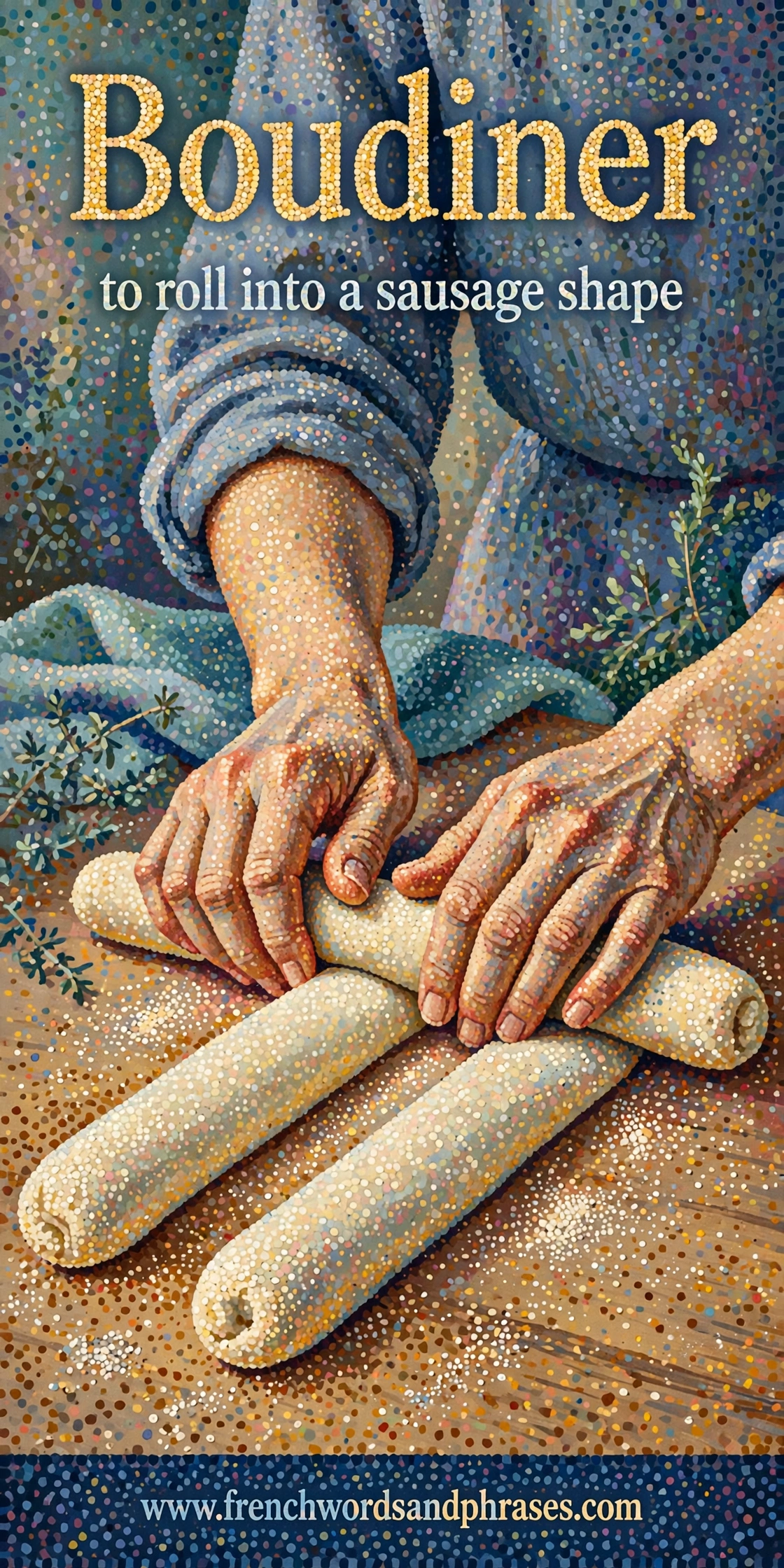
Boudiner means to truss into a sausage shape — to roll, twist or squeeze something long and soft until it looks like a little boudin, a sausage.
A nurse rolling a bandage tightly round a finger, dough twisted into plump little coils, a dress that squeezes its wearer like a casing — boudiner is the verb of the sausage shape: whatever long thing gets rolled or pinched into plump segments has been boudiné.
In this guide, you’ll learn how to conjugate boudiner in all the major French tenses and moods. Explore complete conjugation tables, French examples, English translations, and practice quizzes.
Understanding the French Verb Boudiner
Boudiner is a regular French verb belonging to the first group of verbs, those ending in-er.
It means to roll into a sausage shape. It is a specialist’s verb — nurses, bakers and hairdressers roll things boudinés — while everyone else mostly uses the participle for tight clothes and sausage-shaped curls, always with a smile in the voice.
Verb classification: First group (-er)
Auxiliary verb: Avoir
Past participle: boudiné
Present participle: boudinant
English equivalents: To roll up tight, to twist into a sausage shape; boudiner un doigt — to bandage a finger tightly round and round; boudiner la pâte — to roll dough into coils; être boudiné dans une robe — to be squeezed into a dress (familiar); des cheveux boudinés — hair in tight sausage curls.
One important detail: boudiner is the verb of un boudin — not only the black pudding of French markets, but any plump little roll, including the sausage curls of old-fashioned hairstyles. In daily life you will meet it most often in its past participle, and in the familiar, slightly cruel compliment-insult être boudiné: squeezed into clothes a size too small, like filling in a casing. As a verb of action it belongs to bandages, dough and hairdressing. It is a regular -er: je boudine, nous boudinons, ils boudinent.
Experience the Word
Boudiner is the verb of the tight roll — bandage, dough and curls wound round until they bulge like little sausages.
Imagine a school nurse’s office at break time. A boy holds out a grazed finger, and the nurse winds the bandage round it turn after turn, snug and even: elle boudine le doigt, ties the end, and sends him back to the playground with a finger like a tiny white sausage.
Five turns of bandage, one neat knot. The finger is boudiné — rolled tight — and the game can go on.
How to Conjugate Boudiner: Complete French Conjugation Guide
Let’s explore every major conjugation of boudiner, beginning with the indicative mood.
How to Conjugate Boudiner in the Indicative Mood
The indicative mood is used to express facts, observations, actions, and events.
How to Conjugate Boudiner in the Present Tense (Présent)
Used for actions happening now, habitual actions, and general truths.
| Subject | Conjugation |
|---|---|
| je | boudine |
| tu | boudines |
| il / elle | boudine |
| nous | boudinons |
| vous | boudinez |
| ils / elles | boudinent |
Example
L’infirmière boudine le doigt blessé avec soin.
The nurse bandages the injured finger tightly, round and round.
Quick Quiz 1
Complete the sentence:
Nous ______ la pâte en petits rouleaux.
Reveal the answer
boudinons
Nous boudinons la pâte en petits rouleaux.
We roll the dough into little coils.
How to Conjugate Boudiner in the Passé Composé
Used for completed actions in the past. Boudiner takes the auxiliary verb avoir.
| Subject | Conjugation |
|---|---|
| j’ | ai boudiné |
| tu | as boudiné |
| il / elle | a boudiné |
| nous | avons boudiné |
| vous | avez boudiné |
| ils / elles | ont boudiné |
Example
Elle a boudiné la pâte en petits rouleaux.
She rolled the dough into little coils.
How to Conjugate Boudiner in the Imparfait (Imperfect Tense)
Used for habitual past actions, descriptions, and ongoing situations in the past.
| Subject | Conjugation |
|---|---|
| je | boudinais |
| tu | boudinais |
| il / elle | boudinait |
| nous | boudinions |
| vous | boudiniez |
| ils / elles | boudinaient |
Example
Les coiffeuses boudinaient les cheveux des mariées.
Hairdressers used to put brides’ hair into sausage curls.
Quick Quiz 2
Choose the correct form:
She rolled the dough into coils.
Elle ______ la pâte. (a boudiné / est boudiné)
Reveal the answer
a boudiné
Elle a boudiné la pâte.
Boudiner takes avoir.
How to Conjugate Boudiner in the Plus-que-parfait
Used to describe an action that had already been completed before another past event.
| Subject | Conjugation |
|---|---|
| j’ | avais boudiné |
| tu | avais boudiné |
| il / elle | avait boudiné |
| nous | avions boudiné |
| vous | aviez boudiné |
| ils / elles | avaient boudiné |
Example
Il avait boudiné le bandage trop serré.
He had wound the bandage too tight.
How to Conjugate Boudiner in the Passé Simple
Primarily used in formal writing, literature, and historical narratives. It is rarely used in everyday conversation.
| Subject | Conjugation |
|---|---|
| je | boudinai |
| tu | boudinas |
| il / elle | boudina |
| nous | boudinâmes |
| vous | boudinâtes |
| ils / elles | boudinèrent |
Example
La grand-mère boudina les mèches de la fillette.
The grandmother twisted the little girl’s hair into sausage curls.
How to Conjugate Boudiner in the Passé Antérieur
A literary tense used to express an action completed immediately before another past action, generally in the passé simple.
| Subject | Conjugation |
|---|---|
| j’ | eus boudiné |
| tu | eus boudiné |
| il / elle | eut boudiné |
| nous | eûmes boudiné |
| vous | eûtes boudiné |
| ils / elles | eurent boudiné |
Example
Quand elle eut boudiné le dernier rouleau de pâte, elle le posa sur la plaque.
When she had rolled the last coil of dough, she laid it on the tray.
How to Conjugate Boudiner in the Future Tense (Futur Simple)
Used to describe actions that will take place in the future.
| Subject | Conjugation |
|---|---|
| je | boudinerai |
| tu | boudineras |
| il / elle | boudinera |
| nous | boudinerons |
| vous | boudinerez |
| ils / elles | boudineront |
Example
Tu boudineras le doigt avant de remettre le gant.
You will bandage the finger tightly before putting the glove back on.
How to Conjugate Boudiner in the Futur Antérieur (Future Perfect)
Used for an action that will have been completed before a particular point in the future.
| Subject | Conjugation |
|---|---|
| j’ | aurai boudiné |
| tu | auras boudiné |
| il / elle | aura boudiné |
| nous | aurons boudiné |
| vous | aurez boudiné |
| ils / elles | auront boudiné |
Example
À midi, elle aura boudiné toutes les mèches.
By noon, she will have twisted all the locks of hair into curls.
How to Conjugate Boudiner in the Near Future (Futur Proche)
Used to describe something that is going to happen soon. Formed with aller + infinitive.
| Subject | Conjugation |
|---|---|
| je | vais boudiner |
| tu | vas boudiner |
| il / elle | va boudiner |
| nous | allons boudiner |
| vous | allez boudiner |
| ils / elles | vont boudiner |
Example
Attention, tu vas boudiner ce bandage trop fort.
Careful, you are going to wind that bandage too tight.
How to Conjugate Boudiner in the Conditional Mood
The conditional mood expresses what would happen under certain circumstances. It is also frequently used to make polite requests or express wishes.
How to Conjugate Boudiner in the Present Conditional
| Subject | Conjugation |
|---|---|
| je | boudinerais |
| tu | boudinerais |
| il / elle | boudinerait |
| nous | boudinerions |
| vous | boudineriez |
| ils / elles | boudineraient |
Example
Avec plus de soin, il boudinerait le doigt sans serrer.
With more care, he would bandage the finger without squeezing.
How to Conjugate Boudiner in the Past Conditional
| Subject | Conjugation |
|---|---|
| j’ | aurais boudiné |
| tu | aurais boudiné |
| il / elle | aurait boudiné |
| nous | aurions boudiné |
| vous | auriez boudiné |
| ils / elles | auraient boudiné |
Example
Elle aurait boudiné la pâte en rouleaux plus fins.
She would have rolled the dough into thinner coils.
Boudiner in the Literary Past Conditional Form
This less common literary form uses the imperfect subjunctive of avoir.
| Subject | Conjugation |
|---|---|
| j’ | eusse boudiné |
| tu | eusses boudiné |
| il / elle | eût boudiné |
| nous | eussions boudiné |
| vous | eussiez boudiné |
| ils / elles | eussent boudiné |
Example
La coiffeuse eût boudiné les cheveux de la mariée dès l’aube.
The hairdresser would have put the bride’s hair in sausage curls at dawn.
How to Conjugate Boudiner in the Subjunctive Mood
The subjunctive is used to express wishes, emotions, doubts, necessity, and uncertainty. It frequently follows expressions such as il faut que (it is necessary that) or bien que (although).
How to Conjugate Boudiner in the Present Subjunctive
| Subject | Conjugation |
|---|---|
| que je | boudine |
| que tu | boudines |
| qu’il / qu’elle | boudine |
| que nous | boudinions |
| que vous | boudiniez |
| qu’ils / qu’elles | boudinent |
Example
Il faut que tu boudines ce doigt avant l’entraînement.
You must bandage this finger tightly before training.
Quick Quiz 3
Complete the sentence using the subjunctive:
Il faut que vous ______ le doigt sans trop serrer.
Reveal the answer
boudiniez
Il faut que vous boudiniez le doigt sans trop serrer.
You must bandage the finger tightly without squeezing too much.
How to Conjugate Boudiner in the Imperfect Subjunctive
A literary tense, rarely encountered in modern spoken French.
| Subject | Conjugation |
|---|---|
| que je | boudinasse |
| que tu | boudinasses |
| qu’il / qu’elle | boudinât |
| que nous | boudinassions |
| que vous | boudinassiez |
| qu’ils / qu’elles | boudinassent |
Example
On ne voulait pas qu’elle boudinât les cheveux si serré.
Nobody wanted her to twist the hair so tight.
How to Conjugate Boudiner in the Pluperfect Subjunctive
A literary construction used to express an action completed before another past action.
| Subject | Conjugation |
|---|---|
| que j’ | eusse boudiné |
| que tu | eusses boudiné |
| qu’il / qu’elle | eût boudiné |
| que nous | eussions boudiné |
| que vous | eussiez boudiné |
| qu’ils / qu’elles | eussent boudiné |
Example
On disait que la boulangère eût boudiné la pâte toute la nuit.
People said the baker had rolled the dough into coils all night.
How to Conjugate Boudiner in the Past Subjunctive
| Subject | Conjugation |
|---|---|
| que j’ | aie boudiné |
| que tu | aies boudiné |
| qu’il / qu’elle | ait boudiné |
| que nous | ayons boudiné |
| que vous | ayez boudiné |
| qu’ils / qu’elles | aient boudiné |
Example
Je suis content qu’elle ait boudiné le bandage correctement.
I am glad she wound the bandage properly.
How to Conjugate Boudiner in the Imperative
The imperative is used to give commands, instructions, invitations, or suggestions. Subject pronouns are omitted.
How to Conjugate Boudiner in the Present Imperative
| Person | Conjugation |
|---|---|
| (tu) | boudine |
| (nous) | boudinons |
| (vous) | boudinez |
Example
Boudine ce doigt, mais sans trop serrer !
Bandage this finger tightly, but not too tight!
Quick Quiz 4
How would you say Bandage this finger tightly (tu form)?
Reveal the answer
Boudine ce doigt !
French Participles of Boudiner
Participles are verb forms that can be used in compound tenses and other grammatical constructions.
Present Participle of Boudiner
boudinant
En boudinant la pâte, elle forme de petits pains tordus.
By rolling the dough into coils, she makes little twisted loaves.
Past Participle of Boudiner
boudiné
Boudinée dans sa robe neuve, elle osait à peine respirer.
Squeezed into her new dress, she hardly dared breathe.
Boudiner in Everyday French: Real-Life Examples
Now that you know the conjugations, let’s see how boudiner appears in everyday French.
Example 1 — Present
L’infirmière boudine le doigt blessé avec soin.
The nurse bandages the injured finger tightly, round and round.
Example 2 — Passé composé
Elle a boudiné la pâte en petits rouleaux.
She rolled the dough into little coils.
Example 3 — Imparfait
Les coiffeuses boudinaient les cheveux des mariées.
Hairdressers used to put brides’ hair into sausage curls.
Example 4 — Future
Tu boudineras le doigt avant de remettre le gant.
You will bandage the finger tightly before putting the glove back on.
Example 5 — Conditional
Elle boudinerait la pâte en rouleaux plus fins.
She would roll the dough into thinner coils.
Example 6 — Imperative
Boudine ce doigt, mais sans trop serrer !
Bandage this finger tightly, but not too tight!
Beyond Translation: The Meaning of Boudiner
The boudin is one of France’s oldest foods, and its shape colonised the language: curls, bandages, even the inflatable rolls on a boat’s side can be boudins — and boudiner is the verb that makes them.
A compliment it is not.
To say someone is boudiné dans son jean is to say the jean lost the argument — the familiar sense keeps the sausage-maker’s honesty about anything squeezed into a casing.
How to Remember the French Verb Boudiner
Remember it this way: Boudiner is about a finger rolled up tight like a little sausage.
- Un boudin is a plump little roll: boudiner rolls things into that shape.
- You will meet the participle most: boudiné — bandaged tight, or squeezed into tight clothes.
- Regular -er: je boudine, nous boudinons, past participle boudiné.
The key idea is a finger rolled up tight like a little sausage.
Test Your Knowledge of Boudiner
Let’s see how much you’ve learned. Try answering these questions before revealing the answers.
Question 1
What shape does boudiner give to things?
Reveal the answer
The shape of a boudin — a plump little sausage-shaped roll: bandages, dough coils, tight curls.
Question 2
How do you say The nurse bandages the injured finger in French?
Reveal the answer
L’infirmière boudine le doigt blessé.
Question 3
Translate: She rolled the dough into little coils.
Reveal the answer
Elle a boudiné la pâte en petits rouleaux.
Question 4
What is the past participle of boudiner?
Reveal the answer
Boudiné — as in être boudiné dans une robe, squeezed into a dress.
Question 5
Complete the sentence:
Il faut que tu ______ ce doigt avant l’entraînement.
Reveal the answer
boudines
Il faut que tu boudines ce doigt avant l’entraînement.
You must bandage this finger tightly before training.
Your Final Challenge
Can You Use It?
How would you say this in French?
She winds the bandage tightly round the finger, and the little footballer runs off again.
Reveal the answer
Elle boudine le bandage autour du doigt, et le petit footballeur repart en courant.
She winds the bandage tightly round the finger, and the little footballer runs off again.
A little French. A little curiosity. A richer everyday life.
LEARN FRENCH ONE WORD AT A TIME