A French Word to Live By
How to Conjugate Botaniser in French
/bɔ.ta.ni.ze/
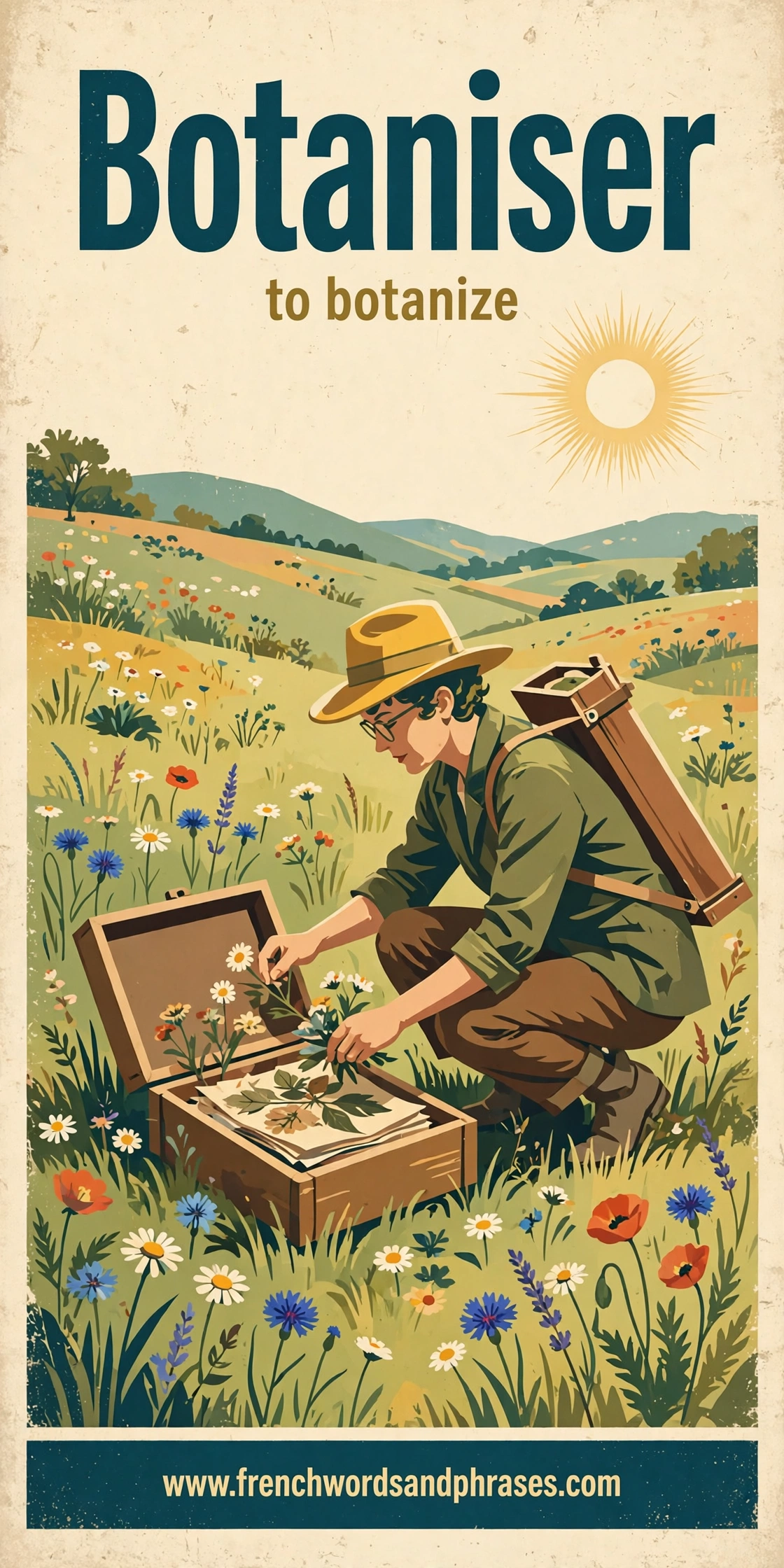
Botaniser means to botanize — to go out into fields and hills collecting and studying plants.
A canvas bag, a plant press, a hand lens, and a whole hillside of flowers — botaniser is the verb of the amateur botanist at work: walking slowly, stopping often, and coming home with a herbarium.
In this guide, you’ll learn how to conjugate botaniser in all the major French tenses and moods. Explore complete conjugation tables, French examples, English translations, and practice quizzes.
Understanding the French Verb Botaniser
Botaniser is a regular French verb belonging to the first group of verbs, those ending in-er.
It means to botanize. It is the classic verb of school outings, natural-history societies and country holidays: always outdoors, always on foot, and always slower than an ordinary walk, because every verge, ditch and hillside is worth a stop.
Verb classification: First group (-er)
Auxiliary verb: Avoir
Past participle: botanisé
Present participle: botanisant
English equivalents: To botanize, to collect plants; aller botaniser — to go botanizing; botaniser dans les Alpes — to botanize in the Alps; un herbier — a herbarium, the pressed collection you bring back; herboriser — the older synonym, gathering (especially medicinal) plants.
No trap in the forms: botaniser is a regular -iser verb — je botanise, nous botanisons, ils botanisent, past participle botanisé. The distinctions worth learning are in the family: la botanique is the science, un botaniste is the scientist, and the amateur who goes out with a press and a hand lens va botaniser for pleasure. Its older near-synonym herboriser leans towards gathering — historically, gathering medicinal plants — where botaniser leans towards studying and naming.
Experience the Word
Botaniser is the verb of the slowest walk in the world — a walk measured in flowers, not in kilometres.
Imagine a retired schoolteacher above a Provençal village in May. Three hours to cover one hillside path: orchids in the notebook, leaves in the press, Latin names murmured like old friends — elle botanise, and the path can wait.
She has walked barely a mile. She has botanized — botanisé — a whole spring hillside into her bag.
How to Conjugate Botaniser: Complete French Conjugation Guide
Let’s explore every major conjugation of botaniser, beginning with the indicative mood.
How to Conjugate Botaniser in the Indicative Mood
The indicative mood is used to express facts, observations, actions, and events.
How to Conjugate Botaniser in the Present Tense (Présent)
Used for actions happening now, habitual actions, and general truths.
| Subject | Conjugation |
|---|---|
| je | botanise |
| tu | botanises |
| il / elle | botanise |
| nous | botanisons |
| vous | botanisez |
| ils / elles | botanisent |
Example
Chaque printemps, ils botanisent dans les Pyrénées.
Every spring, they botanize in the Pyrenees.
Quick Quiz 1
Complete the sentence:
Chaque été, nous ______ dans les Alpes.
Reveal the answer
botanisons
Chaque été, nous botanisons dans les Alpes.
Every summer, we botanize in the Alps.
How to Conjugate Botaniser in the Passé Composé
Used for completed actions in the past. Botaniser takes the auxiliary verb avoir.
| Subject | Conjugation |
|---|---|
| j’ | ai botanisé |
| tu | as botanisé |
| il / elle | a botanisé |
| nous | avons botanisé |
| vous | avez botanisé |
| ils / elles | ont botanisé |
Example
Nous avons botanisé toute la journée dans les prés.
We botanized all day in the meadows.
How to Conjugate Botaniser in the Imparfait (Imperfect Tense)
Used for habitual past actions, descriptions, and ongoing situations in the past.
| Subject | Conjugation |
|---|---|
| je | botanisais |
| tu | botanisais |
| il / elle | botanisait |
| nous | botanisions |
| vous | botanisiez |
| ils / elles | botanisaient |
Example
Enfant, il botanisait avec son grand-père.
As a child, he used to botanize with his grandfather.
Quick Quiz 2
Choose the correct form:
She botanized with her grandfather.
Elle ______ avec son grand-père. (a botanisé / est botanisé)
Reveal the answer
a botanisé
Elle a botanisé avec son grand-père.
Botaniser takes avoir.
How to Conjugate Botaniser in the Plus-que-parfait
Used to describe an action that had already been completed before another past event.
| Subject | Conjugation |
|---|---|
| j’ | avais botanisé |
| tu | avais botanisé |
| il / elle | avait botanisé |
| nous | avions botanisé |
| vous | aviez botanisé |
| ils / elles | avaient botanisé |
Example
Elle avait botanisé des années avant d’écrire son guide.
She had botanized for years before writing her guide.
How to Conjugate Botaniser in the Passé Simple
Primarily used in formal writing, literature, and historical narratives. It is rarely used in everyday conversation.
| Subject | Conjugation |
|---|---|
| je | botanisai |
| tu | botanisas |
| il / elle | botanisa |
| nous | botanisâmes |
| vous | botanisâtes |
| ils / elles | botanisèrent |
Example
Le naturaliste botanisa tout l’été dans les Alpes.
The naturalist botanized all summer in the Alps.
How to Conjugate Botaniser in the Passé Antérieur
A literary tense used to express an action completed immediately before another past action, generally in the passé simple.
| Subject | Conjugation |
|---|---|
| j’ | eus botanisé |
| tu | eus botanisé |
| il / elle | eut botanisé |
| nous | eûmes botanisé |
| vous | eûtes botanisé |
| ils / elles | eurent botanisé |
Example
Quand ils eurent botanisé la colline entière, ils rentrèrent au village.
When they had botanized the whole hill, they went back to the village.
How to Conjugate Botaniser in the Future Tense (Futur Simple)
Used to describe actions that will take place in the future.
| Subject | Conjugation |
|---|---|
| je | botaniserai |
| tu | botaniseras |
| il / elle | botanisera |
| nous | botaniserons |
| vous | botaniserez |
| ils / elles | botaniseront |
Example
Demain, nous botaniserons le long du canal.
Tomorrow, we shall botanize along the canal.
How to Conjugate Botaniser in the Futur Antérieur (Future Perfect)
Used for an action that will have been completed before a particular point in the future.
| Subject | Conjugation |
|---|---|
| j’ | aurai botanisé |
| tu | auras botanisé |
| il / elle | aura botanisé |
| nous | aurons botanisé |
| vous | aurez botanisé |
| ils / elles | auront botanisé |
Example
À la fin de l’été, elle aura botanisé toutes les vallées du canton.
By the end of summer, she will have botanized every valley in the district.
How to Conjugate Botaniser in the Near Future (Futur Proche)
Used to describe something that is going to happen soon. Formed with aller + infinitive.
| Subject | Conjugation |
|---|---|
| je | vais botaniser |
| tu | vas botaniser |
| il / elle | va botaniser |
| nous | allons botaniser |
| vous | allez botaniser |
| ils / elles | vont botaniser |
Example
Regarde ces fleurs, je vais botaniser un peu !
Look at those flowers, I’m going to do a bit of botanizing!
How to Conjugate Botaniser in the Conditional Mood
The conditional mood expresses what would happen under certain circumstances. It is also frequently used to make polite requests or express wishes.
How to Conjugate Botaniser in the Present Conditional
| Subject | Conjugation |
|---|---|
| je | botaniserais |
| tu | botaniserais |
| il / elle | botaniserait |
| nous | botaniserions |
| vous | botaniseriez |
| ils / elles | botaniseraient |
Example
Avec un bon guide, tu botaniserais plus efficacement.
With a good guide, you would botanize more effectively.
How to Conjugate Botaniser in the Past Conditional
| Subject | Conjugation |
|---|---|
| j’ | aurais botanisé |
| tu | aurais botanisé |
| il / elle | aurait botanisé |
| nous | aurions botanisé |
| vous | auriez botanisé |
| ils / elles | auraient botanisé |
Example
Ils auraient botanisé dimanche s’il n’avait pas plu.
They would have botanized on Sunday if it had not rained.
Botaniser in the Literary Past Conditional Form
This less common literary form uses the imperfect subjunctive of avoir.
| Subject | Conjugation |
|---|---|
| j’ | eusse botanisé |
| tu | eusses botanisé |
| il / elle | eût botanisé |
| nous | eussions botanisé |
| vous | eussiez botanisé |
| ils / elles | eussent botanisé |
Example
Il eût botanisé tout l’été sans la mobilisation.
He would have botanized all summer but for the call-up.
How to Conjugate Botaniser in the Subjunctive Mood
The subjunctive is used to express wishes, emotions, doubts, necessity, and uncertainty. It frequently follows expressions such as il faut que (it is necessary that) or bien que (although).
How to Conjugate Botaniser in the Present Subjunctive
| Subject | Conjugation |
|---|---|
| que je | botanise |
| que tu | botanises |
| qu’il / qu’elle | botanise |
| que nous | botanisions |
| que vous | botanisiez |
| qu’ils / qu’elles | botanisent |
Example
Il faut que vous botanisiez avant la floraison.
You must botanize before the flowering is over.
Quick Quiz 3
Complete the sentence using the subjunctive:
Il faut que tu ______ avant la floraison.
Reveal the answer
botanises
Il faut que tu botanises avant la floraison.
You must botanize before the flowering is over.
How to Conjugate Botaniser in the Imperfect Subjunctive
A literary tense, rarely encountered in modern spoken French.
| Subject | Conjugation |
|---|---|
| que je | botanisasse |
| que tu | botanisasses |
| qu’il / qu’elle | botanisât |
| que nous | botanisassions |
| que vous | botanisassiez |
| qu’ils / qu’elles | botanisassent |
Example
Je ne savais pas qu’elle botanisât si savamment.
I did not know she botanized so knowledgeably.
How to Conjugate Botaniser in the Pluperfect Subjunctive
A literary construction used to express an action completed before another past action.
| Subject | Conjugation |
|---|---|
| que j’ | eusse botanisé |
| que tu | eusses botanisé |
| qu’il / qu’elle | eût botanisé |
| que nous | eussions botanisé |
| que vous | eussiez botanisé |
| qu’ils / qu’elles | eussent botanisé |
Example
On disait qu’ils eussent botanisé dans tout le pays.
People said they had botanized all over the country.
How to Conjugate Botaniser in the Past Subjunctive
| Subject | Conjugation |
|---|---|
| que j’ | aie botanisé |
| que tu | aies botanisé |
| qu’il / qu’elle | ait botanisé |
| que nous | ayons botanisé |
| que vous | ayez botanisé |
| qu’ils / qu’elles | aient botanisé |
Example
Je suis heureux qu’ils aient botanisé ensemble.
I am glad they botanized together.
How to Conjugate Botaniser in the Imperative
The imperative is used to give commands, instructions, invitations, or suggestions. Subject pronouns are omitted.
How to Conjugate Botaniser in the Present Imperative
| Person | Conjugation |
|---|---|
| (tu) | botanise |
| (nous) | botanisons |
| (vous) | botanisez |
Example
Botanisez doucement, ne cueillez pas les espèces protégées !
Botanize gently, do not pick protected species!
Quick Quiz 4
How would you say Botanize gently (tu form)?
Reveal the answer
Botanise doucement !
French Participles of Botaniser
Participles are verb forms that can be used in compound tenses and other grammatical constructions.
Present Participle of Botaniser
botanisant
En botanisant, on apprend le nom de chaque fleur.
By botanizing, you learn the name of every flower.
Past Participle of Botaniser
botanisé
Botanisées avec soin, ces collines ont livré trois espèces rares.
Botanized with care, these hills yielded three rare species.
Botaniser in Everyday French: Real-Life Examples
Now that you know the conjugations, let’s see how botaniser appears in everyday French.
Example 1 — Present
Ils botanisent dans les Pyrénées.
They botanize in the Pyrenees.
Example 2 — Passé composé
Nous avons botanisé toute la journée.
We botanized all day.
Example 3 — Imparfait
Il botanisait avec son grand-père.
He used to botanize with his grandfather.
Example 4 — Future
Nous botaniserons le long du canal.
We shall botanize along the canal.
Example 5 — Conditional
Tu botaniserais mieux avec un guide.
You would botanize better with a guide.
Example 6 — Imperative
Botanise doucement, sans tout cueillir !
Botanize gently, without picking everything!
Beyond Translation: The Meaning of Botaniser
From the Greek botanē, a plant or herb, botaniser belongs to the great age of amateur natural history, when every schoolteacher and curé kept a herbier and Rousseau himself botanisait, writing famous letters about his walks.
The trophy of the verb is the herbier.
Pressed flowers between sheets of paper, each with its Latin name and the date of its hillside: to botaniser is to turn a landscape into a library, one specimen at a time.
How to Remember the French Verb Botaniser
Remember it this way: Botaniser is about the slowest walk in the world — a hillside measured in flowers.
- Aller botaniser is the classic phrase — the outing itself: bag, press, hand lens, hillside.
- Regular -iser forms throughout: je botanise, nous botanisons, past participle botanisé.
- Rousseau’s hobby: the botaniste studies in the laboratory, the amateur botanise on the hill.
The key idea is the slowest walk in the world — a hillside measured in flowers.
Test Your Knowledge of Botaniser
Let’s see how much you’ve learned. Try answering these questions before revealing the answers.
Question 1
What do you bring back from an outing spent botanising?
Reveal the answer
Un herbier — a collection of pressed, named plants.
Question 2
How do you say We botanized all day in the meadows in French?
Reveal the answer
Nous avons botanisé toute la journée dans les prés.
Question 3
Translate: Ils botanisent dans les Alpes.
Reveal the answer
They botanize in the Alps.
Question 4
What is the past participle of botaniser?
Reveal the answer
Botanisé.
Question 5
Complete the sentence:
Il faut que vous ______ avant la floraison.
Reveal the answer
botanisiez
Il faut que vous botanisiez avant la floraison.
You must botanize before the flowering is over.
Your Final Challenge
Can You Use It?
How would you say this in French?
She has been botanizing since dawn on the hill, and every flower gives her a name to bring home.
Reveal the answer
Elle botanise depuis l’aube sur la colline, et chaque fleur lui donne un nom à rapporter.
She has been botanizing since dawn on the hill, and every flower gives her a name to bring home.
A little French. A little curiosity. A richer everyday life.
LEARN FRENCH ONE WORD AT A TIME