A French Word to Live By
How to Conjugate Bostonner in French
/bɔs.tɔ.ne/
Bostonner means to play boston, to dance the boston — to pass the evening with the card game, or the slow waltz, that Belle Époque France borrowed from America.
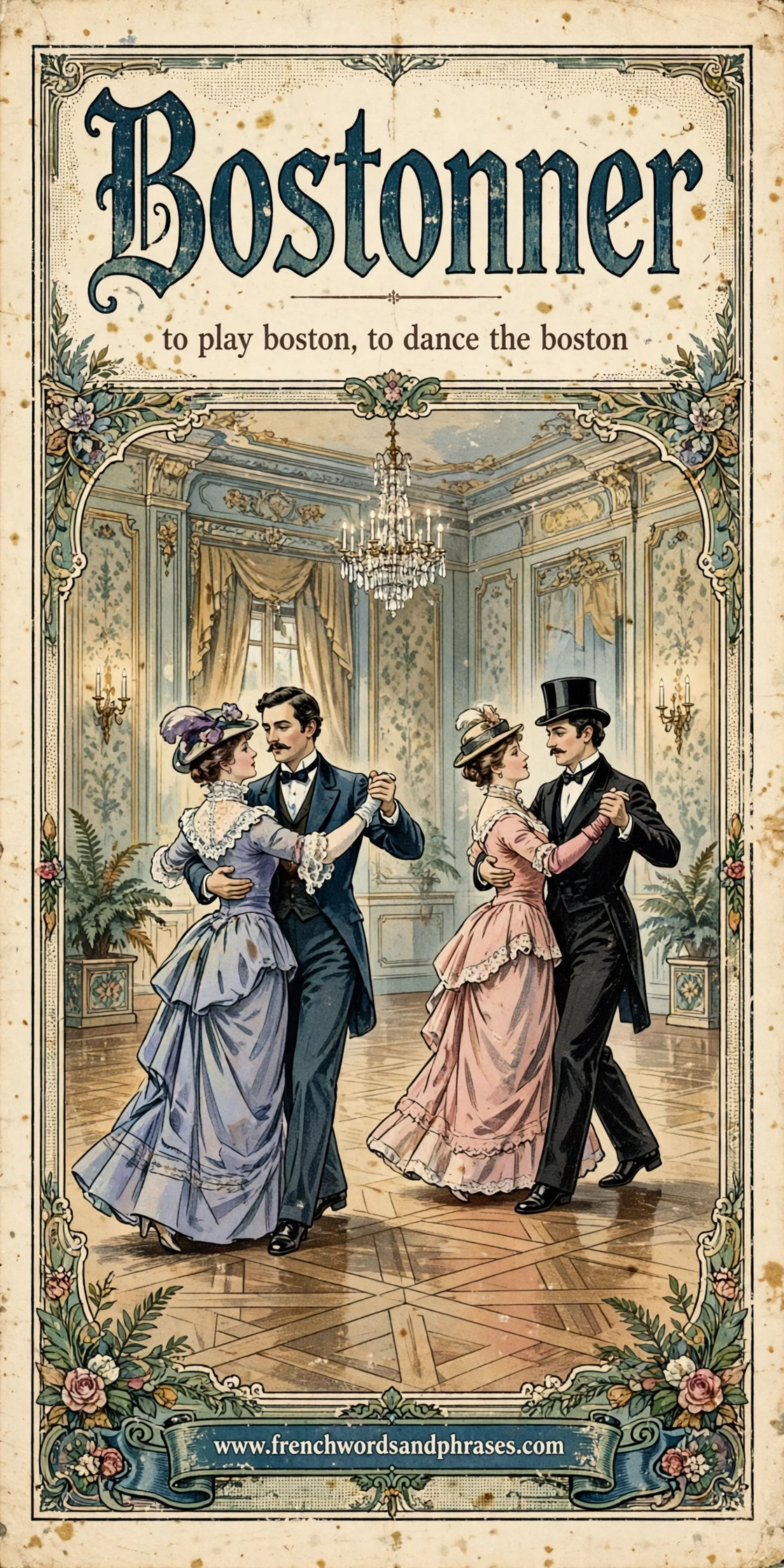
A Paris salon in 1905: cards on the green baize in one room, a slow, gliding waltz in the next — bostonner is the verb of that evening, named twice over for Boston, Massachusetts: the whist-like card game and the dance that scandalised the quick waltzers.
In this guide, you’ll learn how to conjugate bostonner in all the major French tenses and moods. Explore complete conjugation tables, French examples, English translations, and practice quizzes.
Understanding the French Verb Bostonner
Bostonner is a regular French verb belonging to the first group of verbs, those ending in-er.
It means to play boston, to dance the boston. You will meet bostonner in novels and memoirs of the Belle Époque rather than in modern card rooms: grandparents bostonnent in Proust’s century, at the green table after dinner or on the parquet of a provincial ball, and the word itself is a date stamp for a scene.
Verb classification: First group (-er)
Auxiliary verb: Avoir
Past participle: bostonné
Present participle: bostonnant
English equivalents: To play boston (cards); to dance the boston (a slow waltz); une partie de boston — a game of boston; annoncer une misère — to bid misère (at boston); le boston — the card game, the dance.
There is no trap in the forms — bostonner is a perfectly regular -er verb: je bostonne, nous bostonnons, ils bostonnent, past participle bostonné — but keep the name’s spelling intact: the noun le boston takes one s and the verb doubles the n of its stem throughout, bostonn-. The real lesson is historical: the verb is a period piece, and both its senses — the card game, a whist descendant with bidding, fashionable around 1900, and the slow, dipping waltz that replaced the whirl of the valse — belong to the France of before 1914.
Experience the Word
Bostonner is the verb of an evening in 1905 — cards, candlelight, and a waltz slow enough to talk through.
Imagine a bourgeois salon after dinner. At the green table, four players bostonnent en silence, misères et passes annoncées à voix basse; behind the screen, to a piano played softly, the young people bostonnent aussi — turning slowly, scandalously slowly, in the new American waltz.
The cards are put away, the piano is closed. They have bostonné — played and danced the night into memory.
How to Conjugate Bostonner: Complete French Conjugation Guide
Let’s explore every major conjugation of bostonner, beginning with the indicative mood.
How to Conjugate Bostonner in the Indicative Mood
The indicative mood is used to express facts, observations, actions, and events.
How to Conjugate Bostonner in the Present Tense (Présent)
Used for actions happening now, habitual actions, and general truths.
| Subject | Conjugation |
|---|---|
| je | bostonne |
| tu | bostonnes |
| il / elle | bostonne |
| nous | bostonnons |
| vous | bostonnez |
| ils / elles | bostonnent |
Example
Le samedi soir, on bostonne chez les Martin.
On Saturday evenings, they play boston at the Martins’.
Quick Quiz 1
Complete the sentence:
Le samedi, nous ______ chez les Martin.
Reveal the answer
bostonnons
Le samedi, nous bostonnons chez les Martin.
On Saturdays, we play boston at the Martins’.
How to Conjugate Bostonner in the Passé Composé
Used for completed actions in the past. Bostonner takes the auxiliary verb avoir.
| Subject | Conjugation |
|---|---|
| j’ | ai bostonné |
| tu | as bostonné |
| il / elle | a bostonné |
| nous | avons bostonné |
| vous | avez bostonné |
| ils / elles | ont bostonné |
Example
Ils ont bostonné jusqu’à minuit.
They played boston until midnight.
How to Conjugate Bostonner in the Imparfait (Imperfect Tense)
Used for habitual past actions, descriptions, and ongoing situations in the past.
| Subject | Conjugation |
|---|---|
| je | bostonnais |
| tu | bostonnais |
| il / elle | bostonnait |
| nous | bostonnions |
| vous | bostonniez |
| ils / elles | bostonnaient |
Example
Nos grands-parents bostonnaient après le dîner.
Our grandparents used to play boston after dinner.
Quick Quiz 2
Choose the correct form:
They played boston until midnight.
Ils ______ jusqu’à minuit. (ont bostonné / sont bostonné)
Reveal the answer
ont bostonné
Ils ont bostonné jusqu’à minuit.
Bostonner takes avoir.
How to Conjugate Bostonner in the Plus-que-parfait
Used to describe an action that had already been completed before another past event.
| Subject | Conjugation |
|---|---|
| j’ | avais bostonné |
| tu | avais bostonné |
| il / elle | avait bostonné |
| nous | avions bostonné |
| vous | aviez bostonné |
| ils / elles | avaient bostonné |
Example
Elle avait bostonné toute la soirée avant le bal.
She had played boston all evening before the ball.
How to Conjugate Bostonner in the Passé Simple
Primarily used in formal writing, literature, and historical narratives. It is rarely used in everyday conversation.
| Subject | Conjugation |
|---|---|
| je | bostonnai |
| tu | bostonnas |
| il / elle | bostonna |
| nous | bostonnâmes |
| vous | bostonnâtes |
| ils / elles | bostonnèrent |
Example
Ce soir-là, les invités bostonnèrent jusqu’à l’aube.
That evening, the guests played boston until dawn.
How to Conjugate Bostonner in the Passé Antérieur
A literary tense used to express an action completed immediately before another past action, generally in the passé simple.
| Subject | Conjugation |
|---|---|
| j’ | eus bostonné |
| tu | eus bostonné |
| il / elle | eut bostonné |
| nous | eûmes bostonné |
| vous | eûtes bostonné |
| ils / elles | eurent bostonné |
Example
Quand ils eurent bostonné trois heures, le bal commença.
When they had played boston for three hours, the ball began.
How to Conjugate Bostonner in the Future Tense (Futur Simple)
Used to describe actions that will take place in the future.
| Subject | Conjugation |
|---|---|
| je | bostonnerai |
| tu | bostonneras |
| il / elle | bostonnera |
| nous | bostonnerons |
| vous | bostonnerez |
| ils / elles | bostonneront |
Example
Ce soir, nous bostonnerons après le souper.
This evening, we shall play boston after supper.
How to Conjugate Bostonner in the Futur Antérieur (Future Perfect)
Used for an action that will have been completed before a particular point in the future.
| Subject | Conjugation |
|---|---|
| j’ | aurai bostonné |
| tu | auras bostonné |
| il / elle | aura bostonné |
| nous | aurons bostonné |
| vous | aurez bostonné |
| ils / elles | auront bostonné |
Example
À minuit, ils auront bostonné quatre parties.
By midnight, they will have played four games of boston.
How to Conjugate Bostonner in the Near Future (Futur Proche)
Used to describe something that is going to happen soon. Formed with aller + infinitive.
| Subject | Conjugation |
|---|---|
| je | vais bostonner |
| tu | vas bostonner |
| il / elle | va bostonner |
| nous | allons bostonner |
| vous | allez bostonner |
| ils / elles | vont bostonner |
Example
Installez la table, on va bostonner !
Set up the table, we’re going to play boston!
How to Conjugate Bostonner in the Conditional Mood
The conditional mood expresses what would happen under certain circumstances. It is also frequently used to make polite requests or express wishes.
How to Conjugate Bostonner in the Present Conditional
| Subject | Conjugation |
|---|---|
| je | bostonnerais |
| tu | bostonnerais |
| il / elle | bostonnerait |
| nous | bostonnerions |
| vous | bostonneriez |
| ils / elles | bostonneraient |
Example
Sans les enfants, nous bostonnerions tous les soirs.
Without the children, we would play boston every evening.
How to Conjugate Bostonner in the Past Conditional
| Subject | Conjugation |
|---|---|
| j’ | aurais bostonné |
| tu | aurais bostonné |
| il / elle | aurait bostonné |
| nous | aurions bostonné |
| vous | auriez bostonné |
| ils / elles | auraient bostonné |
Example
Elle aurait bostonné si on l’avait invitée à la table.
She would have played boston if she had been invited to the table.
Bostonner in the Literary Past Conditional Form
This less common literary form uses the imperfect subjunctive of avoir.
| Subject | Conjugation |
|---|---|
| j’ | eusse bostonné |
| tu | eusses bostonné |
| il / elle | eût bostonné |
| nous | eussions bostonné |
| vous | eussiez bostonné |
| ils / elles | eussent bostonné |
Example
Il eût bostonné volontiers sans la migraine de sa femme.
He would gladly have played boston but for his wife’s headache.
How to Conjugate Bostonner in the Subjunctive Mood
The subjunctive is used to express wishes, emotions, doubts, necessity, and uncertainty. It frequently follows expressions such as il faut que (it is necessary that) or bien que (although).
How to Conjugate Bostonner in the Present Subjunctive
| Subject | Conjugation |
|---|---|
| que je | bostonne |
| que tu | bostonnes |
| qu’il / qu’elle | bostonne |
| que nous | bostonnions |
| que vous | bostonniez |
| qu’ils / qu’elles | bostonnent |
Example
Il est rare qu’on bostonne encore aujourd’hui.
It is rare for people to still play boston nowadays.
Quick Quiz 3
Complete the sentence using the subjunctive:
Il est rare que vous ______ encore.
Reveal the answer
bostonniez
Il est rare que vous bostonniez encore.
It is rare for you to still play boston.
How to Conjugate Bostonner in the Imperfect Subjunctive
A literary tense, rarely encountered in modern spoken French.
| Subject | Conjugation |
|---|---|
| que je | bostonnasse |
| que tu | bostonnasses |
| qu’il / qu’elle | bostonnât |
| que nous | bostonnassions |
| que vous | bostonnassiez |
| qu’ils / qu’elles | bostonnassent |
Example
On ne pensait pas qu’il bostonnât si tard.
Nobody thought he would play boston so late.
How to Conjugate Bostonner in the Pluperfect Subjunctive
A literary construction used to express an action completed before another past action.
| Subject | Conjugation |
|---|---|
| que j’ | eusse bostonné |
| que tu | eusses bostonné |
| qu’il / qu’elle | eût bostonné |
| que nous | eussions bostonné |
| que vous | eussiez bostonné |
| qu’ils / qu’elles | eussent bostonné |
Example
On racontait qu’ils eussent bostonné chez la duchesse.
People said they had played boston at the duchess’s.
How to Conjugate Bostonner in the Past Subjunctive
| Subject | Conjugation |
|---|---|
| que j’ | aie bostonné |
| que tu | aies bostonné |
| qu’il / qu’elle | ait bostonné |
| que nous | ayons bostonné |
| que vous | ayez bostonné |
| qu’ils / qu’elles | aient bostonné |
Example
Je suis ravi qu’elle ait bostonné avec nous.
I am delighted she played boston with us.
How to Conjugate Bostonner in the Imperative
The imperative is used to give commands, instructions, invitations, or suggestions. Subject pronouns are omitted.
How to Conjugate Bostonner in the Present Imperative
| Person | Conjugation |
|---|---|
| (tu) | bostonne |
| (nous) | bostonnons |
| (vous) | bostonnez |
Example
Bostonnons, mes amis, la soirée commence !
Let’s play boston, friends, the evening is beginning!
Quick Quiz 4
How would you say Let’s play boston (nous form)?
Reveal the answer
Bostonnons !
French Participles of Bostonner
Participles are verb forms that can be used in compound tenses and other grammatical constructions.
Present Participle of Bostonner
bostonnant
En bostonnant, ils parlaient de tout sauf des cartes.
While playing boston, they talked about everything except the cards.
Past Participle of Bostonner
bostonné
Bostonnée jusqu’à minuit, la partie fit place au bal.
Played until midnight, the game of boston gave way to the ball.
Bostonner in Everyday French: Real-Life Examples
Now that you know the conjugations, let’s see how bostonner appears in everyday French.
Example 1 — Present
On bostonne chez les Martin le samedi.
They play boston at the Martins’ on Saturdays.
Example 2 — Passé composé
Ils ont bostonné jusqu’à minuit.
They played boston until midnight.
Example 3 — Imparfait
Grand-mère bostonnait après le dîner.
Grandmother used to play boston after dinner.
Example 4 — Future
Nous bostonnerons après le souper.
We shall play boston after supper.
Example 5 — Conditional
Je bostonnerais volontiers ce soir.
I would gladly play boston this evening.
Example 6 — Imperative
Bostonnons, la soirée commence !
Let’s play boston, the evening is beginning!
Beyond Translation: The Meaning of Bostonner
Boston, Massachusetts, gave French two fashions at once: a card game descended from whist, with bids and misères, and a slow, gliding waltz that let couples talk as they turned — both wildly fashionable around 1900, both swept away by the Great War and the jazz age.
The verb outlived the fashions.
Meet bostonner in a novel and the scene dates itself: green baize, low voices, a piano behind a screen. Few verbs carry a whole decade in their luggage as neatly as this one.
How to Remember the French Verb Bostonner
Remember it this way: Bostonner is about a Paris salon in 1905 — cards on the baize, a slow waltz next door.
- Named for Boston, the American city — twice over: the card game and the slow waltz.
- Regular -er with the name’s double n kept throughout: je bostonne, nous bostonnons, past participle bostonné.
- A period word: meet it in novels of 1900, and let it date the scene for you.
The key idea is a Paris salon in 1905 — cards on the baize, a slow waltz next door.
Test Your Knowledge of Bostonner
Let’s see how much you’ve learned. Try answering these questions before revealing the answers.
Question 1
What are the two things one can bostonner?
Reveal the answer
The two bostons — the card game (a whist descendant) and the slow waltz, both named after Boston, Massachusetts.
Question 2
How do you say They played boston until midnight in French?
Reveal the answer
Ils ont bostonné jusqu’à minuit.
Question 3
Translate: On bostonne chez les Martin.
Reveal the answer
They play boston at the Martins’.
Question 4
What is the past participle of bostonner?
Reveal the answer
Bostonné.
Question 5
Complete the sentence:
Il est rare qu’on ______ encore aujourd’hui.
Reveal the answer
bostonne
Il est rare qu’on bostonne encore aujourd’hui.
It is rare for people to still play boston nowadays.
Your Final Challenge
Can You Use It?
How would you say this in French?
They played boston until midnight, then the piano opened the ball and the night changed century.
Reveal the answer
Ils bostonnèrent jusqu’à minuit, puis le piano ouvrit le bal et la nuit changea de siècle.
They played boston until midnight, then the piano opened the ball and the night changed century.
A little French. A little curiosity. A richer everyday life.
LEARN FRENCH ONE WORD AT A TIME