A French Word to Live By
How to Conjugate Bossuer in French
/bɔ.sɥe/
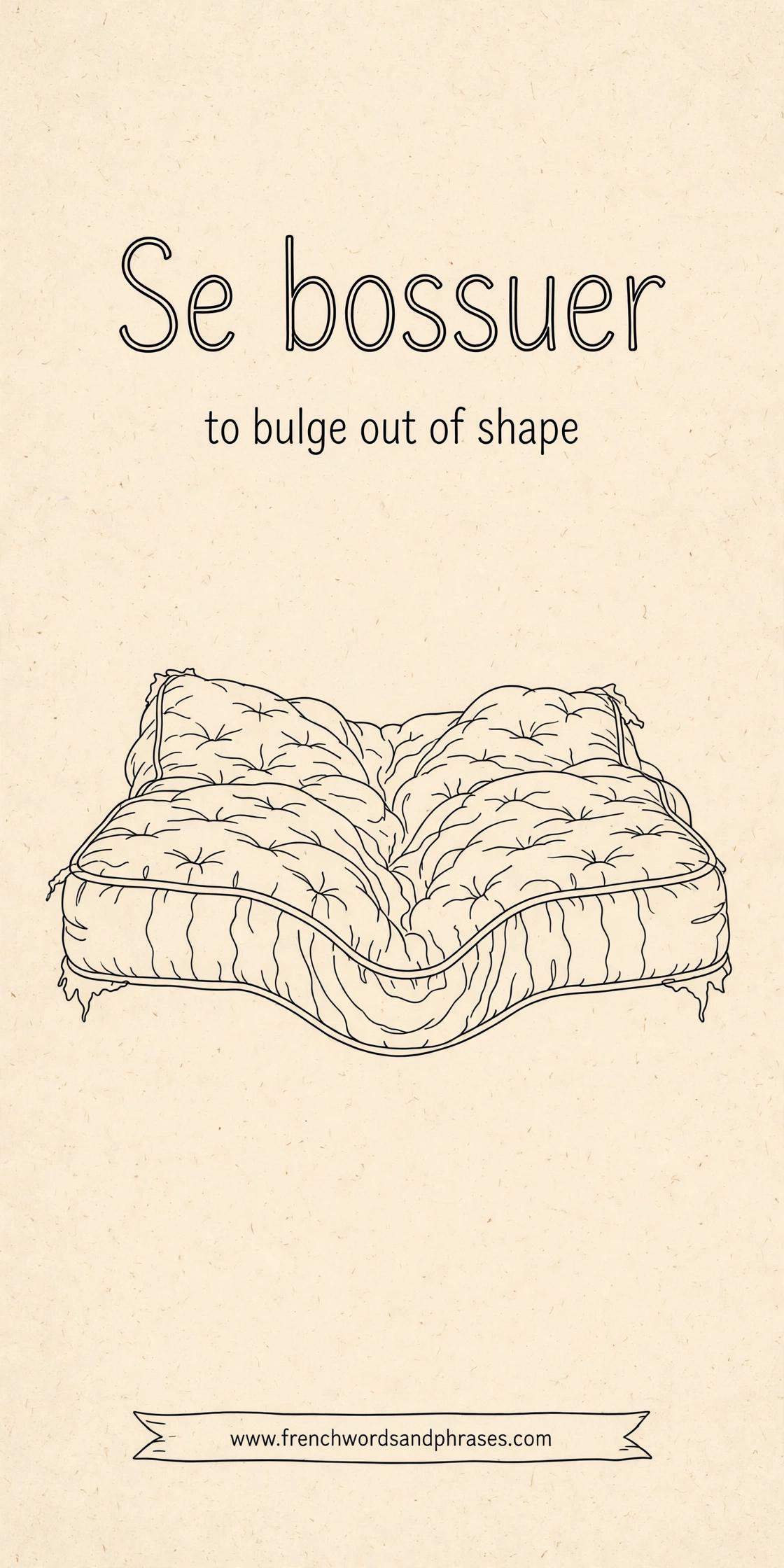
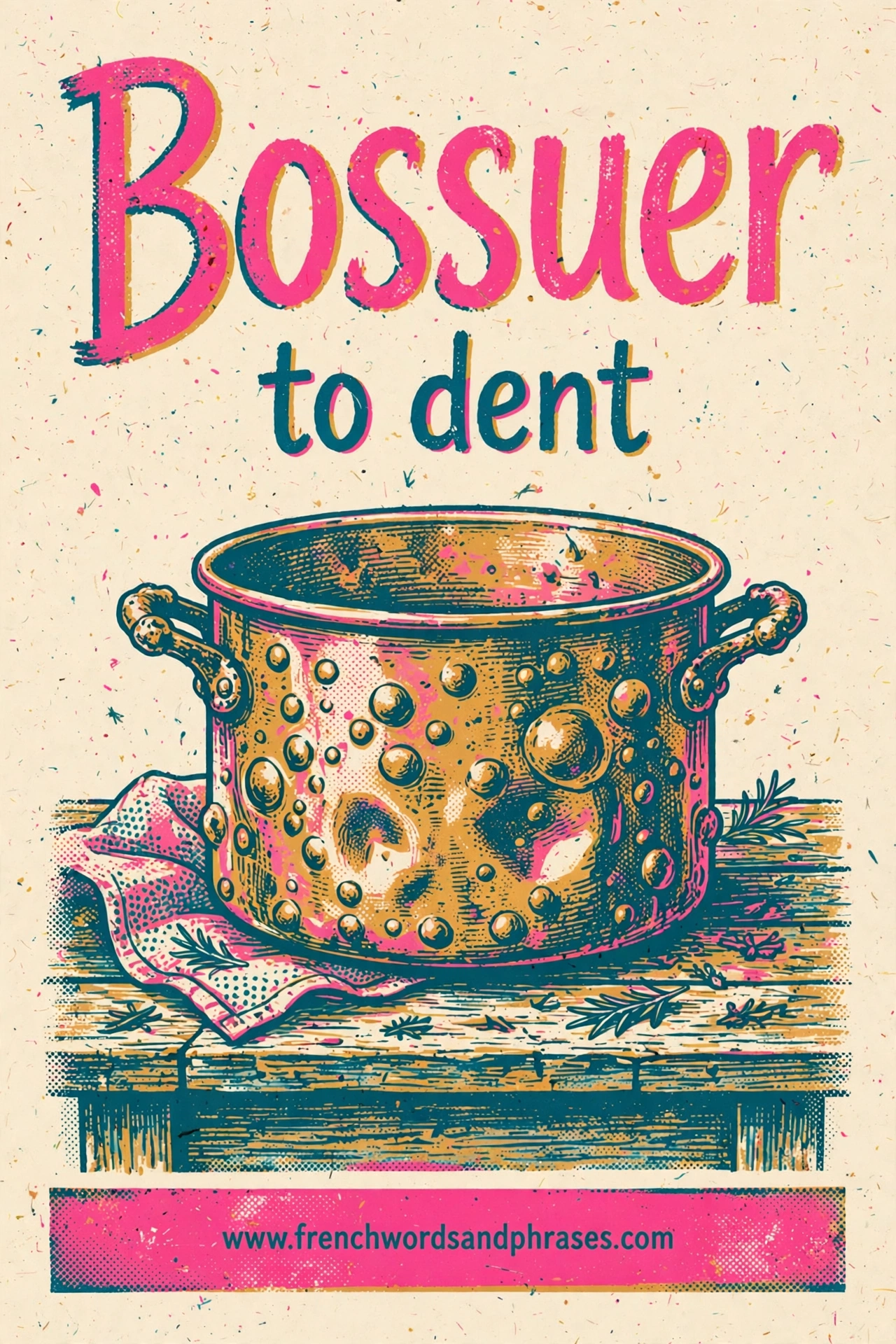
Bossuer means to dent — to cover a surface with bumps and hollows; it is the rare, dictionary cousin of the everyday bosseler.
Open a French dictionary at bossuer and you will find a real verb — to dent, to make bumpy — but open your ears in a French street and you may wait years to hear it: this is the bookish twin of bosseler, the word everybody actually uses.
In this guide, you’ll learn how to conjugate bossuer in all the major French tenses and moods. Explore complete conjugation tables, French examples, English translations, and practice quizzes.
Understanding the French Verb Bossuer
Bossuer is a regular French verb belonging to the first group of verbs, those ending in-er.
It means to dent. You may meet it in older technical writing about metalwork and bodywork, where it means to hammer a surface into bumps and hollows; its past participle bossué(e) has survived better than the infinitive, describing hammered, uneven surfaces in print.
Verb classification: First group (-er)
Auxiliary verb: Avoir
Past participle: bossué
Present participle: bossuant
English equivalents: To dent, to make bumpy; bossuer une tôle — to dent a sheet of metal; une surface bossuée — a dented, uneven surface (you will meet the participle far more often than the verb); rendre bosselé — what people actually say.
Be honest with this one: bossuer is rare. Its forms are perfectly regular — je bossue, tu bossues, nous bossuons, ils bossuent, past participle bossué, no stem change and no doubling anywhere — but modern speakers overwhelmingly reach for bosseler (with its double l: je bosselle) or say rendre bosselé. Learn bossuer to recognise it in older and technical writing, not to use it in the street. Its relatives are common, though: la bosse, a bump, and bossu, hunchbacked — the Bossu de Notre-Dame is the Hunchback of Notre-Dame.
Experience the Word
Bossuer is the verb the dictionary keeps for a job the street gives to another word — the same dent, in an older coat.
Imagine a nineteenth-century workshop manual: « L’ouvrier bossue la tôle à petits coups de marteau. » The craftsman is denting the sheet with little hammer blows — work a modern mechanic would describe, without a second’s hesitation, with bosseler.
The hammer blows are identical. Only the century has changed — bossuée then, bosselée now.
How to Conjugate Bossuer: Complete French Conjugation Guide
Let’s explore every major conjugation of bossuer, beginning with the indicative mood.
How to Conjugate Bossuer in the Indicative Mood
The indicative mood is used to express facts, observations, actions, and events.
How to Conjugate Bossuer in the Present Tense (Présent)
Used for actions happening now, habitual actions, and general truths.
| Subject | Conjugation |
|---|---|
| je | bossue |
| tu | bossues |
| il / elle | bossue |
| nous | bossuons |
| vous | bossuez |
| ils / elles | bossuent |
Example
Le marteau bossue la tôle à chaque coup.
The hammer dents the sheet metal with every blow.
Quick Quiz 1
Complete the sentence:
Le marteau ______ la tôle à chaque coup.
Reveal the answer
bossue
Le marteau bossue la tôle à chaque coup.
The hammer dents the sheet metal with every blow.
How to Conjugate Bossuer in the Passé Composé
Used for completed actions in the past. Bossuer takes the auxiliary verb avoir.
| Subject | Conjugation |
|---|---|
| j’ | ai bossué |
| tu | as bossué |
| il / elle | a bossué |
| nous | avons bossué |
| vous | avez bossué |
| ils / elles | ont bossué |
Example
La grêle a bossué tout le capot.
The hail dented the whole bonnet.
How to Conjugate Bossuer in the Imparfait (Imperfect Tense)
Used for habitual past actions, descriptions, and ongoing situations in the past.
| Subject | Conjugation |
|---|---|
| je | bossuais |
| tu | bossuais |
| il / elle | bossuait |
| nous | bossuions |
| vous | bossuiez |
| ils / elles | bossuaient |
Example
Les chaudronniers bossuaient le cuivre à la main.
The coppersmiths used to dent the copper by hand.
Quick Quiz 2
Choose the correct form:
The hail dented the bonnet.
La grêle ______ le capot. (a bossué / est bossué)
Reveal the answer
a bossué
La grêle a bossué le capot.
Bossuer takes avoir.
How to Conjugate Bossuer in the Plus-que-parfait
Used to describe an action that had already been completed before another past event.
| Subject | Conjugation |
|---|---|
| j’ | avais bossué |
| tu | avais bossué |
| il / elle | avait bossué |
| nous | avions bossué |
| vous | aviez bossué |
| ils / elles | avaient bossué |
Example
Il avait bossué la portière en reculant.
He had dented the door while reversing.
How to Conjugate Bossuer in the Passé Simple
Primarily used in formal writing, literature, and historical narratives. It is rarely used in everyday conversation.
| Subject | Conjugation |
|---|---|
| je | bossuai |
| tu | bossuas |
| il / elle | bossua |
| nous | bossuâmes |
| vous | bossuâtes |
| ils / elles | bossuèrent |
Example
La pierre bossua le pare-brise sans le briser.
The stone dented the windscreen without breaking it.
How to Conjugate Bossuer in the Passé Antérieur
A literary tense used to express an action completed immediately before another past action, generally in the passé simple.
| Subject | Conjugation |
|---|---|
| j’ | eus bossué |
| tu | eus bossué |
| il / elle | eut bossué |
| nous | eûmes bossué |
| vous | eûtes bossué |
| ils / elles | eurent bossué |
Example
Quand la grêle eut bossué le toit, l’eau entra partout.
When the hail had dented the roof, the water got in everywhere.
How to Conjugate Bossuer in the Future Tense (Futur Simple)
Used to describe actions that will take place in the future.
| Subject | Conjugation |
|---|---|
| je | bossuerai |
| tu | bossueras |
| il / elle | bossuera |
| nous | bossuerons |
| vous | bossuerez |
| ils / elles | bossueront |
Example
Ces coups bossueront la carrosserie si tu continues.
Those knocks will dent the bodywork if you go on.
How to Conjugate Bossuer in the Futur Antérieur (Future Perfect)
Used for an action that will have been completed before a particular point in the future.
| Subject | Conjugation |
|---|---|
| j’ | aurai bossué |
| tu | auras bossué |
| il / elle | aura bossué |
| nous | aurons bossué |
| vous | aurez bossué |
| ils / elles | auront bossué |
Example
À la fin de la saison, la grêle aura bossué bien des toits.
By the end of the season, the hail will have dented many roofs.
How to Conjugate Bossuer in the Near Future (Futur Proche)
Used to describe something that is going to happen soon. Formed with aller + infinitive.
| Subject | Conjugation |
|---|---|
| je | vais bossuer |
| tu | vas bossuer |
| il / elle | va bossuer |
| nous | allons bossuer |
| vous | allez bossuer |
| ils / elles | vont bossuer |
Example
Attention, tu vas bossuer la portière !
Careful, you are going to dent the door!
How to Conjugate Bossuer in the Conditional Mood
The conditional mood expresses what would happen under certain circumstances. It is also frequently used to make polite requests or express wishes.
How to Conjugate Bossuer in the Present Conditional
| Subject | Conjugation |
|---|---|
| je | bossuerais |
| tu | bossuerais |
| il / elle | bossuerait |
| nous | bossuerions |
| vous | bossueriez |
| ils / elles | bossueraient |
Example
Un choc plus fort bossuerait le réservoir.
A harder knock would dent the tank.
How to Conjugate Bossuer in the Past Conditional
| Subject | Conjugation |
|---|---|
| j’ | aurais bossué |
| tu | aurais bossué |
| il / elle | aurait bossué |
| nous | aurions bossué |
| vous | auriez bossué |
| ils / elles | auraient bossué |
Example
Sans le poteau, la chute aurait bossué l’aile bien davantage.
Without the post, the fall would have dented the wing far more.
Bossuer in the Literary Past Conditional Form
This less common literary form uses the imperfect subjunctive of avoir.
| Subject | Conjugation |
|---|---|
| j’ | eusse bossué |
| tu | eusses bossué |
| il / elle | eût bossué |
| nous | eussions bossué |
| vous | eussiez bossué |
| ils / elles | eussent bossué |
Example
La grêle eût bossué toutes les voitures du village.
The hail would have dented every car in the village.
How to Conjugate Bossuer in the Subjunctive Mood
The subjunctive is used to express wishes, emotions, doubts, necessity, and uncertainty. It frequently follows expressions such as il faut que (it is necessary that) or bien que (although).
How to Conjugate Bossuer in the Present Subjunctive
| Subject | Conjugation |
|---|---|
| que je | bossue |
| que tu | bossues |
| qu’il / qu’elle | bossue |
| que nous | bossuions |
| que vous | bossuiez |
| qu’ils / qu’elles | bossuent |
Example
Je crains que ce choc bossue le capot.
I fear this knock may dent the bonnet.
Quick Quiz 3
Complete the sentence using the subjunctive:
Je crains que la tempête ______ les toits.
Reveal the answer
bossue
Je crains que la tempête bossue les toits.
I fear the storm may dent the roofs.
How to Conjugate Bossuer in the Imperfect Subjunctive
A literary tense, rarely encountered in modern spoken French.
| Subject | Conjugation |
|---|---|
| que je | bossuasse |
| que tu | bossuasses |
| qu’il / qu’elle | bossuât |
| que nous | bossuassions |
| que vous | bossuassiez |
| qu’ils / qu’elles | bossuassent |
Example
Il fallait éviter que l’outil bossuât la tôle.
They had to stop the tool from denting the sheet metal.
How to Conjugate Bossuer in the Pluperfect Subjunctive
A literary construction used to express an action completed before another past action.
| Subject | Conjugation |
|---|---|
| que j’ | eusse bossué |
| que tu | eusses bossué |
| qu’il / qu’elle | eût bossué |
| que nous | eussions bossué |
| que vous | eussiez bossué |
| qu’ils / qu’elles | eussent bossué |
Example
On racontait que la tempête eût bossué les toits du port.
People said the storm had dented the roofs by the harbour.
How to Conjugate Bossuer in the Past Subjunctive
| Subject | Conjugation |
|---|---|
| que j’ | aie bossué |
| que tu | aies bossué |
| qu’il / qu’elle | ait bossué |
| que nous | ayons bossué |
| que vous | ayez bossué |
| qu’ils / qu’elles | aient bossué |
Example
Je regrette que la grêle ait bossué ta voiture.
I am sorry the hail dented your car.
How to Conjugate Bossuer in the Imperative
The imperative is used to give commands, instructions, invitations, or suggestions. Subject pronouns are omitted.
How to Conjugate Bossuer in the Present Imperative
| Person | Conjugation |
|---|---|
| (tu) | bossue |
| (nous) | bossuons |
| (vous) | bossuez |
Example
Ne bossue pas cette tôle, elle est fragile !
Do not dent this sheet metal, it is fragile!
Quick Quiz 4
How would you say Do not dent this door (tu form)?
Reveal the answer
Ne bossue pas cette portière !
French Participles of Bossuer
Participles are verb forms that can be used in compound tenses and other grammatical constructions.
Present Participle of Bossuer
bossuant
En bossuant le cuivre, l’artisan crée des reflets.
By hammering the copper into bumps, the craftsman creates reflections.
Past Participle of Bossuer
bossué
Bossuée par la grêle, la voiture a perdu de sa valeur.
Dented by the hail, the car lost some of its value.
Bossuer in Everyday French: Real-Life Examples
Now that you know the conjugations, let’s see how bossuer appears in everyday French.
Example 1 — Present
Le marteau bossue la tôle.
The hammer dents the sheet metal.
Example 2 — Passé composé
La grêle a bossué le capot.
The hail dented the bonnet.
Example 3 — Imparfait
On bossuait le cuivre à la main.
They used to dent copper by hand.
Example 4 — Future
Ce choc bossuera la portière.
That knock will dent the door.
Example 5 — Conditional
Un choc plus fort bossuerait le réservoir.
A harder knock would dent the tank.
Example 6 — Imperative
Ne bossue pas cette tôle !
Do not dent this sheet metal!
Beyond Translation: The Meaning of Bossuer
The whole family grows from la bosse, the bump: bossu the hunchback, bosseler the everyday denting verb, and bossuer, the elder brother who stayed in the dictionary.
French often keeps two words for one act.
One lives in the workshop and the street, the other in print and in the past participle — une tôle bossuée still turns up in descriptions long after the infinitive has retired. English to dent has no such pair: learn bossuer as reading knowledge, and bosseler as speaking knowledge.
How to Remember the French Verb Bossuer
Remember it this way: Bossuer is about the dictionary’s dent — same bosse, older coat.
- Rare verb: learn it to recognise it — for speaking, French uses bosseler (je bosselle, double l).
- Perfectly regular forms, no doubling: je bossue, nous bossuons, past participle bossué.
- The participle bossué(e) is the form you will actually meet, in descriptions of hammered, uneven surfaces.
The key idea is the dictionary’s dent — same bosse, older coat.
Test Your Knowledge of Bossuer
Let’s see how much you’ve learned. Try answering these questions before revealing the answers.
Question 1
Which verb do the French actually use every day for ‘to dent’?
Reveal the answer
Bosseler — je bosselle, with the double l. Bossuer is its rare dictionary cousin.
Question 2
How do you say The hail dented the bonnet in French, using bossuer?
Reveal the answer
La grêle a bossué le capot.
Question 3
Translate: Le marteau bossue la tôle.
Reveal the answer
The hammer dents the sheet metal.
Question 4
What is the past participle of bossuer?
Reveal the answer
Bossué.
Question 5
Complete the sentence:
Je crains que ce choc ______ le capot.
Reveal the answer
bossue
Je crains que ce choc bossue le capot.
I fear this knock may dent the bonnet.
Your Final Challenge
Can You Use It?
How would you say this in French?
The hail dented the barn roof, and ever since, the rain has been drawing maps on it.
Reveal the answer
La grêle a bossué le toit de la grange, et depuis, la pluie y dessine des cartes.
The hail dented the barn roof, and ever since, the rain has been drawing maps on it.
A little French. A little curiosity. A richer everyday life.
LEARN FRENCH ONE WORD AT A TIME