A French Word to Live By
How to Conjugate Bosser in French
/bɔ.se/
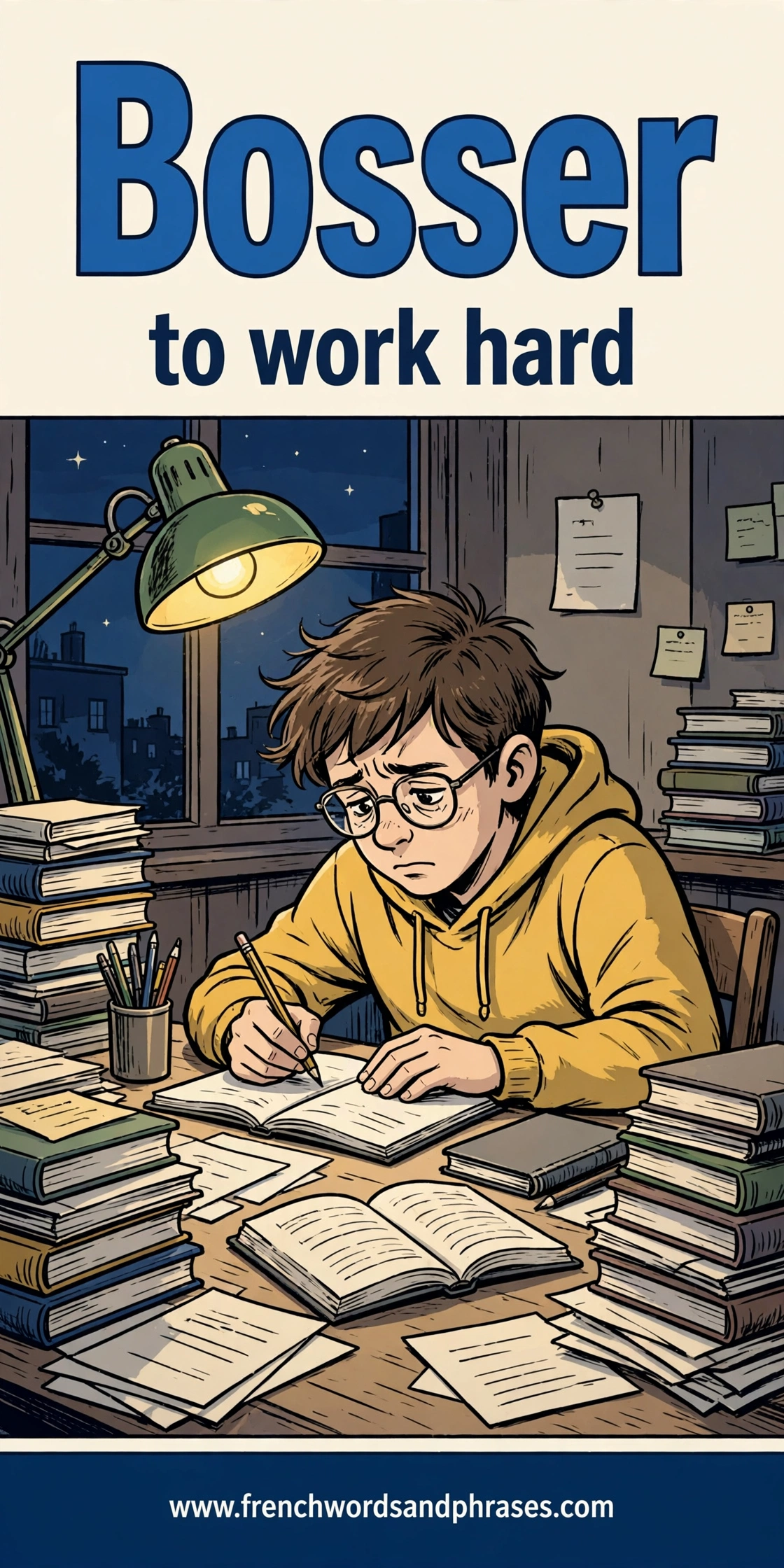
Bosser means to work hard — to slog away at a job; it is familiar French for plain travailler, with the sleeves rolled up.
An office at midnight, a building site at dawn, a student the night before the exam — bosser is the familiar verb of work done with effort: not just having a job, but grafting at it.
In this guide, you’ll learn how to conjugate bosser in all the major French tenses and moods. Explore complete conjugation tables, French examples, English translations, and practice quizzes.
Understanding the French Verb Bosser
Bosser is a regular French verb belonging to the first group of verbs, those ending in-er.
It means to work hard. It covers both simply working and working hard: il bosse dans une banque just says where he works, while il bosse dur adds the effort — the context decides, and the tone is always relaxed and approving of effort.
Verb classification: First group (-er)
Auxiliary verb: Avoir
Past participle: bossé
Present participle: bossant
English equivalents: To work, to slog, to graft (familiar); bosser dur — to work hard; bosser sur un dossier — to work on a file; bosser pour quelqu’un — to work for someone; un bosseur, une bosseuse — a hard worker, a grafter.
The trap here is register, not spelling: bosser is familiar French — the spoken synonym of travailler that friends, colleagues and students use all day, but too casual for a formal letter or an exam essay, where travailler or exercer are expected. The forms themselves are perfectly regular: je bosse, tu bosses, nous bossons, ils bossent, past participle bossé. Its badge of honour is the noun un bosseur — someone who really grafts. And keep it apart from the bosseler family on the neighbouring pages: same bosse at the root, very different working day.
Experience the Word
Bosser is travailler with its tie loosened — the verb of work as people actually talk about it.
Imagine two friends meeting in June. « Tu fais quoi, cet été ? — Je bosse dans un café, six jours sur sept. » No complaint and no glory either: just the summer’s graft, named with the word everybody actually uses.
He has not ‘exercised a profession’. He has grafted — il a bossé — and the word itself sounds like effort.
How to Conjugate Bosser: Complete French Conjugation Guide
Let’s explore every major conjugation of bosser, beginning with the indicative mood.
How to Conjugate Bosser in the Indicative Mood
The indicative mood is used to express facts, observations, actions, and events.
How to Conjugate Bosser in the Present Tense (Présent)
Used for actions happening now, habitual actions, and general truths.
| Subject | Conjugation |
|---|---|
| je | bosse |
| tu | bosses |
| il / elle | bosse |
| nous | bossons |
| vous | bossez |
| ils / elles | bossent |
Example
Elle bosse dans un restaurant le soir.
She works in a restaurant in the evenings.
Quick Quiz 1
Complete the sentence:
Nous ______ dur avant l’examen.
Reveal the answer
bossons
Nous bossons dur avant l’examen.
We are working hard before the exam.
How to Conjugate Bosser in the Passé Composé
Used for completed actions in the past. Bosser takes the auxiliary verb avoir.
| Subject | Conjugation |
|---|---|
| j’ | ai bossé |
| tu | as bossé |
| il / elle | a bossé |
| nous | avons bossé |
| vous | avez bossé |
| ils / elles | ont bossé |
Example
Nous avons bossé tout le week-end sur ce rapport.
We worked all weekend on this report.
How to Conjugate Bosser in the Imparfait (Imperfect Tense)
Used for habitual past actions, descriptions, and ongoing situations in the past.
| Subject | Conjugation |
|---|---|
| je | bossais |
| tu | bossais |
| il / elle | bossait |
| nous | bossions |
| vous | bossiez |
| ils / elles | bossaient |
Example
Autrefois, il bossait douze heures par jour.
In the old days, he used to work twelve hours a day.
Quick Quiz 2
Choose the correct form:
He works in a factory.
Il ______ dans une usine. (bosse / bossent)
Reveal the answer
bosse
Il bosse dans une usine.
Singular subject, singular form: il bosse.
How to Conjugate Bosser in the Plus-que-parfait
Used to describe an action that had already been completed before another past event.
| Subject | Conjugation |
|---|---|
| j’ | avais bossé |
| tu | avais bossé |
| il / elle | avait bossé |
| nous | avions bossé |
| vous | aviez bossé |
| ils / elles | avaient bossé |
Example
Ils avaient bossé dur avant les vacances.
They had worked hard before the holidays.
How to Conjugate Bosser in the Passé Simple
Primarily used in formal writing, literature, and historical narratives. It is rarely used in everyday conversation.
| Subject | Conjugation |
|---|---|
| je | bossai |
| tu | bossas |
| il / elle | bossa |
| nous | bossâmes |
| vous | bossâtes |
| ils / elles | bossèrent |
Example
Pendant la guerre, elle bossa à l’usine jour et nuit.
During the war, she worked at the factory day and night.
How to Conjugate Bosser in the Passé Antérieur
A literary tense used to express an action completed immediately before another past action, generally in the passé simple.
| Subject | Conjugation |
|---|---|
| j’ | eus bossé |
| tu | eus bossé |
| il / elle | eut bossé |
| nous | eûmes bossé |
| vous | eûtes bossé |
| ils / elles | eurent bossé |
Example
Quand il eut bossé dix ans dans la mine, il changea de métier.
When he had worked ten years in the mine, he changed trade.
How to Conjugate Bosser in the Future Tense (Futur Simple)
Used to describe actions that will take place in the future.
| Subject | Conjugation |
|---|---|
| je | bosserai |
| tu | bosseras |
| il / elle | bossera |
| nous | bosserons |
| vous | bosserez |
| ils / elles | bosseront |
Example
Demain, tu bosseras à la maison.
Tomorrow, you will work from home.
How to Conjugate Bosser in the Futur Antérieur (Future Perfect)
Used for an action that will have been completed before a particular point in the future.
| Subject | Conjugation |
|---|---|
| j’ | aurai bossé |
| tu | auras bossé |
| il / elle | aura bossé |
| nous | aurons bossé |
| vous | aurez bossé |
| ils / elles | auront bossé |
Example
À la fin du mois, nous aurons bossé sur ce projet pendant un an.
By the end of the month, we will have been working on this project for a year.
How to Conjugate Bosser in the Near Future (Futur Proche)
Used to describe something that is going to happen soon. Formed with aller + infinitive.
| Subject | Conjugation |
|---|---|
| je | vais bosser |
| tu | vas bosser |
| il / elle | va bosser |
| nous | allons bosser |
| vous | allez bosser |
| ils / elles | vont bosser |
Example
Allez, on va bosser un peu !
Come on, let’s get some work done!
How to Conjugate Bosser in the Conditional Mood
The conditional mood expresses what would happen under certain circumstances. It is also frequently used to make polite requests or express wishes.
How to Conjugate Bosser in the Present Conditional
| Subject | Conjugation |
|---|---|
| je | bosserais |
| tu | bosserais |
| il / elle | bosserait |
| nous | bosserions |
| vous | bosseriez |
| ils / elles | bosseraient |
Example
Avec un meilleur bureau, je bosserais plus vite.
With a better desk, I would work faster.
How to Conjugate Bosser in the Past Conditional
| Subject | Conjugation |
|---|---|
| j’ | aurais bossé |
| tu | aurais bossé |
| il / elle | aurait bossé |
| nous | aurions bossé |
| vous | auriez bossé |
| ils / elles | auraient bossé |
Example
Elle aurait bossé ce soir si elle n’avait pas été malade.
She would have worked this evening if she had not been ill.
Bosser in the Literary Past Conditional Form
This less common literary form uses the imperfect subjunctive of avoir.
| Subject | Conjugation |
|---|---|
| j’ | eusse bossé |
| tu | eusses bossé |
| il / elle | eût bossé |
| nous | eussions bossé |
| vous | eussiez bossé |
| ils / elles | eussent bossé |
Example
Il eût bossé toute la nuit sans la panne d’électricité.
He would have worked all night without the power cut.
How to Conjugate Bosser in the Subjunctive Mood
The subjunctive is used to express wishes, emotions, doubts, necessity, and uncertainty. It frequently follows expressions such as il faut que (it is necessary that) or bien que (although).
How to Conjugate Bosser in the Present Subjunctive
| Subject | Conjugation |
|---|---|
| que je | bosse |
| que tu | bosses |
| qu’il / qu’elle | bosse |
| que nous | bossions |
| que vous | bossiez |
| qu’ils / qu’elles | bossent |
Example
Il faut que tu bosses sérieusement cette semaine.
You must work seriously this week.
Quick Quiz 3
Complete the sentence using the subjunctive:
Il faut que vous ______ ce week-end.
Reveal the answer
bossiez
Il faut que vous bossiez ce week-end.
You must work this weekend.
How to Conjugate Bosser in the Imperfect Subjunctive
A literary tense, rarely encountered in modern spoken French.
| Subject | Conjugation |
|---|---|
| que je | bossasse |
| que tu | bossasses |
| qu’il / qu’elle | bossât |
| que nous | bossassions |
| que vous | bossassiez |
| qu’ils / qu’elles | bossassent |
Example
Je ne croyais pas qu’il bossât autant.
I did not think he worked so much.
How to Conjugate Bosser in the Pluperfect Subjunctive
A literary construction used to express an action completed before another past action.
| Subject | Conjugation |
|---|---|
| que j’ | eusse bossé |
| que tu | eusses bossé |
| qu’il / qu’elle | eût bossé |
| que nous | eussions bossé |
| que vous | eussiez bossé |
| qu’ils / qu’elles | eussent bossé |
Example
On disait qu’ils eussent bossé jour et nuit pour finir à temps.
People said they had worked day and night to finish on time.
How to Conjugate Bosser in the Past Subjunctive
| Subject | Conjugation |
|---|---|
| que j’ | aie bossé |
| que tu | aies bossé |
| qu’il / qu’elle | ait bossé |
| que nous | ayons bossé |
| que vous | ayez bossé |
| qu’ils / qu’elles | aient bossé |
Example
Je suis content que vous ayez bossé ensemble.
I am glad you worked together.
How to Conjugate Bosser in the Imperative
The imperative is used to give commands, instructions, invitations, or suggestions. Subject pronouns are omitted.
How to Conjugate Bosser in the Present Imperative
| Person | Conjugation |
|---|---|
| (tu) | bosse |
| (nous) | bossons |
| (vous) | bossez |
Example
Bosse un peu au lieu de rêver !
Do some work instead of daydreaming!
Quick Quiz 4
How would you say Work hard (tu form)?
Reveal the answer
Bosse dur !
French Participles of Bosser
Participles are verb forms that can be used in compound tenses and other grammatical constructions.
Present Participle of Bosser
bossant
En bossant régulièrement, elle a réussi son examen.
By working steadily, she passed her exam.
Past Participle of Bosser
bossé
Les heures bossées le dimanche sont payées double.
The hours worked on Sundays are paid double.
Bosser in Everyday French: Real-Life Examples
Now that you know the conjugations, let’s see how bosser appears in everyday French.
Example 1 — Present
Je bosse dans un café le week-end.
I work in a café at weekends.
Example 2 — Passé composé
On a bossé tard hier soir.
We worked late last night.
Example 3 — Imparfait
Il bossait dans une usine autrefois.
He used to work in a factory.
Example 4 — Future
Tu bosseras samedi matin.
You will work on Saturday morning.
Example 5 — Conditional
Je bosserais mieux avec plus de sommeil.
I would work better with more sleep.
Example 6 — Imperative
Bosse sérieusement cette semaine !
Work seriously this week!
Beyond Translation: The Meaning of Bosser
French has a whole staircase of words for work: exercer at the top for professions in formal prose, travailler on the landing for everybody, and bosser in the kitchen with friends — the same act, three temperatures.
Bosser says the effort, not the job title.
That is why students bosse their exams, builders bosse on site, and nobody has ever bossé in a curriculum vitae: the word carries its own smile of complicity, and the noun un bosseur is pure praise.
How to Remember the French Verb Bosser
Remember it this way: Bosser is about sleeves rolled up at midnight — work, talked about plainly.
- Familiar register: say bosser with friends, write travailler in formal prose.
- Perfectly regular: je bosse, nous bossons, past participle bossé, auxiliary avoir.
- Un bosseur is a hard worker — the noun is a compliment.
The key idea is sleeves rolled up at midnight — work, talked about plainly.
Test Your Knowledge of Bosser
Let’s see how much you’ve learned. Try answering these questions before revealing the answers.
Question 1
What register is bosser, and what is its neutral synonym?
Reveal the answer
Familiar — its neutral synonym is travailler: same work, cooler tone.
Question 2
How do you say We worked all weekend on this report in French?
Reveal the answer
Nous avons bossé tout le week-end sur ce rapport.
Question 3
Translate: She works in a bank. (familiar)
Reveal the answer
Elle bosse dans une banque.
Question 4
What is the past participle of bosser?
Reveal the answer
Bossé.
Question 5
Complete the sentence:
Il faut que tu ______ sérieusement cette semaine.
Reveal the answer
bosses
Il faut que tu bosses sérieusement cette semaine.
You must work seriously this week.
Your Final Challenge
Can You Use It?
How would you say this in French?
He has been working since dawn on the building site, and in the evening he still finds the strength to smile.
Reveal the answer
Il bosse depuis l’aube sur le chantier, et le soir, il trouve encore la force de sourire.
He has been working since dawn on the building site, and in the evening he still finds the strength to smile.
A little French. A little curiosity. A richer everyday life.
LEARN FRENCH ONE WORD AT A TIME