A French Word to Live By
How to Conjugate Bluffer in French
/blœ.fe/
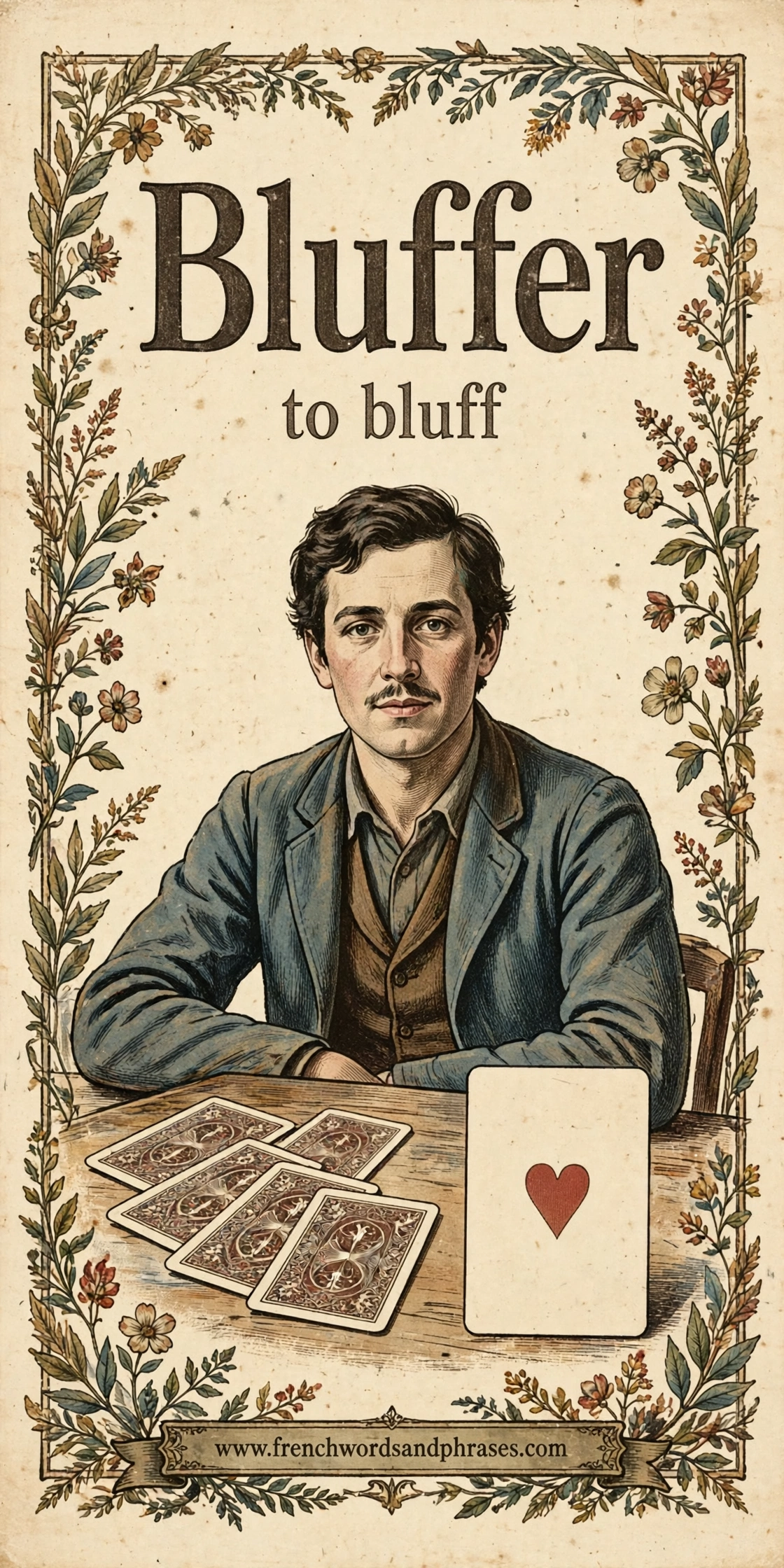
Bluffer means to bluff — to win by pretending, with an empty hand and a steady face.
A poker player pushing a mountain of chips forward on a pair of twos, a minister talking confidently about figures he has not read — bluffer is the verb of the well-kept pretence: nothing behind the curtain, and a performance good enough that nobody looks.
In this guide, you’ll learn how to conjugate bluffer in all the major French tenses and moods. Explore complete conjugation tables, French examples, English translations, and practice quizzes.
Understanding the French Verb Bluffer
Bluffer is a regular French verb belonging to the first group of verbs, those ending in-er.
It means to bluff. Born at the card table, it now covers any confident pretence: candidates bluffing through interviews, negotiators bluffing about deadlines, children bluffing about homework. It implies the hand is empty or weak — praise the performance with bluffer and you are also saying there was nothing behind it.
Verb classification: First group (-er)
Auxiliary verb: Avoir
Past participle: bluffé
Present participle: bluffant
English equivalents: To bluff; bluffer au poker — to bluff at poker; bluffer quelqu’un — to bluff someone, to take them in; un bluff — a bluff; un bluffeur, une bluffeuse — a bluffer; il bluffe ! — he is bluffing!
One important detail: bluffer is English to bluff wearing French endings — a borrowing so complete that it conjugates as a model regular -er verb: je bluffe, nous bluffons, ils bluffent, past participle bluffé, and the double f never changes. French gave the loan a family of its own: le bluff for the act, un bluffeur for the player. There is no trap in the spelling — the only bluff is in the game.
Experience the Word
Bluffer is the verb of the empty hand played like a full one — nerve, timing, and not one blink too many.
Imagine the last hand of the night. She has nothing — a pair of twos and a hopeless board. She looks at her cards once, sighs like a woman bored by her own luck, and pushes every chip she owns into the middle. One by one, the better hands fold. Elle a bluffé, and the pot is hers.
Her cards were worthless. Her nerve — le bluff — was worth the whole table.
How to Conjugate Bluffer: Complete French Conjugation Guide
Let’s explore every major conjugation of bluffer, beginning with the indicative mood.
How to Conjugate Bluffer in the Indicative Mood
The indicative mood is used to express facts, observations, actions, and events.
How to Conjugate Bluffer in the Present Tense (Présent)
Used for actions happening now, habitual actions, and general truths.
| Subject | Conjugation |
|---|---|
| je | bluffe |
| tu | bluffes |
| il / elle | bluffe |
| nous | bluffons |
| vous | bluffez |
| ils / elles | bluffent |
Example
Il bluffe rarement, et c’est pour cela qu’on le croit.
He rarely bluffs, and that is why people believe him.
Quick Quiz 1
Complete the sentence:
Nous ______ seulement quand le pot en vaut la peine.
Reveal the answer
bluffons
Nous bluffons seulement quand le pot en vaut la peine.
We only bluff when the pot is worth it.
How to Conjugate Bluffer in the Passé Composé
Used for completed actions in the past. Bluffer takes the auxiliary verb avoir.
| Subject | Conjugation |
|---|---|
| j’ | ai bluffé |
| tu | as bluffé |
| il / elle | a bluffé |
| nous | avons bluffé |
| vous | avez bluffé |
| ils / elles | ont bluffé |
Example
Elle a bluffé tout le monde avec une paire de deux.
She bluffed everyone with a pair of twos.
How to Conjugate Bluffer in the Imparfait (Imperfect Tense)
Used for habitual past actions, descriptions, and ongoing situations in the past.
| Subject | Conjugation |
|---|---|
| je | bluffais |
| tu | bluffais |
| il / elle | bluffait |
| nous | bluffions |
| vous | bluffiez |
| ils / elles | bluffaient |
Example
Au poker, il bluffait une fois sur trois.
At poker, he used to bluff one time in three.
Quick Quiz 2
Choose the correct form:
She bluffed and took the pot.
Elle ______ et a ramassé le pot. (a bluffé / est bluffée)
Reveal the answer
a bluffé
Elle a bluffé et a ramassé le pot.
Bluffer takes avoir.
How to Conjugate Bluffer in the Plus-que-parfait
Used to describe an action that had already been completed before another past event.
| Subject | Conjugation |
|---|---|
| j’ | avais bluffé |
| tu | avais bluffé |
| il / elle | avait bluffé |
| nous | avions bluffé |
| vous | aviez bluffé |
| ils / elles | avaient bluffé |
Example
Il avait bluffé si souvent que personne ne le suivait plus.
He had bluffed so often that nobody called him any more.
How to Conjugate Bluffer in the Passé Simple
Primarily used in formal writing, literature, and historical narratives. It is rarely used in everyday conversation.
| Subject | Conjugation |
|---|---|
| je | bluffai |
| tu | bluffas |
| il / elle | bluffa |
| nous | bluffâmes |
| vous | bluffâtes |
| ils / elles | bluffèrent |
Example
Au dernier tour, elle bluffa et ramassa le pot.
On the last round, she bluffed and took the pot.
How to Conjugate Bluffer in the Passé Antérieur
A literary tense used to express an action completed immediately before another past action, generally in the passé simple.
| Subject | Conjugation |
|---|---|
| j’ | eus bluffé |
| tu | eus bluffé |
| il / elle | eut bluffé |
| nous | eûmes bluffé |
| vous | eûtes bluffé |
| ils / elles | eurent bluffé |
Example
Quand il eut bluffé une fois de trop, les autres cessèrent de miser.
When he had bluffed once too often, the others stopped betting.
How to Conjugate Bluffer in the Future Tense (Futur Simple)
Used to describe actions that will take place in the future.
| Subject | Conjugation |
|---|---|
| je | blufferai |
| tu | blufferas |
| il / elle | bluffera |
| nous | blufferons |
| vous | blufferez |
| ils / elles | blufferont |
Example
Ce soir, je ne blufferai pas : je jouerai serré.
This evening, I will not bluff: I will play tight.
How to Conjugate Bluffer in the Futur Antérieur (Future Perfect)
Used for an action that will have been completed before a particular point in the future.
| Subject | Conjugation |
|---|---|
| j’ | aurai bluffé |
| tu | auras bluffé |
| il / elle | aura bluffé |
| nous | aurons bluffé |
| vous | aurez bluffé |
| ils / elles | auront bluffé |
Example
À la fin de la partie, il aura bluffé au moins dix fois.
By the end of the game, he will have bluffed at least ten times.
How to Conjugate Bluffer in the Near Future (Futur Proche)
Used to describe something that is going to happen soon. Formed with aller + infinitive.
| Subject | Conjugation |
|---|---|
| je | vais bluffer |
| tu | vas bluffer |
| il / elle | va bluffer |
| nous | allons bluffer |
| vous | allez bluffer |
| ils / elles | vont bluffer |
Example
Attention, il va bluffer, je le sens.
Careful, he is going to bluff, I can feel it.
How to Conjugate Bluffer in the Conditional Mood
The conditional mood expresses what would happen under certain circumstances. It is also frequently used to make polite requests or express wishes.
How to Conjugate Bluffer in the Present Conditional
| Subject | Conjugation |
|---|---|
| je | blufferais |
| tu | blufferais |
| il / elle | blufferait |
| nous | blufferions |
| vous | blufferiez |
| ils / elles | blufferaient |
Example
Avec de meilleures cartes, je blufferais moins.
With better cards, I would bluff less.
How to Conjugate Bluffer in the Past Conditional
| Subject | Conjugation |
|---|---|
| j’ | aurais bluffé |
| tu | aurais bluffé |
| il / elle | aurait bluffé |
| nous | aurions bluffé |
| vous | auriez bluffé |
| ils / elles | auraient bluffé |
Example
Elle aurait bluffé jusqu’au bout sans ce regard qui l’a trahie.
She would have bluffed to the very end without that look that gave her away.
Bluffer in the Literary Past Conditional Form
This less common literary form uses the imperfect subjunctive of avoir.
| Subject | Conjugation |
|---|---|
| j’ | eusse bluffé |
| tu | eusses bluffé |
| il / elle | eût bluffé |
| nous | eussions bluffé |
| vous | eussiez bluffé |
| ils / elles | eussent bluffé |
Example
Il eût bluffé le diable lui-même avec ce sourire.
He would have bluffed the devil himself with that smile.
How to Conjugate Bluffer in the Subjunctive Mood
The subjunctive is used to express wishes, emotions, doubts, necessity, and uncertainty. It frequently follows expressions such as il faut que (it is necessary that) or bien que (although).
How to Conjugate Bluffer in the Present Subjunctive
| Subject | Conjugation |
|---|---|
| que je | bluffe |
| que tu | bluffes |
| qu’il / qu’elle | bluffe |
| que nous | bluffions |
| que vous | bluffiez |
| qu’ils / qu’elles | bluffent |
Example
Il faut que tu bluffes avec conviction.
You must bluff with conviction.
Quick Quiz 3
Complete the sentence using the subjunctive:
Il faut que vous ______ sans trembler.
Reveal the answer
bluffiez
Il faut que vous bluffiez sans trembler.
You must bluff without trembling.
How to Conjugate Bluffer in the Imperfect Subjunctive
A literary tense, rarely encountered in modern spoken French.
| Subject | Conjugation |
|---|---|
| que je | bluffasse |
| que tu | bluffasses |
| qu’il / qu’elle | bluffât |
| que nous | bluffassions |
| que vous | bluffassiez |
| qu’ils / qu’elles | bluffassent |
Example
Personne ne pensait qu’il bluffât avec si peu de jeu.
Nobody thought he would bluff with so weak a hand.
How to Conjugate Bluffer in the Pluperfect Subjunctive
A literary construction used to express an action completed before another past action.
| Subject | Conjugation |
|---|---|
| que j’ | eusse bluffé |
| que tu | eusses bluffé |
| qu’il / qu’elle | eût bluffé |
| que nous | eussions bluffé |
| que vous | eussiez bluffé |
| qu’ils / qu’elles | eussent bluffé |
Example
On racontait qu’elle eût bluffé les meilleurs joueurs de la ville.
People said she had bluffed the best players in town.
How to Conjugate Bluffer in the Past Subjunctive
| Subject | Conjugation |
|---|---|
| que j’ | aie bluffé |
| que tu | aies bluffé |
| qu’il / qu’elle | ait bluffé |
| que nous | ayons bluffé |
| que vous | ayez bluffé |
| qu’ils / qu’elles | aient bluffé |
Example
Je n’arrive pas à croire qu’il ait bluffé avec rien en main.
I cannot believe he bluffed with nothing in his hand.
How to Conjugate Bluffer in the Imperative
The imperative is used to give commands, instructions, invitations, or suggestions. Subject pronouns are omitted.
How to Conjugate Bluffer in the Present Imperative
| Person | Conjugation |
|---|---|
| (tu) | bluffe |
| (nous) | bluffons |
| (vous) | bluffez |
Example
Bluffe si tu veux, mais regarde-moi dans les yeux !
Bluff if you like, but look me in the eyes!
Quick Quiz 4
How would you say Bluff (tu form)?
Reveal the answer
Bluffe !
French Participles of Bluffer
Participles are verb forms that can be used in compound tenses and other grammatical constructions.
Present Participle of Bluffer
bluffant
En bluffant calmement, elle a gagné la partie.
By bluffing calmly, she won the game.
Past Participle of Bluffer
bluffé
Bluffé par son air innocent, j’ai abandonné la main.
Bluffed by her innocent air, I folded the hand.
Bluffer in Everyday French: Real-Life Examples
Now that you know the conjugations, let’s see how bluffer appears in everyday French.
Example 1 — Present
Il bluffe rarement au poker.
He rarely bluffs at poker.
Example 2 — Passé composé
Elle a bluffé tout le monde.
She bluffed everyone.
Example 3 — Imparfait
Il bluffait une fois sur trois.
He used to bluff one time in three.
Example 4 — Future
Ce soir, je ne blufferai pas.
This evening, I will not bluff.
Example 5 — Conditional
Avec ce jeu, je blufferais sans hésiter.
With this hand, I would bluff without hesitating.
Example 6 — Imperative
Bluffe, mais sans sourire !
Bluff, but without smiling!
Beyond Translation: The Meaning of Bluffer
English lent the word and French naturalised it so thoroughly that bluffer now feels like a native — complete with le bluff and le bluffeur, a little family the original never had.
Some borrowings move in; this one took the house.
It has also escaped the casino: in politics, in business, in the classroom, il bluffe is the standard French verdict on a performance with nothing behind it — two syllables, and the curtain lifts.
How to Remember the French Verb Bluffer
Remember it this way: Bluffer is about the pair of twos played like a royal flush.
- Regular -er, double f throughout: je bluffe, nous bluffons, past participle bluffé.
- An English loan fully at home: le bluff, un bluffeur, bluffer au poker.
- To say bluffer is to say the hand was empty — the pretence is the whole point.
The key idea is the pair of twos played like a royal flush.
Test Your Knowledge of Bluffer
Let’s see how much you’ve learned. Try answering these questions before revealing the answers.
Question 1
Where does bluffer come from, and how does it conjugate?
Reveal the answer
From English ‘to bluff’ — and it conjugates as a regular -er verb: je bluffe, bluffé.
Question 2
How do you say She bluffed everyone in French?
Reveal the answer
Elle a bluffé tout le monde.
Question 3
Translate: He rarely bluffs at poker.
Reveal the answer
Il bluffe rarement au poker.
Question 4
What is the past participle of bluffer?
Reveal the answer
Bluffé.
Question 5
Complete the sentence:
Il faut que tu ______ avec conviction.
Reveal the answer
bluffes
Il faut que tu bluffes avec conviction.
You must bluff with conviction.
Your Final Challenge
Can You Use It?
How would you say this in French?
She bluffs with a pair of twos, and the whole table holds its breath.
Reveal the answer
Elle bluffe avec une paire de deux, et toute la table retient son souffle.
She bluffs with a pair of twos, and the whole table holds its breath.
A little French. A little curiosity. A richer everyday life.
LEARN FRENCH ONE WORD AT A TIME