A French Word to Live By
How to Conjugate Blouser in French
/blu.ze/
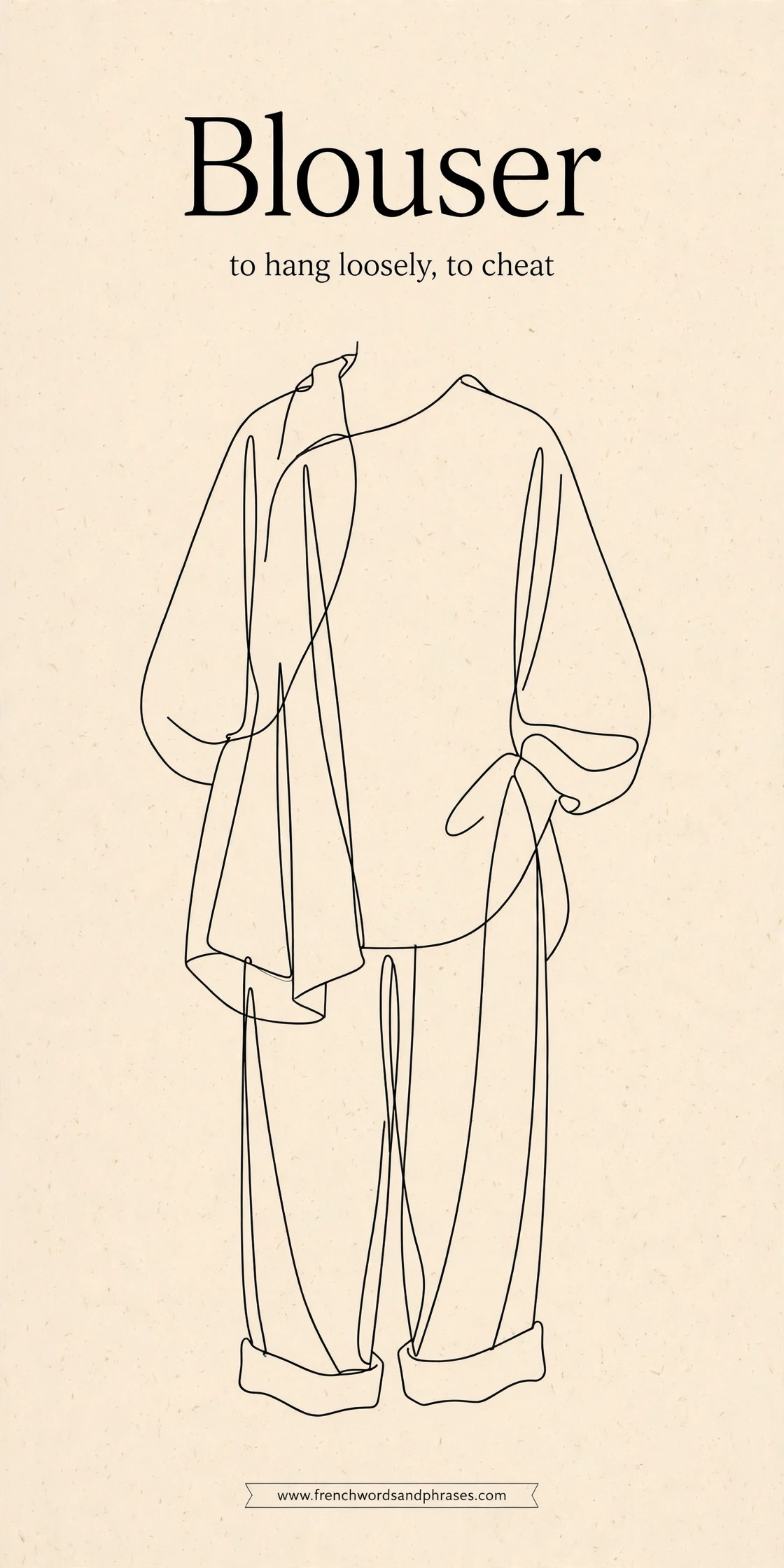
Blouser means to hang loosely, to cheat — a blouse’s soft fullness at the waist, and, in familiar French, the trick of taking someone in.
A silk blouse gathered softly above a belt in a 1920s photograph, and a market sharp relieving a tourist of his money with a smile — blouser lives in both worlds: the dressmaker’s, where cloth hangs in gentle folds, and the familiar one, where to be blousé is to be thoroughly had.
In this guide, you’ll learn how to conjugate blouser in all the major French tenses and moods. Explore complete conjugation tables, French examples, English translations, and practice quizzes.
Understanding the French Verb Blouser
Blouser is a regular French verb belonging to the first group of verbs, those ending in-er.
It means to hang loosely, to cheat. In fashion and sewing it describes the soft overhang of a bodice or shirt gathered at the waist — faire blouser, laisser blouser. In familiar speech it means to swindle or outwit, close to rouler or avoir quelqu’un, and almost always heard in se faire blouser when the victim tells the story.
Verb classification: First group (-er)
Auxiliary verb: Avoir
Past participle: blousé
Present participle: blousant
English equivalents: To blouse, to hang loosely; faire blouser un corsage — to let a bodice blouse over; (familiar) to dupe, to take in — blouser quelqu’un, to con someone; se faire blouser — to get conned, to be had; une robe qui blouse — a dress that hangs loose at the waist.
One important detail: blouser is a regular -er verb — je blouse, nous blousons, past participle blousé — and it is simply the verb of une blouse, the loose smock-like garment. From the garment come both lives: cloth that blouse hangs full and loose, and the familiar slang sense, where blouser quelqu’un is to dupe them — the usual shape of that joke is se faire blouser, to get oneself conned. The dressmaking sense is polite; the cheating sense is familiar register, for friends, not for formal letters.
Experience the Word
Blouser is a verb of soft folds and hard lessons — cloth that hangs loose, and people who hang their trust on the wrong smile.
Imagine the market at closing time. The tourist admires the ‘antique’ vase, the stallholder wraps it with a flourish, and only on the train home, reading the factory stamp underneath, does the truth arrive: il s’est fait blouser — conned, cleanly and completely, by a man who blousait les clients all day long.
The vase was worth almost nothing. The lesson — blousé once, wary for ever — was worth the price.
How to Conjugate Blouser: Complete French Conjugation Guide
Let’s explore every major conjugation of blouser, beginning with the indicative mood.
How to Conjugate Blouser in the Indicative Mood
The indicative mood is used to express facts, observations, actions, and events.
How to Conjugate Blouser in the Present Tense (Présent)
Used for actions happening now, habitual actions, and general truths.
| Subject | Conjugation |
|---|---|
| je | blouse |
| tu | blouses |
| il / elle | blouse |
| nous | blousons |
| vous | blousez |
| ils / elles | blousent |
Example
Cette chemise blouse joliment à la taille.
This shirt blouses prettily at the waist.
Quick Quiz 1
Complete the sentence:
Nous laissons la robe ______ à la taille.
Reveal the answer
blouser
Nous laissons la robe blouser à la taille.
We let the dress hang loose at the waist.
How to Conjugate Blouser in the Passé Composé
Used for completed actions in the past. Blouser takes the auxiliary verb avoir.
| Subject | Conjugation |
|---|---|
| j’ | ai blousé |
| tu | as blousé |
| il / elle | a blousé |
| nous | avons blousé |
| vous | avez blousé |
| ils / elles | ont blousé |
Example
Le marchand l’a blousé avec une copie sans valeur.
The stallholder conned him with a worthless copy.
How to Conjugate Blouser in the Imparfait (Imperfect Tense)
Used for habitual past actions, descriptions, and ongoing situations in the past.
| Subject | Conjugation |
|---|---|
| je | blousais |
| tu | blousais |
| il / elle | blousait |
| nous | blousions |
| vous | blousiez |
| ils / elles | blousaient |
Example
Son corsage blousait sur une jupe droite, à la mode d’alors.
Her bodice used to blouse over a straight skirt, in the fashion of the time.
Quick Quiz 2
Choose the correct form:
He conned my brother.
Il ______ mon frère. (a blousé / est blousé)
Reveal the answer
a blousé
Il a blousé mon frère.
Blouser takes avoir.
How to Conjugate Blouser in the Plus-que-parfait
Used to describe an action that had already been completed before another past event.
| Subject | Conjugation |
|---|---|
| j’ | avais blousé |
| tu | avais blousé |
| il / elle | avait blousé |
| nous | avions blousé |
| vous | aviez blousé |
| ils / elles | avaient blousé |
Example
Il avait blousé plus d’un client avant d’être démasqué.
He had conned more than one customer before being unmasked.
How to Conjugate Blouser in the Passé Simple
Primarily used in formal writing, literature, and historical narratives. It is rarely used in everyday conversation.
| Subject | Conjugation |
|---|---|
| je | blousai |
| tu | blousas |
| il / elle | blousa |
| nous | blousâmes |
| vous | blousâtes |
| ils / elles | blousèrent |
Example
La blouse blousa légèrement au-dessus de la ceinture.
The blouse hung loosely just above the belt.
How to Conjugate Blouser in the Passé Antérieur
A literary tense used to express an action completed immediately before another past action, generally in the passé simple.
| Subject | Conjugation |
|---|---|
| j’ | eus blousé |
| tu | eus blousé |
| il / elle | eut blousé |
| nous | eûmes blousé |
| vous | eûtes blousé |
| ils / elles | eurent blousé |
Example
Quand le tissu eut blousé comme il fallait, la couturière le fixa d’un point.
When the cloth had bloused as it should, the dressmaker fixed it with a stitch.
How to Conjugate Blouser in the Future Tense (Futur Simple)
Used to describe actions that will take place in the future.
| Subject | Conjugation |
|---|---|
| je | blouserai |
| tu | blouseras |
| il / elle | blousera |
| nous | blouserons |
| vous | blouserez |
| ils / elles | blouseront |
Example
Avec cette coupe, la robe blousera doucement à la taille.
With this cut, the dress will hang softly loose at the waist.
How to Conjugate Blouser in the Futur Antérieur (Future Perfect)
Used for an action that will have been completed before a particular point in the future.
| Subject | Conjugation |
|---|---|
| j’ | aurai blousé |
| tu | auras blousé |
| il / elle | aura blousé |
| nous | aurons blousé |
| vous | aurez blousé |
| ils / elles | auront blousé |
Example
À ce rythme, il aura blousé tous les touristes du marché.
At this rate, he will have conned every tourist in the market.
How to Conjugate Blouser in the Near Future (Futur Proche)
Used to describe something that is going to happen soon. Formed with aller + infinitive.
| Subject | Conjugation |
|---|---|
| je | vais blouser |
| tu | vas blouser |
| il / elle | va blouser |
| nous | allons blouser |
| vous | allez blouser |
| ils / elles | vont blouser |
Example
Attention, ce vendeur va te blouser.
Careful, that salesman is going to con you.
How to Conjugate Blouser in the Conditional Mood
The conditional mood expresses what would happen under certain circumstances. It is also frequently used to make polite requests or express wishes.
How to Conjugate Blouser in the Present Conditional
| Subject | Conjugation |
|---|---|
| je | blouserais |
| tu | blouserais |
| il / elle | blouserait |
| nous | blouserions |
| vous | blouseriez |
| ils / elles | blouseraient |
Example
Un tissu plus souple blouserait mieux à la taille.
A softer cloth would blouse better at the waist.
How to Conjugate Blouser in the Past Conditional
| Subject | Conjugation |
|---|---|
| j’ | aurais blousé |
| tu | aurais blousé |
| il / elle | aurait blousé |
| nous | aurions blousé |
| vous | auriez blousé |
| ils / elles | auraient blousé |
Example
Tu te serais fait blouser sans mon avertissement.
You would have got yourself conned without my warning.
Blouser in the Literary Past Conditional Form
This less common literary form uses the imperfect subjunctive of avoir.
| Subject | Conjugation |
|---|---|
| j’ | eusse blousé |
| tu | eusses blousé |
| il / elle | eût blousé |
| nous | eussions blousé |
| vous | eussiez blousé |
| ils / elles | eussent blousé |
Example
Le filou eût blousé la veuve sans l’œil du notaire.
The crook would have conned the widow without the notary’s watchful eye.
How to Conjugate Blouser in the Subjunctive Mood
The subjunctive is used to express wishes, emotions, doubts, necessity, and uncertainty. It frequently follows expressions such as il faut que (it is necessary that) or bien que (although).
How to Conjugate Blouser in the Present Subjunctive
| Subject | Conjugation |
|---|---|
| que je | blouse |
| que tu | blouses |
| qu’il / qu’elle | blouse |
| que nous | blousions |
| que vous | blousiez |
| qu’ils / qu’elles | blousent |
Example
Il faut que la chemise blouse un peu à la taille.
The shirt must blouse a little at the waist.
Quick Quiz 3
Complete the sentence using the subjunctive:
Elle veut que le corsage ______ juste ce qu’il faut.
Reveal the answer
blouse
Elle veut que le corsage blouse juste ce qu’il faut.
She wants the bodice to hang loose just the right amount.
How to Conjugate Blouser in the Imperfect Subjunctive
A literary tense, rarely encountered in modern spoken French.
| Subject | Conjugation |
|---|---|
| que je | blousasse |
| que tu | blousasses |
| qu’il / qu’elle | blousât |
| que nous | blousassions |
| que vous | blousassiez |
| qu’ils / qu’elles | blousassent |
Example
Elle voulait que le corsage blousât juste ce qu’il faut.
She wanted the bodice to hang loose just the right amount.
How to Conjugate Blouser in the Pluperfect Subjunctive
A literary construction used to express an action completed before another past action.
| Subject | Conjugation |
|---|---|
| que j’ | eusse blousé |
| que tu | eusses blousé |
| qu’il / qu’elle | eût blousé |
| que nous | eussions blousé |
| que vous | eussiez blousé |
| qu’ils / qu’elles | eussent blousé |
Example
On disait qu’il eût blousé la moitié du village.
People said he had conned half the village.
How to Conjugate Blouser in the Past Subjunctive
| Subject | Conjugation |
|---|---|
| que j’ | aie blousé |
| que tu | aies blousé |
| qu’il / qu’elle | ait blousé |
| que nous | ayons blousé |
| que vous | ayez blousé |
| qu’ils / qu’elles | aient blousé |
Example
Je suis furieux qu’il ait blousé mon frère.
I am furious that he conned my brother.
How to Conjugate Blouser in the Imperative
The imperative is used to give commands, instructions, invitations, or suggestions. Subject pronouns are omitted.
How to Conjugate Blouser in the Present Imperative
| Person | Conjugation |
|---|---|
| (tu) | blouse |
| (nous) | blousons |
| (vous) | blousez |
Example
Blouse le tissu à la taille, puis épingle-le !
Let the cloth blouse at the waist, then pin it!
Quick Quiz 4
How would you say Let the cloth blouse at the waist (tu form)?
Reveal the answer
Blouse le tissu à la taille !
French Participles of Blouser
Participles are verb forms that can be used in compound tenses and other grammatical constructions.
Present Participle of Blouser
blousant
En blousant les clients pressés, il a fait sa petite fortune.
By conning hurried customers, he made his little fortune.
Past Participle of Blouser
blousé
Blousée à la taille, la robe avait une allure très années vingt.
Bloused at the waist, the dress had a very nineteen-twenties look.
Blouser in Everyday French: Real-Life Examples
Now that you know the conjugations, let’s see how blouser appears in everyday French.
Example 1 — Present
Cette chemise blouse à la taille.
This shirt hangs loose at the waist.
Example 2 — Passé composé
Il s’est fait blouser au marché.
He got conned at the market.
Example 3 — Imparfait
Le corsage blousait sur la jupe.
The bodice used to hang loose over the skirt.
Example 4 — Future
Ce vendeur te blousera si tu n’y prends pas garde.
That salesman will con you if you are not careful.
Example 5 — Conditional
Un tissu souple blouserait mieux.
A soft cloth would blouse better.
Example 6 — Imperative
Blouse le tissu, puis couds !
Let the cloth blouse, then sew!
Beyond Translation: The Meaning of Blouser
Few verbs wear their etymology as openly as blouser: it is une blouse set in motion, the loose workman’s smock that gave French both a garment and a drape.
And the slang? A con is a kind of drapery too.
To blouser someone is to hang a fine cloth over their eyes — the familiar sense keeps the family trade: cloth, folds, and something hidden underneath. Between the sewing room and the market stall, the verb has never changed its subject: appearances.
How to Remember the French Verb Blouser
Remember it this way: Blouser is about the blouse that hangs loose — and the tourist who got conned.
- Regular -er: je blouse, nous blousons, past participle blousé.
- Two lives: the garment hangs loose (la chemise blouse), and familiar French cons people (se faire blouser).
- It is the verb of une blouse — remember the smock and you remember both senses.
The key idea is the blouse that hangs loose — and the tourist who got conned.
Test Your Knowledge of Blouser
Let’s see how much you’ve learned. Try answering these questions before revealing the answers.
Question 1
What are the two lives of blouser?
Reveal the answer
Sewing — cloth hanging loosely at the waist; and familiar slang — to con someone, se faire blouser.
Question 2
How do you say He got conned at the market in French?
Reveal the answer
Il s’est fait blouser au marché.
Question 3
Translate: This shirt blouses at the waist.
Reveal the answer
Cette chemise blouse à la taille.
Question 4
What is the past participle of blouser?
Reveal the answer
Blousé.
Question 5
Complete the sentence:
Il faut que la chemise ______ un peu à la taille.
Reveal the answer
blouse
Il faut que la chemise blouse un peu à la taille.
The shirt must blouse a little at the waist.
Your Final Challenge
Can You Use It?
How would you say this in French?
She blouses her shirt at the waist, lifts her head, and nobody is going to con her today.
Reveal the answer
Elle blouse sa chemise à la taille, relève la tête, et personne ne la blousera aujourd’hui.
She blouses her shirt at the waist, lifts her head, and nobody is going to con her today.
A little French. A little curiosity. A richer everyday life.
LEARN FRENCH ONE WORD AT A TIME