A French Word to Live By
How to Conjugate Bissecter in French
/bi.sɛk.te/
Bissecter means to bisect — to cut something, usually an angle, into two exactly equal parts.
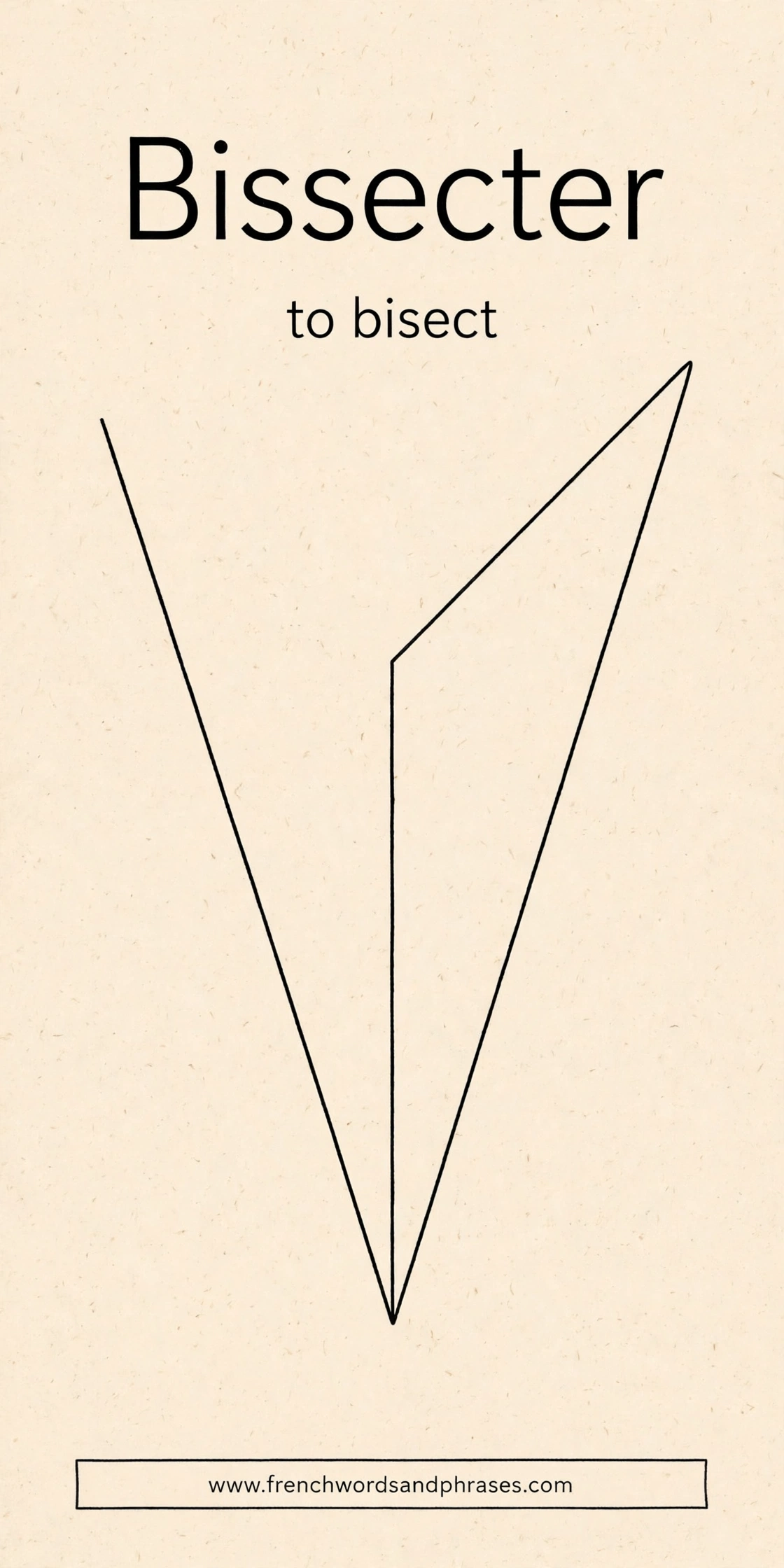
A geometry classroom, a compass, a protractor and one perfect line down the middle of an angle — bissecter is the precise, schoolroom verb of cutting in two: not roughly in half, but exactly, provably in half.
In this guide, you’ll learn how to conjugate bissecter in all the major French tenses and moods. Explore complete conjugation tables, French examples, English translations, and practice quizzes.
Understanding the French Verb Bissecter
Bissecter is a regular French verb belonging to the first group of verbs, those ending in -er.
It means to bisect. It belongs almost entirely to geometry and technical drawing: one bissecte angles and segments, with a compass far more often than with scissors, and the whole point of the verb is exactness — a thing coupé en deux is merely in two pieces, but a thing bissecté is in two equal pieces.
Verb classification: First group (-er)
Auxiliary verb: Avoir
Past participle: bissecté
Present participle: bissectant
English equivalents: To bisect, to cut into two equal parts; bissecter un angle — to bisect an angle; bissecter un segment — to bisect a segment; la bissectrice — the bisector (the line that does the cutting).
One important detail: bissecter wears its meaning in its spelling — bi- (two) plus a cutting root, written with a double s and a firm -ct- that never softens: je bissecte, nous bissectons, ils bissectent, past participle bissecté. Its partner noun is feminine and everywhere in the geometry book: la bissectrice, the bisector — the line you draw when you bissectez an angle, famous for being, at every point, equally far from both sides.
Experience the Word
Bissecter is the verb of the perfect half — the cut that a protractor can applaud.
Imagine a pupil with a compass, opening it wider than half the angle, drawing two arcs that cross like a small X in the air. One straight line through that crossing point, and the angle is bissecté — two twins where a moment ago there was one.
Nothing has been guessed or eyeballed. The angle has been bisected — bissecté, exactly, and provably so.
How to Conjugate Bissecter: Complete French Conjugation Guide
Let’s explore every major conjugation of bissecter, beginning with the indicative mood.
How to Conjugate Bissecter in the Indicative Mood
The indicative mood is used to express facts, observations, actions, and events.
How to Conjugate Bissecter in the Present Tense (Présent)
Used for actions happening now, habitual actions, and general truths.
| Subject | Conjugation |
|---|---|
| je | bissecte |
| tu | bissectes |
| il / elle | bissecte |
| nous | bissectons |
| vous | bissectez |
| ils / elles | bissectent |
Example
Avec un compas, l’élève bissecte l’angle en deux parties égales.
With a compass, the pupil bisects the angle into two equal parts.
Quick Quiz 1
Complete the sentence:
Nous ______ l’angle en deux parties égales.
Reveal the answer
bissectons
Nous bissectons l’angle en deux parties égales.
We bisect the angle into two equal parts.
How to Conjugate Bissecter in the Passé Composé
Used for completed actions in the past. Bissecter takes the auxiliary verb avoir.
| Subject | Conjugation |
|---|---|
| j’ | ai bissecté |
| tu | as bissecté |
| il / elle | a bissecté |
| nous | avons bissecté |
| vous | avez bissecté |
| ils / elles | ont bissecté |
Example
Nous avons bissecté l’angle droit pour obtenir deux angles de quarante-cinq degrés.
We bisected the right angle to obtain two forty-five-degree angles.
How to Conjugate Bissecter in the Imparfait (Imperfect Tense)
Used for habitual past actions, descriptions, and ongoing situations in the past.
| Subject | Conjugation |
|---|---|
| je | bissectais |
| tu | bissectais |
| il / elle | bissectait |
| nous | bissections |
| vous | bissectiez |
| ils / elles | bissectaient |
Example
Le professeur bissectait chaque angle au tableau avec soin.
The teacher used to bisect each angle on the board with care.
Quick Quiz 2
Choose the correct form:
She bisected the segment.
Elle ______ le segment. (a bissecté / est bissectée)
Reveal the answer
a bissecté
Elle a bissecté le segment.
Bissecter takes avoir.
How to Conjugate Bissecter in the Plus-que-parfait
Used to describe an action that had already been completed before another past event.
| Subject | Conjugation |
|---|---|
| j’ | avais bissecté |
| tu | avais bissecté |
| il / elle | avait bissecté |
| nous | avions bissecté |
| vous | aviez bissecté |
| ils / elles | avaient bissecté |
Example
Elle avait bissecté le segment avant de tracer le cercle.
She had bisected the segment before drawing the circle.
How to Conjugate Bissecter in the Passé Simple
Primarily used in formal writing, literature, and historical narratives. It is rarely used in everyday conversation.
| Subject | Conjugation |
|---|---|
| je | bissectai |
| tu | bissectas |
| il / elle | bissecta |
| nous | bissectâmes |
| vous | bissectâtes |
| ils / elles | bissectèrent |
Example
Le géomètre bissecta l’angle et traça la bissectrice.
The surveyor bisected the angle and drew the bisector.
How to Conjugate Bissecter in the Passé Antérieur
A literary tense used to express an action completed immediately before another past action, generally in the passé simple.
| Subject | Conjugation |
|---|---|
| j’ | eus bissecté |
| tu | eus bissecté |
| il / elle | eut bissecté |
| nous | eûmes bissecté |
| vous | eûtes bissecté |
| ils / elles | eurent bissecté |
Example
Quand il eut bissecté l’angle, il mesura les deux moitiés.
When he had bisected the angle, he measured the two halves.
How to Conjugate Bissecter in the Future Tense (Futur Simple)
Used to describe actions that will take place in the future.
| Subject | Conjugation |
|---|---|
| je | bissecterai |
| tu | bissecteras |
| il / elle | bissectera |
| nous | bissecterons |
| vous | bissecterez |
| ils / elles | bissecteront |
Example
Demain, vous bissecterez cet angle en classe.
Tomorrow, you will bisect this angle in class.
How to Conjugate Bissecter in the Futur Antérieur (Future Perfect)
Used for an action that will have been completed before a particular point in the future.
| Subject | Conjugation |
|---|---|
| j’ | aurai bissecté |
| tu | auras bissecté |
| il / elle | aura bissecté |
| nous | aurons bissecté |
| vous | aurez bissecté |
| ils / elles | auront bissecté |
Example
Quand vous aurez bissecté le segment, vous pourrez tracer le cercle.
When you have bisected the segment, you will be able to draw the circle.
How to Conjugate Bissecter in the Near Future (Futur Proche)
Used to describe something that is going to happen soon. Formed with aller + infinitive.
| Subject | Conjugation |
|---|---|
| je | vais bissecter |
| tu | vas bissecter |
| il / elle | va bissecter |
| nous | allons bissecter |
| vous | allez bissecter |
| ils / elles | vont bissecter |
Example
Je vais bissecter cet angle, regarde bien.
I am going to bisect this angle, watch carefully.
How to Conjugate Bissecter in the Conditional Mood
The conditional mood expresses what would happen under certain circumstances. It is also frequently used to make polite requests or express wishes.
How to Conjugate Bissecter in the Present Conditional
| Subject | Conjugation |
|---|---|
| je | bissecterais |
| tu | bissecterais |
| il / elle | bissecterait |
| nous | bissecterions |
| vous | bissecteriez |
| ils / elles | bissecteraient |
Example
Sans compas, on bissecterait difficilement un angle.
Without a compass, one would bisect an angle with difficulty.
How to Conjugate Bissecter in the Past Conditional
| Subject | Conjugation |
|---|---|
| j’ | aurais bissecté |
| tu | aurais bissecté |
| il / elle | aurait bissecté |
| nous | aurions bissecté |
| vous | auriez bissecté |
| ils / elles | auraient bissecté |
Example
Avec une équerre, il aurait bissecté l’angle plus vite.
With a set square, he would have bisected the angle more quickly.
Bissecter in the Literary Past Conditional Form
This less common literary form uses the imperfect subjunctive of avoir.
| Subject | Conjugation |
|---|---|
| j’ | eusse bissecté |
| tu | eusses bissecté |
| il / elle | eût bissecté |
| nous | eussions bissecté |
| vous | eussiez bissecté |
| ils / elles | eussent bissecté |
Example
Il eût bissecté l’angle d’un trait sûr.
He would have bisected the angle with one sure stroke.
How to Conjugate Bissecter in the Subjunctive Mood
The subjunctive is used to express wishes, emotions, doubts, necessity, and uncertainty. It frequently follows expressions such as il faut que (it is necessary that) or bien que (although).
How to Conjugate Bissecter in the Present Subjunctive
| Subject | Conjugation |
|---|---|
| que je | bissecte |
| que tu | bissectes |
| qu’il / qu’elle | bissecte |
| que nous | bissections |
| que vous | bissectiez |
| qu’ils / qu’elles | bissectent |
Example
Il faut que tu bissectes cet angle exactement.
You must bisect this angle exactly.
Quick Quiz 3
Complete the sentence using the subjunctive:
Il faut que tu ______ cet angle exactement.
Reveal the answer
bissectes
Il faut que tu bissectes cet angle exactement.
You must bisect this angle exactly.
How to Conjugate Bissecter in the Imperfect Subjunctive
A literary tense, rarely encountered in modern spoken French.
| Subject | Conjugation |
|---|---|
| que je | bissectasse |
| que tu | bissectasses |
| qu’il / qu’elle | bissectât |
| que nous | bissectassions |
| que vous | bissectassiez |
| qu’ils / qu’elles | bissectassent |
Example
Le maître voulait que l’élève bissectât l’angle sans aide.
The teacher wanted the pupil to bisect the angle unaided.
How to Conjugate Bissecter in the Pluperfect Subjunctive
A literary construction used to express an action completed before another past action.
| Subject | Conjugation |
|---|---|
| que j’ | eusse bissecté |
| que tu | eusses bissecté |
| qu’il / qu’elle | eût bissecté |
| que nous | eussions bissecté |
| que vous | eussiez bissecté |
| qu’ils / qu’elles | eussent bissecté |
Example
On vérifia qu’il eût bissecté le segment au bon endroit.
They checked that he had bisected the segment in the right place.
How to Conjugate Bissecter in the Past Subjunctive
| Subject | Conjugation |
|---|---|
| que j’ | aie bissecté |
| que tu | aies bissecté |
| qu’il / qu’elle | ait bissecté |
| que nous | ayons bissecté |
| que vous | ayez bissecté |
| qu’ils / qu’elles | aient bissecté |
Example
Je suis content que vous ayez bissecté l’angle correctement.
I am glad you bisected the angle correctly.
How to Conjugate Bissecter in the Imperative
The imperative is used to give commands, instructions, invitations, or suggestions. Subject pronouns are omitted.
How to Conjugate Bissecter in the Present Imperative
| Person | Conjugation |
|---|---|
| (tu) | bissecte |
| (nous) | bissectons |
| (vous) | bissectez |
Example
Bissectez cet angle, puis vérifiez au rapporteur !
Bisect this angle, then check with the protractor!
Quick Quiz 4
How would you say Bisect this angle (tu form)?
Reveal the answer
Bissecte cet angle !
French Participles of Bissecter
Participles are verb forms that can be used in compound tenses and other grammatical constructions.
Present Participle of Bissecter
bissectant
En bissectant l’angle, on obtient sa bissectrice.
By bisecting the angle, one obtains its bisector.
Past Participle of Bissecter
bissecté
Bissecté en deux angles égaux, l’angle droit donne deux angles de quarante-cinq degrés.
Bisected into two equal angles, the right angle gives two forty-five-degree angles.
Bissecter in Everyday French: Real-Life Examples
Now that you know the conjugations, let’s see how bissecter appears in everyday French.
Example 1 — Present
L’élève bissecte l’angle au compas.
The pupil bisects the angle with a compass.
Example 2 — Passé composé
Nous avons bissecté le segment en deux.
We bisected the segment in two.
Example 3 — Imparfait
Le professeur bissectait les angles au tableau.
The teacher used to bisect the angles on the board.
Example 4 — Future
Vous bissecterez cet angle demain.
You will bisect this angle tomorrow.
Example 5 — Conditional
Sans compas, je bissecterais mal cet angle.
Without a compass, I would bisect this angle badly.
Example 6 — Imperative
Bissecte cet angle, s’il te plaît !
Bisect this angle, please!
Beyond Translation: The Meaning of Bissecter
English bisect and French bissecter are the same Latin machine — bi-, twice, plus sect-, cut, the root you also meet in section and dissect.
But French keeps the family together on the page.
The line the verb produces has its own name, la bissectrice, and French schoolchildren meet the pair together: on bissecte un angle, on trace la bissectrice — you bisect the angle, you draw the bisector.
How to Remember the French Verb Bissecter
Remember it this way: Bissecter is about the compass drawing one perfect line down the middle of an angle.
- Bi- (two) + a cutting root: to cut into two — and the two parts must be equal.
- The -ss- and -ct- never change: je bissecte, nous bissectons, bissecté.
- Its partner noun: la bissectrice, the bisector line you draw by bisecting.
The key idea is the compass drawing one perfect line down the middle of an angle.
Test Your Knowledge of Bissecter
Let’s see how much you’ve learned. Try answering these questions before revealing the answers.
Question 1
What does la bissectrice do to an angle?
Reveal the answer
It cuts it into two equal parts — it is the line produced when you bissectez the angle.
Question 2
How do you say We bisected the segment in French?
Reveal the answer
Nous avons bissecté le segment.
Question 3
Translate: The pupil bisects the angle with a compass.
Reveal the answer
L’élève bissecte l’angle au compas.
Question 4
What is the past participle of bissecter?
Reveal the answer
Bissecté.
Question 5
Complete the sentence:
Il faut que vous ______ cet angle exactement.
Reveal the answer
bissectiez
Il faut que vous bissectiez cet angle exactement.
You must bisect this angle exactly.
Your Final Challenge
Can You Use It?
How would you say this in French?
The pupil bisects the angle with one sure stroke, and the bisector divides the page into two equal worlds.
Reveal the answer
L’élève bissecte l’angle d’un trait sûr, et la bissectrice partage la page en deux mondes égaux.
The pupil bisects the angle with one sure stroke, and the bisector divides the page into two equal worlds.
A little French. A little curiosity. A richer everyday life.
LEARN FRENCH ONE WORD AT A TIME