A French Word to Live By
How to Conjugate Bisquer in French
/bis.ke/
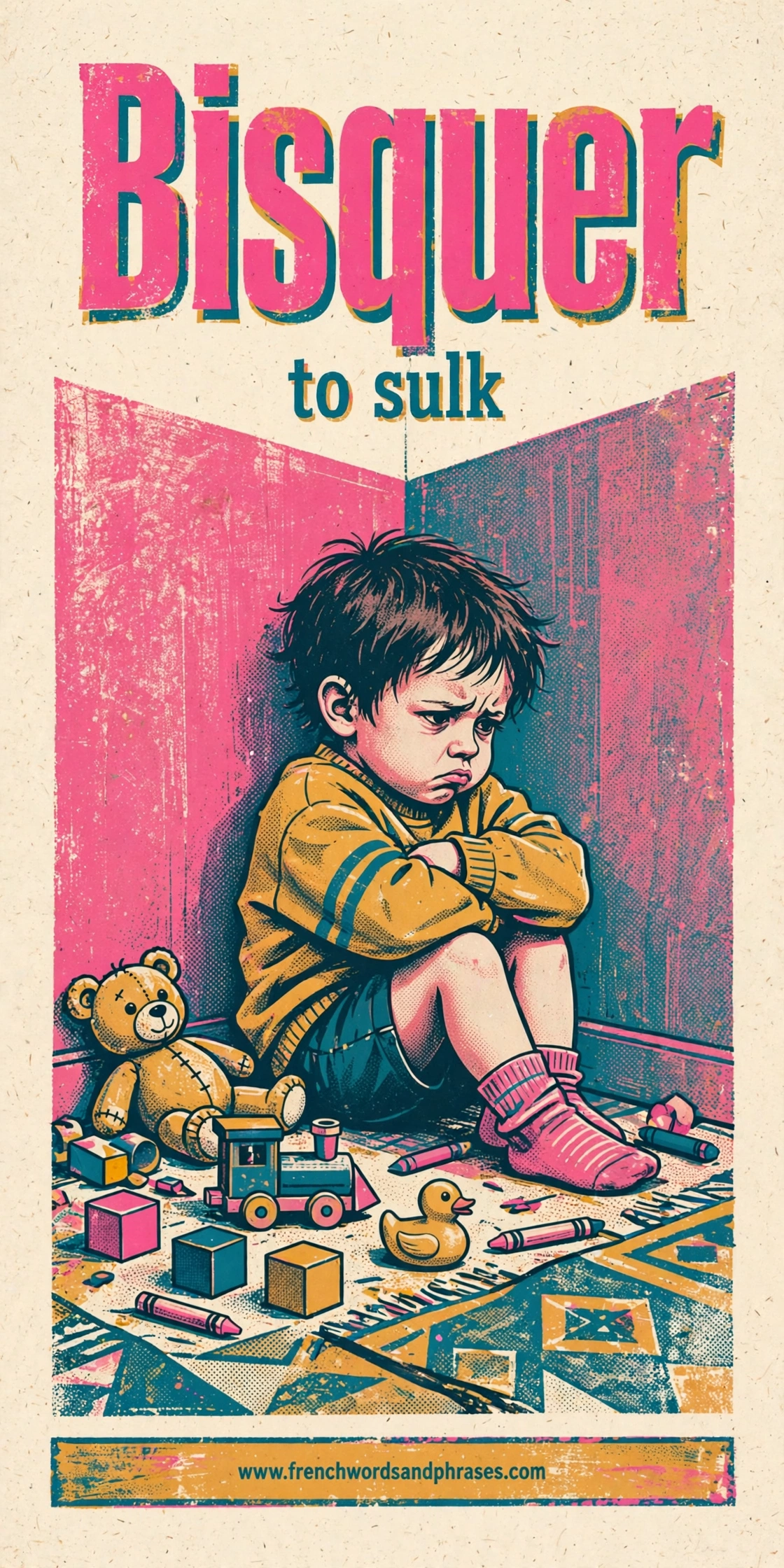
Bisquer means to sulk — to stew in silent annoyance because something has riled you.
A card player who has just lost for the third time, arms crossed, staring at the table; a child sent to the corner of the playground — bisquer is the familiar French verb for that hot, silent sulk: you are not sad, you are annoyed, and everyone can see it.
In this guide, you’ll learn how to conjugate bisquer in all the major French tenses and moods. Explore complete conjugation tables, French examples, English translations, and practice quizzes.
Understanding the French Verb Bisquer
Bisquer is a regular French verb belonging to the first group of verbs, those ending in -er.
It means to sulk. It is commonly used among family, friends and card players for that particular sulk which is half anger, half wounded pride — stronger than bouder in its sting of annoyance, and often said with a smile: on bisque, mais on s’en remet vite, you sulk, but you get over it quickly.
Verb classification: First group (-er)
Auxiliary verb: Avoir
Past participle: bisqué
Present participle: bisquant
English equivalents: To sulk, to be annoyed, to stew; bisquer dans son coin — to sulk in one’s corner; faire bisquer quelqu’un — to rile someone, to wind someone up on purpose; il bisque ! — he’s in a huff!
One important detail: bisquer is a familiar, spoken-register verb — the everyday slang cousin of être vexé (to be put out) — and you will hear it far more than you will read it. Its spelling hides a small trap: the -qu- never loses its u, in any form: je bisque, nous bisquons, vous bisquez, en bisquant. And its favourite construction is causative: faire bisquer quelqu’un is to rile someone deliberately — il l’a fait bisquer en gagnant trois fois de suite, he made him sulk by winning three times in a row.
Experience the Word
Bisquer is the verb of the huff — not grief, not rage, just the hot little cloud of being riled.
Imagine a Sunday card game. Grandfather has lost three hands running to his grandson, who is trying very hard not to grin. Grandfather gathers his cards slowly, crosses his arms and looks out of the window — il bisque, and the whole table knows it, and loves him for it.
He has not left or shouted. He is sulking — bisqué, deliciously, for exactly as long as it takes someone to pour him a coffee.
How to Conjugate Bisquer: Complete French Conjugation Guide
Let’s explore every major conjugation of bisquer, beginning with the indicative mood.
How to Conjugate Bisquer in the Indicative Mood
The indicative mood is used to express facts, observations, actions, and events.
How to Conjugate Bisquer in the Present Tense (Présent)
Used for actions happening now, habitual actions, and general truths.
| Subject | Conjugation |
|---|---|
| je | bisque |
| tu | bisques |
| il / elle | bisque |
| nous | bisquons |
| vous | bisquez |
| ils / elles | bisquent |
Example
Depuis que je lui ai pris sa place, il bisque dans son coin.
Since I took his seat, he has been sulking in his corner.
Quick Quiz 1
Complete the sentence:
Nous ______ quand on nous oublie.
Reveal the answer
bisquons
Nous bisquons quand on nous oublie.
We sulk when people forget us.
How to Conjugate Bisquer in the Passé Composé
Used for completed actions in the past. Bisquer takes the auxiliary verb avoir.
| Subject | Conjugation |
|---|---|
| j’ | ai bisqué |
| tu | as bisqué |
| il / elle | a bisqué |
| nous | avons bisqué |
| vous | avez bisqué |
| ils / elles | ont bisqué |
Example
Elle a bisqué toute la soirée parce qu’on avait oublié son anniversaire.
She sulked all evening because they had forgotten her birthday.
How to Conjugate Bisquer in the Imparfait (Imperfect Tense)
Used for habitual past actions, descriptions, and ongoing situations in the past.
| Subject | Conjugation |
|---|---|
| je | bisquais |
| tu | bisquais |
| il / elle | bisquait |
| nous | bisquions |
| vous | bisquiez |
| ils / elles | bisquaient |
Example
Enfant, mon frère bisquait dès qu’il perdait aux cartes.
As a child, my brother would sulk the moment he lost at cards.
Quick Quiz 2
Choose the correct form:
She sulked all evening.
Elle ______ toute la soirée. (a bisqué / est bisquée)
Reveal the answer
a bisqué
Elle a bisqué toute la soirée.
Bisquer takes avoir.
How to Conjugate Bisquer in the Plus-que-parfait
Used to describe an action that had already been completed before another past event.
| Subject | Conjugation |
|---|---|
| j’ | avais bisqué |
| tu | avais bisqué |
| il / elle | avait bisqué |
| nous | avions bisqué |
| vous | aviez bisqué |
| ils / elles | avaient bisqué |
Example
Il avait bisqué pendant des heures avant de daigner nous parler.
He had sulked for hours before deigning to speak to us.
How to Conjugate Bisquer in the Passé Simple
Primarily used in formal writing, literature, and historical narratives. It is rarely used in everyday conversation.
| Subject | Conjugation |
|---|---|
| je | bisquai |
| tu | bisquas |
| il / elle | bisqua |
| nous | bisquâmes |
| vous | bisquâtes |
| ils / elles | bisquèrent |
Example
Apprenant la nouvelle, elle bisqua et quitta la table.
On hearing the news, she took offence and left the table.
How to Conjugate Bisquer in the Passé Antérieur
A literary tense used to express an action completed immediately before another past action, generally in the passé simple.
| Subject | Conjugation |
|---|---|
| j’ | eus bisqué |
| tu | eus bisqué |
| il / elle | eut bisqué |
| nous | eûmes bisqué |
| vous | eûtes bisqué |
| ils / elles | eurent bisqué |
Example
Dès qu’il eut bisqué un moment, il revint jouer avec les autres.
As soon as he had sulked for a while, he came back to play with the others.
How to Conjugate Bisquer in the Future Tense (Futur Simple)
Used to describe actions that will take place in the future.
| Subject | Conjugation |
|---|---|
| je | bisquerai |
| tu | bisqueras |
| il / elle | bisquera |
| nous | bisquerons |
| vous | bisquerez |
| ils / elles | bisqueront |
Example
Si tu le bats encore, il bisquera, c’est certain.
If you beat him again, he will sulk, that is certain.
How to Conjugate Bisquer in the Futur Antérieur (Future Perfect)
Used for an action that will have been completed before a particular point in the future.
| Subject | Conjugation |
|---|---|
| j’ | aurai bisqué |
| tu | auras bisqué |
| il / elle | aura bisqué |
| nous | aurons bisqué |
| vous | aurez bisqué |
| ils / elles | auront bisqué |
Example
À la fin de la fête, elle aura bisqué trois fois pour rien.
By the end of the party, she will have sulked three times over nothing.
How to Conjugate Bisquer in the Near Future (Futur Proche)
Used to describe something that is going to happen soon. Formed with aller + infinitive.
| Subject | Conjugation |
|---|---|
| je | vais bisquer |
| tu | vas bisquer |
| il / elle | va bisquer |
| nous | allons bisquer |
| vous | allez bisquer |
| ils / elles | vont bisquer |
Example
Attention, il va bisquer si tu ris de sa coiffure.
Careful, he is going to sulk if you laugh at his haircut.
How to Conjugate Bisquer in the Conditional Mood
The conditional mood expresses what would happen under certain circumstances. It is also frequently used to make polite requests or express wishes.
How to Conjugate Bisquer in the Present Conditional
| Subject | Conjugation |
|---|---|
| je | bisquerais |
| tu | bisquerais |
| il / elle | bisquerait |
| nous | bisquerions |
| vous | bisqueriez |
| ils / elles | bisqueraient |
Example
Sans cette remarque, il ne bisquerait pas.
Without that remark, he would not be sulking.
How to Conjugate Bisquer in the Past Conditional
| Subject | Conjugation |
|---|---|
| j’ | aurais bisqué |
| tu | aurais bisqué |
| il / elle | aurait bisqué |
| nous | aurions bisqué |
| vous | auriez bisqué |
| ils / elles | auraient bisqué |
Example
Elle aurait bisqué si on ne l’avait pas invitée.
She would have sulked if we had not invited her.
Bisquer in the Literary Past Conditional Form
This less common literary form uses the imperfect subjunctive of avoir.
| Subject | Conjugation |
|---|---|
| j’ | eusse bisqué |
| tu | eusses bisqué |
| il / elle | eût bisqué |
| nous | eussions bisqué |
| vous | eussiez bisqué |
| ils / elles | eussent bisqué |
Example
Il eût bisqué longtemps sans l’intervention de sa sœur.
He would have sulked a long time without his sister stepping in.
How to Conjugate Bisquer in the Subjunctive Mood
The subjunctive is used to express wishes, emotions, doubts, necessity, and uncertainty. It frequently follows expressions such as il faut que (it is necessary that) or bien que (although).
How to Conjugate Bisquer in the Present Subjunctive
| Subject | Conjugation |
|---|---|
| que je | bisque |
| que tu | bisques |
| qu’il / qu’elle | bisque |
| que nous | bisquions |
| que vous | bisquiez |
| qu’ils / qu’elles | bisquent |
Example
Je préfère qu’il bisque un peu plutôt qu’il explose.
I would rather he sulked a little than exploded.
Quick Quiz 3
Complete the sentence using the subjunctive:
Il vaut mieux qu’elle ne ______ pas pour si peu.
Reveal the answer
bisque
Il vaut mieux qu’elle ne bisque pas pour si peu.
It is better that she not sulk over so little.
How to Conjugate Bisquer in the Imperfect Subjunctive
A literary tense, rarely encountered in modern spoken French.
| Subject | Conjugation |
|---|---|
| que je | bisquasse |
| que tu | bisquasses |
| qu’il / qu’elle | bisquât |
| que nous | bisquassions |
| que vous | bisquassiez |
| qu’ils / qu’elles | bisquassent |
Example
Il fallait qu’elle bisquât en silence, sans déranger personne.
She had to sulk in silence, without disturbing anyone.
How to Conjugate Bisquer in the Pluperfect Subjunctive
A literary construction used to express an action completed before another past action.
| Subject | Conjugation |
|---|---|
| que j’ | eusse bisqué |
| que tu | eusses bisqué |
| qu’il / qu’elle | eût bisqué |
| que nous | eussions bisqué |
| que vous | eussiez bisqué |
| qu’ils / qu’elles | eussent bisqué |
Example
On disait qu’il eût bisqué des jours entiers pour une broutille.
People said he had sulked for days over a trifle.
How to Conjugate Bisquer in the Past Subjunctive
| Subject | Conjugation |
|---|---|
| que j’ | aie bisqué |
| que tu | aies bisqué |
| qu’il / qu’elle | ait bisqué |
| que nous | ayons bisqué |
| que vous | ayez bisqué |
| qu’ils / qu’elles | aient bisqué |
Example
Je suis étonné qu’elle ait bisqué pour si peu.
I am amazed she sulked over so little.
How to Conjugate Bisquer in the Imperative
The imperative is used to give commands, instructions, invitations, or suggestions. Subject pronouns are omitted.
How to Conjugate Bisquer in the Present Imperative
| Person | Conjugation |
|---|---|
| (tu) | bisque |
| (nous) | bisquons |
| (vous) | bisquez |
Example
Ne bisque pas, viens jouer avec nous !
Do not sulk, come and play with us!
Quick Quiz 4
How would you say Do not sulk (tu form)?
Reveal the answer
Ne bisque pas !
French Participles of Bisquer
Participles are verb forms that can be used in compound tenses and other grammatical constructions.
Present Participle of Bisquer
bisquant
En bisquant ainsi, tu ne convaincras personne.
By sulking like that, you will not convince anyone.
Past Participle of Bisquer
bisqué
Fâché et bisqué, il est resté muet tout le repas.
Angry and sulking, he stayed silent through the whole meal.
Bisquer in Everyday French: Real-Life Examples
Now that you know the conjugations, let’s see how bisquer appears in everyday French.
Example 1 — Present
Il bisque parce qu’on a ri de lui.
He is sulking because people laughed at him.
Example 2 — Passé composé
Elle a bisqué toute la soirée.
She sulked all evening.
Example 3 — Imparfait
Tu bisquais chaque fois que tu perdais.
You used to sulk every time you lost.
Example 4 — Future
Il bisquera si on l’oublie encore.
He will sulk if we forget him again.
Example 5 — Conditional
Elle bisquerait pour moins que ça.
She would sulk over less than that.
Example 6 — Imperative
Ne bisquez pas, ce n’était qu’une blague !
Do not sulk, it was only a joke!
Beyond Translation: The Meaning of Bisquer
English sulk is the translation, but it misses the heat: bisquer is sulking with a sting in it — you bisquez because someone has riled you, beaten you, teased you.
That is why its causative twin matters so much.
Faire bisquer quelqu’un — to make someone bisquer — is a small national sport at French card tables: you do not just win, you win in a way that makes the loser bisquer, and then you offer him a drink.
How to Remember the French Verb Bisquer
Remember it this way: Bisquer is about the card player in a huff — arms crossed, waiting for his coffee.
- Familiar register: the spoken verb for être vexé — you will hear it at card tables, not in essays.
- The -qu- keeps its u everywhere: je bisque, nous bisquons, en bisquant.
- Faire bisquer quelqu’un = to rile someone on purpose; the loser bisque, the winner fait bisquer.
The key idea is the card player in a huff — arms crossed, waiting for his coffee.
Test Your Knowledge of Bisquer
Let’s see how much you’ve learned. Try answering these questions before revealing the answers.
Question 1
What register is bisquer, and when would you use it?
Reveal the answer
Familiar, spoken French — for sulking among friends and family: il bisque dans son coin.
Question 2
How do you say He is sulking because he lost in French?
Reveal the answer
Il bisque parce qu’il a perdu.
Question 3
Translate: She sulked all evening.
Reveal the answer
Elle a bisqué toute la soirée.
Question 4
What is the past participle of bisquer?
Reveal the answer
Bisqué.
Question 5
Complete the sentence:
Je sais qu’il ______ dès qu’on le contredit.
Reveal the answer
bisque
Je sais qu’il bisque dès qu’on le contredit.
I know he sulks as soon as anyone contradicts him.
Your Final Challenge
Can You Use It?
How would you say this in French?
He has been sulking in his corner since losing at cards, but the smell of coffee will bring him back to the table.
Reveal the answer
Il bisque dans son coin depuis sa défaite aux cartes, mais l’odeur du café va le ramener à table.
He has been sulking in his corner since losing at cards, but the smell of coffee will bring him back to the table.
A little French. A little curiosity. A richer everyday life.
LEARN FRENCH ONE WORD AT A TIME