A French Word to Live By
Translate Billet to English
/bi.jɛ/
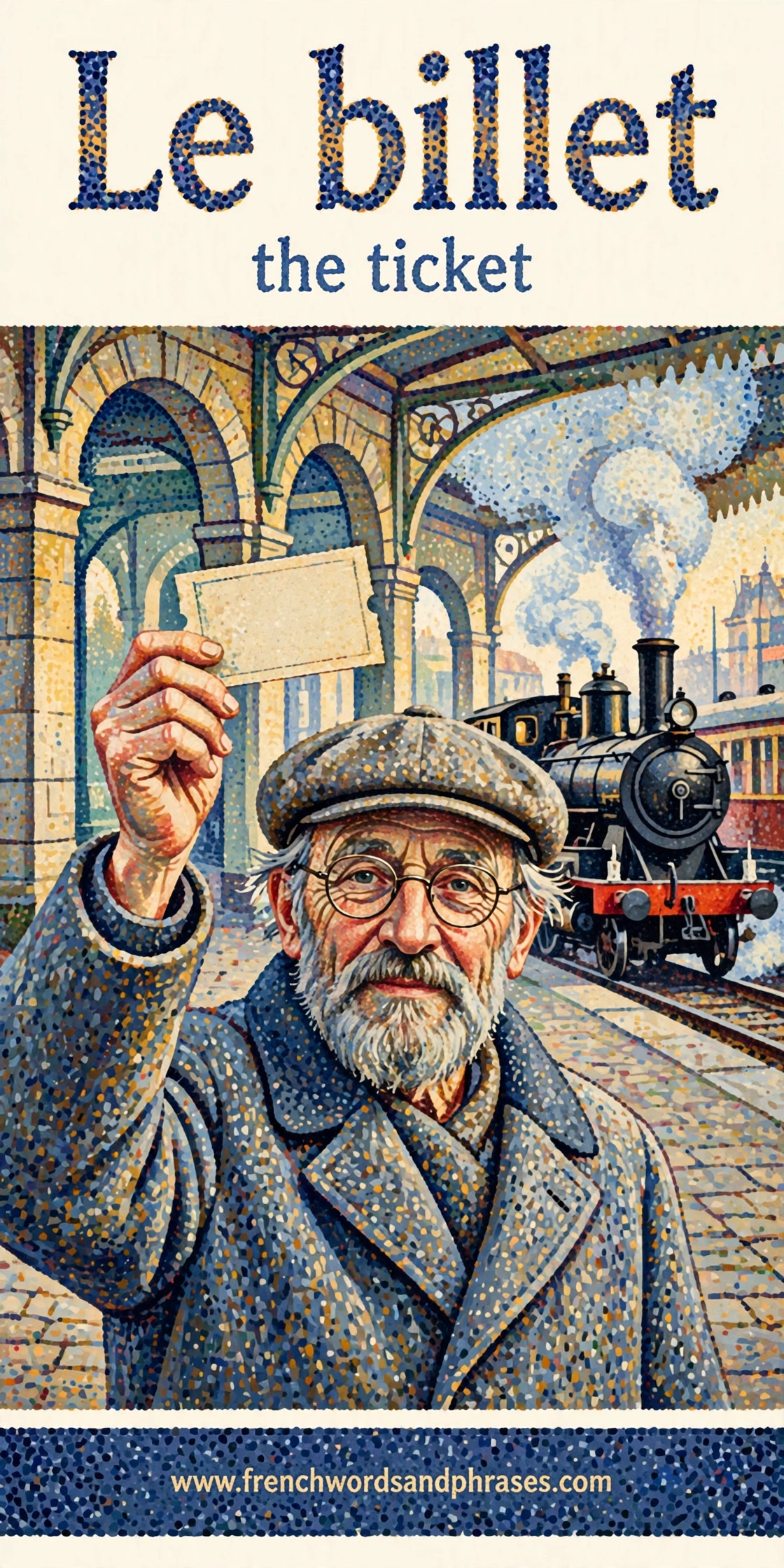
Le billet means the ticket.
The train is announced, the platform fills, and every hand dives into a pocket or a phone. Without one small rectangle of paper — le billet — nobody is going anywhere.
In this guide, you’ll learn what billet means in English, how to use it with its articles, how to form its plural, and how it appears in everyday French. Explore French examples, English translations, and practice quizzes.
Understanding the French Noun Billet
Billet is a masculine French noun, learned with its article: le billet, un billet. It is one of French’s great double-duty words: the same billet takes you onto a train and comes out of a cash machine — a ticket and a banknote in a single word.
It means the ticket — the proof of payment that lets you travel or enter: un billet de train (a train ticket), un billet d’avion (a plane ticket), un billet de cinéma. And it also means the banknote: un billet de vingt euros, a twenty-euro note. Context always tells you which billet is in your hand.
Gender: Masculine
Definite article: le — le billet (the ticket)
Indefinite article: un — un billet (a ticket)
Plural: les billets
Double duty: Also a banknote: un billet de cinquante euros
English equivalents: The ticket; also the (bank)note.
One important usage detail: the ticket type follows with de — billet de train, billet d’avion, billet de spectacle — and a return is un aller-retour, while one way is un aller simple. At the machine or the counter, the question is always: « Aller simple ou aller-retour ? »
Experience the Word
Billet is the small paper border between staying and going. It has been punched, stamped, torn and checked a million times — and now it lives in phones, a QR code keeping the old name.
Imagine the departure board, the suitcase handle in one hand, and the billet checked one last time, then checked again, the traveller’s little ritual of reassurance.
You have not just bought a ticket. You have a promise — une place, un départ, somewhere to be.
How to Use Billet in French: Complete Guide
Let’s explore how billet works in French, beginning with its articles — le billet, the ticket and the banknote in one.
Billet with the Definite Article (Le, Les)
Used for the ticket in your hand — the one the inspector is about to ask for.
| Form | French |
|---|---|
| Masculine singular | le billet |
| Plural | les billets |
Example
Le billet est dans la poche de mon manteau.
The ticket is in my coat pocket.
Billet with the Indefinite Article (Un, Des)
Used for a ticket in general — un billet, the thing every journey starts with.
| Form | French |
|---|---|
| Masculine singular | un billet |
| Plural | des billets |
Example
Il faut un billet pour prendre ce train.
You need a ticket to take this train.
Tickets for Everything: Billet de…
Trains, planes and theatres — the billet changes its surname with de.
| French | In English |
|---|---|
| un billet de train | a train ticket |
| un billet d’avion | a plane ticket |
| un billet de cinéma | a cinema ticket |
| un billet aller-retour | a return ticket |
| un billet aller simple | a one-way ticket |
| un billet de vingt euros | a twenty-euro note |
Example
J’ai acheté un billet d’avion pour Lisbonne.
I bought a plane ticket to Lisbon.
Quick Quiz 1
Complete the sentence:
Le contrôleur demande ______ billet à chaque passager.
Reveal the answer
le
Le contrôleur demande le billet à chaque passager.
The inspector asks each passenger for the ticket — le, the specific ticket each traveller holds.
The Plural of Billet
Billet adds an -s in the plural — les billets, tickets for the whole family.
| Number | French |
|---|---|
| Singular | le billet |
| Plural | les billets |
Example
Les billets pour le concert sont déjà en vente.
The tickets for the concert are already on sale.
Billet with Possessive Adjectives (Mon, Ton, Son…)
Possessives agree with the noun: billet is masculine, so it takes mon, ton, son.
| Owner | French |
|---|---|
| my | mon billet |
| your (tu) | ton billet |
| his / her | son billet |
| our | notre billet |
| your (vous) | votre billet |
| their | leur billet |
Example
J’ai perdu mon billet, je dois en racheter un.
I’ve lost my ticket, I have to buy another one.
Quick Quiz 2
Complete the sentence:
Avez-vous ______ billets, s’il vous plaît ? (your)
Reveal the answer
vos
Avez-vous vos billets, s’il vous plaît ?
Do you have your tickets, please? — vos, the plural of votre.
Billet with Demonstrative Adjectives (Ce, Ces)
Used to point: ce billet, this ticket here, with the date everyone is checking.
| Form | French |
|---|---|
| Masculine singular | ce billet |
| Plural | ces billets |
Example
Ce billet n’est plus valable, il date du mois dernier.
This ticket is no longer valid, it’s from last month.
Billet with Adjectives
Adjectives agree with billet: un billet valable, a ticket that will actually work.
| Adjective | With Billet |
|---|---|
| valable (valid) | un billet valable |
| électronique (electronic) | un billet électronique |
| premier (first) | le premier billet |
| cher (expensive) | un billet cher |
| nouveau (new) | un nouveau billet |
Example
Un billet électronique suffit, pas besoin d’imprimer.
An e-ticket is enough, no need to print.
Quick Quiz 3
Complete the sentence:
Ce billet de train est très ______. (expensive)
Reveal the answer
cher
Ce billet de train est très cher.
This train ticket is very expensive.
Everyday Expressions with Billet
Counters, inspectors and cash machines — the billet phrases of daily life.
| Expression | In English |
|---|---|
| acheter un billet | to buy a ticket |
| composter son billet | to validate (punch) your ticket |
| un billet de banque | a banknote |
| prendre un billet | to get a ticket |
| le guichet des billets | the ticket office window |
| échanger un billet | to exchange a ticket (or a note) |
Example
N’oublie pas de composter ton billet avant de monter.
Don’t forget to validate your ticket before boarding.
Words from the Same Family as Billet
Ticket offices and small notes — the billet family includes the billetterie.
| French | In English |
|---|---|
| la billetterie | the ticket office, the box office |
| le guichet | the ticket window, the booth |
| le ticket | the receipt, the (metro) ticket |
| la pièce | the coin |
| le contrôleur | the ticket inspector |
| réserver | to book, to reserve |
Example
La billetterie du théâtre ouvre à dix heures.
The theatre box office opens at ten o’clock.
Quick Quiz 4
Apart from a ticket, what else is un billet?
Reveal the answer
A banknote — un billet de vingt euros is twenty euros in paper.
Il paie avec un billet de cinquante euros.
He pays with a fifty-euro note.
Billet in Everyday French: Real-Life Examples
Now that you know the word, let’s see how billet appears in everyday French.
Example 1 — At the station
Un billet aller-retour pour Bordeaux, s’il vous plaît.
A return ticket to Bordeaux, please.
Example 2 — On the train
Le contrôleur passe : « Vos billets, s’il vous plaît ! »
The inspector comes round: ‘Your tickets, please!’
Example 3 — At the cash machine
La machine ne donne que des billets de vingt euros.
The machine only gives out twenty-euro notes.
Example 4 — Booking a show
J’ai réservé deux billets pour le spectacle de samedi.
I booked two tickets for Saturday’s show.
Example 5 — A problem
Mon billet n’est pas valable sur ce train.
My ticket isn’t valid on this train.
Example 6 — At the airport
Elle présente son billet d’avion et son passeport.
She shows her plane ticket and her passport.
Beyond Translation: The Meaning of Billet
Few French words work two jobs as gracefully as billet. It began as a little note — a billet doux is still a love letter — and grew into the two papers modern life runs on: the ticket that moves you and the banknote that pays for the moving. Generations of travellers heard the same platform cry, « En voiture ! », billet in hand, and the word survived every revolution of travel, from the punched cardboard of the old SNCF to the QR code on a phone.
To say billet is to hold departure and money in a single small rectangle.
It evokes the stamp of the composteur, the inspector’s punch, the folded note in a birthday card — paper that means you are expected somewhere.
How to Remember the French Noun Billet
Remember it this way: Billet is the ticket — masculine, and the same word is a banknote, so un billet can start a journey or pay for one.
- You travel with it — un billet de train, un billet d’avion.
- You pay with it — un billet de vingt euros.
- You choose the journey — aller simple ou aller-retour.
The key idea is le billet — the ticket and the banknote in one word.
Test Your Knowledge of Billet
Let’s see how much you’ve learned. Try answering these questions before revealing the answers.
Question 1
Is billet masculine or feminine?
Reveal the answer
Masculine — le billet, un billet.
Question 2
How do you say a return ticket in French?
Reveal the answer
Un billet aller-retour — and one way is un aller simple.
Question 3
Translate: I lost my ticket.
Reveal the answer
J’ai perdu mon billet.
Question 4
What is la billetterie?
Reveal the answer
The ticket office, the box office — where billets are sold, from the same family.
Question 5
Complete the sentence:
Nous achetons ______ billets pour le concert.
Reveal the answer
des
Nous achetons des billets pour le concert.
We are buying tickets for the concert.
Your Final Challenge
Can You Use It?
How would you say this in French?
“She buys a return ticket at the station.”
Reveal the answer
Elle achète un billet aller-retour à la gare.
She buys a return ticket at the station.
A little French. A little curiosity. A richer everyday life.
LEARN FRENCH ONE WORD AT A TIME