A French Word to Live By
Translate Beignet to English
/bɛ.ɲɛ/
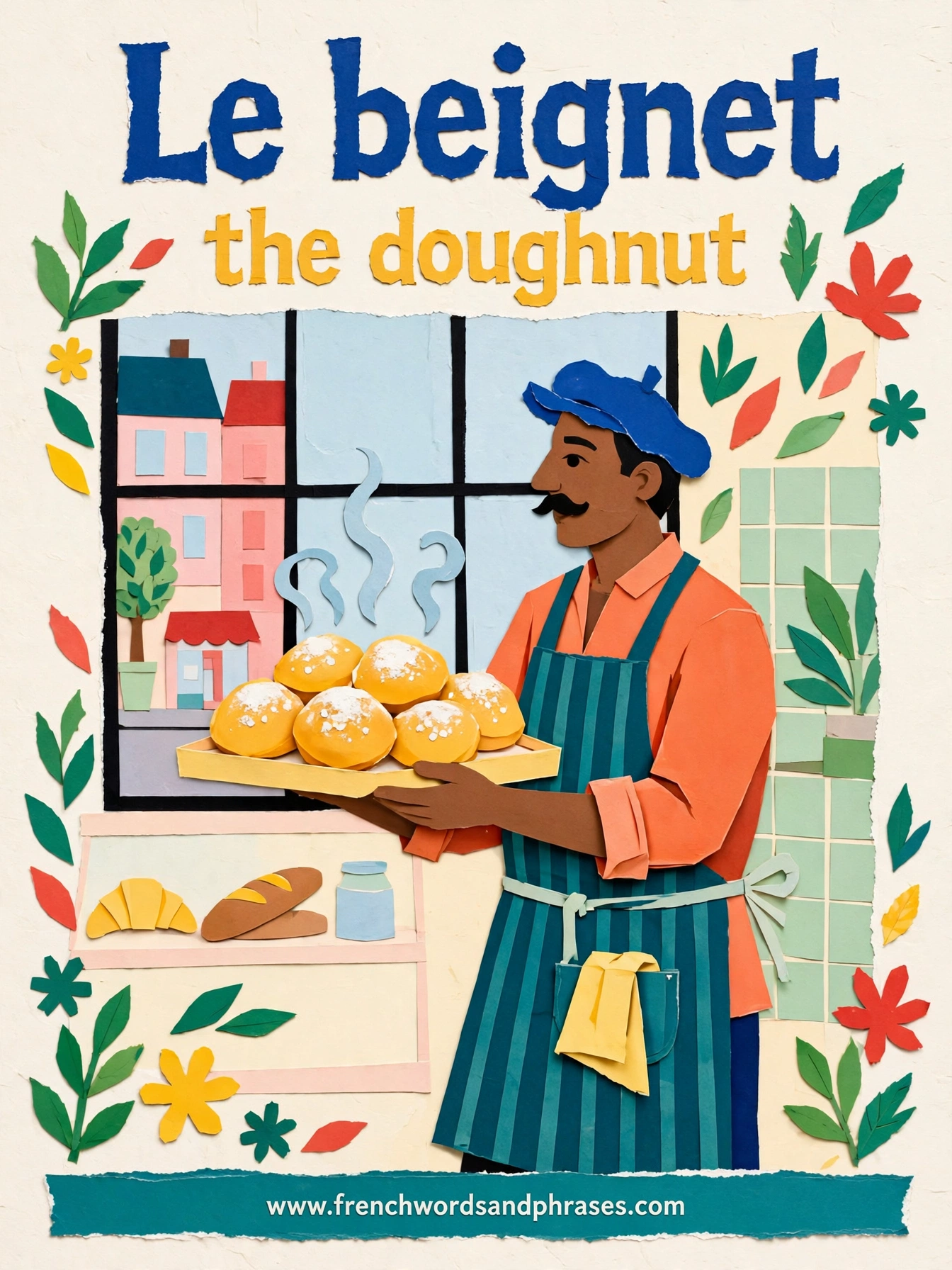
Le beignet means the doughnut.
The fair is in town, the smell of hot oil and sugar drifts between the rides, and a paper cone changes hands, still warm. Inside, golden and dusted with sugar: le beignet.
In this guide, you’ll learn what beignet means in English, how to use it with its articles, how to form its plural, and how it appears in everyday French. Explore French examples, English translations, and practice quizzes.
Understanding the French Noun Beignet
Beignet is a masculine French noun, learned with its article: le beignet, un beignet. It names a whole family of fried joys — in French, a beignet is anything delicious that has taken a bath in hot oil: fruit, vegetables, even cheese can become des beignets.
It means the doughnut — the soft, golden ball or ring of fried dough, rolled in sugar, sold at fairs, markets and bakeries. But the French word travels further than the English one: des beignets de pommes are apple fritters, des beignets de crevettes are prawn fritters, and at carnival time the beignet reigns — les beignets de carnaval are eaten all through February.
Gender: Masculine
Definite article: le — le beignet (the doughnut)
Indefinite article: un — un beignet (a doughnut)
Plural: les beignets
Big season: Carnaval — beignets are the treat of Mardi Gras
English equivalents: The doughnut; for savoury versions, a fritter.
One important usage detail: the sweet beignet of the fairground is the doughnut, but beignet de plus an ingredient makes a fritter — beignets de banane, beignets de courgettes. The pattern is always the same: the ingredient follows, and the frying does the rest.
Experience the Word
Beignet is the taste of the fair. It cannot be eaten elegantly — sugar on the fingers, sugar on the chin, and a burn if you are impatient, because the inside keeps the heat of the oil like a secret.
Imagine the stall at dusk: the fryer bubbling, the vendor fishing out the golden balls with a slotted spoon, the paper cone passed to a child who has been watching for ten minutes.
You have not just eaten a doughnut. You have been to the fair — la fête foraine, with sugar on your hands.
How to Use Beignet in French: Complete Guide
Let’s explore how beignet works in French, beginning with its articles — le beignet, un beignet, warm from the fryer.
Beignet with the Definite Article (Le, Les)
Used for the doughnut everyone can smell — the one in the paper cone.
| Form | French |
|---|---|
| Masculine singular | le beignet |
| Plural | les beignets |
Example
Le beignet est encore chaud, attention à la langue !
The doughnut is still hot, mind your tongue!
Beignet with the Indefinite Article (Un, Des)
Used for a doughnut in general — un beignet, and rarely just one.
| Form | French |
|---|---|
| Masculine singular | un beignet |
| Plural | des beignets |
Example
Je voudrais un beignet au sucre, s’il vous plaît.
I’d like a sugar doughnut, please.
A Family of Fritters: Beignets of Every Kind
Sweet and savoury — the beignet welcomes every ingredient.
| French | In English |
|---|---|
| un beignet aux pommes | an apple fritter |
| des beignets de crevettes | prawn fritters |
| des beignets de carnaval | carnival doughnuts |
| un beignet au chocolat | a chocolate doughnut |
| des beignets de courgettes | courgette fritters |
| la pâte à beignets | fritter batter |
Example
Pour le carnaval, ma grand-mère prépare des beignets aux pommes.
For carnival, my grandmother makes apple fritters.
Quick Quiz 1
Complete the sentence:
À la fête, les enfants mangent ______ beignet au sucre.
Reveal the answer
un
À la fête, les enfants mangent un beignet au sucre.
At the fair, the children are eating a sugar doughnut — beignet is masculine, so it takes un.
The Plural of Beignet
Beignet adds an -s in the plural — les beignets, bought by the half-dozen.
| Number | French |
|---|---|
| Singular | le beignet |
| Plural | les beignets |
Example
Les beignets de la foire se vendent par six.
The fair’s doughnuts are sold in sixes.
Beignet with Possessive Adjectives (Mon, Ton, Son…)
Possessives agree with the noun: beignet is masculine, so it takes mon, ton, son.
| Owner | French |
|---|---|
| my | mon beignet |
| your (tu) | ton beignet |
| his / her | son beignet |
| our | notre beignet |
| your (vous) | votre beignet |
| their | leur beignet |
Example
Ne touche pas à mon beignet, prends le tien !
Don’t touch my doughnut, take yours!
Quick Quiz 2
Complete the sentence:
______ beignets sont pour les enfants. (Our)
Reveal the answer
Nos
Nos beignets sont pour les enfants.
Our doughnuts are for the children — nos, the plural of notre.
Beignet with Demonstrative Adjectives (Ce, Ces)
Used to point at the tray: ce beignet, that golden one there.
| Form | French |
|---|---|
| Masculine singular | ce beignet |
| Plural | ces beignets |
Example
Ce beignet au chocolat a l’air délicieux.
This chocolate doughnut looks delicious.
Beignet with Adjectives
Adjectives agree with beignet: un beignet chaud, fresh from the oil.
| Adjective | With Beignet |
|---|---|
| chaud (hot) | un beignet chaud |
| sucré (sugary, sweet) | un beignet sucré |
| moelleux (soft) | un beignet moelleux |
| premier (first) | le premier beignet |
| gros (big) | un gros beignet |
Example
Rien de meilleur qu’un beignet chaud et moelleux.
Nothing better than a hot, soft doughnut.
Quick Quiz 3
Complete the sentence:
Je préfère les beignets ______ pommes. (apple)
Reveal the answer
aux
Je préfère les beignets aux pommes.
I prefer apple fritters — beignets aux pommes, with the filling introduced by à.
Everyday Expressions with Beignet
Fairs, carnivals and markets — the beignet phrases of daily life.
| Expression | In English |
|---|---|
| faire des beignets | to make doughnuts, to make fritters |
| un marchand de beignets | a doughnut seller |
| les beignets de carnaval | the carnival doughnuts |
| manger un beignet | to eat a doughnut |
| la fête foraine | the fair, the funfair |
| sentir le beignet | to smell of frying (joking) |
Example
Le dimanche, nous faisons des beignets pour les petits-enfants.
On Sundays, we make doughnuts for the grandchildren.
Words from the Same Family as Beignet
Frying and batter — the beignet’s kitchen family.
| French | In English |
|---|---|
| frire | to fry |
| la friture | fried food, the frying |
| la pâte | the dough, the batter |
| le sucre glace | icing sugar |
| la friteuse | the deep fryer |
| doré | golden (an adjective) |
Example
On laisse frire les beignets jusqu’à ce qu’ils soient dorés.
You fry the doughnuts until they are golden.
Quick Quiz 4
When is the great season of the beignet in France?
Reveal the answer
Carnival, around Mardi Gras — February tables fill with beignets de carnaval before Lent begins.
Les beignets de carnaval sont une tradition de février.
Carnival doughnuts are a February tradition.
Beignet in Everyday French: Real-Life Examples
Now that you know the word, let’s see how beignet appears in everyday French.
Example 1 — At the fair
Deux beignets au sucre et un au chocolat, s’il vous plaît.
Two sugar doughnuts and a chocolate one, please.
Example 2 — At carnival
Pour Mardi Gras, l’école distribue des beignets aux enfants.
For Mardi Gras, the school gives doughnuts to the children.
Example 3 — In the kitchen
La pâte à beignets doit reposer une heure avant la friture.
The fritter batter must rest for an hour before frying.
Example 4 — At the market
Le marchand de beignets installe son stand près de la fontaine.
The doughnut seller sets up his stall near the fountain.
Example 5 — A warning
Attends un peu, le beignet sort de la friteuse, il est brûlant.
Wait a bit, the doughnut is just out of the fryer, it’s piping hot.
Example 6 — Savoury version
En entrée, nous avons pris des beignets de crevettes.
As a starter, we had prawn fritters.
Beyond Translation: The Meaning of Beignet
The beignet is France’s carnival king: in the weeks before Lent, when tradition said to use up the eggs, butter and oil of the house, every region fried its own version — bugnes in Lyon, merveilles in the South-West, oreillettes in Provence — different names, same golden idea. The word then travelled the world: in Louisiana, the beignet of New Orleans, buried under icing sugar, still carries its French name with pride.
To say beignet is to name fried dough at its happiest — a festival you can hold in one hand.
It evokes the fairground lights and the smell of hot sugar, paper cones and sticky fingers, and the oldest rule of the fryer: the first one is always for the cook.
How to Remember the French Noun Beignet
Remember it this way: Beignet is the doughnut — masculine, golden and fried, and with de plus an ingredient it becomes a fritter of anything you like.
- You order it sweet — un beignet au sucre.
- You order it savoury — des beignets de crevettes.
- You time it right — les beignets de carnaval, en février.
The key idea is le beignet — the doughnut, and every fritter besides.
Test Your Knowledge of Beignet
Let’s see how much you’ve learned. Try answering these questions before revealing the answers.
Question 1
Is beignet masculine or feminine?
Reveal the answer
Masculine — le beignet, un beignet.
Question 2
What are des beignets de crevettes?
Reveal the answer
Prawn fritters — with de plus an ingredient, a beignet is a fritter.
Question 3
Translate: The doughnut is still hot.
Reveal the answer
Le beignet est encore chaud.
Question 4
What is la pâte à beignets?
Reveal the answer
Fritter batter — the mixture the beignets are fried from.
Question 5
Complete the sentence:
Je voudrais ______ beignets aux pommes. (six)
Reveal the answer
six
Je voudrais six beignets aux pommes.
I’d like six apple fritters.
Your Final Challenge
Can You Use It?
How would you say this in French?
“The children eat warm doughnuts at the fair.”
Reveal the answer
Les enfants mangent des beignets chauds à la fête foraine.
The children eat warm doughnuts at the fair.
A little French. A little curiosity. A richer everyday life.
LEARN FRENCH ONE WORD AT A TIME