A French Word to Live By
How to Conjugate Bétonner in French
/be.tɔ.ne/
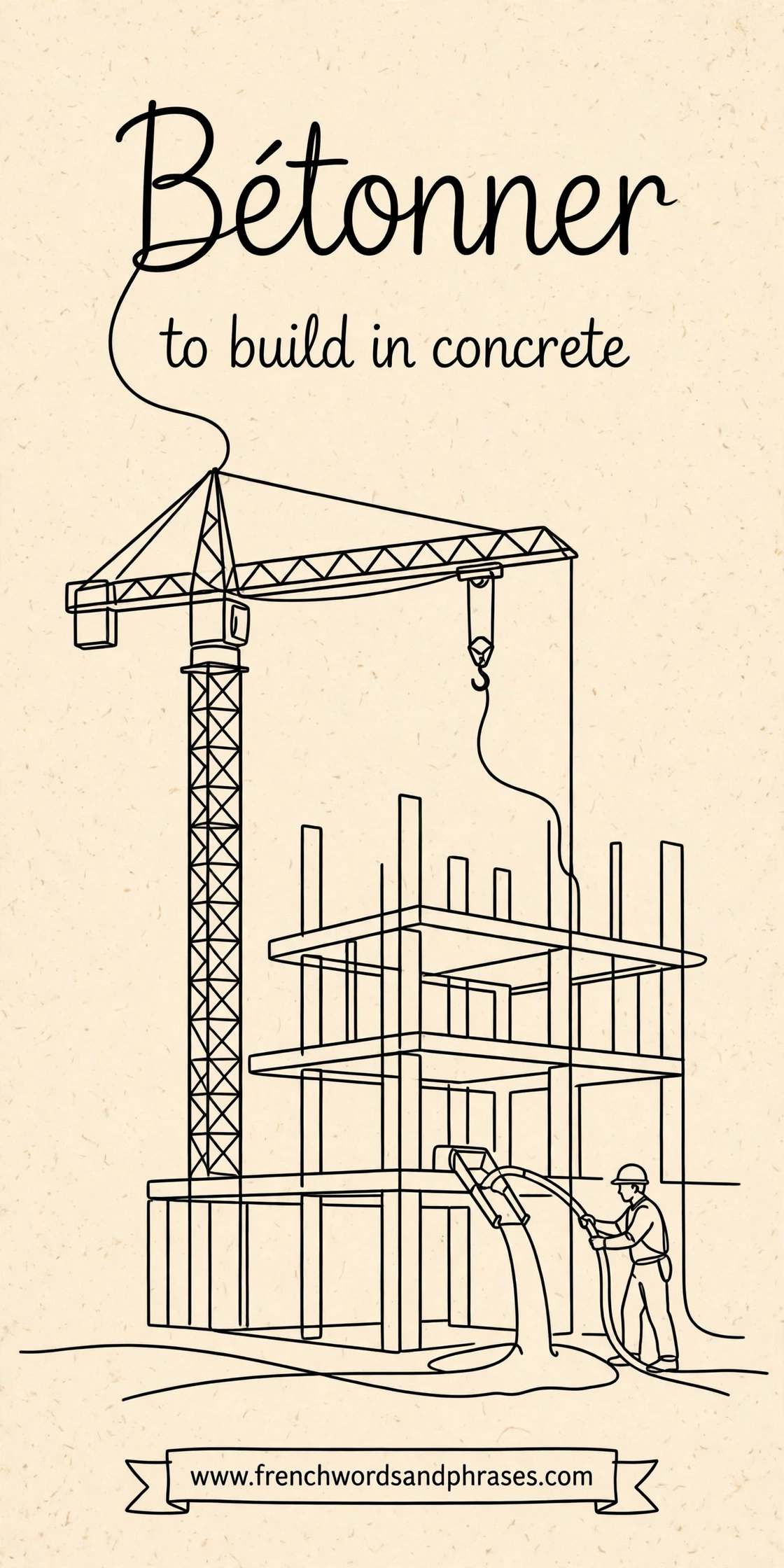
Bétonner means to build in concrete — to cover, line or construct with the grey material that now edges so many of France’s rivers, coasts and squares.
A village square losing its last tree to a car park, a riverbank straightened into a grey wall, a garden vanishing under a terrace slab — bétonner is the verb of concrete spreading: practical, solid, and, in the mouths of those who watch it happen, quietly mournful.
In this guide, you’ll learn how to conjugate bétonner in all the major French tenses and moods. Explore complete conjugation tables, French examples, English translations, and practice quizzes.
Understanding the French Verb Bétonner
Bétonner is a regular French verb belonging to the first group of verbs, those ending in -er.
It means to build in concrete. It is used by builders for slabs, yards, banks and foundations, and by journalists and residents, critically, for the concreting-over of landscapes — le bétonnage des côtes is a standing complaint of French summers. The noun béton is one of the commonest building words in the language.
Verb classification: First group (-er)
Auxiliary verb: Avoir
Past participle: bétonné
Present participle: bétonnant
English equivalents: To concrete, to concrete over, to build in concrete; bétonner une cour — to concrete a yard; bétonner les berges — to line the banks with concrete; le béton — concrete; le bétonnage — concreting, the spread of concrete.
One important detail: bétonner is a regular -er verb — je bétonne, nous bétonnons with the double n kept everywhere, past participle bétonné — and its trap is tone, not spelling. In neutral, technical French it simply means to build or pave with concrete: bétonner une dalle. But in everyday speech it often carries a sigh: bétonner la côte, bétonner la campagne is what developers are accused of when coast and countryside disappear under slabs and car parks. Listen for the context before deciding whether the speaker is describing a building site or deploring one.
Experience the Word
Bétonner is the verb of the grey tide — every slab is permanent, every garden it covers is gone for good.
Imagine the last garden in a city district: one fig tree, a bench, a patch of earth where old men play cards. In March the machines arrive; by April there is a smooth grey car park with white lines. On a bétonné le jardin — and only the pigeons still come looking for the fig tree.
The work is clean, solid and finished on time. It has been concreted — bétonné — and nothing will grow there for a hundred years.
How to Conjugate Bétonner: Complete French Conjugation Guide
Let’s explore every major conjugation of bétonner, beginning with the indicative mood.
How to Conjugate Bétonner in the Indicative Mood
The indicative mood is used to express facts, observations, actions, and events.
How to Conjugate Bétonner in the Present Tense (Présent)
Used for actions happening now, habitual actions, and general truths.
| Subject | Conjugation |
|---|---|
| je | bétonne |
| tu | bétonnes |
| il / elle | bétonne |
| nous | bétonnons |
| vous | bétonnez |
| ils / elles | bétonnent |
Example
La mairie bétonne toutes les places du centre-ville.
The town hall is concreting over all the squares in the town centre.
Quick Quiz 1
Complete the sentence:
Nous ______ la cour avant l’hiver.
Reveal the answer
bétonnons
Nous bétonnons la cour avant l’hiver.
We are concreting the yard before winter.
How to Conjugate Bétonner in the Passé Composé
Used for completed actions in the past. Bétonner takes the auxiliary verb avoir.
| Subject | Conjugation |
|---|---|
| j’ | ai bétonné |
| tu | as bétonné |
| il / elle | a bétonné |
| nous | avons bétonné |
| vous | avez bétonné |
| ils / elles | ont bétonné |
Example
Ils ont bétonné le jardin pour en faire un parking.
They concreted over the garden to make a car park.
How to Conjugate Bétonner in the Imparfait (Imperfect Tense)
Used for habitual past actions, descriptions, and ongoing situations in the past.
| Subject | Conjugation |
|---|---|
| je | bétonnais |
| tu | bétonnais |
| il / elle | bétonnait |
| nous | bétonnions |
| vous | bétonniez |
| ils / elles | bétonnaient |
Example
Autrefois, on bétonnait les berges des rivières.
In the old days, riverbanks were lined with concrete.
Quick Quiz 2
Choose the correct form:
They concreted the garden.
Ils ______ le jardin. (ont bétonné / sont bétonnés)
Reveal the answer
ont bétonné
Ils ont bétonné le jardin.
Bétonner takes avoir.
How to Conjugate Bétonner in the Plus-que-parfait
Used to describe an action that had already been completed before another past event.
| Subject | Conjugation |
|---|---|
| j’ | avais bétonné |
| tu | avais bétonné |
| il / elle | avait bétonné |
| nous | avions bétonné |
| vous | aviez bétonné |
| ils / elles | avaient bétonné |
Example
L’entreprise avait bétonné la cour avant l’hiver.
The firm had concreted the yard before winter.
How to Conjugate Bétonner in the Passé Simple
Primarily used in formal writing, literature, and historical narratives. It is rarely used in everyday conversation.
| Subject | Conjugation |
|---|---|
| je | bétonnai |
| tu | bétonnas |
| il / elle | bétonna |
| nous | bétonnâmes |
| vous | bétonnâtes |
| ils / elles | bétonnèrent |
Example
En une semaine, ils bétonnèrent toute la terrasse.
In one week, they concreted the whole terrace.
How to Conjugate Bétonner in the Passé Antérieur
A literary tense used to express an action completed immediately before another past action, generally in the passé simple.
| Subject | Conjugation |
|---|---|
| j’ | eus bétonné |
| tu | eus bétonné |
| il / elle | eut bétonné |
| nous | eûmes bétonné |
| vous | eûtes bétonné |
| ils / elles | eurent bétonné |
Example
Quand les ouvriers eurent bétonné la dalle, ils laissèrent sécher le béton.
When the workers had concreted the slab, they let the concrete dry.
How to Conjugate Bétonner in the Future Tense (Futur Simple)
Used to describe actions that will take place in the future.
| Subject | Conjugation |
|---|---|
| je | bétonnerai |
| tu | bétonneras |
| il / elle | bétonnera |
| nous | bétonnerons |
| vous | bétonnerez |
| ils / elles | bétonneront |
Example
L’an prochain, la commune bétonnera le chemin de halage.
Next year, the council will concrete the towpath.
How to Conjugate Bétonner in the Futur Antérieur (Future Perfect)
Used for an action that will have been completed before a particular point in the future.
| Subject | Conjugation |
|---|---|
| j’ | aurai bétonné |
| tu | auras bétonné |
| il / elle | aura bétonné |
| nous | aurons bétonné |
| vous | aurez bétonné |
| ils / elles | auront bétonné |
Example
À la fin du mois, nous aurons bétonné tout le rez-de-chaussée.
By the end of the month, we will have concreted the whole ground floor.
How to Conjugate Bétonner in the Near Future (Futur Proche)
Used to describe something that is going to happen soon. Formed with aller + infinitive.
| Subject | Conjugation |
|---|---|
| je | vais bétonner |
| tu | vas bétonner |
| il / elle | va bétonner |
| nous | allons bétonner |
| vous | allez bétonner |
| ils / elles | vont bétonner |
Example
Attention, ils vont bétonner l’allée demain matin.
Careful, they are going to concrete the drive tomorrow morning.
How to Conjugate Bétonner in the Conditional Mood
The conditional mood expresses what would happen under certain circumstances. It is also frequently used to make polite requests or express wishes.
How to Conjugate Bétonner in the Present Conditional
| Subject | Conjugation |
|---|---|
| je | bétonnerais |
| tu | bétonnerais |
| il / elle | bétonnerait |
| nous | bétonnerions |
| vous | bétonneriez |
| ils / elles | bétonneraient |
Example
Sans les protestations des voisins, ils bétonneraient même le parc.
Without the neighbours’ protests, they would concrete over even the park.
How to Conjugate Bétonner in the Past Conditional
| Subject | Conjugation |
|---|---|
| j’ | aurais bétonné |
| tu | aurais bétonné |
| il / elle | aurait bétonné |
| nous | aurions bétonné |
| vous | auriez bétonné |
| ils / elles | auraient bétonné |
Example
On aurait bétonné la place si le budget l’avait permis.
They would have concreted the square if the budget had allowed it.
Bétonner in the Literary Past Conditional Form
This less common literary form uses the imperfect subjunctive of avoir.
| Subject | Conjugation |
|---|---|
| j’ | eusse bétonné |
| tu | eusses bétonné |
| il / elle | eût bétonné |
| nous | eussions bétonné |
| vous | eussiez bétonné |
| ils / elles | eussent bétonné |
Example
Ils eussent bétonné la vallée entière sans la loi nouvelle.
They would have concreted the entire valley without the new law.
How to Conjugate Bétonner in the Subjunctive Mood
The subjunctive is used to express wishes, emotions, doubts, necessity, and uncertainty. It frequently follows expressions such as il faut que (it is necessary that) or bien que (although).
How to Conjugate Bétonner in the Present Subjunctive
| Subject | Conjugation |
|---|---|
| que je | bétonne |
| que tu | bétonnes |
| qu’il / qu’elle | bétonne |
| que nous | bétonnions |
| que vous | bétonniez |
| qu’ils / qu’elles | bétonnent |
Example
Je regrette qu’on bétonne tant d’espaces verts.
I regret that so many green spaces are being concreted over.
Quick Quiz 3
Complete the sentence using the subjunctive:
Les habitants craignent que la mairie ______ le parc.
Reveal the answer
bétonne
Les habitants craignent que la mairie bétonne le parc.
The residents fear the council will concrete over the park.
How to Conjugate Bétonner in the Imperfect Subjunctive
A literary tense, rarely encountered in modern spoken French.
| Subject | Conjugation |
|---|---|
| que je | bétonnasse |
| que tu | bétonnasses |
| qu’il / qu’elle | bétonnât |
| que nous | bétonnassions |
| que vous | bétonnassiez |
| qu’ils / qu’elles | bétonnassent |
Example
Les habitants craignaient que la mairie bétonnât le dernier jardin du quartier.
The residents feared the council might concrete over the last garden in the district.
How to Conjugate Bétonner in the Pluperfect Subjunctive
A literary construction used to express an action completed before another past action.
| Subject | Conjugation |
|---|---|
| que j’ | eusse bétonné |
| que tu | eusses bétonné |
| qu’il / qu’elle | eût bétonné |
| que nous | eussions bétonné |
| que vous | eussiez bétonné |
| qu’ils / qu’elles | eussent bétonné |
Example
On racontait que l’entrepreneur eût bétonné la cour en une nuit.
People said the builder had concreted the yard in a single night.
How to Conjugate Bétonner in the Past Subjunctive
| Subject | Conjugation |
|---|---|
| que j’ | aie bétonné |
| que tu | aies bétonné |
| qu’il / qu’elle | ait bétonné |
| que nous | ayons bétonné |
| que vous | ayez bétonné |
| qu’ils / qu’elles | aient bétonné |
Example
Je suis étonné qu’ils aient bétonné sans permis.
I am amazed they concreted without a permit.
How to Conjugate Bétonner in the Imperative
The imperative is used to give commands, instructions, invitations, or suggestions. Subject pronouns are omitted.
How to Conjugate Bétonner in the Present Imperative
| Person | Conjugation |
|---|---|
| (tu) | bétonne |
| (nous) | bétonnons |
| (vous) | bétonnez |
Example
Ne bétonnez pas tout, laissez un peu de terre aux fleurs !
Do not concrete everything, leave a little soil for the flowers!
Quick Quiz 4
How would you say Do not concrete everything (tu form)?
Reveal the answer
Ne bétonne pas tout !
French Participles of Bétonner
Participles are verb forms that can be used in compound tenses and other grammatical constructions.
Present Participle of Bétonner
bétonnant
En bétonnant les sols, on empêche l’eau de s’infiltrer.
By concreting over the ground, we stop water from soaking in.
Past Participle of Bétonner
bétonné
Bétonnée dans les années soixante, la place a perdu tout son charme.
Concreted over in the sixties, the square lost all its charm.
Bétonner in Everyday French: Real-Life Examples
Now that you know the conjugations, let’s see how bétonner appears in everyday French.
Example 1 — Present
La mairie bétonne les places du centre-ville.
The town hall is concreting over the squares in the town centre.
Example 2 — Passé composé
Ils ont bétonné le jardin pour faire un parking.
They concreted over the garden to make a car park.
Example 3 — Imparfait
On bétonnait les berges des rivières.
Riverbanks were lined with concrete.
Example 4 — Future
La commune bétonnera le chemin de halage.
The council will concrete the towpath.
Example 5 — Conditional
Ils bétonneraient même le parc sans les protestations.
They would concrete over even the park without the protests.
Example 6 — Imperative
Ne bétonnez pas tout !
Do not concrete everything!
Beyond Translation: The Meaning of Bétonner
The noun came first: le béton, concrete — a word French borrowed from an old term for a rough mortar, and which now names the material of motorways, bunkers and tower blocks. The verb bétonner simply puts that material to work.
But modern French hears a warning in it.
Campaigners speak of le bétonnage — the concreting of the coastline, the mountains, the countryside — and a mayor who bétonne too eagerly may find the word waiting for him, in grey letters, at the next election.
How to Remember the French Verb Bétonner
Remember it this way: Bétonner is about the last garden in the district disappearing under grey concrete.
- Le béton is concrete; bétonner is to cover or build with it — one grey word family.
- The double n never changes: je bétonne, nous bétonnons, past participle bétonné.
- Tone is the trap: on a building site it is neutral; about a coastline, it is an accusation.
The key idea is the last garden in the district disappearing under grey concrete.
Test Your Knowledge of Bétonner
Let’s see how much you’ve learned. Try answering these questions before revealing the answers.
Question 1
When a French newspaper says a mayor bétonne la côte, is it praising him?
Reveal the answer
Almost certainly not — about landscapes, bétonner is an accusation: concreting over, spoiling with concrete.
Question 2
How do you say They concreted over the garden to make a car park in French?
Reveal the answer
Ils ont bétonné le jardin pour en faire un parking.
Question 3
Translate: The town hall is concreting over the squares in the town centre.
Reveal the answer
La mairie bétonne les places du centre-ville.
Question 4
What is the past participle of bétonner?
Reveal the answer
Bétonné — with the double n kept, like the whole verb.
Question 5
Complete the sentence:
Je regrette qu’on ______ tant d’espaces verts.
Reveal the answer
bétonne
Je regrette qu’on bétonne tant d’espaces verts.
I regret that so many green spaces are being concreted over.
Your Final Challenge
Can You Use It?
How would you say this in French?
They concreted the square in a week, and the pigeons are still looking for the old fig tree.
Reveal the answer
On a bétonné la place en une semaine, et les pigeons cherchent encore le vieux figuier.
They concreted the square in a week, and the pigeons are still looking for the old fig tree.
A little French. A little curiosity. A richer everyday life.
LEARN FRENCH ONE WORD AT A TIME