A French Word to Live By
How to Conjugate Bêtiser in French
/be.ti.ze/
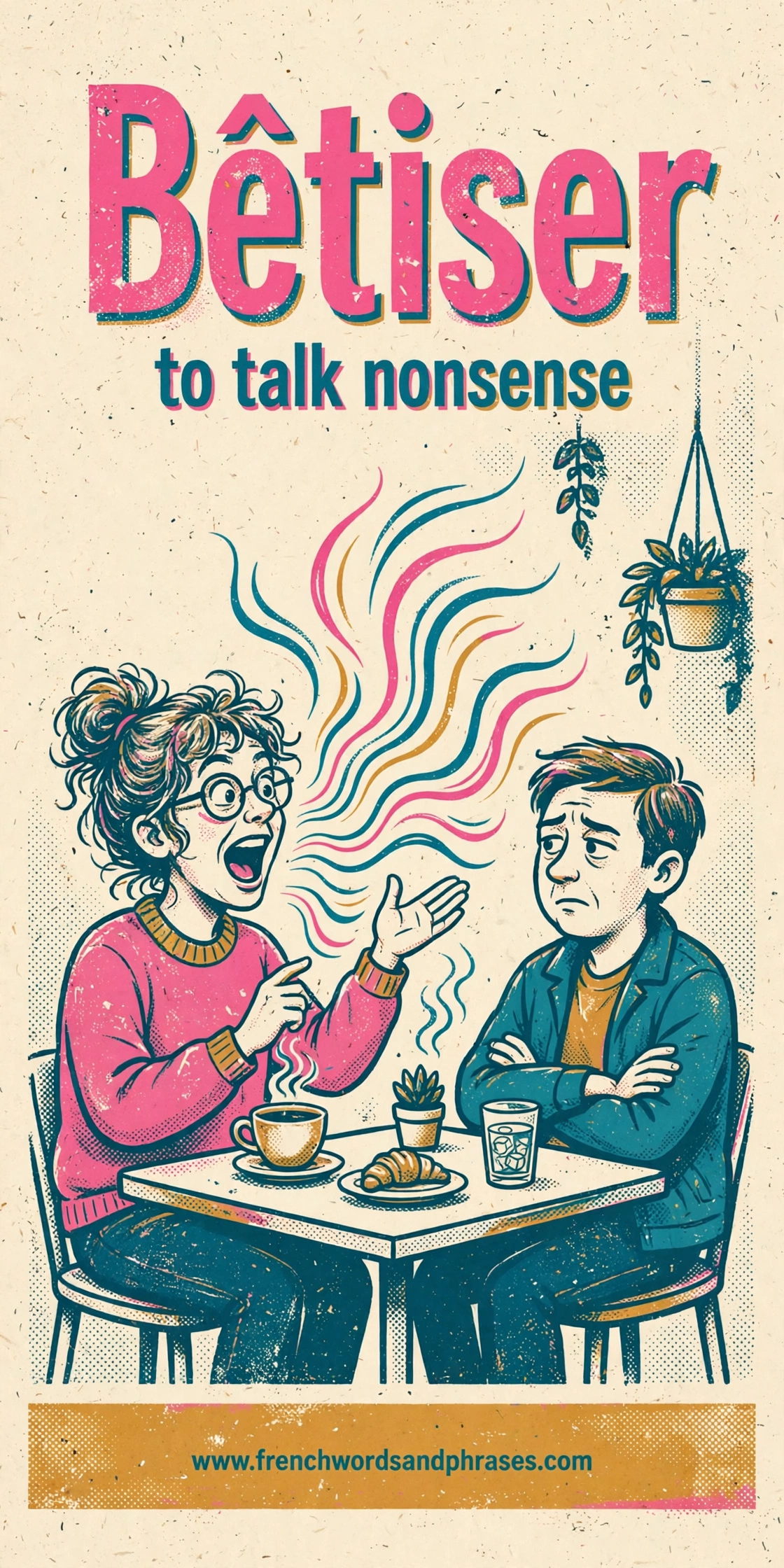
Bêtiser means to talk nonsense — to say stupid things, usually with complete confidence.
The uncle who holds forth at Sunday lunch on subjects he knows nothing about, the pundit filling an hour of television with empty certainty, the friend who explains the world after two glasses of wine — bêtiser is the verb of confident nonsense: the mouth works, the brain rests, and the bêtises flow.
In this guide, you’ll learn how to conjugate bêtiser in all the major French tenses and moods. Explore complete conjugation tables, French examples, English translations, and practice quizzes.
Understanding the French Verb Bêtiser
Bêtiser is a regular French verb belonging to the first group of verbs, those ending in -er.
It means to talk nonsense. It is used of talk that is foolish through ignorance, drink or sheer love of the sound of one’s own voice — interviews, debates, family dinners. It is rarely cruel: the person who bêtise is more empty than wicked, and the word always leaves room for a laugh.
Verb classification: First group (-er)
Auxiliary verb: Avoir
Past participle: bêtisé
Present participle: bêtisant
English equivalents: To talk nonsense, to talk rubbish; bêtiser devant les caméras — to talk nonsense on camera; une bêtise — a silly thing said or done, a mistake; dire des bêtises — to talk nonsense; faire des bêtises — to get up to mischief.
One important detail: bêtiser is a regular -er verb — je bêtise, nous bêtisons, past participle bêtisé — and it is all about speech. Where bêtifier covers behaviour in general, bêtiser means to say bêtises: silly, empty or stupid things. Its noun is one of the most useful words in French: une bêtise is a stupid remark, a silly mistake, or a child’s piece of mischief — faire des bêtises is what children do when the adults leave the room. The register is familiar and affectionate rather than harsh: to say il bêtise is to smile while you say it.
Experience the Word
Bêtiser is the verb of the empty speech delivered with total assurance — nonsense, pronounced like wisdom.
Imagine a television studio. The guest knows nothing about farming, but the programme needs twenty minutes filled, so he leans back, folds his hands and bêtise — beautifully, fluently, unstoppably — while real farmers at home shout at their screens.
He has not lied about a single fact; he has simply never met one. He has talked nonsense — il a bêtisé — with the confidence of an expert.
How to Conjugate Bêtiser: Complete French Conjugation Guide
Let’s explore every major conjugation of bêtiser, beginning with the indicative mood.
How to Conjugate Bêtiser in the Indicative Mood
The indicative mood is used to express facts, observations, actions, and events.
How to Conjugate Bêtiser in the Present Tense (Présent)
Used for actions happening now, habitual actions, and general truths.
| Subject | Conjugation |
|---|---|
| je | bêtise |
| tu | bêtises |
| il / elle | bêtise |
| nous | bêtisons |
| vous | bêtisez |
| ils / elles | bêtisent |
Example
Quand il est fatigué, il bêtise sans s’en rendre compte.
When he is tired, he talks nonsense without realising it.
Quick Quiz 1
Complete the sentence:
Nous ______ quand nous sommes fatigués.
Reveal the answer
bêtisons
Nous bêtisons quand nous sommes fatigués.
We talk nonsense when we are tired.
How to Conjugate Bêtiser in the Passé Composé
Used for completed actions in the past. Bêtiser takes the auxiliary verb avoir.
| Subject | Conjugation |
|---|---|
| j’ | ai bêtisé |
| tu | as bêtisé |
| il / elle | a bêtisé |
| nous | avons bêtisé |
| vous | avez bêtisé |
| ils / elles | ont bêtisé |
Example
Tu as bêtisé pendant toute l’interview.
You talked nonsense throughout the interview.
How to Conjugate Bêtiser in the Imparfait (Imperfect Tense)
Used for habitual past actions, descriptions, and ongoing situations in the past.
| Subject | Conjugation |
|---|---|
| je | bêtisais |
| tu | bêtisais |
| il / elle | bêtisait |
| nous | bêtisions |
| vous | bêtisiez |
| ils / elles | bêtisaient |
Example
Le vieux conteur bêtisait volontiers après deux verres de vin.
The old storyteller would happily talk nonsense after two glasses of wine.
Quick Quiz 2
Choose the correct form:
You talked nonsense all evening.
Tu ______ toute la soirée. (as bêtisé / es bêtisé)
Reveal the answer
as bêtisé
Tu as bêtisé toute la soirée.
Bêtiser takes avoir.
How to Conjugate Bêtiser in the Plus-que-parfait
Used to describe an action that had already been completed before another past event.
| Subject | Conjugation |
|---|---|
| j’ | avais bêtisé |
| tu | avais bêtisé |
| il / elle | avait bêtisé |
| nous | avions bêtisé |
| vous | aviez bêtisé |
| ils / elles | avaient bêtisé |
Example
Elle avait bêtisé si longtemps que plus personne ne l’écoutait.
She had talked nonsense for so long that nobody was listening any more.
How to Conjugate Bêtiser in the Passé Simple
Primarily used in formal writing, literature, and historical narratives. It is rarely used in everyday conversation.
| Subject | Conjugation |
|---|---|
| je | bêtisai |
| tu | bêtisas |
| il / elle | bêtisa |
| nous | bêtisâmes |
| vous | bêtisâtes |
| ils / elles | bêtisèrent |
Example
Il bêtisa un instant, puis devint soudain sérieux.
He talked nonsense for a moment, then suddenly turned serious.
How to Conjugate Bêtiser in the Passé Antérieur
A literary tense used to express an action completed immediately before another past action, generally in the passé simple.
| Subject | Conjugation |
|---|---|
| j’ | eus bêtisé |
| tu | eus bêtisé |
| il / elle | eut bêtisé |
| nous | eûmes bêtisé |
| vous | eûtes bêtisé |
| ils / elles | eurent bêtisé |
Example
Quand elle eut bêtisé assez longtemps, elle se tut enfin.
When she had talked enough nonsense, she finally fell silent.
How to Conjugate Bêtiser in the Future Tense (Futur Simple)
Used to describe actions that will take place in the future.
| Subject | Conjugation |
|---|---|
| je | bêtiserai |
| tu | bêtiseras |
| il / elle | bêtisera |
| nous | bêtiserons |
| vous | bêtiserez |
| ils / elles | bêtiseront |
Example
Si on le laisse parler, il bêtisera jusqu’à minuit.
If we let him talk, he will spout nonsense until midnight.
How to Conjugate Bêtiser in the Futur Antérieur (Future Perfect)
Used for an action that will have been completed before a particular point in the future.
| Subject | Conjugation |
|---|---|
| j’ | aurai bêtisé |
| tu | auras bêtisé |
| il / elle | aura bêtisé |
| nous | aurons bêtisé |
| vous | aurez bêtisé |
| ils / elles | auront bêtisé |
Example
À la fin du débat, ils auront bêtisé plus qu’ils n’auront réfléchi.
By the end of the debate, they will have talked more nonsense than sense.
How to Conjugate Bêtiser in the Near Future (Futur Proche)
Used to describe something that is going to happen soon. Formed with aller + infinitive.
| Subject | Conjugation |
|---|---|
| je | vais bêtiser |
| tu | vas bêtiser |
| il / elle | va bêtiser |
| nous | allons bêtiser |
| vous | allez bêtiser |
| ils / elles | vont bêtiser |
Example
Attention, il va encore bêtiser devant les invités.
Careful, he is going to talk nonsense in front of the guests again.
How to Conjugate Bêtiser in the Conditional Mood
The conditional mood expresses what would happen under certain circumstances. It is also frequently used to make polite requests or express wishes.
How to Conjugate Bêtiser in the Present Conditional
| Subject | Conjugation |
|---|---|
| je | bêtiserais |
| tu | bêtiserais |
| il / elle | bêtiserait |
| nous | bêtiserions |
| vous | bêtiseriez |
| ils / elles | bêtiseraient |
Example
Avec moins de vin, il bêtiserait beaucoup moins.
With less wine, he would talk far less nonsense.
How to Conjugate Bêtiser in the Past Conditional
| Subject | Conjugation |
|---|---|
| j’ | aurais bêtisé |
| tu | aurais bêtisé |
| il / elle | aurait bêtisé |
| nous | aurions bêtisé |
| vous | auriez bêtisé |
| ils / elles | auraient bêtisé |
Example
Elle aurait moins bêtisé si elle avait préparé son discours.
She would have talked less nonsense if she had prepared her speech.
Bêtiser in the Literary Past Conditional Form
This less common literary form uses the imperfect subjunctive of avoir.
| Subject | Conjugation |
|---|---|
| j’ | eusse bêtisé |
| tu | eusses bêtisé |
| il / elle | eût bêtisé |
| nous | eussions bêtisé |
| vous | eussiez bêtisé |
| ils / elles | eussent bêtisé |
Example
Il eût bêtisé toute la soirée sans la présence de sa femme.
He would have talked nonsense all evening without his wife being there.
How to Conjugate Bêtiser in the Subjunctive Mood
The subjunctive is used to express wishes, emotions, doubts, necessity, and uncertainty. It frequently follows expressions such as il faut que (it is necessary that) or bien que (although).
How to Conjugate Bêtiser in the Present Subjunctive
| Subject | Conjugation |
|---|---|
| que je | bêtise |
| que tu | bêtises |
| qu’il / qu’elle | bêtise |
| que nous | bêtisions |
| que vous | bêtisiez |
| qu’ils / qu’elles | bêtisent |
Example
Je doute qu’il bêtise vraiment ; il fait semblant.
I doubt he is really talking nonsense; he is pretending.
Quick Quiz 3
Complete the sentence using the subjunctive:
Je doute que vous ______ devant les journalistes.
Reveal the answer
bêtisiez
Je doute que vous bêtisiez devant les journalistes.
I doubt you are talking nonsense in front of the journalists.
How to Conjugate Bêtiser in the Imperfect Subjunctive
A literary tense, rarely encountered in modern spoken French.
| Subject | Conjugation |
|---|---|
| que je | bêtisasse |
| que tu | bêtisasses |
| qu’il / qu’elle | bêtisât |
| que nous | bêtisassions |
| que vous | bêtisassiez |
| qu’ils / qu’elles | bêtisassent |
Example
On craignait qu’il bêtisât devant les journalistes.
People feared he might talk nonsense in front of the journalists.
How to Conjugate Bêtiser in the Pluperfect Subjunctive
A literary construction used to express an action completed before another past action.
| Subject | Conjugation |
|---|---|
| que j’ | eusse bêtisé |
| que tu | eusses bêtisé |
| qu’il / qu’elle | eût bêtisé |
| que nous | eussions bêtisé |
| que vous | eussiez bêtisé |
| qu’ils / qu’elles | eussent bêtisé |
Example
On disait qu’elle eût bêtisé pendant tout le repas.
People said she had talked nonsense throughout the meal.
How to Conjugate Bêtiser in the Past Subjunctive
| Subject | Conjugation |
|---|---|
| que j’ | aie bêtisé |
| que tu | aies bêtisé |
| qu’il / qu’elle | ait bêtisé |
| que nous | ayons bêtisé |
| que vous | ayez bêtisé |
| qu’ils / qu’elles | aient bêtisé |
Example
Je suis surpris qu’il ait bêtisé devant tant de monde.
I am surprised he talked nonsense in front of so many people.
How to Conjugate Bêtiser in the Imperative
The imperative is used to give commands, instructions, invitations, or suggestions. Subject pronouns are omitted.
How to Conjugate Bêtiser in the Present Imperative
| Person | Conjugation |
|---|---|
| (tu) | bêtise |
| (nous) | bêtisons |
| (vous) | bêtisez |
Example
Ne bêtise pas, réponds sérieusement !
Do not talk nonsense, answer seriously!
Quick Quiz 4
How would you say Do not talk nonsense (tu form)?
Reveal the answer
Ne bêtise pas !
French Participles of Bêtiser
Participles are verb forms that can be used in compound tenses and other grammatical constructions.
Present Participle of Bêtiser
bêtisant
En bêtisant de la sorte, il a perdu toute crédibilité.
By talking nonsense like that, he lost all credibility.
Past Participle of Bêtiser
bêtisé
Des propos bêtisés devant les caméras ne s’effacent pas facilement.
Words spoken foolishly in front of the cameras are not easily erased.
Bêtiser in Everyday French: Real-Life Examples
Now that you know the conjugations, let’s see how bêtiser appears in everyday French.
Example 1 — Present
Il bêtise sans s’en rendre compte.
He talks nonsense without realising it.
Example 2 — Passé composé
Tu as bêtisé pendant toute l’interview.
You talked nonsense throughout the interview.
Example 3 — Imparfait
Le conteur bêtisait après deux verres de vin.
The storyteller would talk nonsense after two glasses of wine.
Example 4 — Future
Il bêtisera jusqu’à minuit si on le laisse parler.
He will spout nonsense until midnight if we let him talk.
Example 5 — Conditional
Elle bêtiserait moins avec un peu de préparation.
She would talk less nonsense with a little preparation.
Example 6 — Imperative
Ne bêtise pas, réponds sérieusement !
Do not talk nonsense, answer seriously!
Beyond Translation: The Meaning of Bêtiser
The whole family turns around une bêtise: a silly remark, a daft mistake, a child’s mischief — the word French reaches for a hundred times a day, from une petite bêtise costing nothing to la bêtise humaine, human stupidity itself.
Bêtiser is the verb of producing them aloud.
And like its cousin bêtifier, it comes from bête, at once an animal and a fool — the speaker who bêtise has, for a moment, more confidence than mind.
How to Remember the French Verb Bêtiser
Remember it this way: Bêtiser is about confident nonsense after two glasses of wine.
- Bêtiser is about speech: to say des bêtises. For behaviour in general, French uses bêtifier.
- The noun does the heavy lifting in daily life: une bêtise — a silly remark, a mistake, a piece of mischief.
- Regular -er: je bêtise, nous bêtisons, past participle bêtisé.
The key idea is confident nonsense after two glasses of wine.
Test Your Knowledge of Bêtiser
Let’s see how much you’ve learned. Try answering these questions before revealing the answers.
Question 1
What exactly does the person who bêtise produce?
Reveal the answer
Des bêtises — silly, empty or stupid remarks, usually delivered with complete confidence.
Question 2
How do you say You talked nonsense throughout the interview in French?
Reveal the answer
Tu as bêtisé pendant toute l’interview.
Question 3
Translate: When he is tired, he talks nonsense without realising it.
Reveal the answer
Quand il est fatigué, il bêtise sans s’en rendre compte.
Question 4
What is the past participle of bêtiser?
Reveal the answer
Bêtisé.
Question 5
Complete the sentence:
Je doute qu’il ______ vraiment ; il fait semblant.
Reveal the answer
bêtise
Je doute qu’il bêtise vraiment ; il fait semblant.
I doubt he is really talking nonsense; he is pretending.
Your Final Challenge
Can You Use It?
How would you say this in French?
He talks nonsense with confidence, and that is how rumours are born.
Reveal the answer
Il bêtise avec assurance, et c’est ainsi que les rumeurs naissent.
He talks nonsense with confidence, and that is how rumours are born.
A little French. A little curiosity. A richer everyday life.
LEARN FRENCH ONE WORD AT A TIME