A French Word to Live By
Translate Battre comme plâtre to English
/batʁ kɔm plɑtʁ/
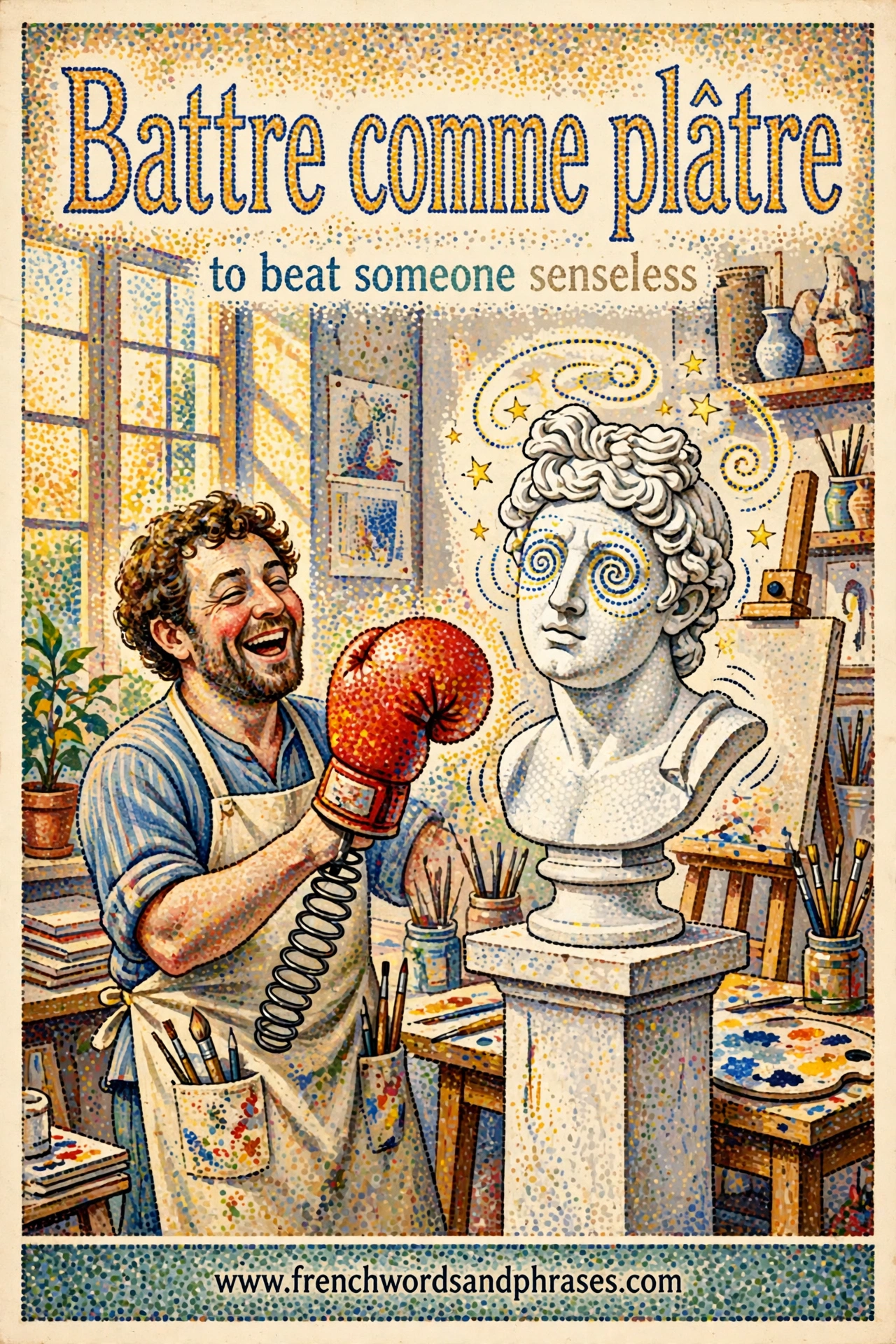
Battre comme plâtre means to beat someone senseless — to thrash them black and blue.
Behind the school, two grandfathers are retelling a fight from 1968 for the hundredth time. The smaller one mimes the footwork, the taller one shakes his head with respect across the decades: « Il l’a battu comme plâtre, ce jour-là. » Nobody at the café table doubts it — the phrase itself sounds like a drum.
Let’s explore how battre comme plâtre works in French, beginning with the whole phrase on one card.
Understanding the French Phrase Battre comme plâtre
Battre comme plâtre is a French idiomatic expression built from battre (to beat) and le plâtre (plaster). Plaster is beaten and pounded when it is worked — and the image is of a beating so thorough that the victim is worked over like a lump of plaster, flattened and softened by blows.
It means to beat someone senseless — to thrash them severely, black and blue, in a one-sided fight. The phrase is old, vivid and almost always hyperbolic today: it lives in stories, sports talk and mock threats rather than police reports. When a grandmother warns a squabbling grandson that his brother will le battre comme plâtre, everyone at the table understands theatre, not a forecast.
Type: Idiomatic expression — fighting (verb + material picture)
Answers the need: Saying someone was thrashed completely, in a story or a warning
Register: Familiar, old-fashioned flavour — storytelling, humour, mock threats
Strength: Maximum — a total, one-sided beating, usually exaggerated
One important usage detail: the phrase is almost always told afterwards or threatened beforehand — il l’a battu comme plâtre, je vais te battre comme plâtre — rarely narrated mid-fight. Its natural home is the anecdote: fights from school, from the army, from the stadium, growing slightly more one-sided with every retelling.
Experience the Word
Battre comme plâtre is the heavyweight champion of French fight stories — a phrase you can hear, all rhythm and impact.
Imagine the story as it travels: the fight was even in 1970, one-sided by 1990, and by now the loser was plaster by the second minute. The phrase does that work. Plaster is what a wall becomes when the hammer is finished — and the listener sees the whole fight in the material.
French tells violence the way it tells weather, with an image you can touch. Plâtre is soft, white and thoroughly worked — exactly how the loser feels.
How to Use Battre comme plâtre in French: Complete Guide
Let’s explore how battre comme plâtre works in French, beginning with the whole phrase on one card.
Battre comme plâtre at a Glance
The Whole Phrase on One Card
Real meaning, literal picture, English twin and register — battre comme plâtre in five lines.
| Point | Battre comme plâtre |
|---|---|
| What it really means | to beat someone senseless, to thrash them completely |
| Word for word | to beat like plaster — worked over like a lump of plaster |
| English equivalent | to beat black and blue / to beat to a pulp / to thrash soundly |
| Register | familiar, a little old-fashioned — stories and mock threats |
| Use it for | one-sided fights in anecdotes, warnings and sporting massacres |
Example
Au match de boxe, le champion l’a battu comme plâtre.
In the boxing match, the champion beat him senseless.
Word by Word: Building the Thrashing
Three small pieces — take them one by one and the blows start to land.
| Word | Literal meaning | Its job in the phrase |
|---|---|---|
| battre | to beat | the verb of the fight — also of hearts, eggs and drums |
| comme | like, as | the little word that sets up the comparison |
| plâtre | plaster | the material that gets pounded and worked — the victim’s fate in one word |
Example
Battu comme plâtre, il a fini par abandonner.
Beaten senseless, he ended up giving up.
Quick Quiz 1
What material gives the phrase its picture — plâtre or marbre?
Reveal the answer
Plâtre — plaster. Marble is hard and noble; plaster is what gets pounded soft. The victim is plaster, never marble.
Il l’a battu comme plâtre, pas comme marbre.
He beat him like plaster, not like marble.
When You Say It: The Thrashing Moments
Battre comme plâtre fires at moments like these — in stories, warnings and very one-sided contests.
| Situation | Example |
|---|---|
| Telling an old fight | en 1968, il l’a battu comme plâtre derrière l’école — in 1968, he beat him senseless behind the school |
| A mock threat | continue et je te bats comme plâtre — carry on and I’ll beat you senseless |
| At the stadium | l’équipe visiteuse a été battue comme plâtre — the visiting team got thrashed |
| Between brothers | son grand frère l’a battu comme plâtre, paraît-il — his big brother thrashed him, apparently |
| In a novel | le héros bat les bandits comme plâtre — the hero beats the bandits senseless |
Example
Continue comme ça et ton frère te bat comme plâtre.
Carry on like that and your brother will beat you senseless.
Make It Yours: The Thrashing for Every Fighter
Battre is irregular — je bats, il bat, ils battent — and comme plâtre never changes.
| Form | French | In English |
|---|---|---|
| He beat him senseless | il l’a battu comme plâtre | he beat him senseless |
| I will beat you senseless | je vais te battre comme plâtre | I’ll beat you senseless |
| He was beaten senseless | il a été battu comme plâtre | he was beaten senseless |
| They thrash everyone | ils battent tout le monde comme plâtre | they thrash everyone |
| Question (mock threat) | tu veux être battu comme plâtre ? | do you want to be beaten senseless? |
| In a story’s present | le champion le bat comme plâtre | the champion is beating him senseless |
Example
Le champion l’a battu comme plâtre en trois rounds.
The champion beat him senseless in three rounds.
Quick Quiz 2
What is the past participle of battre — battu or batté?
Reveal the answer
Battu — battre is irregular: il l’a battu comme plâtre.
Battu comme plâtre, le boxeur a quitté le ring.
Beaten senseless, the boxer left the ring.
Everyday Expressions: Building on the Plaster
Battre comme plâtre slots into these everyday frames — each one ready to use as it stands.
| Frame | In English |
|---|---|
| battre quelqu’un comme plâtre | to beat someone senseless |
| être battu comme plâtre | to be beaten senseless — the receiving end |
| je vais te battre comme plâtre | I’ll beat you senseless — the classic mock threat |
| se faire battre comme plâtre | to get beaten senseless |
| battu comme plâtre, mais debout | beaten senseless, but still standing — the story’s proud ending |
Example
Battu comme plâtre, mais debout : c’est ainsi qu’il raconte le match.
Beaten senseless, but still standing: that’s how he tells the match.
Close Cousins: The Other Thrashings
French has a whole shelf of beating phrases — the plaster is the storyteller’s one; its cousins are blunter, slangier or more official.
| Expression | The difference |
|---|---|
| battre comme plâtre | to beat senseless — old-flavoured, hyperbolic, the anecdote’s phrase |
| rouer de coups | to beat with blows — the classic literary version, equally severe |
| passer à tabac | to beat up — informal, modern, the slang of the street and the news |
| donner une raclée | to give a thrashing — the defeat itself, also used for heavy losses in games |
| corriger quelqu’un | to give someone a hiding — old-fashioned, the schoolmaster’s word |
Example
Une raclée au match, battus comme plâtre au retour : quelle soirée.
A thrashing at the match, beaten senseless on the way home: what an evening.
Quick Quiz 3
Which cousin is the modern slang for a beating — passer à tabac or battre comme plâtre?
Reveal the answer
Passer à tabac — the street’s phrase. Battre comme plâtre belongs to the storytellers, a generation or two older.
Dans le journal, on lit passer à tabac ; au café, battre comme plâtre.
In the paper you read passer à tabac; at the café, battre comme plâtre.
Battre comme plâtre and Its Neighbours
The fight shelf around the phrase — blows, defeats and the plaster cast that may follow.
| French | In English |
|---|---|
| un coup | a blow, a hit |
| se battre | to fight — the reciprocal version |
| une raclée | a thrashing, a drubbing |
| un bleu | a bruise — literally, a blue |
| le plâtre | plaster — also the cast a broken bone ends up in |
| abandonner | to give up — what the plastered fighter does |
Example
Après les coups, un bleu partout et presque le plâtre.
After the blows, bruises everywhere and nearly a plaster cast.
Watch Out: The Traps Around Battre comme plâtre
The traps: plaster that heals instead of hurts, a verb with many lives, and hyperbole mistaken for a report.
| Trap | The truth |
|---|---|
| plaster’s second job | le plâtre is also the cast that mends broken bones — the beaten man may meet the same material twice, in the phrase and at the hospital |
| battre beats many things | battre also beats eggs, cards and records, and the heart beats with it — le cœur bat; only the fight context brings the plaster |
| it is hyperbole | in everyday mouths the phrase exaggerates for the story — a real, serious assault is une agression, and nobody jokes with comme plâtre |
| comme stays comme | the comparison never changes: comme plâtre for every subject, every tense, every fighter |
Example
Battu comme plâtre au match, il a fini avec un vrai plâtre au poignet.
Beaten senseless in the match, he ended up with a real plaster cast on his wrist.
Quick Quiz 4
True or false: battre comme plâtre is the phrase a newspaper would use for a serious assault.
Reveal the answer
False — it is the storyteller’s hyperbole. Serious reporting says une agression or passer à tabac.
Le journal parle d’agression ; le grand-père, lui, dit battre comme plâtre.
The newspaper says assault; grandfather says battre comme plâtre.
Battre comme plâtre in Everyday French: Real-Life Examples
Now that you know the word, let’s see how battre comme plâtre appears in everyday French.
Example 1 — The old story
En 1968, il l’a battu comme plâtre derrière la gare.
In 1968, he beat him senseless behind the station.
Example 2 — The mock threat
Continue et je te bats comme plâtre, moi.
Carry on and I’ll beat you senseless.
Example 3 — The boxing match
Le champion l’a battu comme plâtre en trois rounds.
The champion beat him senseless in three rounds.
Example 4 — The stadium
L’équipe a été battue comme plâtre, cinq à zéro.
The team got thrashed, five-nil.
Example 5 — Between brothers
Son grand frère l’a battu comme plâtre pour la dernière part de gâteau.
His big brother beat him senseless over the last slice of cake.
Example 6 — Still standing
Battu comme plâtre, mais il souriait encore.
Beaten senseless, but he was still smiling.
Beyond Translation: The Meaning of Battre comme plâtre
English beats people black and blue, or to a pulp — colour and cooking. French reaches for the builder’s yard: plaster, the material that exists to be pounded, spread and flattened. The loser of the fight is not bruised fruit or a bruise with legs; he is a wall that has been worked on.
To battre comme plâtre is to be finished like a surface — thoroughly, professionally, and in the telling, forever.
The phrase survives because fights become stories, and stories need a material you can hear being hit.
How to Remember the French Phrase Battre comme plâtre
Remember it this way: Battre comme plâtre is the fight told in building materials — the loser worked over like a lump of plaster under the hammer.
- You hear the material — plâtre is plaster: soft, white, and made to be pounded flat.
- You keep the participle irregular — battu comme plâtre, never batté.
- You save it for stories — it is hyperbole with an old-fashioned grin, not the language of real reports.
The key idea is battre comme plâtre means to beat someone senseless — worked over like plaster.
Test Your Knowledge of Battre comme plâtre
Let’s see how much you’ve learned. Try answering these questions before revealing the answers.
Question 1
What does battre comme plâtre mean?
Reveal the answer
To beat someone senseless — to thrash them completely, in a one-sided fight.
Question 2
Why plaster?
Reveal the answer
Because plaster is pounded and worked flat — the victim is treated like a lump of it under the blows.
Question 3
How do you say ‘he beat him senseless’?
Reveal the answer
Il l’a battu comme plâtre — with battu, the irregular past participle of battre.
Question 4
Is the phrase literal reporting or hyperbole?
Reveal the answer
Hyperbole — it belongs to stories, warnings and jokes; serious assaults are agressions in plain French.
Question 5
Complete the sentence:
Le champion l’a battu comme ______. (The champion beat him senseless.)
Reveal the answer
plâtre
Le champion l’a battu comme plâtre.
The champion beat him senseless.
Your Final Challenge
Can You Use It?
How would you say this in French?
“The champion beat him senseless in three rounds.”
Reveal the answer
Le champion l’a battu comme plâtre en trois rounds.
The champion beat him senseless in three rounds.
A little French. A little curiosity. A richer everyday life.
LEARN FRENCH ONE WORD AT A TIME