A French Word to Live By
Translate Battre froid à quelqu’un to English
/batʁ fʁwa a kɛl.kœ̃/
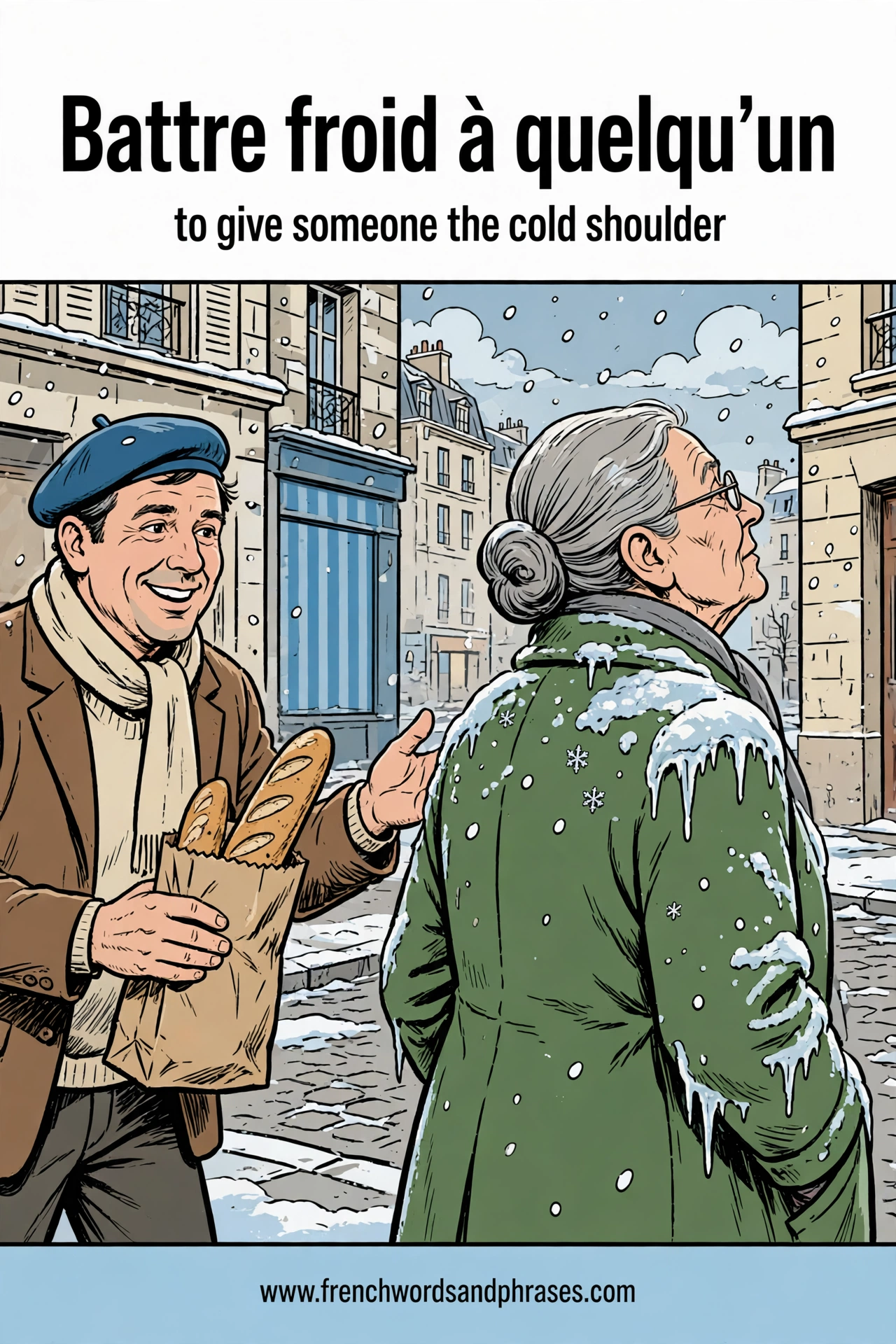
Battre froid à quelqu’un means to give someone the cold shoulder — to treat them with deliberate, icy distance.
At the office party, the director crosses the room to greet his deputy — and the deputy answers with a nod so brief and a smile so thin that the temperature around them drops. They quarrelled on Monday; nobody has apologised. A colleague whispers the technical term: « Il lui bat froid depuis lundi. »
Let’s explore how battre froid à quelqu’un works in French, beginning with the whole phrase on one card.
Understanding the French Phrase Battre froid à quelqu’un
Battre froid à quelqu’un is a French idiomatic expression built from battre (here, to show or strike out), froid (cold — used as a noun, ‘coldness’) and à quelqu’un (to someone). The cold is not weather: it is a manner, aimed at one person, on purpose.
It means to give someone the cold shoulder — to greet them coldly, keep them at a distance and let them feel your displeasure without ever raising your voice. Nothing is said and that is precisely the message. French speakers use it for the frosty treatment after a quarrel, a slight or a disappointment: the politeness remains, the warmth is withdrawn.
Type: Idiomatic expression — relations (verb + noun + à quelqu’un)
Answers the need: Saying someone is being deliberately cold and distant to you
Register: Neutral to literary — understood everywhere, a touch refined
Strength: Quiet but unmistakable — frost, not a storm; the message is the silence
One important usage detail: the cold is always aimed — battre froid à quelqu’un, with the person after à. The phrase also stands alone when the target is understood: depuis l’incident, il me bat froid. Its cousin noun names the result: il y a un froid entre eux, there is a chill between them — the cold shoulder, kept in the fridge of a friendship.
Experience the Word
Battre froid à quelqu’un is a quarrel conducted entirely in temperature — no raised voices, just the heating switched off.
Imagine the family lunch after the inheritance discussion: the soup is served, the conversation is correct, and yet one chair at the table is clearly in another climate. Short answers. No second helping offered. Eyes that pass over a face like weather over a map. That is battre froid — punishment by thermostat.
French, which has a phrase for every social weather, keeps this one for the cold front. It is the politest weapon in the language: nothing to quote, everything understood.
How to Use Battre froid à quelqu’un in French: Complete Guide
Let’s explore how battre froid à quelqu’un works in French, beginning with the whole phrase on one card.
Battre froid à quelqu’un at a Glance
The Whole Phrase on One Card
Real meaning, literal picture, English twin and register — battre froid à quelqu’un in five lines.
| Point | Battre froid à quelqu’un |
|---|---|
| What it really means | to give someone the cold shoulder — deliberate cold distance |
| Word for word | to beat cold to someone — to deal out coldness |
| English equivalent | to give someone the cold shoulder / to freeze someone out |
| Register | neutral to literary — refined, never slangy |
| Use it for | the frost after a quarrel, a snub, a friendship in the fridge |
Example
Depuis la dispute, elle lui bat froid.
Since the quarrel, she has been giving him the cold shoulder.
Word by Word: Building the Cold Shoulder
Four small pieces — take them one by one and the temperature starts to fall.
| Word | Literal meaning | Its job in the phrase |
|---|---|---|
| battre | to beat | here, to deal out, to show — the cold is administered, like a treatment |
| froid | cold, coldness | a noun here: the chill itself, the withdrawn warmth |
| à | to | the little word that aims the cold at its target |
| quelqu’un | someone | the person being frozen out — replaced in real life by lui, me, son frère… |
Example
Il me bat froid depuis la réunion.
He has been giving me the cold shoulder since the meeting.
Quick Quiz 1
Is the froid in this phrase about the weather?
Reveal the answer
No — it is coldness of manner, aimed at a person on purpose. The weather has nothing to do with it.
Il ne fait pas froid, mais elle lui bat froid.
It isn’t cold, but she is giving him the cold shoulder.
When You Say It: The Cold-Shoulder Moments
Battre froid fires at moments like these — wherever warmth is withdrawn and the silence does the talking.
| Situation | Example |
|---|---|
| After a quarrel | depuis leur dispute, il lui bat froid — since their quarrel, he gives her the cold shoulder |
| At the office | le directeur bat froid à son adjoint — the director is freezing out his deputy |
| In the family | elle bat froid à sa belle-sœur depuis Noël — she has been cold to her sister-in-law since Christmas |
| Noticing it | tu as vu ? il me bat froid — did you see? he’s giving me the cold shoulder |
| The result, as a noun | il y a un froid entre eux depuis — there has been a chill between them since |
Example
Il y a un froid entre eux : il lui bat froid depuis des semaines.
There is a chill between them: he has been giving her the cold shoulder for weeks.
Make It Yours: The Cold for Every Target
Battre is irregular — je bats, il bat — and the target slides in after à, or as a pronoun before the verb.
| Form | French | In English |
|---|---|---|
| He gives me the cold shoulder | il me bat froid | he gives me the cold shoulder |
| She gives him the cold shoulder | elle lui bat froid | she gives him the cold shoulder |
| To give the cold shoulder to a colleague | battre froid à un collègue | to give a colleague the cold shoulder |
| Since the quarrel (ongoing) | il me bat froid depuis lundi | he has been cold to me since Monday |
| Question | pourquoi tu me bats froid ? | why are you giving me the cold shoulder? |
| The chill as a noun | il y a un froid entre nous | there is a chill between us |
Example
Pourquoi tu me bats froid ? Qu’est-ce que j’ai fait ?
Why are you giving me the cold shoulder? What did I do?
Quick Quiz 2
Which sentence aims the cold correctly — il bat froid elle or il lui bat froid?
Reveal the answer
Il lui bat froid — the target comes as lui (or after à: battre froid à quelqu’un).
Depuis lundi, il lui bat froid sans explication.
Since Monday, he has been giving her the cold shoulder without explanation.
Everyday Expressions: Building on the Cold
Battre froid à quelqu’un slots into these everyday frames — each one ready to use as it stands.
| Frame | In English |
|---|---|
| battre froid à quelqu’un | to give someone the cold shoulder |
| il y a un froid entre eux | there is a chill between them — the cold as a state |
| battre froid depuis X | to have been cold to someone since X |
| un accueil froid | a cold welcome — the same frost, at the door |
| rompre le froid | to break the chill — the thaw, when someone finally speaks warmly |
Example
Un mot gentil a suffi à rompre le froid entre elles.
One kind word was enough to break the chill between them.
Close Cousins: The Other Cold Treatments
French has a whole shelf of distance phrases — battre froid is the frosty one; its cousins ignore, sulk and snub.
| Expression | The difference |
|---|---|
| battre froid à quelqu’un | to give the cold shoulder — deliberate frost, politeness kept, warmth withdrawn |
| ignorer quelqu’un | to ignore someone — the coldest version: they simply do not exist |
| bouder | to sulk — withdrawing with a pout; the cold is childish and visible |
| snober quelqu’un | to snub someone — coldness from above, with social disdain |
| prendre ses distances | to distance yourself — the neutral, adult decision to step back |
Example
Il ne l’ignore pas, il lui bat froid : c’est plus poli et plus froid.
He isn’t ignoring her, he’s giving her the cold shoulder: politer, and colder.
Quick Quiz 3
Which cousin means the person simply does not exist for you any more?
Reveal the answer
Ignorer quelqu’un — total invisibility. Battre froid still acknowledges the person — coldly.
L’ignorer serait trop ; elle se contente de lui battre froid.
Ignoring him would be too much; she contents herself with the cold shoulder.
Battre froid à quelqu’un and Its Neighbours
The frost shelf around the phrase — quarrels, silences and thaws.
| French | In English |
|---|---|
| une dispute | a quarrel — the usual cause |
| la froideur | coldness, frostiness — the manner itself |
| un accueil glacial | an icy welcome |
| se réconcilier | to make up, to be reconciled — the thaw |
| des excuses | an apology — the usual way to end the cold |
| tourner la page | to turn the page, to move on |
Example
Après les excuses, fini le froid : ils se sont réconciliés.
After the apology, the cold was over: they made up.
Watch Out: The Traps Around Battre froid à quelqu’un
The traps: weather that sneaks in, a missing à, and sulking that is not the same cold.
| Trap | The truth |
|---|---|
| not the weather forecast | il fait froid is the weather; battre froid is a relationship — same word, different climate |
| the à is compulsory | the cold must be aimed: battre froid à quelqu’un. Without a target, the phrase has no address |
| not the same as bouder | bouder is sulking — a pout, often a child’s. Battre froid is adult, controlled and deliberate |
| froid is a noun here | in the phrase, froid is the thing dealt out, not an adjective: on bat froid, one deals coldness |
Example
Il fait froid dehors, et dedans, elle lui bat froid : double hiver.
It is cold outside, and inside she gives him the cold shoulder: a double winter.
Quick Quiz 4
True or false: bouder and battre froid are exactly the same thing.
Reveal the answer
False — bouder is sulking, visible and a little childish. Battre froid is a deliberate, polite frost, administered by an adult.
Elle ne boude pas, elle bat froid : c’est bien plus sérieux.
She isn’t sulking, she’s giving the cold shoulder: much more serious.
Battre froid à quelqu’un in Everyday French: Real-Life Examples
Now that you know the word, let’s see how battre froid à quelqu’un appears in everyday French.
Example 1 — Since the quarrel
Depuis la dispute, il lui bat froid.
Since the quarrel, he has been giving her the cold shoulder.
Example 2 — At the office
Le directeur bat froid à son adjoint depuis la réunion.
The director has been freezing out his deputy since the meeting.
Example 3 — Noticing it
Tu as remarqué ? Elle me bat froid.
Did you notice? She’s giving me the cold shoulder.
Example 4 — The question
Pourquoi tu me bats froid depuis lundi ?
Why have you been giving me the cold shoulder since Monday?
Example 5 — The chill named
Il y a un froid entre eux depuis l’héritage.
There has been a chill between them since the inheritance.
Example 6 — The thaw
Après ses excuses, elle a cessé de lui battre froid.
After his apology, she stopped giving him the cold shoulder.
Beyond Translation: The Meaning of Battre froid à quelqu’un
English gives a cold shoulder — one body part, turned away. French administers cold like a treatment, battre froid, a whole climate delivered to one address. The English phrase is a gesture; the French one is a policy, and policies can last all winter.
To battre froid à quelqu’un is to keep every rule of politeness and break only the warmth.
That is what makes it feared: there is nothing to protest against, nothing to quote — just a room that is suddenly colder where you stand.
How to Remember the French Phrase Battre froid à quelqu’un
Remember it this way: Battre froid à quelqu’un is a quarrel run on temperature — no shouting, no door slammed, just the warmth switched off at one chair.
- You aim the cold — it always travels with à: battre froid à quelqu’un, or as a pronoun, il me bat froid.
- You name the result with a noun — il y a un froid entre eux: the chill that settles in.
- You keep it adult — bouder is the child’s sulk; battre froid is the grown-up frost.
The key idea is battre froid à quelqu’un means to give someone the cold shoulder — deliberate frost after a quarrel.
Test Your Knowledge of Battre froid à quelqu’un
Let’s see how much you’ve learned. Try answering these questions before revealing the answers.
Question 1
What does battre froid à quelqu’un mean?
Reveal the answer
To give someone the cold shoulder — to treat them with deliberate coldness and distance, usually after a quarrel.
Question 2
How is the target of the cold expressed?
Reveal the answer
With à — battre froid à quelqu’un, or with a pronoun: il me bat froid, elle lui bat froid.
Question 3
How do you say ‘he has been giving me the cold shoulder since Monday’?
Reveal the answer
Il me bat froid depuis lundi — the present tense carries the ‘since’ in French.
Question 4
How does bouder differ from battre froid?
Reveal the answer
Bouder is sulking — a visible pout. Battre froid is controlled, polite and deliberate: frost, not a tantrum.
Question 5
Complete the sentence:
Depuis la dispute, elle lui bat ______. (Since the quarrel, she has been giving him the cold shoulder.)
Reveal the answer
froid
Depuis la dispute, elle lui bat froid.
Since the quarrel, she has been giving him the cold shoulder.
Your Final Challenge
Can You Use It?
How would you say this in French?
“Since the quarrel, she has been giving him the cold shoulder.”
Reveal the answer
Depuis la dispute, elle lui bat froid.
Since the quarrel, she has been giving him the cold shoulder.
A little French. A little curiosity. A richer everyday life.
LEARN FRENCH ONE WORD AT A TIME