A French Word to Live By
Translate Avoir une dent contre quelqu’un to English
/a.vwaʁ yn dɑ̃ kɔ̃tʁ kɛl.kœ̃/
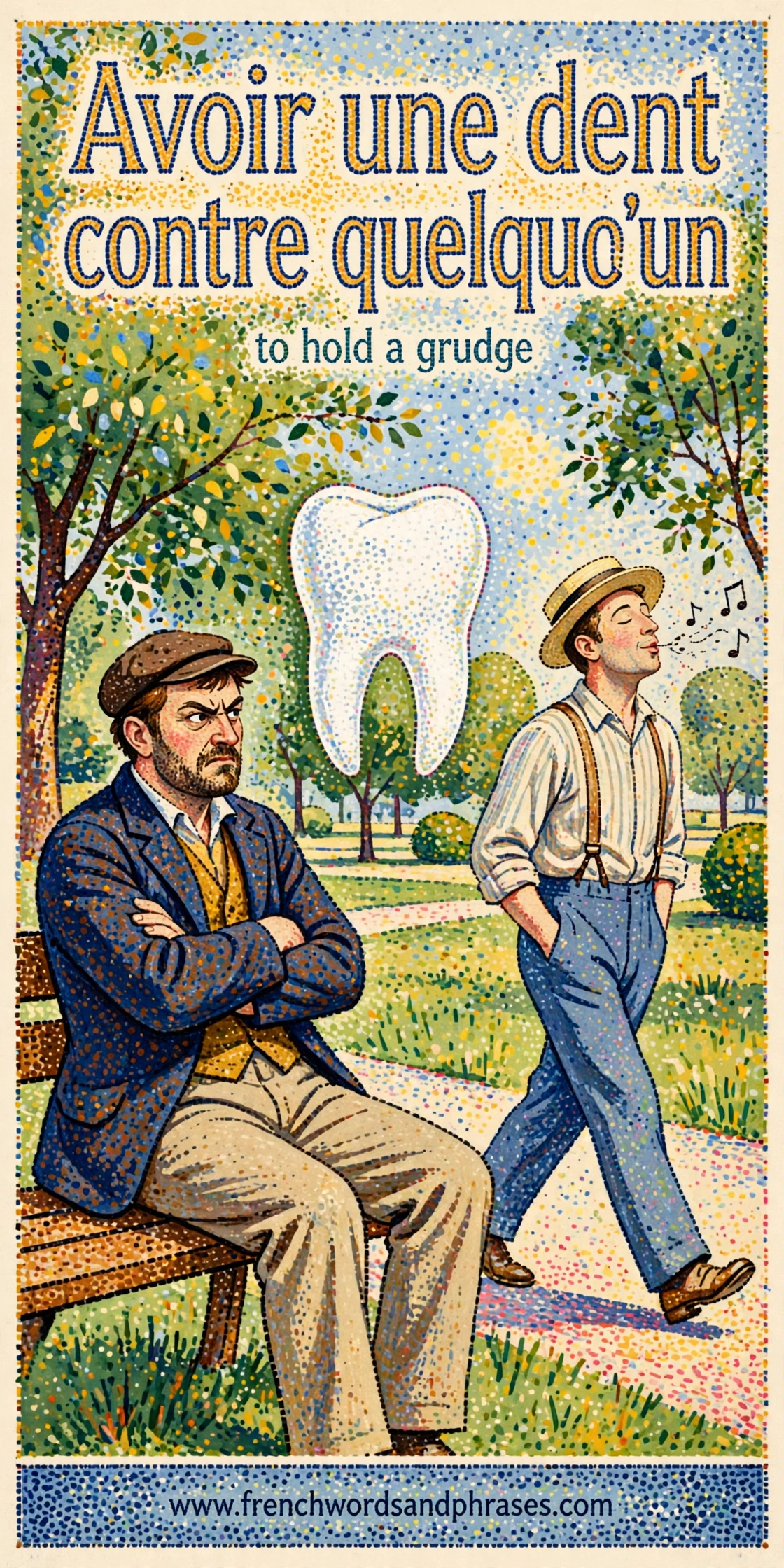
Avoir une dent contre quelqu’un means to hold a grudge against someone — to keep a lingering resentment.
Two years after the village fête committee changed its president, Madame Fabre still crosses the street to avoid the baker — all because of one sentence about her tarte in 2023. Nobody else remembers it. She does, in detail, daily. The village has a phrase for what she is carrying: « Elle a une dent contre lui. »
Let’s explore how avoir une dent contre quelqu’un works in French, beginning with the whole phrase on one card.
Understanding the French Phrase Avoir une dent contre quelqu’un
Avoir une dent contre quelqu’un is a French idiomatic expression built from avoir (to have), une dent (a tooth) and contre quelqu’un (against someone). The tooth is the biting kind — the grudge is pictured as a fang kept sharp for one particular person.
It means to hold a grudge against someone — to keep a resentment alive long after the offence, and to let it colour everything that person does. The picture is of a tooth kept for biting: old, pointed, and saved for a single enemy. Unlike a flash of anger, une dent is a possession — people carry it for years, sometimes with a certain pride.
Type: Idiomatic expression — resentment (avoir + noun + contre quelqu’un)
Answers the need: Saying someone bears a lasting grudge against a particular person
Register: Neutral to familiar — everyday speech and lively writing, never crude
Strength: Durable — not a passing anger but a kept, fed resentment
One important usage detail: the grudge is always aimed — avoir une dent contre quelqu’un, contre son voisin, contre elle. The verb garder often keeps it company: garder une dent contre quelqu’un, to keep a grudge. It describes the holder, not the offence: the same quarrel can leave une dent in one person and nothing at all in the other.
Experience the Word
Avoir une dent contre quelqu’un is anger that has settled in, unpacked, and started paying rent.
Imagine two brothers who have not spoken since an inheritance was divided, twenty years ago. At family weddings they are seated at opposite ends, and each could still recite the exact sentence that started it. The tooth is the smallest object in the family and the hardest: everything else has been forgiven, forgotten or outlived — except that.
French gives the grudge a body part because it behaves like one. A tooth aches quietly for years and bites when you least expect it.
How to Use Avoir une dent contre quelqu’un in French: Complete Guide
Let’s explore how avoir une dent contre quelqu’un works in French, beginning with the whole phrase on one card.
Avoir une dent contre quelqu’un at a Glance
The Whole Phrase on One Card
Real meaning, literal picture, English twin and register — avoir une dent contre quelqu’un in five lines.
| Point | Avoir une dent contre quelqu’un |
|---|---|
| What it really means | to hold a grudge against someone — a resentment kept alive for years |
| Word for word | to have a tooth against someone — a fang saved for one enemy |
| English equivalent | to hold a grudge against someone / to bear someone a grudge |
| Register | neutral to familiar — safe in everyday speech and writing |
| Use it for | old quarrels, lasting resentments, feuds that outlive their cause |
Example
Elle a une dent contre lui depuis l’héritage.
She has held a grudge against him since the inheritance.
Word by Word: Building the Grudge
Four small pieces — take them one by one and the tooth sharpens itself.
| Word | Literal meaning | Its job in the phrase |
|---|---|---|
| avoir | to have | the holding verb — the grudge is a possession you carry |
| une dent | a tooth | the biting tool — one tooth, kept pointed, for one person |
| contre | against | the aim — every grudge has a target |
| quelqu’un | someone | the target’s placeholder — a name takes its place in real speech |
Example
Une dent contre quelqu’un, ça se garde des années.
A grudge against someone can be kept for years.
Quick Quiz 1
Why a tooth? What is the picture inside avoir une dent contre quelqu’un?
Reveal the answer
A fang kept for biting — the resentment is a tooth saved for one enemy: quiet for years, ready to bite.
Sa dent contre son ancien associé n’a jamais disparu.
His grudge against his former partner never disappeared.
When You Say It: The Grudge-Keeping Moments
Avoir une dent contre quelqu’un fires at moments like these — the offence is old, and the feeling is not.
| Situation | Example |
|---|---|
| After an inheritance | elle a une dent contre son frère depuis l’héritage — she has held a grudge against her brother since the inheritance |
| At work | il a une dent contre son ancien patron — he bears a grudge against his former boss |
| Between neighbours | ils ont une dent l’un contre l’autre — they hold grudges against each other |
| Explaining a coldness | si elle te parle froidement, c’est qu’elle a une dent contre toi — if she is cold with you, she holds a grudge |
| Admitting your own | je l’avoue, j’ai une dent contre lui — I admit it, I hold a grudge against him |
Example
Trois ans après, il a toujours une dent contre son voisin.
Three years later, he still holds a grudge against his neighbour.
Make It Yours: The Grudge for Every Holder
Avoir conjugates as usual — and garder, to keep, is the grudge’s favourite companion.
| Form | French | In English |
|---|---|---|
| She holds one | elle a une dent contre lui | she holds a grudge against him |
| I hold one | j’ai une dent contre elle | I hold a grudge against her |
| Kept, deliberately | il garde une dent contre son frère | he keeps a grudge against his brother |
| Mutual | ils ont une dent l’un contre l’autre | they bear each other a grudge |
| Question | tu as une dent contre moi ? | do you hold a grudge against me? |
| Long-lasting | une dent qui dure depuis dix ans | a grudge that has lasted ten years |
Example
Tu as une dent contre moi ? Dis-moi pourquoi.
Do you hold a grudge against me? Tell me why.
Quick Quiz 2
Which verb joins avoir as the grudge’s keeper — garder or perdre une dent contre quelqu’un?
Reveal the answer
Garder — garder une dent contre quelqu’un, to keep a grudge: the keeping is exactly what makes it a grudge.
Elle garde une dent contre lui depuis l’école.
She has kept a grudge against him since school.
Everyday Expressions: Building on the Grudge
Avoir une dent contre quelqu’un slots into these everyday frames — each one ready to use as it stands.
| Frame | In English |
|---|---|
| avoir une dent contre quelqu’un | to hold a grudge against someone |
| garder une dent contre quelqu’un | to keep a grudge against someone |
| avoir une dent contre lui depuis des années | to have held a grudge against him for years |
| une dent l’un contre l’autre | a grudge against each other |
| sa dent contre le monde entier | his grudge against the whole world — humorous exaggeration |
Example
Il garde une dent contre le monde entier, ce matin.
He is bearing a grudge against the whole world, this morning.
Close Cousins: The Other Resentments
French has a whole shelf of resentment phrases — the tooth is the picturesque one; its cousins formalise it, heat it or let it go.
| Expression | The difference |
|---|---|
| avoir une dent contre quelqu’un | to hold a grudge — the kept tooth, durable and aimed |
| en vouloir à quelqu’un | to hold it against someone — the commonest cousin, from a fresh offence to an old one |
| garder rancune | to bear a grudge — rancune is the plain noun for resentment, a shade more formal |
| avoir quelque chose contre quelqu’un | to have something against someone — vaguer, milder, sometimes just an objection |
| être fâché contre quelqu’un | to be angry with someone — the hot, present feeling, not the kept one |
| pardonner | to forgive — the exit door from every phrase on this shelf |
Example
Elle lui en veut encore : sa dent contre lui ne s’use pas.
She still holds it against him: her grudge against him does not wear down.
Quick Quiz 3
A colleague offended you this morning and you are still angry. Une dent already, or simply fâché?
Reveal the answer
Fâché — anger is the hot, present feeling. The dent is what remains when anger has been kept for months or years.
Fâché le matin, il lui a pardonné le soir même.
Angry in the morning, he forgave her that same evening.
Avoir une dent contre quelqu’un and Its Neighbours
The resentment shelf around the phrase — from the quarrel to the forgiveness.
| French | In English |
|---|---|
| une dispute | a quarrel |
| la rancune | resentment, a grudge |
| en vouloir à quelqu’un | to hold it against someone |
| avoir une dent contre quelqu’un | to hold a grudge against someone |
| se brouiller | to fall out with someone |
| pardonner | to forgive |
Example
Après la dispute, la rancune est restée : une vraie dent.
After the quarrel, the resentment stayed: a real grudge.
Watch Out: The Traps Around Avoir une dent contre quelqu’un
The traps: a hollow tooth that means hunger, a dentist who is innocent, and a grudge that needs its target.
| Trap | The truth |
|---|---|
| the hollow tooth trap | avoir une dent creuse is a different idiom — to be a little hungry, peckish; a hollow tooth fills with food, not resentment |
| no dentist involved | the dent of the grudge never aches, is never filled and never pulled — it bites other people, not you |
| the target is compulsory | avoir une dent, alone, says nothing — the contre quelqu’un is part of the machine; a grudge without a target is just a bad mood |
| not a moment’s anger | for today’s flash of temper, French says être fâché or en colère — the dent is measured in years |
Example
Il a une dent creuse avant le dîner, mais aucune dent contre le cuisinier.
He is a bit peckish before dinner, but holds no grudge against the cook.
Quick Quiz 4
True or false: avoir une dent creuse means to hold a deep grudge.
Reveal the answer
False — a hollow tooth means you are a little hungry. The grudge is the plain dent, aimed with contre.
Une dent creuse avant midi, c’est normal.
A hollow tooth before noon is normal — feeling peckish, that is.
Avoir une dent contre quelqu’un in Everyday French: Real-Life Examples
Now that you know the word, let’s see how avoir une dent contre quelqu’un appears in everyday French.
Example 1 — In the village
Elle a une dent contre le boulanger depuis 2023.
She has held a grudge against the baker since 2023.
Example 2 — Between brothers
Il garde une dent contre son frère depuis l’héritage.
He has kept a grudge against his brother since the inheritance.
Example 3 — The confession
Je l’avoue, j’ai une dent contre lui.
I admit it, I hold a grudge against him.
Example 4 — Mutual coldness
Ils ont une dent l’un contre l’autre.
They bear each other a grudge.
Example 5 — The question
Tu as une dent contre moi ? Dis-le-moi.
Do you hold a grudge against me? Tell me.
Example 6 — At the office
Elle a une dent contre son ancien patron.
She bears a grudge against her former boss.
Beyond Translation: The Meaning of Avoir une dent contre quelqu’un
English holds its grudges like luggage — to hold a grudge, to bear one: the resentment is baggage, carried in the hands. French grows its grudge in the mouth. A tooth is part of you, fed by you, and it bites almost by itself when the enemy walks in — which is uncomfortably close to how grudges actually behave.
To avoir une dent contre quelqu’un is to keep a small weapon alive inside your own jaw — and to pay for its keep in peace of mind.
The phrase is usually said of others, with a shake of the head. Said of yourself — j’ai une dent contre lui — it is already halfway to letting it go.
How to Remember the French Phrase Avoir une dent contre quelqu’un
Remember it this way: Avoir une dent contre quelqu’un is resentment grown in the mouth — one tooth, kept sharp for one person, for years.
- You picture the fang — a single tooth kept pointed for a single enemy, quiet for years, ready to bite.
- You always name the target — the phrase is built on contre quelqu’un; no target, no grudge.
- You separate the hollow tooth — une dent creuse is hunger, not hatred; the grudge’s tooth is solid.
The key idea is avoir une dent contre quelqu’un means to hold a grudge — a tooth kept sharp for one person.
Test Your Knowledge of Avoir une dent contre quelqu’un
Let’s see how much you’ve learned. Try answering these questions before revealing the answers.
Question 1
What does avoir une dent contre quelqu’un mean?
Reveal the answer
To hold a grudge against someone — a resentment kept alive long after the offence.
Question 2
Why a tooth?
Reveal the answer
Because a grudge bites — the tooth is a fang kept sharp for one particular person.
Question 3
How do you say ‘she has held a grudge against him for years’?
Reveal the answer
Elle a une dent contre lui depuis des années — the grudge is aimed with contre.
Question 4
What does avoir une dent creuse mean instead?
Reveal the answer
To be a little hungry — a hollow tooth is about food, not resentment.
Question 5
Complete the sentence:
Il a une ______ contre son voisin depuis la dispute. (He has held a grudge against his neighbour since the quarrel.)
Reveal the answer
dent
Il a une dent contre son voisin depuis la dispute.
He has held a grudge against his neighbour since the quarrel.
Your Final Challenge
Can You Use It?
How would you say this in French?
“She has held a grudge against him for years.”
Reveal the answer
Elle a une dent contre lui depuis des années.
She has held a grudge against him for years.
A little French. A little curiosity. A richer everyday life.
LEARN FRENCH ONE WORD AT A TIME