A French Word to Live By
Translate Touché to English
/tu.ʃe/
Touché means fair point — you got me; a direct hit conceded in an argument.
You have been teasing your sister for ten minutes about her terrible sense of direction — until she quietly reminds you who got lost in his own street last spring. The table laughs, you raise both hands like a fencer lowering his sword, and you concede with the one word built for the moment: « Touché. »
Let’s explore how touché works in French, beginning with the whole phrase on one card.
Understanding the French Phrase Touché
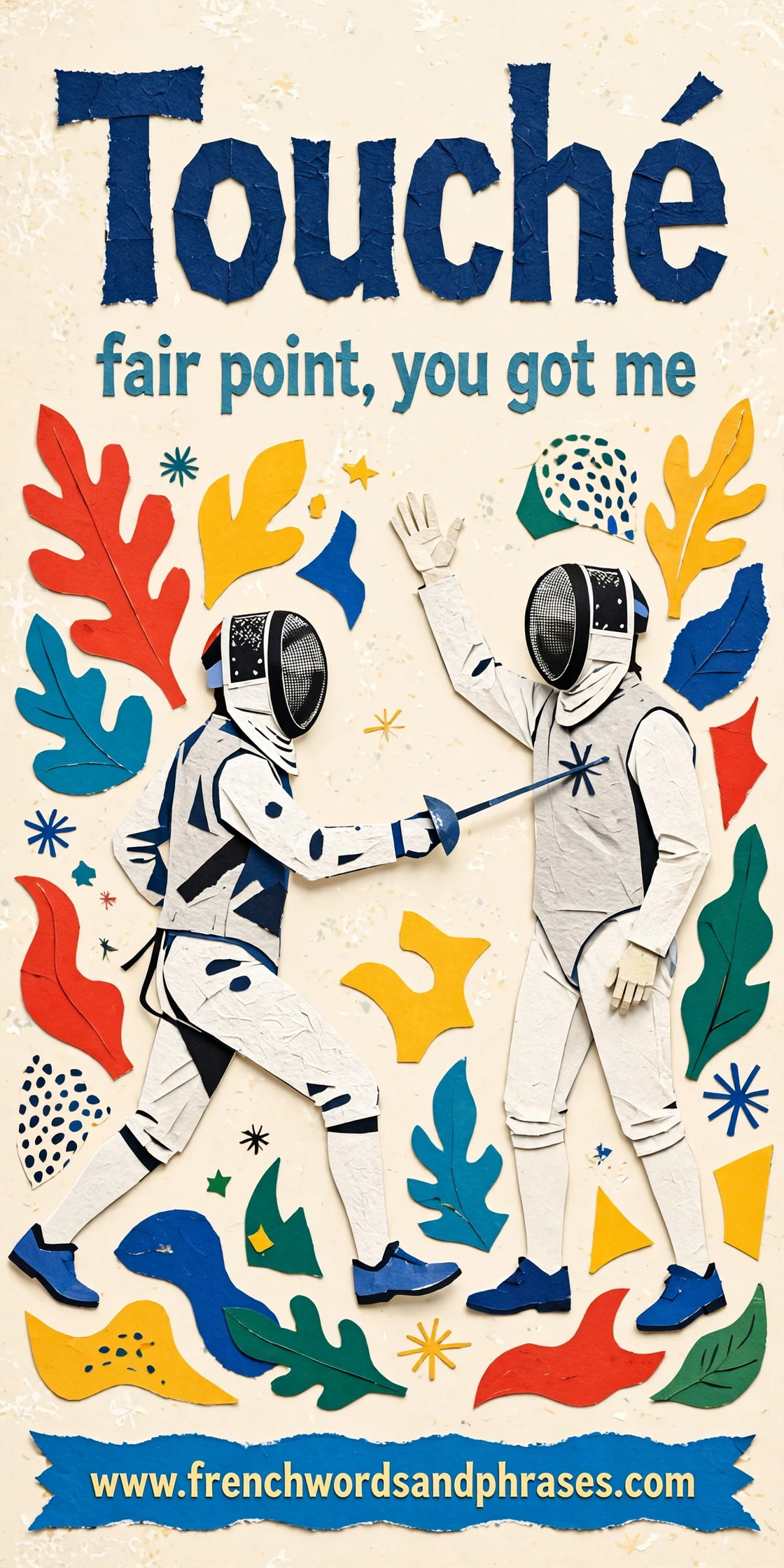
Touché is a French idiomatic expression taken whole from fencing: it is the past participle of toucher (to touch, to hit), called out when a blade lands cleanly. English borrowed it unchanged, accent and all — one of the rare French words that crossed the Channel without losing a letter.
It means fair point — you got me. Said in an argument or a teasing match, it concedes that the other person’s remark has landed: true, well aimed, and impossible to parry. It is the graceful way to lose a point — quick, smiling, and final, like the fencer’s call that ends the exchange.
Type: Idiomatic expression — concession (a single fencing call)
Answers the need: Conceding a point gracefully — fair enough, you got me
Register: Neutral to playful — at home in conversation, debate and friendly teasing
Strength: Complete but light — the point is conceded, the friendship is not
One important usage detail: touché stands alone — it is a whole reply in one word, usually with a smile or raised hands, and it closes that exchange. It answers a remark that hits home about YOU; for a point scored on a third party, French more often says bien vu or bien dit.
Experience the Word
Touché is defeat at its most elegant — the fencer’s salute turned into a conversational art.
Imagine the long-running duel of wits at a family table: uncle against niece, year after year, neither ever yielding. Then one Christmas, a remark lands so cleanly that the whole table hears the blade. He laughs, inclines his head — touché. The single word is worth more than the victory: it says the game is honoured even by its loser.
French borrowed the call from the fencing hall and kept the etiquette with it. To say touché is to lose beautifully, in public, on purpose.
How to Use Touché in French: Complete Guide
Let’s explore how touché works in French, beginning with the whole phrase on one card.
Touché at a Glance
The Whole Word on One Card
Real meaning, literal picture, English twin and register — touché in five lines.
| Point | Touché |
|---|---|
| What it really means | fair point — you got me, that remark landed |
| Word for word | touched, hit — the past participle of toucher, called out in fencing |
| English equivalent | touché — English borrowed it unchanged, accent included |
| Register | neutral to playful — conversation, debate, friendly teasing |
| Use it for | conceding a witty or truthful point scored against you |
Example
Tu as raison sur ce point. Touché.
You are right on that point. Touché.
Word by Word: Building the Hit
One word, two roots — take them one by one and the blade lands.
| Word | Literal meaning | Its job in the phrase |
|---|---|---|
| toucher | to touch, to hit, to affect | the verb — in fencing, to land your blade on the opponent |
| -é | the past participle ending | marks the hit as done: not touching, but touched |
| touché | touched! | the fencer’s call — the hit is acknowledged and the point is given |
Example
En escrime, on crie « touché » quand la lame atteint sa cible.
In fencing, you call ‘touché’ when the blade reaches its target.
Quick Quiz 1
From which sport does touché come?
Reveal the answer
Fencing — it is the call that acknowledges a clean hit with the blade, and the point that follows it.
Touché ! Le point est pour l’adversaire.
Touché! The point goes to the opponent.
When You Say It: The Conceding Moments
Touché fires at moments like these — a remark lands, and you honour it instead of fighting it.
| Situation | Example |
|---|---|
| Teased, fairly | tu me rappelles ma propre erreur ? touché — you remind me of my own mistake? fair point |
| In a debate | bel argument — touché — fine argument — you got me |
| Caught in a contradiction | touché, je me contredis — touché, I contradict myself |
| Between old friends | touché, vieux frère — touché, old brother |
| With a bow | touché, je m’incline — touché, I bow to that |
Example
Tu as marqué un point. Touché, vraiment.
You scored a point. Touché, truly.
Make It Yours: The Concession for Every Duel
One word does the work — dress it with the small phrases that aim it.
| Form | French | In English |
|---|---|---|
| Bare | touché | touché — fair point |
| With surrender | touché, je m’incline | touché, I bow to it |
| With the point named | touché, tu as raison | fair point, you are right |
| Laughing | touché ! bien joué | touché! well played |
| In the game of battleships | touché ! | hit! (in touché-coulé, the French battleships game) |
| Doubled, in the game | touché, coulé ! | hit and sunk! |
Example
Touché, coulé ! Ton porte-avions est au fond.
Hit and sunk! Your aircraft carrier is at the bottom.
Quick Quiz 2
In the game of battleships, what follows touché when the ship goes down?
Reveal the answer
Coulé — touché, coulé: hit, and sunk. The French game is named touché-coulé after the two calls.
Touché, coulé ! Il ne te reste qu’un navire.
Hit and sunk! You have only one ship left.
Everyday Expressions: Building on the Hit
Touché slots into these everyday frames — each one ready to use as it stands.
| Frame | In English |
|---|---|
| touché, tu as raison | fair point, you are right |
| touché, je m’incline | touché, I bow to that |
| touché, bien joué | touché, well played |
| touché, coulé | hit and sunk (battleships) |
| un point pour toi — touché | a point to you — touché |
Example
Un point pour toi. Touché, bien joué.
A point to you. Touché, well played.
Close Cousins: The Other Ways to Concede
French has a whole shelf of concession phrases — touché is the fencer’s one; its cousins applaud, admit or yield the floor.
| Expression | The difference |
|---|---|
| touché | fair point — the hit conceded with a fencer’s grace |
| bien vu | well spotted — praise for noticing something; the point was about the world, not about you |
| bien dit | well said — applauds the remark itself |
| je te l’accorde | I’ll grant you that — a measured concession, a negotiator’s tone |
| tu marques un point | you score a point — the sports commentator’s version |
| chapeau | hats off — pure admiration, no defeat in it |
Example
Bien vu, bien dit — et pour moi, touché.
Well spotted, well said — and for me, touché.
Quick Quiz 3
Your colleague spots a flaw in a report. Touché or bien vu?
Reveal the answer
Bien vu — the hit was on the report, not on you. Touché concedes a point scored against yourself.
Bien vu, cette erreur était bien cachée.
Well spotted, that error was well hidden.
Touché and Its Neighbours
The fencing shelf around the word — blades, points and graceful defeats.
| French | In English |
|---|---|
| l’escrime | fencing |
| une lame | a blade |
| toucher | to touch, to hit |
| un point | a point |
| touché | touché — fair point |
| s’incliner | to bow, to yield gracefully |
Example
En escrime comme en discussion, un touché se reconnaît avec grâce.
In fencing as in argument, a hit is acknowledged with grace.
Watch Out: The Traps Around Touché
The traps: a second, tender life for the same word, and a concession that must be about you.
| Trap | The truth |
|---|---|
| the tender touché | être touché also means to be moved, emotionally — j’ai été touché par sa lettre, I was touched by her letter; same word, no duel in sight |
| it concedes, it does not attack | touché is spoken by the one who was hit — using it to claim your own victory reverses the etiquette |
| the accent travels | English kept the é — writing ‘touche’ in either language loses the word; in French it would read as a piano key or a brushstroke |
| one word is enough | touché needs no sentence around it — adding explanations waters down the grace that makes it work |
Example
Touché par sa remarque autant qu’émue, elle a répondu : touché.
Stung by his remark as much as moved, she answered: touché.
Quick Quiz 4
True or false: touché is what you say when YOUR remark lands on someone else.
Reveal the answer
False — the fencer who is hit concedes it. Touché is spoken by the loser of the point, gracefully.
C’est moi qui ai été touché : touché.
I am the one who was hit: touché.
Touché in Everyday French: Real-Life Examples
Now that you know the word, let’s see how touché appears in everyday French.
Example 1 — At the family table
Tu me rappelles ma propre bêtise ? Touché.
You remind me of my own foolishness? Touché.
Example 2 — In the debate
Bel argument. Touché, vraiment.
Fine argument. Touché, truly.
Example 3 — Caught out
Touché, je me contredis, tu as raison.
Touché, I contradict myself, you are right.
Example 4 — Between friends
Touché, vieux frère, bien joué.
Touché, old brother, well played.
Example 5 — At battleships
Touché, coulé ! C’est mon dernier navire.
Hit and sunk! That was my last ship.
Example 6 — With a bow
Touché, je m’incline.
Touché, I bow to that.
Beyond Translation: The Meaning of Touché
Most languages make losing an argument a small humiliation to be escaped as fast as possible. French, borrowing the etiquette of the fencing hall, made it a ceremony: the hit is named, the point is given, and the loser keeps his dignity precisely by conceding beautifully.
Touché is the sound of honour surviving defeat — one word that turns ‘you got me’ into a salute.
English admired the trick so much it imported the word whole, accent, etiquette and all — the surest proof that graceful losing is a universal wish.
How to Remember the French Phrase Touché
Remember it this way: Touché is the fencer’s salute to the blade that landed — you name the hit, and losing becomes graceful.
- You picture the fencing hall — the blade lands, the hit is called, the point is given without a quarrel.
- You speak it as the loser — touché is conceded by the one who was hit, never claimed by the winner.
- You keep the accent — touché crossed into English with its é; without it, the word is a piano key.
The key idea is touché means fair point, you got me — a hit conceded with a fencer’s grace.
Test Your Knowledge of Touché
Let’s see how much you’ve learned. Try answering these questions before revealing the answers.
Question 1
What does touché mean?
Reveal the answer
Fair point — you got me: a remark has landed and you concede it gracefully.
Question 2
Where does the word come from?
Reveal the answer
From fencing — the call that acknowledges a clean hit of the blade.
Question 3
Who says touché — the winner or the loser of the point?
Reveal the answer
The loser — the one who was hit concedes it; that is the etiquette.
Question 4
What does touché, coulé mean?
Reveal the answer
Hit and sunk — the two calls of touché-coulé, the French game of battleships.
Question 5
Complete the sentence:
Tu as raison, je me contredis. ______. (You are right, I contradict myself. Fair point.)
Reveal the answer
Touché
Tu as raison, je me contredis. Touché.
You are right, I contradict myself. Touché.
Your Final Challenge
Can You Use It?
How would you say this in French?
“Fair point, you’re right on that one.”
Reveal the answer
Touché, tu as raison sur ce point.
Fair point, you’re right on that one.
A little French. A little curiosity. A richer everyday life.
LEARN FRENCH ONE WORD AT A TIME