A French Word to Live By
Translate Ne pas être dans son assiette to English
/nə pa ɛtʁ dɑ̃ sɔ̃ na.sjɛt/
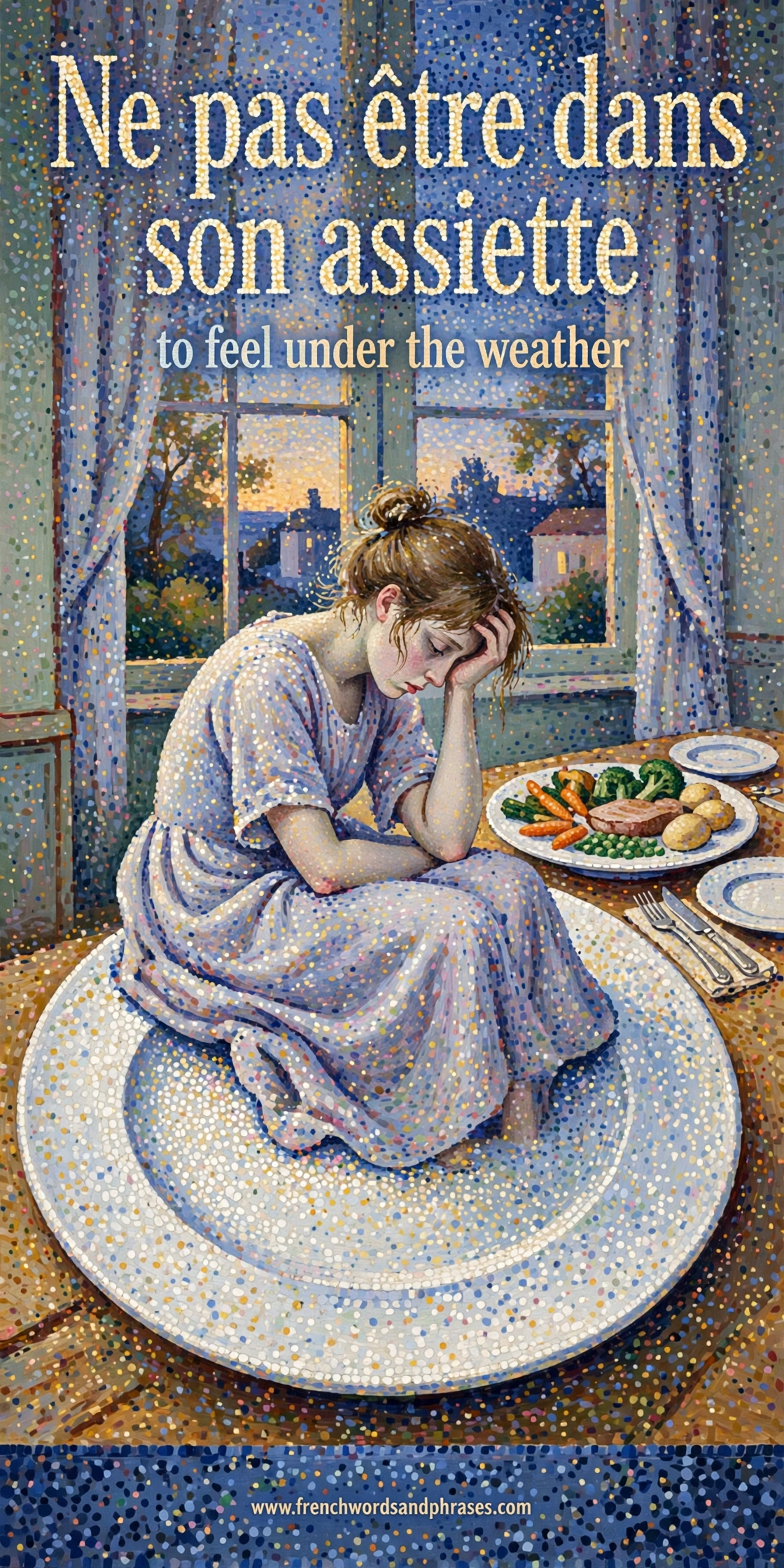
Ne pas être dans son assiette means to feel under the weather, not oneself.
Your neighbour, who usually whistles on the stairs and stops for a chat, shuffles past this morning with a grey face and barely a nod. Nothing is dramatically wrong — no fever, no bad news — she is simply not herself today. French has a gentle phrase for exactly that off-day feeling, and it involves a plate that nobody is sitting in.
Let’s explore how ne pas être dans son assiette works in French, beginning with the whole phrase on one card.
Understanding the French Phrase Ne pas être dans son assiette
Ne pas être dans son assiette is a French idiom built on être (to be), the negative ne… pas (not) and assiette — which here is not the dinner plate but an old word for your seat, your balance, your usual settled state. To not be in your assiette is to be out of your normal equilibrium: unwell, low, not yourself.
It means to feel under the weather — off-colour, out of sorts, not quite yourself, without being properly ill. A bad night’s sleep, a vague headache, a heavy heart: any of these can leave you pas dans votre assiette. English says under the weather; French says you are not in your plate.
Type: Idiom — the negative of être dans son assiette (to be in one’s usual state)
Answers the need: Saying someone feels off — unwell, low, not themselves
Register: Everyday and gentle — safe about anyone, from a toddler to a grandmother
Strength: Mild — a vague off-day feeling, not a diagnosis
One important usage detail: the phrase lives in the negative. The positive être dans son assiette exists but is rare and old-fashioned; when someone is off-colour, French reaches straight for the negative — il n’est pas dans son assiette. The possessive also follows the person: dans mon assiette, dans ton assiette, dans leur assiette.
Experience the Word
Ne pas être dans son assiette is the kindest diagnosis French owns — it names the grey day without dramatising it.
Imagine a grandfather at Sunday lunch, pushing his food around, quieter than usual. Nobody calls a doctor; his daughter simply says, with a hand on his shoulder, that he is not in his assiette today, and passes him the water. The phrase holds the whole family’s concern in six small words.
French prefers its understatements gentle. Not ill, not fine — just not in your plate.
How to Use Ne pas être dans son assiette in French: Complete Guide
Let’s explore how ne pas être dans son assiette works in French, beginning with the whole phrase on one card.
Ne pas être dans son assiette at a Glance
The Whole Phrase on One Card
Real meaning, literal building blocks, English twin and register — ne pas être dans son assiette in five lines.
| Point | Ne pas être dans son assiette |
|---|---|
| What it really means | to feel under the weather — off-colour, not yourself |
| Word for word | not to be in one’s plate (assiette once meant your seat, your balance) |
| English equivalent | to feel under the weather / to be out of sorts |
| Register | everyday and gentle — safe about anyone |
| Use it for | off days — vague illness, low spirits, a bad night |
Example
Excuse-moi, je ne suis pas dans mon assiette aujourd’hui.
Sorry, I’m not feeling myself today.
Word by Word: Building the Off Day
Five pieces — and one of them is not the plate you think it is.
| Word | Literal meaning | Its job in the phrase |
|---|---|---|
| ne… pas | not | the two-part French negative wrapped around the verb — the phrase lives in this negative |
| être | to be | the verb of state — how someone is, today |
| dans | in | inside your usual state, or outside it |
| son | his / her / one’s | the possessive — it changes with the person: mon, ton, son, leur |
| assiette | plate — but here: seat, balance | the old sense is your settled position; not being in it means being off-balance |
Example
Elle n’est pas dans son assiette depuis ce matin.
She hasn’t been feeling herself since this morning.
Quick Quiz 1
In this phrase, does assiette really mean a dinner plate?
Reveal the answer
No — here assiette keeps an older meaning: your seat, your balance, your usual settled state. To be out of it is to feel off-colour.
Il n’est pas dans son assiette aujourd’hui.
He is not feeling himself today.
When You Say It: The Grey Days
Ne pas être dans son assiette belongs to the vague, grey days — nothing broken, nothing quite right.
| Situation | Example |
|---|---|
| About yourself, gently | je ne suis pas trop dans mon assiette ce matin — I’m not really feeling myself this morning |
| About a quiet child | elle n’est pas dans son assiette, elle est toute pâle — she’s not herself, she’s all pale |
| After a bad night | il n’est pas dans son assiette, il a très mal dormi — he’s out of sorts, he slept very badly |
| At work, softly | le patron n’est pas dans son assiette, mieux vaut attendre — the boss isn’t himself today, better to wait |
Example
Tu n’as pas l’air dans ton assiette, ça va ?
You don’t look yourself, are you OK?
Make It Yours: Whose Plate Is It?
The possessive follows the person, and the negative wraps around être in every tense.
| Form | French | In English |
|---|---|---|
| For me | je ne suis pas dans mon assiette | I’m not feeling myself |
| For you (tu) | tu n’es pas dans ton assiette | you’re not feeling yourself |
| For her | elle n’est pas dans son assiette | she’s not feeling herself |
| For them | ils ne sont pas dans leur assiette | they’re not feeling themselves |
| In the past | hier, je n’étais pas dans mon assiette | yesterday, I was out of sorts |
| As a question | tu n’es pas dans ton assiette ? | aren’t you feeling yourself? |
Example
Nous ne sommes pas dans notre assiette après ce voyage.
We’re not feeling ourselves after that trip.
Quick Quiz 2
How do you say ‘They are not feeling themselves’?
Reveal the answer
Ils ne sont pas dans leur assiette — the possessive changes to leur for they.
Ils ne sont pas dans leur assiette ce week-end.
They are not feeling themselves this weekend.
Everyday Expressions: Building on the Off Day
Ne pas être dans son assiette slots into these everyday frames — each one ready to use as it stands.
| Frame | In English |
|---|---|
| ne pas être dans son assiette aujourd’hui | to not be feeling oneself today |
| avoir l’air de ne pas être dans son assiette | to look out of sorts |
| je ne me sens pas dans mon assiette | I don’t feel myself (with se sentir) |
| il n’est vraiment pas dans son assiette | he really isn’t himself |
| demain, tu seras de nouveau dans ton assiette | tomorrow you’ll be yourself again |
Example
Il a l’air de ne pas être dans son assiette depuis lundi.
He has looked out of sorts since Monday.
Close Cousins: The Other Off Days
French has several ways to feel off — this one is the gentlest and the vaguest.
| Expression | The difference |
|---|---|
| ne pas être dans son assiette | the gentle all-rounder — unwell, low or just not yourself |
| ne pas se sentir bien | the plain version — to not feel well, no image attached |
| être patraque | informal — properly under the weather, often with aches or a bug |
| avoir un coup de mou | a slump — a dip in energy or spirits, often temporary |
| être mal en point | stronger — in a bad way, in poor shape |
Example
Elle n’est pas malade, elle n’est juste pas dans son assiette.
She isn’t ill, she’s just not feeling herself.
Quick Quiz 3
A colleague has a real fever and shivers. Is pas dans son assiette enough?
Reveal the answer
It understates it — the phrase is for vague off days. With a fever, être malade or être patraque fits better.
Il est patraque, il a de la fièvre.
He’s under the weather, he has a fever.
Ne pas être dans son assiette and Its Neighbours
The feelings shelf around the phrase — the good days on one side, the grey ones on the other.
| French | In English |
|---|---|
| être en forme | to be on form, fit and well |
| être en pleine forme | to be in great shape |
| avoir la pêche | to feel great, full of energy |
| être fatigué | to be tired |
| se sentir bien | to feel well |
| être malade | to be ill — beyond the grey day |
Example
D’habitude elle a la pêche, mais pas aujourd’hui.
Usually she’s full of energy, but not today.
Watch Out: The Traps Around the Plate
The traps: the plate that is not a plate, the positive form, and the wandering possessive.
| Trap | The truth |
|---|---|
| picturing a dinner plate | assiette here means your seat and balance — nobody is sitting in any crockery |
| using the positive to say someone is fine | être dans son assiette is rare and old-fashioned; for fine, say être en forme |
| keeping son for everyone | the possessive follows the person: mon assiette, ton assiette, leur assiette |
| using it for serious illness | the phrase is deliberately mild — for real illness, French says être malade |
Example
Depuis son retour, elle n’est pas dans son assiette.
Since she got back, she hasn’t been feeling herself.
Quick Quiz 4
True or false: French speakers commonly say je suis dans mon assiette to mean ‘I feel great’.
Reveal the answer
False — the positive form is rare; the idiom lives in the negative. For feeling great, say je suis en forme or j’ai la pêche.
Aujourd’hui, je suis en pleine forme !
Today, I’m in great shape!
Ne pas être dans son assiette in Everyday French: Real-Life Examples
Now that you know the word, let’s see how ne pas être dans son assiette appears in everyday French.
Example 1 — Monday morning
Le lundi, je ne suis jamais dans mon assiette avant le café.
On Mondays, I’m never feeling myself before coffee.
Example 2 — A quiet pupil
La maîtresse a remarqué que Léa n’était pas dans son assiette.
The teacher noticed that Léa wasn’t feeling herself.
Example 3 — After the journey
Après dix heures de train, nous n’étions pas dans notre assiette.
After ten hours on the train, we were out of sorts.
Example 4 — Checking on a friend
Tu n’es pas dans ton assiette, toi — raconte-moi.
You’re not yourself — tell me what’s wrong.
Example 5 — A light excuse
Pardonnez mon retard, je ne suis pas dans mon assiette ce matin.
Sorry I’m late, I’m not feeling myself this morning.
Example 6 — Grandfather at lunch
Papy n’est pas dans son assiette, il mange à peine.
Grandpa isn’t feeling himself, he’s barely eating.
Beyond Translation: The Meaning of Ne pas être dans son assiette
The plate on the table is a red herring. Assiette once named the way a rider sits in the saddle — your seat, your balance, your settled place. To slip out of your assiette was to lose that balance, and the word kept the meaning long after the saddles were forgotten.
To not be in your assiette is to be slightly out of your own saddle.
That is why the phrase is so kind: it describes a wobble, not a fall, and it leaves the person their dignity.
How to Remember the French Phrase Ne pas être dans son assiette
Remember it this way: Picture a rider who has slipped sideways in the saddle — still on the horse, but wobbling, not settled, not right. That wobble is the feeling the phrase names.
- You hear assiette and think seat, not plate — your usual settled position in the day.
- You keep the phrase negative: French almost always says someone is not in their assiette.
- You match the possessive to the person: mon assiette for me, leur assiette for them.
The key idea is ne pas être dans son assiette means to feel under the weather — out of your usual seat and balance, in the negative form.
Test Your Knowledge of Ne pas être dans son assiette
Let’s see how much you’ve learned. Try answering these questions before revealing the answers.
Question 1
What does ne pas être dans son assiette mean?
Reveal the answer
To feel under the weather — off-colour, low, not yourself, without being properly ill.
Question 2
What does assiette mean in this phrase?
Reveal the answer
Your seat, balance, usual settled state — an older sense of the word, not the dinner plate.
Question 3
Why is the phrase nearly always negative?
Reveal the answer
Because that is how French uses it — the positive form exists but is rare and old-fashioned.
Question 4
Translate: She is not feeling herself today.
Reveal the answer
Elle n’est pas dans son assiette aujourd’hui.
Question 5
Complete the sentence:
Ils ne sont pas dans ______ assiette. (They are not feeling themselves.)
Reveal the answer
leur
Ils ne sont pas dans leur assiette.
They are not feeling themselves.
Your Final Challenge
Can You Use It?
How would you say this in French?
“I’m not feeling myself today.”
Reveal the answer
Je ne suis pas dans mon assiette aujourd’hui.
I’m not feeling myself today.
A little French. A little curiosity. A richer everyday life.
LEARN FRENCH ONE WORD AT A TIME