
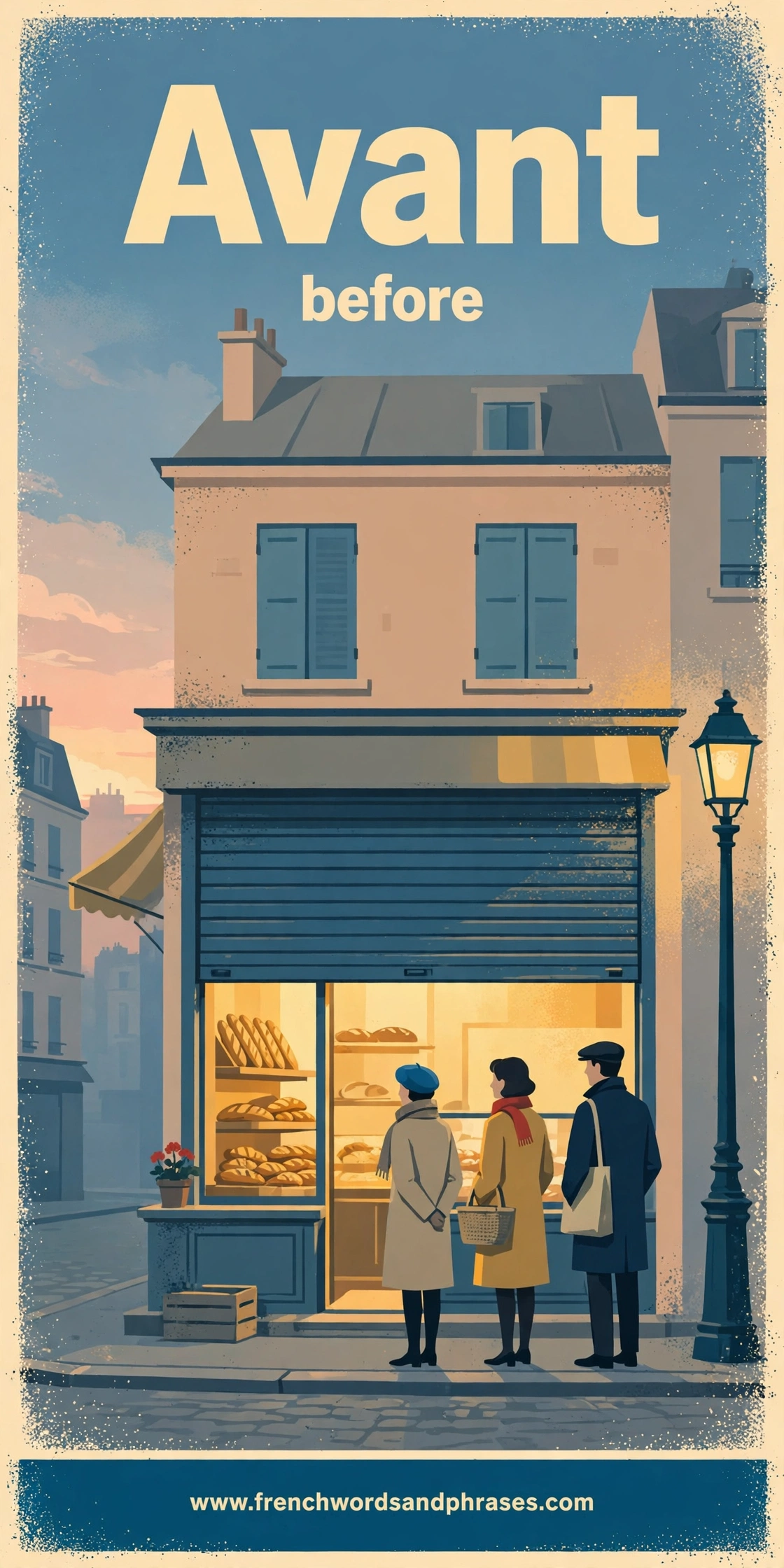
A French Word to Live By
Translate Avant to English
/a.vɑ̃/
Avant means before (beforehand).
The station clock shows twenty minutes to spare, and the traveller sits down with his coffee instead of pacing the platform. He checked the times last night, packed before breakfast, and arrived — as always — avant.
In this guide, you’ll learn what avant means in English, how it works alone as beforehand and before a noun as before, how avant que unlocks the subjunctive, and the expressions built on it. Explore French examples, English translations, and practice quizzes.
Understanding the French Adverb Avant
Avant is a French adverb of time and sequence. Standing alone, it means beforehand, earlier — the mirror image of après. Followed by a noun or a verb, it becomes a preposition meaning before, and with que it opens one of the great doors of French grammar.
As an adverb, it means beforehand. Je l’ai vu avant — I saw him before, earlier. Avant is the word of preparation and anticipation: the list made the night before, the door locked before leaving, the guest who arrives before everyone else. It always looks forward to the event it precedes.
Type: Adverb of time — sequence
Answers the question: When? — beforehand, earlier
Changes form: Never — avant is invariable
English equivalents: Beforehand; earlier; (before a noun) before.
One important usage detail: avant changes its companions, not its form. Before a noun: avant le repas. Before a verb with the same subject: avant de partir. Before a clause with a different subject: avant qu’il arrive — and there, French asks for the subjunctive. One word, three doorways.
Experience the Word
Avant is the adverb of the prepared mind. It belongs to cooks who chop before the guests arrive, travellers who pack the night before, and grandmothers who are ready an hour early, hat on, by the door.
Imagine the kitchen before a feast: the table laid at ten, the soup simmering at eleven, everything in its place — because someone thought avant, long before anyone thought maintenant.
You have not just said earlier. You have stepped in front of time itself.
How to Use Avant in French: Complete Guide
Let’s explore how avant works in French, beginning with the whole word on one card.
Avant at a Glance
Before the details, here is the whole word on one card.
The Whole Word on One Card
Meaning, type, position and form — avant in four lines.
| Point | Avant |
|---|---|
| Meaning | beforehand (alone); before (before a noun or verb) |
| Type | adverb of time and sequence |
| Usual position | after the verb, or at the end of the sentence |
| Form | invariable — never changes |
Example
Je l’avais déjà vu avant.
I had already seen him before.
Where Avant Goes in the Sentence
As an adverb, avant usually closes the sentence or follows the verb — a quiet word that points backwards from the event.
| Situation | Pattern |
|---|---|
| End of the sentence | Je te l’avais dit avant. — I had told you before. |
| After the verb | Il faut réfléchir avant. — You must think beforehand. |
| With déjà | Je l’ai déjà fait avant. — I already did it before. |
| A warning | Préviens-moi avant ! — Let me know beforehand! |
Example
Nous étions déjà venus ici avant.
We had already come here before.
Quick Quiz 1
What does avant mean when it stands alone at the end of a sentence?
Reveal the answer
Beforehand, earlier
Je l’ai vu avant.
I saw him before.
Avant as a Preposition: Three Doorways
Avant’s three companions decide the shape of what follows: a noun, an infinitive with de, or a whole clause with que and the subjunctive.
| Pattern | Example |
|---|---|
| Before a thing | avant le repas — before the meal |
| Before a time | avant midi — before noon |
| Before doing (same person) | avant de partir — before leaving |
| Before someone else acts | avant qu’il arrive — before he arrives (subjunctive) |
Example
Avant de partir, ferme la porte.
Before leaving, close the door.
Avant in the Sequence of a Day
Avant anchors the family of ordering words — and it has a close relative for the day before: la veille.
| French | In English |
|---|---|
| la veille | the day before, the eve |
| avant-hier | the day before yesterday |
| avant | before, beforehand |
| d’abord | first |
| après | after, afterwards — the opposite |
Example
La veille du départ, elle prépare sa valise.
The day before the trip, she packs her suitcase.
Quick Quiz 2
Complete the sentence:
______ de partir, ferme la porte. (Before)
Reveal the answer
Avant
Avant de partir, ferme la porte.
Before leaving, close the door.
Everyday Expressions with Avant
Avant runs in several directions at once: forward in space with en avant, first in importance with avant tout.
| Expression | In English |
|---|---|
| en avant | forward, onward (En avant ! — Forward!) |
| avant tout | above all, first of all |
| avant-hier | the day before yesterday |
| la semaine d’avant | the week before |
| mettre en avant | to highlight, to put forward |
Example
Avant tout, je voudrais vous remercier.
Above all, I would like to thank you.
Avant and Its Neighbours
Auparavant is the formal twin of the adverb; précédemment signs official letters; après walks the other way.
| French | In English |
|---|---|
| auparavant | beforehand, previously (formal synonym) |
| précédemment | previously (formal, written) |
| plus tôt | earlier |
| après | after, afterwards — the opposite |
Example
Il faut réserver auparavant, sinon il n’y a plus de places.
You must book beforehand, otherwise there are no seats left.
Quick Quiz 3
What does avant tout mean?
Reveal the answer
Above all, first of all
Avant tout, soyez prudents sur la route.
Above all, be careful on the road.
Avant with Different Tenses
The adverb never changes — only its neighbours do. Here is avant standing in front of every tense.
| Tense | Example |
|---|---|
| Present | Je prépare toujours mes affaires avant. |
| Passé composé | Elle est arrivée avant tout le monde. |
| Imparfait | Avant, nous habitions à la campagne. |
| Future | Je t’appellerai avant. |
Example
Avant, ce café était une librairie.
Before, this café was a bookshop.
Watch Out: Avant Que and the Subjunctive
Two traps in one small word. First: avant alone is beforehand — « before the meeting » needs the noun attached, avant la réunion. Second: avant que opens the subjunctive, while après que (its mirror) stays in the indicative.
| Pattern | Example |
|---|---|
| avant que + subjunctive | avant qu’il parte — before he leaves |
| après que + indicative | après qu’il est parti — after he left |
| en avant (a different expression!) | en avant = forwards, in space; les roues avant = the front wheels |
| The simple test | If a noun follows, avant is a preposition; if nothing follows, it is the adverb — beforehand |
Example
Téléphone-moi avant que tu partes.
Phone me before you leave.
Quick Quiz 4
Choose the correct French: avant qu’il ______ (part / parte).
Reveal the answer
parte
Avant qu’il parte, dis-lui au revoir.
Avant que takes the subjunctive — parte, not part.
Avant in Everyday French: Real-Life Examples
Now that you know the word, let’s see how avant appears in everyday French.
Example 1 — At home
Lave-toi les mains avant de manger.
Wash your hands before eating.
Example 2 — At work
Je relis toujours mes messages avant de les envoyer.
I always reread my messages before sending them.
Example 3 — Travel
Nous sommes arrivés à la gare bien avant le départ.
We arrived at the station well before the departure.
Example 4 — A reminder
Préviens-moi avant, s’il te plaît !
Let me know beforehand, please!
Example 5 — Talking about the past
Avant, ce quartier était très calme.
Before, this neighbourhood was very quiet.
Example 6 — An invitation
Passe à la maison avant le dîner.
Come by the house before dinner.
Beyond Translation: The Meaning of Avant
English before is a patient word, happy to wait in front of nouns and clauses alike. French avant is the same — but standing alone it becomes something more personal: beforehand, the mark of the person who prepared.
To say avant is to arrive ahead of your own life.
It evokes the cook with everything chopped, the traveller with time for a coffee, la veille — the eve, with its suitcase packed by the door. Avant is foresight in a single syllable, and French, a language that loves a plan, uses it all day long.
How to Remember the French Adverb Avant
Remember it this way: Avant is beforehand when it stands alone, and before in its three doorways — noun, de + infinitive, que + subjunctive.
- You mirror it against its twin — avant looks back from the event, après looks forward from it.
- You walk through the doorways — avant le repas, avant de partir, avant qu’il arrive.
- You give it the subjunctive key — avant qu’il parte.
The key idea is avant = beforehand; avant de + infinitive; avant que + subjunctive.
Test Your Knowledge of Avant
Let’s see how much you’ve learned. Try answering these questions before revealing the answers.
Question 1
What does avant mean on its own?
Reveal the answer
Beforehand, earlier — je l’ai vu avant, I saw him before.
Question 2
How do you say before leaving (same person)?
Reveal the answer
Avant de partir — avant de plus the infinitive.
Question 3
Translate: Phone me before you leave.
Reveal the answer
Téléphone-moi avant que tu partes.
Question 4
Does avant que take the indicative or the subjunctive?
Reveal the answer
The subjunctive — avant qu’il parte. (Après que takes the indicative.)
Question 5
Complete the sentence:
______ tout, je voudrais vous remercier. (Above all)
Reveal the answer
Avant
Avant tout, je voudrais vous remercier.
Above all, I would like to thank you.
Your Final Challenge
Can You Use It?
How would you say this in French?
“I had already read this book before.”
Reveal the answer
J’avais déjà lu ce livre avant.
I had already read this book before.
A little French. A little curiosity. A richer everyday life.
LEARN FRENCH ONE WORD AT A TIME




