
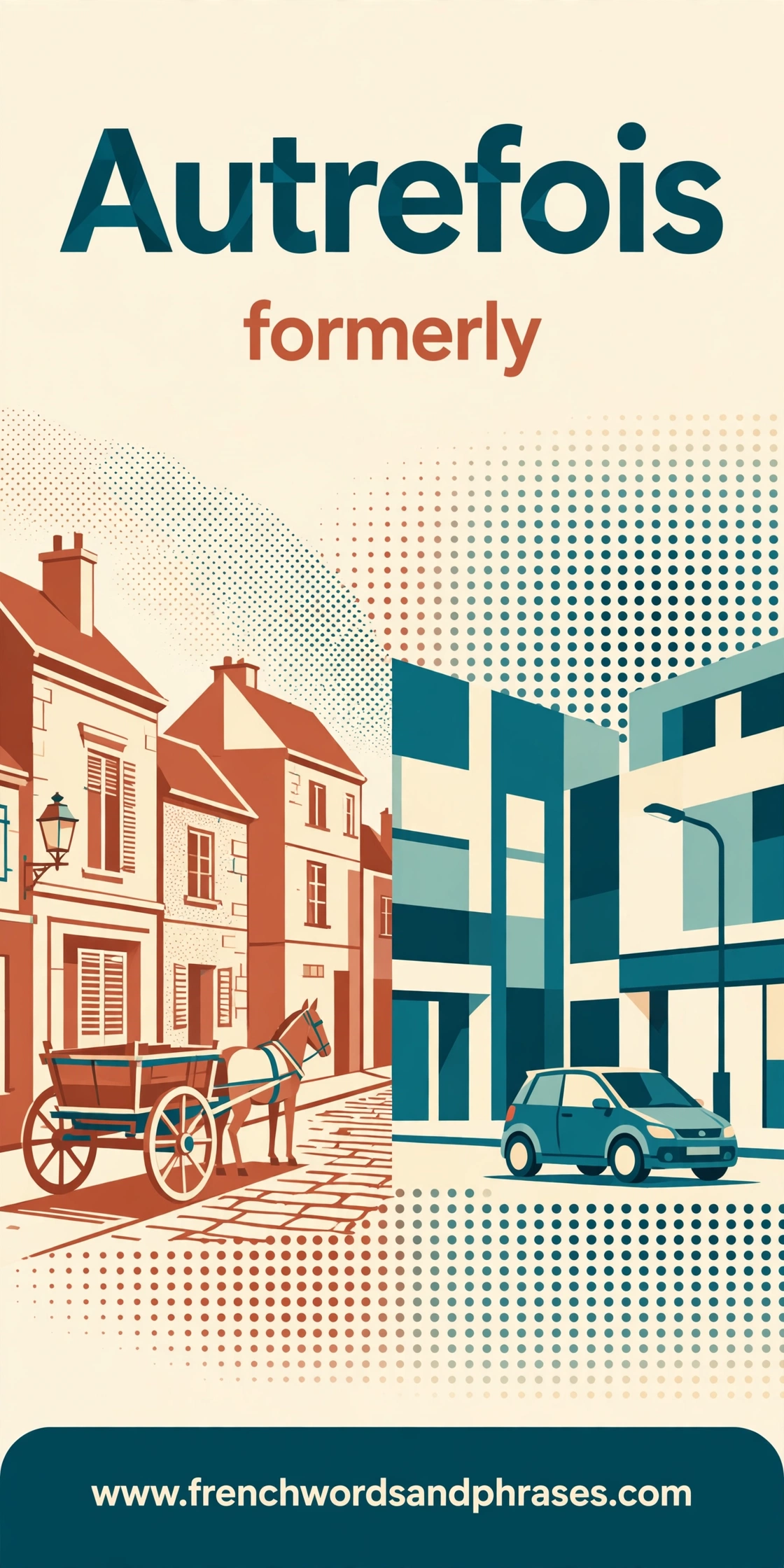
A French Word to Live By
Translate Autrefois to English
/o.tʁə.fwa/
Autrefois means formerly (in the past).
In the attic there is a photograph the colour of weak tea: a horse in the village street, a forge where the bakery stands now, and a great-grandfather in his Sunday waistcoat, squinting at a camera that took a minute to see him. That vanished world is autrefois.
In this guide, you’ll learn what autrefois means in English, how it partners with the imparfait, how it differs from jadis and naguère, and the phrases that open the door to the past. Explore French examples, English translations, and practice quizzes.
Understanding the French Adverb Autrefois
Autrefois is a French adverb of time that looks backwards — not at a single past moment, but at a whole past era. It is autre (other) plus fois (time, occasion): the other times, the times that are not ours.
It means formerly, in the past, in days gone by. Autrefois, le village n’avait pas l’électricité — in the past, the village had no electricity. Autrefois never reports yesterday’s errand; it paints the backdrop of a story, the way things used to be, usually with a breath of nostalgia.
Type: Adverb of time — a past era
Answers the question: When? — in the past, in days gone by
Changes form: Never — autrefois is invariable
English equivalents: Formerly; in the past; in days gone by.
One important usage detail: autrefois describes an era, not an event. For a single recent moment French chooses other words — hier (yesterday), l’autre jour (the other day). Autrefois belongs with the imparfait, the tense of how things used to be.
Experience the Word
Autrefois is the storyteller’s adverb. It is the word a grandfather says before the room goes quiet — the signal that the present is about to be measured against a vanished world.
Imagine the kitchen table after dinner, the photographs spread out like cards: the horse, the forge, the wedding under the linden tree. « Autrefois, tout le village se connaissait. »
You have not just said in the past. You have opened a door onto another century.
How to Use Autrefois in French: Complete Guide
Let’s explore how autrefois works in French, beginning with the whole word on one card.
Autrefois at a Glance
Before the details, here is the whole word on one card.
The Whole Word on One Card
Meaning, type, position and form — autrefois in four lines.
| Point | Autrefois |
|---|---|
| Meaning | formerly, in the past, in days gone by |
| Type | adverb of time — a whole past era |
| Usual position | at the head of the sentence, like a story opening |
| Form | invariable — never changes |
Example
Autrefois, le village n’avait pas de boulangerie.
In the past, the village had no bakery.
Where Autrefois Goes in the Sentence
Autrefois loves the head of the sentence, where it works like « Once upon a time » for real life. It can also follow the verb, more quietly.
| Situation | Pattern |
|---|---|
| Head of the sentence (storytelling) | Autrefois, + sentence — Autrefois, on voyageait en train |
| After the verb | Les gens vivaient autrefois sans téléphone |
| With d’ (of) | les métiers d’autrefois — the trades of yesteryear |
| In a question | Autrefois, les hivers étaient-ils plus froids ? — In the past, were winters colder? |
Example
Autrefois, les enfants allaient à l’école à pied.
In the past, children walked to school.
Quick Quiz 1
True or false: autrefois is the right word for a single event yesterday.
Reveal the answer
False
Autrefois paints a whole era. For yesterday, say hier.
Hier, je suis allé au marché. — Yesterday, I went to the market.
Autrefois and the Imparfait
Autrefois and the imparfait are natural partners: the adverb opens the era, and the tense fills it with habits and scenery.
| Scene | Example |
|---|---|
| Homes | Autrefois, on s’éclairait à la lampe à huile. |
| Work | Les paysans travaillaient autrefois avec des chevaux. |
| Letters | On écrivait autrefois des lettres à la main. |
| Travel | Les voyages duraient autrefois des semaines. |
Example
Autrefois, nous passions l’été chez mes grands-parents.
In the past, we spent the summer at my grandparents’ house.
Shades of the Past: Autrefois, Jadis, Naguère
French keeps several doors into the past, each opening onto a different distance.
| French | In English |
|---|---|
| autrefois | in the past, formerly — the storyteller’s word |
| jadis | long ago, in olden days — literary, almost poetic |
| naguère | not long ago, recently — formal and literary |
| anciennement | formerly — official, for buildings and uses |
| dans le temps | in the old days — warm, spoken |
Example
Jadis, un château se dressait sur la colline.
Long ago, a castle stood on the hill.
Quick Quiz 2
Complete the sentence:
______, on écrivait des lettres à la main. (In the past)
Reveal the answer
Autrefois
Autrefois, on écrivait des lettres à la main.
In the past, people wrote letters by hand.
Everyday Expressions with Autrefois
With d’ in front of a noun, autrefois becomes an adjective of nostalgia — the France of yesteryear.
| Expression | In English |
|---|---|
| les métiers d’autrefois | the trades of yesteryear |
| la France d’autrefois | the France of the old days |
| les chansons d’autrefois | the songs of yesteryear |
| un charme d’autrefois | an old-world charm |
| les photos d’autrefois | old photographs, photos of the past |
Example
Cette maison a gardé un charme d’autrefois.
This house has kept an old-world charm.
Autrefois and Its Neighbours
Around autrefois stand its fellow time travellers — and, facing it, the words of the present it left behind.
| French | In English |
|---|---|
| jadis | long ago (literary synonym) |
| dans le temps | in the old days (spoken synonym) |
| aujourd’hui | today (the opposite shore) |
| de nos jours | nowadays (the opposite shore) |
| à l’avenir | in the future (further still) |
Example
Autrefois on écrivait des lettres ; de nos jours, on envoie des messages.
In the past people wrote letters; nowadays, they send messages.
Quick Quiz 3
What does un charme d’autrefois mean?
Reveal the answer
An old-world charm
Le vieux hôtel a un charme d’autrefois.
The old hotel has an old-world charm.
Autrefois vs Aujourd’hui: Then and Now
The favourite game of autrefois is contrast: the same village, the same family, two different centuries.
| Autrefois (then) | Aujourd’hui (now) |
|---|---|
| On écrivait des lettres à la main. | On envoie des messages en une seconde. |
| Le village avait un forgeron. | Le village a une boulangerie et un café. |
| Les voyages duraient des semaines. | Paris est à deux heures de train. |
| On s’éclairait à la bougie. | On allume la lumière d’un geste. |
Example
Autrefois, la place était pleine de chevaux ; aujourd’hui, elle est pleine de voitures.
In the past, the square was full of horses; today, it is full of cars.
Watch Out: An Era, Not an Event
The one real trap with autrefois is scale. It paints decades, not days — keep it for the backdrop, and let smaller words carry single moments.
| Mistake | Correct French |
|---|---|
| « Autrefois, hier, je suis allé… » (mixing era and day) | Hier, je suis allé au marché. |
| « autrefois » for the other day | l’autre jour — Je l’ai vu l’autre jour. |
| Translating word by word: « other times » | autrefois is one fixed word for the past as an era |
| « autrefois » with a future word | autrefois only ever looks backwards — it never points at tomorrow |
Example
Je l’ai rencontré l’autre jour, devant la poste.
I met him the other day, in front of the post office.
Quick Quiz 4
How do you say the other day in French?
Reveal the answer
L’autre jour
Je l’ai vu l’autre jour.
I saw him the other day. (Autrefois is for whole eras.)
Autrefois in Everyday French: Real-Life Examples
Now that you know the word, let’s see how autrefois appears in everyday French.
Example 1 — Family stories
Autrefois, mon grand-père allait à l’école à pied.
In the past, my grandfather walked to school.
Example 2 — The village
Autrefois, il y avait un forgeron sur la place.
In the past, there was a blacksmith on the square.
Example 3 — Letters
Autrefois, on écrivait des lettres à la main.
In the past, people wrote letters by hand.
Example 4 — Nostalgia
J’aime les chansons d’autrefois.
I love the songs of yesteryear.
Example 5 — Contrast
Autrefois c’était un petit village ; aujourd’hui, c’est une ville.
In the past it was a small village; today, it is a town.
Example 6 — At the museum
Ce musée montre les métiers d’autrefois.
This museum shows the trades of yesteryear.
Beyond Translation: The Meaning of Autrefois
English formerly sounds like a form being filled in. French autrefois — autre, other, and fois, times — names something warmer: the other times, the ones that belong to other people in old photographs.
To say autrefois is to admit the world has changed, and to miss it a little.
It evokes lamplight and letter-writing, horses on the square, a France that survives in attics and proverbs. Every family story in France begins, sooner or later, with this word.
How to Remember the French Adverb Autrefois
Remember it this way: Autrefois is the past as an era — autre plus fois, the other times — and it walks hand in hand with the imparfait.
- You take the word apart — autre + fois, the other times.
- You open a story with it — Autrefois, le village n’avait pas l’électricité.
- You keep it for eras — for yesterday, hier ; for the other day, l’autre jour.
The key idea is autrefois = the past as an era, with the imparfait — not for single events.
Test Your Knowledge of Autrefois
Let’s see how much you’ve learned. Try answering these questions before revealing the answers.
Question 1
What does autrefois mean?
Reveal the answer
Formerly, in the past — in days gone by, as an era.
Question 2
Which tense is autrefois’s natural partner?
Reveal the answer
The imparfait — the tense of how things used to be.
Question 3
Translate: In the past, people wrote letters by hand.
Reveal the answer
Autrefois, on écrivait des lettres à la main.
Question 4
What is the difference between autrefois and jadis?
Reveal the answer
Jadis is longer ago and more literary — long ago, in olden days. Autrefois is the everyday storyteller’s word.
Question 5
Complete the sentence:
______, le village n’avait pas l’électricité. (In the past)
Reveal the answer
Autrefois
Autrefois, le village n’avait pas l’électricité.
In the past, the village had no electricity.
Your Final Challenge
Can You Use It?
How would you say this in French?
“In the past, people wrote letters by hand.”
Reveal the answer
Autrefois, on écrivait les lettres à la main.
In the past, people wrote letters by hand.
A little French. A little curiosity. A richer everyday life.
LEARN FRENCH ONE WORD AT A TIME




