A French Word to Live By
How to Conjugate Aspirer in French
/as.pi.ʁe/
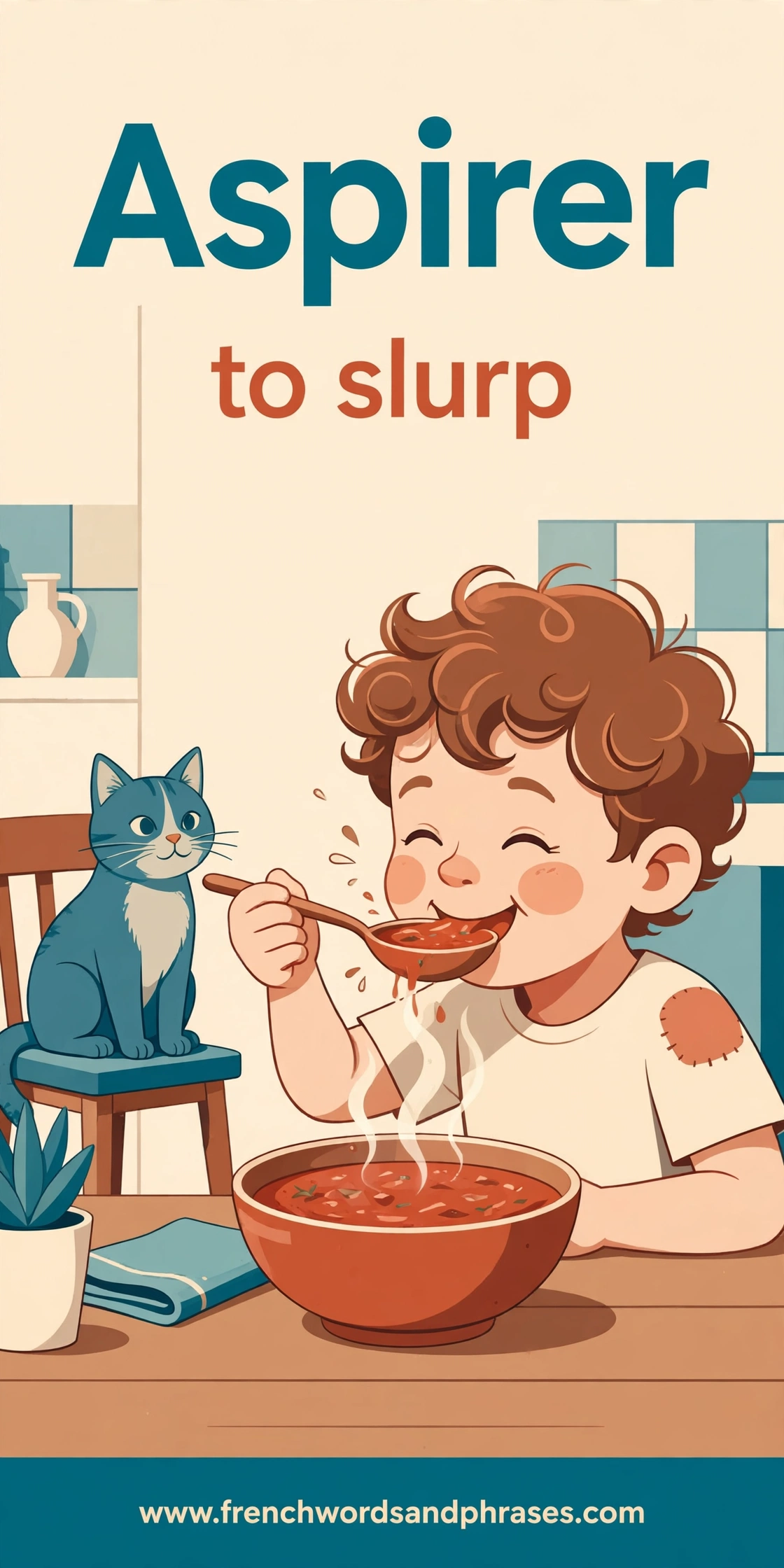
Aspirer means to slurp — to suck up a soup or a drink noisily through your lips or a straw. At its heart it is the verb of pulling air or liquid inwards, and French also uses it to inhale, to vacuum up dust, and, with à, to aspire to something.
A steaming bowl of soup, a hungry eater, and that long, satisfied slurp: aspirer is the verb for sucking in air or liquid. It is the sound of someone aspirant sa soupe at a noodle stall — and the same verb drives the vacuum cleaner, l’aspirateur, and the quiet ambition of aspirer à devenir médecin.
In this guide, you’ll learn how to conjugate aspirer in all the major French tenses and moods. Explore complete conjugation tables, French examples, English translations, and practice quizzes.
Understanding the French Verb Aspirer
Aspirer is a regular French verb belonging to the first group of verbs, those ending in-er.
It means to slurp. Three lives in one verb. At the table, aspirer is the noisy one: aspirer sa soupe. Around the house, aspirer la poussière is what the vacuum cleaner does — l’aspirateur is named after it. And in careful speech, aspirer à quelque chose means to long for it, to aspire to it: elle aspire à la tranquillité.
Verb classification: First group (-er)
Auxiliary verb: Avoir
Past participle: aspiré
Present participle: aspirant
English equivalents: To slurp, to suck in, to inhale; aspirer sa soupe — to slurp one’s soup; aspirer une boisson avec une paille — to suck up a drink through a straw; aspirer la poussière — to vacuum up the dust; aspirer à + infinitive — to aspire to do something; un aspirateur — a vacuum cleaner.
One important detail: aspirer begins with a vowel sound, so je becomes j’ — j’aspire — while the stem aspir- itself never changes: nous aspirons, j’aspirais, aspiré. Keep aspirer (the inward pull) apart from its cousin respirer, to breathe: respirer covers the whole breath in and out, aspirer is only the way in.
Experience the Word
Aspirer is the verb of the inward pull — soup through lips, air through the nose, dust through a hose, and hopes through a whole life.
Imagine a tiny noodle shop at lunchtime. Bowls steam, chopsticks lift, and the cook smiles at the noise: here, a customer who aspire sa soupe bruyamment is paying the highest compliment a soup can earn.
No shame in the slurp. He is slurping — il aspire — and the soup has never tasted better.
How to Conjugate Aspirer: Complete French Conjugation Guide
Let’s explore every major conjugation of aspirer, beginning with the indicative mood.
How to Conjugate Aspirer in the Indicative Mood
The indicative mood is used to express facts, observations, actions, and events.
How to Conjugate Aspirer in the Present Tense (Présent)
Used for actions happening now, habitual actions, and general truths.
| Subject | Conjugation |
|---|---|
| je | aspire |
| tu | aspires |
| il / elle | aspire |
| nous | aspirons |
| vous | aspirez |
| ils / elles | aspirent |
Example
Il aspire sa soupe avec un plaisir évident.
He slurps his soup with obvious pleasure.
Quick Quiz 1
Complete the sentence:
Nous ______ l’air frais du matin.
Reveal the answer
aspirons
Nous aspirons l’air frais du matin.
We breathe in the fresh morning air.
How to Conjugate Aspirer in the Passé Composé
Used for completed actions in the past. Aspirer takes the auxiliary verb avoir.
| Subject | Conjugation |
|---|---|
| j’ | ai aspiré |
| tu | as aspiré |
| il / elle | a aspiré |
| nous | avons aspiré |
| vous | avez aspiré |
| ils / elles | ont aspiré |
Example
Elle a aspiré son milkshake en une minute.
She sucked up her milkshake in one minute.
How to Conjugate Aspirer in the Imparfait (Imperfect Tense)
Used for habitual past actions, descriptions, and ongoing situations in the past.
| Subject | Conjugation |
|---|---|
| je | aspirais |
| tu | aspirais |
| il / elle | aspirait |
| nous | aspirions |
| vous | aspiriez |
| ils / elles | aspiraient |
Example
Le matin, il aspirait l’air frais à la fenêtre.
In the morning, he used to breathe in the fresh air at the window.
Quick Quiz 2
Choose the correct form:
She sucked up her juice through a straw.
Elle ______ son jus avec une paille. (a aspiré / est aspirée)
Reveal the answer
a aspiré
Elle a aspiré son jus avec une paille.
Aspirer takes avoir.
How to Conjugate Aspirer in the Plus-que-parfait
Used to describe an action that had already been completed before another past event.
| Subject | Conjugation |
|---|---|
| j’ | avais aspiré |
| tu | avais aspiré |
| il / elle | avait aspiré |
| nous | avions aspiré |
| vous | aviez aspiré |
| ils / elles | avaient aspiré |
Example
L’aspirateur avait aspiré toute la poussière du tapis.
The vacuum cleaner had sucked up all the dust from the carpet.
How to Conjugate Aspirer in the Passé Simple
Primarily used in formal writing, literature, and historical narratives. It is rarely used in everyday conversation.
| Subject | Conjugation |
|---|---|
| je | aspirai |
| tu | aspiras |
| il / elle | aspira |
| nous | aspirâmes |
| vous | aspirâtes |
| ils / elles | aspirèrent |
Example
Il aspira profondément avant de répondre.
He breathed in deeply before answering.
How to Conjugate Aspirer in the Passé Antérieur
A literary tense used to express an action completed immediately before another past action, generally in the passé simple.
| Subject | Conjugation |
|---|---|
| j’ | eus aspiré |
| tu | eus aspiré |
| il / elle | eut aspiré |
| nous | eûmes aspiré |
| vous | eûtes aspiré |
| ils / elles | eurent aspiré |
Example
Quand elle eut aspiré la dernière gorgée, elle reposa son bol.
When she had slurped the last mouthful, she put her bowl down.
How to Conjugate Aspirer in the Future Tense (Futur Simple)
Used to describe actions that will take place in the future.
| Subject | Conjugation |
|---|---|
| je | aspirerai |
| tu | aspireras |
| il / elle | aspirera |
| nous | aspirerons |
| vous | aspirerez |
| ils / elles | aspireront |
Example
Un jour, tu aspireras à de plus grandes choses.
One day, you will aspire to greater things.
How to Conjugate Aspirer in the Futur Antérieur (Future Perfect)
Used for an action that will have been completed before a particular point in the future.
| Subject | Conjugation |
|---|---|
| j’ | aurai aspiré |
| tu | auras aspiré |
| il / elle | aura aspiré |
| nous | aurons aspiré |
| vous | aurez aspiré |
| ils / elles | auront aspiré |
Example
À midi, le robot aura aspiré toute la maison.
By noon, the robot vacuum will have vacuumed the whole house.
How to Conjugate Aspirer in the Near Future (Futur Proche)
Used to describe something that is going to happen soon. Formed with aller + infinitive.
| Subject | Conjugation |
|---|---|
| je | vais aspirer |
| tu | vas aspirer |
| il / elle | va aspirer |
| nous | allons aspirer |
| vous | allez aspirer |
| ils / elles | vont aspirer |
Example
Chut, il va aspirer sa soupe, écoute ce bruit !
Listen, he is going to slurp his soup — hear that noise!
How to Conjugate Aspirer in the Conditional Mood
The conditional mood expresses what would happen under certain circumstances. It is also frequently used to make polite requests or express wishes.
How to Conjugate Aspirer in the Present Conditional
| Subject | Conjugation |
|---|---|
| je | aspirerais |
| tu | aspirerais |
| il / elle | aspirerait |
| nous | aspirerions |
| vous | aspireriez |
| ils / elles | aspireraient |
Example
Sans paille, elle aspirerait son jus directement au verre.
Without a straw, she would suck her juice straight from the glass.
How to Conjugate Aspirer in the Past Conditional
| Subject | Conjugation |
|---|---|
| j’ | aurais aspiré |
| tu | aurais aspiré |
| il / elle | aurait aspiré |
| nous | aurions aspiré |
| vous | auriez aspiré |
| ils / elles | auraient aspiré |
Example
Il aurait aspiré à ce poste sans sa modestie.
He would have aspired to that post, if not for his modesty.
Aspirer in the Literary Past Conditional Form
This less common literary form uses the imperfect subjunctive of avoir.
| Subject | Conjugation |
|---|---|
| j’ | eusse aspiré |
| tu | eusses aspiré |
| il / elle | eût aspiré |
| nous | eussions aspiré |
| vous | eussiez aspiré |
| ils / elles | eussent aspiré |
Example
Il eût aspiré au repos sans les soucis de la boutique.
He would have longed for rest, if not for the worries of the shop.
How to Conjugate Aspirer in the Subjunctive Mood
The subjunctive is used to express wishes, emotions, doubts, necessity, and uncertainty. It frequently follows expressions such as il faut que (it is necessary that) or bien que (although).
How to Conjugate Aspirer in the Present Subjunctive
| Subject | Conjugation |
|---|---|
| que je | aspire |
| que tu | aspires |
| qu’il / qu’elle | aspire |
| que nous | aspirions |
| que vous | aspiriez |
| qu’ils / qu’elles | aspirent |
Example
Le médecin demande que vous aspiriez lentement par le nez.
The doctor asks you to breathe in slowly through your nose.
Quick Quiz 3
Complete the sentence using the subjunctive:
Le médecin demande que vous ______ lentement par le nez.
Reveal the answer
aspiriez
Le médecin demande que vous aspiriez lentement par le nez.
The doctor asks you to breathe in slowly through your nose.
How to Conjugate Aspirer in the Imperfect Subjunctive
A literary tense, rarely encountered in modern spoken French.
| Subject | Conjugation |
|---|---|
| que je | aspirasse |
| que tu | aspirasses |
| qu’il / qu’elle | aspirât |
| que nous | aspirassions |
| que vous | aspirassiez |
| qu’ils / qu’elles | aspirassent |
Example
Il fallait qu’elle aspirât son bouillon sans faire de bruit.
She had to slurp her broth without making a noise.
How to Conjugate Aspirer in the Pluperfect Subjunctive
A literary construction used to express an action completed before another past action.
| Subject | Conjugation |
|---|---|
| que j’ | eusse aspiré |
| que tu | eusses aspiré |
| qu’il / qu’elle | eût aspiré |
| que nous | eussions aspiré |
| que vous | eussiez aspiré |
| qu’ils / qu’elles | eussent aspiré |
Example
On doutait qu’il eût aspiré à autre chose qu’à la gloire.
People doubted he had aspired to anything but glory.
How to Conjugate Aspirer in the Past Subjunctive
| Subject | Conjugation |
|---|---|
| que j’ | aie aspiré |
| que tu | aies aspiré |
| qu’il / qu’elle | ait aspiré |
| que nous | ayons aspiré |
| que vous | ayez aspiré |
| qu’ils / qu’elles | aient aspiré |
Example
Je suis ravi que le nouvel appareil ait aspiré toute la poussière.
I am delighted the new vacuum sucked up all the dust.
How to Conjugate Aspirer in the Imperative
The imperative is used to give commands, instructions, invitations, or suggestions. Subject pronouns are omitted.
How to Conjugate Aspirer in the Present Imperative
| Person | Conjugation |
|---|---|
| (tu) | aspire |
| (nous) | aspirons |
| (vous) | aspirez |
Example
Aspirez profondément, puis soufflez !
Breathe in deeply, then blow out!
Quick Quiz 4
How would you say Slurp your soup (tu form)?
Reveal the answer
Aspire ta soupe !
French Participles of Aspirer
Participles are verb forms that can be used in compound tenses and other grammatical constructions.
Present Participle of Aspirer
aspirant
En aspirant sa soupe trop vite, il s’est brûlé la langue.
By slurping his soup too fast, he burnt his tongue.
Past Participle of Aspirer
aspiré
Aspirée par la machine, la poussière disparaît en quelques secondes.
Sucked up by the machine, the dust disappears in a few seconds.
Aspirer in Everyday French: Real-Life Examples
Now that you know the conjugations, let’s see how aspirer appears in everyday French.
Example 1 — Present
Il aspire sa soupe bruyamment.
He slurps his soup noisily.
Example 2 — Passé composé
Elle a aspiré son jus avec une paille.
She sucked up her juice through a straw.
Example 3 — Imparfait
Nous aspirions l’air pur de la montagne.
We used to breathe in the pure mountain air.
Example 4 — Future
Un jour, elle aspirera à diriger l’école.
One day, she will aspire to run the school.
Example 5 — Conditional
Il aspirerait à plus de calme.
He would long for more calm.
Example 6 — Imperative
Aspire profondément et détends-toi !
Breathe in deeply and relax!
Beyond Translation: The Meaning of Aspirer
Latin again: aspirare, to breathe towards — ad plus spirare, to breathe. English borrowed the same word twice over: aspire kept the ambition, while the medical aspirate kept the suction.
The household name is the giveaway.
Un aspirateur, the vacuum cleaner, is literally the sucker-upper — the machine that aspire la poussière all day long. And when a happy eater aspire sa soupe at a market stall, it is the very same inward pull, just with better seasoning.
How to Remember the French Verb Aspirer
Remember it this way: Aspirer is about a happy eater slurping soup while a vacuum hums in the corner and a student dreams of medical school.
- Three senses, one inward pull: aspirer sa soupe (to slurp), aspirer la poussière (to vacuum), aspirer à + infinitive (to aspire to).
- Je becomes j’ before the vowel: j’aspire, j’aspirais — but the stem aspir- never changes.
- Regular -er endings throughout: j’aspire, nous aspirons, past participle aspiré.
The key idea is a happy eater slurping soup while a vacuum hums in the corner and a student dreams of medical school.
Test Your Knowledge of Aspirer
Let’s see how much you’ve learned. Try answering these questions before revealing the answers.
Question 1
How do you say to aspire to something in French?
Reveal the answer
Aspirer à + infinitive — elle aspire à devenir médecin, she aspires to become a doctor. Mind the à: without it, aspirer means to suck in or to slurp.
Question 2
How do you say He slurps his soup noisily in French?
Reveal the answer
Il aspire sa soupe bruyamment.
Question 3
Translate: Breathe in deeply, then blow out!
Reveal the answer
Aspirez profondément, puis soufflez !
Question 4
What is the past participle of aspirer?
Reveal the answer
Aspiré.
Question 5
Complete the sentence:
Le nouvel appareil ______ toute la poussière du tapis.
Reveal the answer
aspire
Le nouvel appareil aspire toute la poussière du tapis.
The new vacuum sucks up all the dust from the carpet.
Your Final Challenge
Can You Use It?
How would you say this in French?
He slurps his soup without shame, and he aspires to much more than this meal.
Reveal the answer
Il aspire sa soupe sans honte, et il aspire à bien plus que ce repas.
He slurps his soup without shame, and he aspires to much more than this meal.
A little French. A little curiosity. A richer everyday life.
LEARN FRENCH ONE WORD AT A TIME