A French Word to Live By
How to Conjugate Renifler in French
/ʁə.ni.fle/
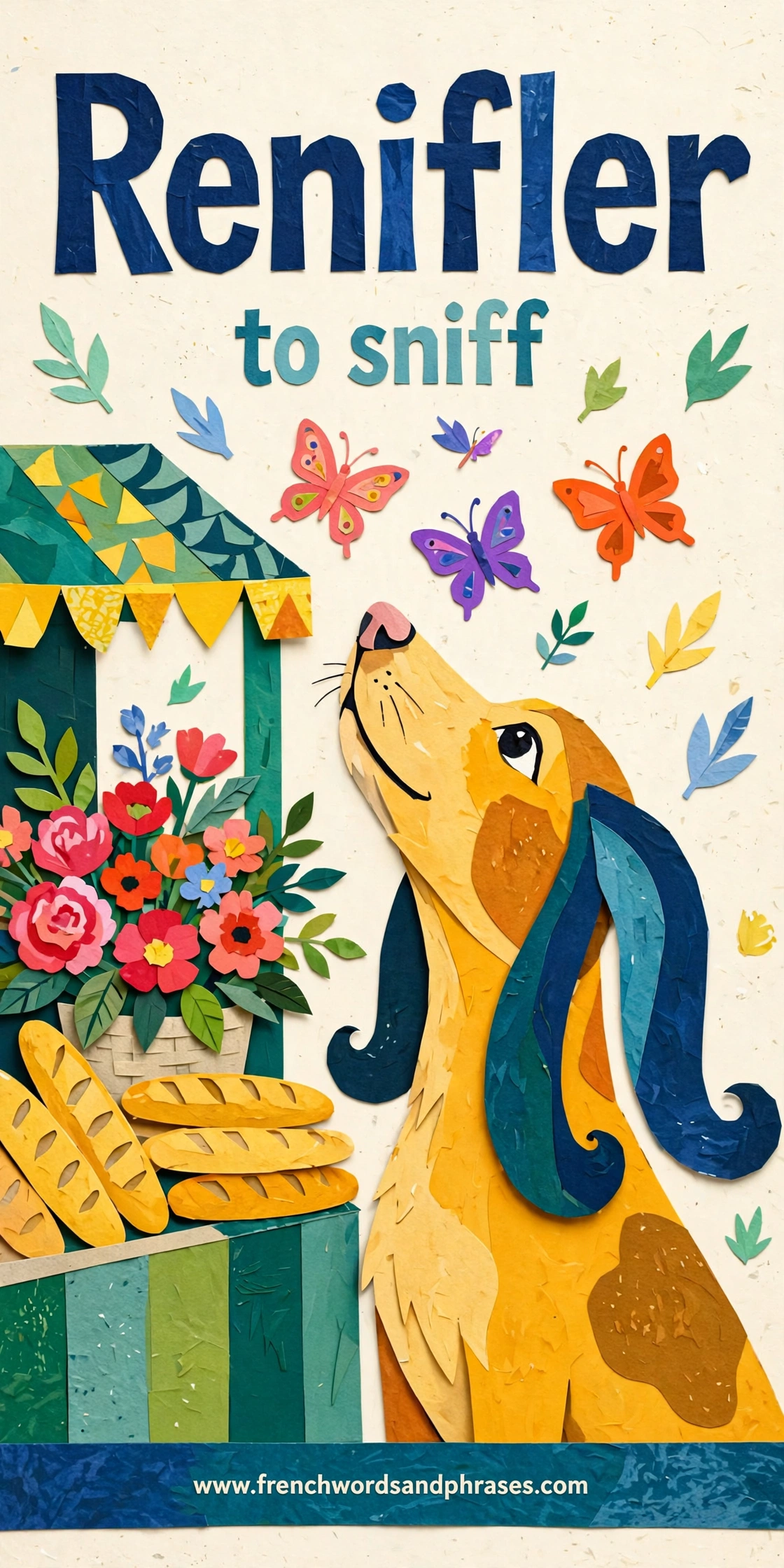
Renifler means to sniff, to sniffle — to pull air in noisily through the nose, whether you are fighting a cold, holding back tears, or checking whether the milk has turned.
A winter cold, a sad film, a forgotten carton at the back of the fridge: renifler is the verb of the noisy nose. It covers the constant sniffle of the person next to you on the train, and the careful sniff with which a cook tests a sauce before anyone tastes it.
In this guide, you’ll learn how to conjugate renifler in all the major French tenses and moods. Explore complete conjugation tables, French examples, English translations, and practice quizzes.
Understanding the French Verb Renifler
Renifler is a regular French verb belonging to the first group of verbs, those ending in-er.
It means to sniff, to sniffle. Renifler describes the sound as much as the action: short, repeated intakes of air through a nose that is blocked, wet or curious. Dogs reniflent at lampposts, children reniflent after crying, and half the carriage renifle in January. For one slow, appreciative breath of a perfume, French often says respirer or sentir; renifler keeps the noisy, nose-first flavour.
Verb classification: First group (-er)
Auxiliary verb: Avoir
Past participle: reniflé
Present participle: reniflant
English equivalents: To sniff, to sniffle, to snuffle; renifler sans arrêt — to sniff non-stop; renifler un plat — to sniff at a dish; renifler un parfum — to sniff a perfume; arrête de renifler ! — stop sniffling!; un reniflement — a sniff, a sniffle.
One important detail: renifler is a perfectly regular -er verb — no stem changes, no surprises: je renifle, nous reniflons, je reniflais, reniflé. Do not confuse it with respirer (to breathe, quietly and normally): renifler is always audible, and usually a little damp.
Experience the Word
Renifler is the verb of noses at work — blocked, curious or tearful, and never silent.
Imagine a night train in January. Outside, frost on the windows; inside, a whole carriage of winter colds. Every few seconds, from a different seat, comes the same small sound: quelqu’un renifle, and nobody even looks up.
It is the soundtrack of winter. He sniffles — il renifle — and reaches for another handkerchief.
How to Conjugate Renifler: Complete French Conjugation Guide
Let’s explore every major conjugation of renifler, beginning with the indicative mood.
How to Conjugate Renifler in the Indicative Mood
The indicative mood is used to express facts, observations, actions, and events.
How to Conjugate Renifler in the Present Tense (Présent)
Used for actions happening now, habitual actions, and general truths.
| Subject | Conjugation |
|---|---|
| je | renifle |
| tu | renifles |
| il / elle | renifle |
| nous | reniflons |
| vous | reniflez |
| ils / elles | reniflent |
Example
Il renifle sans arrêt depuis ce matin.
He has been sniffling non-stop since this morning.
Quick Quiz 1
Complete the sentence:
Nous ______ à cause du froid.
Reveal the answer
reniflons
Nous reniflons à cause du froid.
We are sniffling because of the cold.
How to Conjugate Renifler in the Passé Composé
Used for completed actions in the past. Renifler takes the auxiliary verb avoir.
| Subject | Conjugation |
|---|---|
| j’ | ai reniflé |
| tu | as reniflé |
| il / elle | a reniflé |
| nous | avons reniflé |
| vous | avez reniflé |
| ils / elles | ont reniflé |
Example
Elle a reniflé le lait avant de le jeter.
She sniffed the milk before throwing it away.
How to Conjugate Renifler in the Imparfait (Imperfect Tense)
Used for habitual past actions, descriptions, and ongoing situations in the past.
| Subject | Conjugation |
|---|---|
| je | reniflais |
| tu | reniflais |
| il / elle | reniflait |
| nous | reniflions |
| vous | renifliez |
| ils / elles | reniflaient |
Example
Le chien reniflait chaque réverbère du quartier.
The dog used to sniff every lamppost in the neighbourhood.
Quick Quiz 2
Choose the correct form:
The dog sniffed my shoes.
Le chien ______ mes chaussures. (a reniflé / est reniflé)
Reveal the answer
a reniflé
Le chien a reniflé mes chaussures.
Renifler takes avoir.
How to Conjugate Renifler in the Plus-que-parfait
Used to describe an action that had already been completed before another past event.
| Subject | Conjugation |
|---|---|
| j’ | avais reniflé |
| tu | avais reniflé |
| il / elle | avait reniflé |
| nous | avions reniflé |
| vous | aviez reniflé |
| ils / elles | avaient reniflé |
Example
Le petit avait reniflé pendant tout le film triste.
The little boy had sniffled through the whole sad film.
How to Conjugate Renifler in the Passé Simple
Primarily used in formal writing, literature, and historical narratives. It is rarely used in everyday conversation.
| Subject | Conjugation |
|---|---|
| je | reniflai |
| tu | reniflas |
| il / elle | renifla |
| nous | reniflâmes |
| vous | reniflâtes |
| ils / elles | reniflèrent |
Example
Il renifla le bouquet, puis il éternua.
He sniffed the bunch of flowers, then he sneezed.
How to Conjugate Renifler in the Passé Antérieur
A literary tense used to express an action completed immediately before another past action, generally in the passé simple.
| Subject | Conjugation |
|---|---|
| j’ | eus reniflé |
| tu | eus reniflé |
| il / elle | eut reniflé |
| nous | eûmes reniflé |
| vous | eûtes reniflé |
| ils / elles | eurent reniflé |
Example
Quand elle eut reniflé le plat, elle ajouta du sel.
When she had sniffed the dish, she added salt.
How to Conjugate Renifler in the Future Tense (Futur Simple)
Used to describe actions that will take place in the future.
| Subject | Conjugation |
|---|---|
| je | reniflerai |
| tu | renifleras |
| il / elle | reniflera |
| nous | reniflerons |
| vous | reniflerez |
| ils / elles | renifleront |
Example
Sans traitement, vous reniflerez tout l’hiver.
Without treatment, you will sniffle all winter.
How to Conjugate Renifler in the Futur Antérieur (Future Perfect)
Used for an action that will have been completed before a particular point in the future.
| Subject | Conjugation |
|---|---|
| j’ | aurai reniflé |
| tu | auras reniflé |
| il / elle | aura reniflé |
| nous | aurons reniflé |
| vous | aurez reniflé |
| ils / elles | auront reniflé |
Example
À la fin du rhume, il aura reniflé cent fois par jour.
By the end of the cold, he will have sniffled a hundred times a day.
How to Conjugate Renifler in the Near Future (Futur Proche)
Used to describe something that is going to happen soon. Formed with aller + infinitive.
| Subject | Conjugation |
|---|---|
| je | vais renifler |
| tu | vas renifler |
| il / elle | va renifler |
| nous | allons renifler |
| vous | allez renifler |
| ils / elles | vont renifler |
Example
Le chien va renifler vos chaussures, attention !
The dog is going to sniff your shoes, watch out!
How to Conjugate Renifler in the Conditional Mood
The conditional mood expresses what would happen under certain circumstances. It is also frequently used to make polite requests or express wishes.
How to Conjugate Renifler in the Present Conditional
| Subject | Conjugation |
|---|---|
| je | reniflerais |
| tu | reniflerais |
| il / elle | reniflerait |
| nous | reniflerions |
| vous | renifleriez |
| ils / elles | renifleraient |
Example
Avec un bon sirop, elle reniflerait beaucoup moins.
With a good syrup, she would sniffle much less.
How to Conjugate Renifler in the Past Conditional
| Subject | Conjugation |
|---|---|
| j’ | aurais reniflé |
| tu | aurais reniflé |
| il / elle | aurait reniflé |
| nous | aurions reniflé |
| vous | auriez reniflé |
| ils / elles | auraient reniflé |
Example
Il aurait reniflé le plat avant de goûter, par habitude.
He would have sniffed the dish before tasting, out of habit.
Renifler in the Literary Past Conditional Form
This less common literary form uses the imperfect subjunctive of avoir.
| Subject | Conjugation |
|---|---|
| j’ | eusse reniflé |
| tu | eusses reniflé |
| il / elle | eût reniflé |
| nous | eussions reniflé |
| vous | eussiez reniflé |
| ils / elles | eussent reniflé |
Example
Sans ce rhume tenace, il eût reniflé les roses du jardin.
Without that stubborn cold, he would have sniffed the roses in the garden.
How to Conjugate Renifler in the Subjunctive Mood
The subjunctive is used to express wishes, emotions, doubts, necessity, and uncertainty. It frequently follows expressions such as il faut que (it is necessary that) or bien que (although).
How to Conjugate Renifler in the Present Subjunctive
| Subject | Conjugation |
|---|---|
| que je | renifle |
| que tu | renifles |
| qu’il / qu’elle | renifle |
| que nous | reniflions |
| que vous | renifliez |
| qu’ils / qu’elles | reniflent |
Example
Le vétérinaire veut que le chien renifle le sol pendant la promenade.
The vet wants the dog to sniff the ground during the walk.
Quick Quiz 3
Complete the sentence using the subjunctive:
Je veux que tu ______ ce lait avant de le boire.
Reveal the answer
renifles
Je veux que tu renifles ce lait avant de le boire.
I want you to sniff this milk before drinking it.
How to Conjugate Renifler in the Imperfect Subjunctive
A literary tense, rarely encountered in modern spoken French.
| Subject | Conjugation |
|---|---|
| que je | reniflasse |
| que tu | reniflasses |
| qu’il / qu’elle | reniflât |
| que nous | reniflassions |
| que vous | reniflassiez |
| qu’ils / qu’elles | reniflassent |
Example
La maîtresse détestait que les élèves reniflassent en classe.
The teacher hated the pupils sniffling in class.
How to Conjugate Renifler in the Pluperfect Subjunctive
A literary construction used to express an action completed before another past action.
| Subject | Conjugation |
|---|---|
| que j’ | eusse reniflé |
| que tu | eusses reniflé |
| qu’il / qu’elle | eût reniflé |
| que nous | eussions reniflé |
| que vous | eussiez reniflé |
| qu’ils / qu’elles | eussent reniflé |
Example
On voyait qu’elle eût reniflé avant de répondre, les yeux rouges.
You could see she had been sniffling before answering, her eyes red.
How to Conjugate Renifler in the Past Subjunctive
| Subject | Conjugation |
|---|---|
| que j’ | aie reniflé |
| que tu | aies reniflé |
| qu’il / qu’elle | ait reniflé |
| que nous | ayons reniflé |
| que vous | ayez reniflé |
| qu’ils / qu’elles | aient reniflé |
Example
Je suis content que tu aies reniflé ce lait avant de le boire.
I am glad you sniffed that milk before drinking it.
How to Conjugate Renifler in the Imperative
The imperative is used to give commands, instructions, invitations, or suggestions. Subject pronouns are omitted.
How to Conjugate Renifler in the Present Imperative
| Person | Conjugation |
|---|---|
| (tu) | renifle |
| (nous) | reniflons |
| (vous) | reniflez |
Example
Renifle ce parfum et dis-moi ce que tu en penses !
Sniff this perfume and tell me what you think of it!
Quick Quiz 4
How would you say Stop sniffling (tu form)?
Reveal the answer
Arrête de renifler !
French Participles of Renifler
Participles are verb forms that can be used in compound tenses and other grammatical constructions.
Present Participle of Renifler
reniflant
En reniflant le plat, la cuisinière devine les épices.
By sniffing the dish, the cook can guess the spices.
Past Participle of Renifler
reniflé
Reniflé par le chien, le sac a livré tous ses secrets.
Sniffed by the dog, the bag gave up all its secrets.
Renifler in Everyday French: Real-Life Examples
Now that you know the conjugations, let’s see how renifler appears in everyday French.
Example 1 — Present
Elle renifle, elle doit avoir un rhume.
She is sniffling, she must have a cold.
Example 2 — Passé composé
Le chien a reniflé mes chaussures.
The dog sniffed my shoes.
Example 3 — Imparfait
Il reniflait pendant tout le film.
He was sniffling through the whole film.
Example 4 — Future
Tu renifleras moins avec ce sirop.
You will sniffle less with this syrup.
Example 5 — Conditional
Sans son allergie, il reniflerait moins au printemps.
Without his allergy, he would sniffle less in spring.
Example 6 — Imperative
Renifle doucement, voici un mouchoir !
Sniff gently — here is a handkerchief!
Beyond Translation: The Meaning of Renifler
Renifler is built on nifler, an old expressive word for wrinkling the nose and sniffing; the re- in front adds the idea of doing it again and again, which is exactly what a sniffle is.
Its noun is just as expressive.
Un reniflement is one sniff; une série de reniflements is the January chorus on the night train. English sniffle and French renifler are not related, but they describe the same small human music.
How to Remember the French Verb Renifler
Remember it this way: Renifler is about a dog working its way along a row of lampposts, nose in charge.
- Perfectly regular: je renifle, nous reniflons, past participle reniflé — no stem change anywhere.
- Renifler is the NOISY nose: sniffles, colds and curious dogs. For quiet breathing, French says respirer.
- Useful phrase: renifler sans arrêt — to sniff non-stop, the soundtrack of every winter train.
The key idea is a dog working its way along a row of lampposts, nose in charge.
Test Your Knowledge of Renifler
Let’s see how much you’ve learned. Try answering these questions before revealing the answers.
Question 1
What is the difference between renifler and respirer?
Reveal the answer
Renifler is noisy nose-breathing — sniffing or sniffling. Respirer is ordinary, quiet breathing.
Question 2
How do you say He has been sniffling non-stop since this morning in French?
Reveal the answer
Il renifle sans arrêt depuis ce matin.
Question 3
Translate: She sniffed the milk before throwing it away.
Reveal the answer
Elle a reniflé le lait avant de le jeter.
Question 4
What is the past participle of renifler?
Reveal the answer
Reniflé.
Question 5
Complete the sentence:
Le chien ______ chaque réverbère du quartier.
Reveal the answer
renifle
Le chien renifle chaque réverbère du quartier.
The dog sniffs every lamppost in the neighbourhood.
Your Final Challenge
Can You Use It?
How would you say this in French?
He sniffles on the train, the dog sniffs in the street: winter has its own music.
Reveal the answer
Il renifle dans le train, le chien renifle dans la rue : l’hiver a sa musique.
He sniffles on the train, the dog sniffs in the street: winter has its own music.
A little French. A little curiosity. A richer everyday life.
LEARN FRENCH ONE WORD AT A TIME