A French Word to Live By
Translate Argent to English
/aʁ.ʒɑ̃/
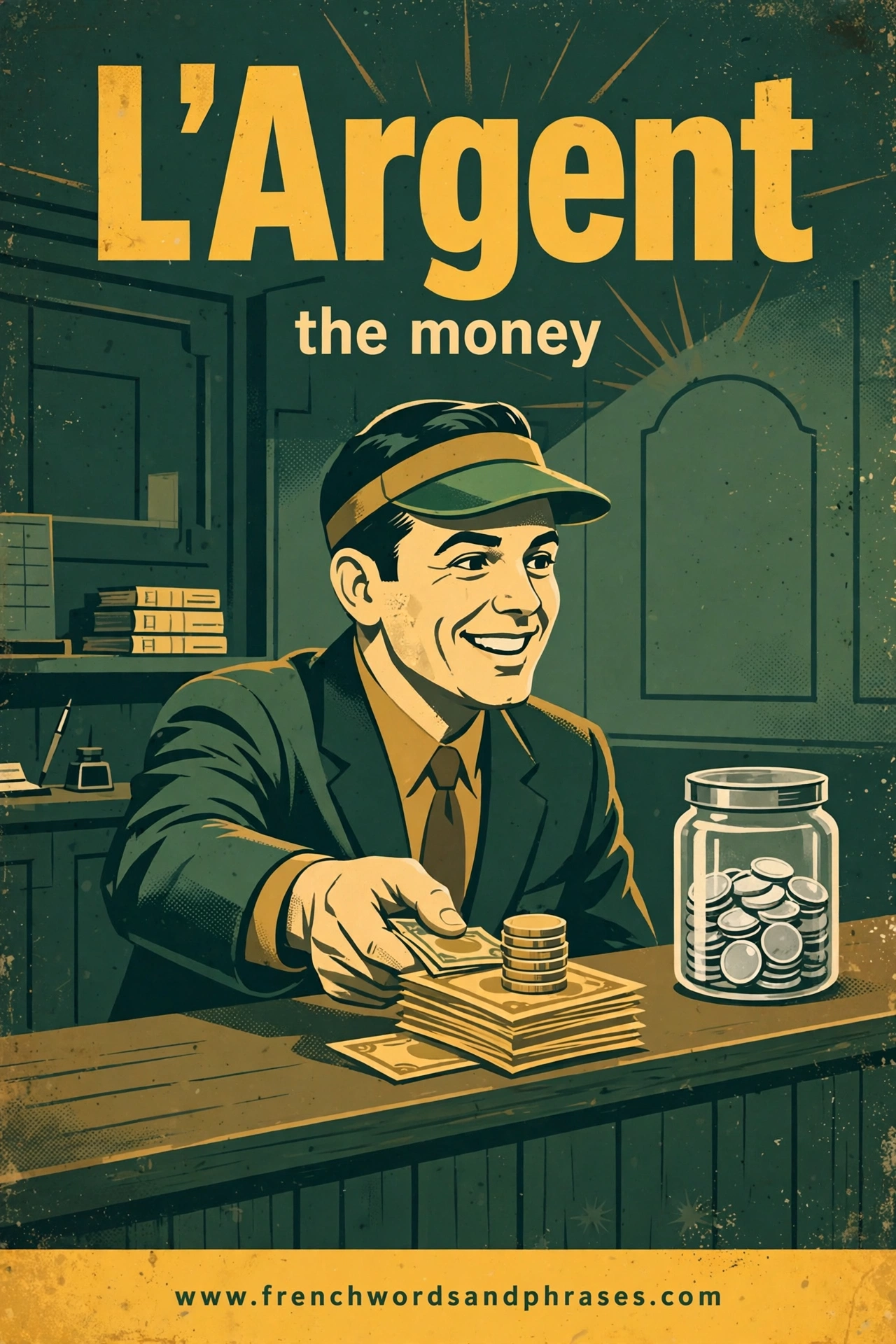
L’argent means the money.
The wallet opens, the coins chink in a pocket, the bill arrives at the end of a long lunch — behind a thousand small moments of French life stands one quiet word: l’argent.
In this guide, you’ll learn what argent means in English, how to use it with its articles, how to form its plural, and how it appears in everyday French. Explore French examples, English translations, and practice quizzes.
Understanding the French Noun Argent
Argent is a masculine French noun, learned with its article: l’argent. Because it begins with a vowel, le shrinks to l’. Argent is normally uncountable — French does not count it one by one, it measures it: de l’argent, some money; beaucoup d’argent, a lot of money.
It means money — the coins, notes and numbers that pay for le pain, le loyer (the rent) and les vacances. But argent has a second life: it is also the metal silver, so une bague en argent is a silver ring and les couverts en argent are the silver cutlery. One word, two treasures: the money in your pocket and the metal in the drawer.
Gender: Masculine
Definite article: l’ — l’argent (the money); the word begins with a vowel
Indefinite article: No everyday un argent — money is uncountable: de l’argent, some money
Plural: Normally singular only; des argents appears in finance for funds
Two meanings: Money — and the metal silver: une cuillère en argent, a silver spoon
English equivalents: The money; silver.
One important usage detail: do not confuse argent with monnaie. Argent is money in general — wealth, funds, what you earn and save. Monnaie is the small physical change in your pocket, and also « currency »: « Vous avez de la monnaie ? » means « Do you have any change? » For money as a substance, French almost always says de l’argent, never « du argent ».
Experience the Word
Argent is more than coins and notes. It is the subject France pretends not to talk about — famously discreet at the dinner table, yet present in every plan, every dream and every worry.
Imagine the market at closing time: the stallholder counting the day’s takings, coin by coin, while the square empties and the café lights come on.
You have not just paid. You have taken part in the oldest dance in the world — gagner, dépenser, économiser: earn, spend, save.
How to Use Argent in French: Complete Guide
Let’s explore how argent works in French, beginning with its articles — and watch how an uncountable word is measured rather than counted.
Argent with the Definite Article (L’)
Used for money in general, or the money everyone in the conversation knows about.
| Form | French |
|---|---|
| Singular | l’argent |
| All of it | tout l’argent |
| Plural (finance only) | les argents |
Example
L’argent ne fait pas le bonheur, dit le proverbe.
Money doesn’t buy happiness, says the proverb.
Talking about Money without Counting It
Argent is uncountable: French measures it with de l’argent and with sums, never with un, deux, trois.
| Idea | French |
|---|---|
| some money | de l’argent |
| a sum of money | une somme d’argent |
| pocket money | l’argent de poche |
| a lot of money | beaucoup d’argent |
| money in general | l’argent |
Example
Elle met une somme d’argent de côté chaque mois.
She puts a sum of money aside every month.
Argent with the Partitive (De l’Argent)
The partitive is argent’s home ground: de l’argent — some money, an amount of money.
| Expression | French |
|---|---|
| some money | de l’argent |
| a lot of money | beaucoup d’argent |
| little money | peu d’argent |
| enough money | assez d’argent |
| no money | pas d’argent |
| too much money | trop d’argent |
Example
Il n’a plus d’argent pour prendre le train.
He has no money left to take the train.
Quick Quiz 1
Complete the sentence:
Je n’ai pas ______ pour payer le café. (money)
Reveal the answer
d’argent
Je n’ai pas d’argent pour payer le café.
I have no money to pay for the coffee — after pas, de l’argent becomes d’argent.
Argent: A Word That Stays Singular
Money is a mass, not a pile of separate things, so argent lives in the singular — sums and coins do the counting instead.
| Number | French |
|---|---|
| Singular | l’argent |
| Counted instead as | une somme d’argent, des pièces, des billets |
| Plural (rare, finance) | les argents — funds of different kinds |
Example
Elle compte son argent avant de partir au marché.
She counts her money before leaving for the market.
Argent with Possessive Adjectives (Mon, Ton, Son…)
Possessives agree with the noun: argent is masculine, so mon, ton, son — and the vowel start makes them flow into the word.
| Owner | French |
|---|---|
| my | mon argent |
| your (tu) | ton argent |
| his / her | son argent |
| our | notre argent |
| your (vous) | votre argent |
| their | leur argent |
Example
Il garde son argent dans une petite boîte en métal.
He keeps his money in a small metal box.
Quick Quiz 2
Complete the sentence:
______ argent de poche arrive chaque samedi. (Her)
Reveal the answer
Son
Son argent de poche arrive chaque samedi.
Her pocket money arrives every Saturday — son, because argent is masculine.
Argent with Demonstrative Adjectives (Cet)
Used to point at a particular sum: cet argent — this money here. Argent is masculine and starts with a vowel, so ce becomes cet.
| Form | French |
|---|---|
| Singular | cet argent |
| Emphatic | tout cet argent |
| Plural (rare) | ces argents |
Example
Avec tout cet argent, il peut enfin voyager.
With all this money, he can finally travel.
Argent with Adjectives
Adjectives agree with argent, masculine singular: sale, facile, liquide.
| Adjective | With Argent |
|---|---|
| sale (dirty) | l’argent sale — dirty money |
| facile (easy) | l’argent facile — easy money |
| liquide (liquid, cash) | l’argent liquide — cash |
| public (public) | l’argent public — public money |
| propre (clean, honest) | l’argent propre — honestly earned money |
Example
Dans ce film, un gangster cache son argent sale.
In this film, a gangster hides his dirty money.
Quick Quiz 3
Complete the sentence:
Elle garde un peu d’argent ______ pour le marché. (in cash)
Reveal the answer
liquide
Elle garde un peu d’argent liquide pour le marché.
She keeps a little cash for the market — argent liquide is the French for cash.
Everyday Expressions with Argent
Earning, spending and wanting it all — the argent phrases of daily life.
| Expression | In English |
|---|---|
| gagner de l’argent | to earn money |
| dépenser de l’argent | to spend money |
| l’argent de poche | pocket money |
| prêter de l’argent | to lend money |
| le temps, c’est de l’argent | time is money |
| vouloir le beurre et l’argent du beurre | to want it both ways, to have your cake and eat it |
Example
Les enfants reçoivent leur argent de poche le samedi.
The children get their pocket money on Saturdays.
Words from the Same Family as Argent
Silver, silverware and change — the words that travel with argent.
| French | In English |
|---|---|
| argenté | silvery, silver-plated |
| l’argenterie | the silverware |
| en argent | made of silver |
| la monnaie | change; currency |
| le billet | the banknote |
| la pièce | the coin |
Example
Ma grand-mère sort l’argenterie pour les fêtes.
My grandmother brings out the silverware for celebrations.
Quick Quiz 4
What is l’argent de poche?
Reveal the answer
Pocket money — the small regular sum children receive.
Il dépense tout son argent de poche en bonbons.
He spends all his pocket money on sweets.
Argent in Everyday French: Real-Life Examples
Now that you know the word, let’s see how argent appears in everyday French.
Example 1 — Saving up
Elle met de l’argent de côté pour un vélo.
She is putting money aside for a bike.
Example 2 — Pocket money
Mon fils reçoit son argent de poche le samedi.
My son gets his pocket money on Saturdays.
Example 3 — At the market
Je n’ai plus d’argent liquide pour les légumes.
I have no cash left for the vegetables.
Example 4 — The idiom
Il veut le beurre et l’argent du beurre, comme toujours.
He wants it both ways, as always.
Example 5 — A silver ring
Elle porte une belle bague en argent.
She is wearing a beautiful silver ring.
Example 6 — Borrowing
Tu peux me prêter un peu d’argent jusqu’à vendredi ?
Can you lend me a little money until Friday?
Beyond Translation: The Meaning of Argent
Argent holds a mirror up to French life. The word names both money and silver because for centuries the two were the same thing — coins were silver, and silver was money. France still guards the link: the good cutlery is l’argenterie, kept for Sundays, and a silvery head of hair is une chevelure argentée. Around the word gather the great proverbs: « L’argent ne fait pas le bonheur » (money doesn’t buy happiness), « Le temps, c’est de l’argent » (time is money), and the greedy little masterpiece « vouloir le beurre et l’argent du beurre » — to want the butter and the money for the butter too.
To say argent is to name both the coin and the metal, the wage and the wedding ring.
It evokes the market stall and the silver drawer, the child’s pocket money and the proverb’s warning — one small word carrying the whole economy of a life.
How to Remember the French Noun Argent
Remember it this way: Argent is money — and silver too. It is masculine, uncountable, and almost always travels with de: de l’argent, beaucoup d’argent, pas d’argent.
- You measure it, never count it — de l’argent, beaucoup d’argent, peu d’argent.
- You spot the metal — une bague en argent, a ring made of silver.
- You keep the change apart — la monnaie is change; l’argent is money itself.
The key idea is l’argent — money and silver in one word.
Test Your Knowledge of Argent
Let’s see how much you’ve learned. Try answering these questions before revealing the answers.
Question 1
Is argent masculine or feminine?
Reveal the answer
Masculine — l’argent, mon argent.
Question 2
How do you say some money?
Reveal the answer
De l’argent — argent is uncountable, so French measures it with the partitive.
Question 3
Translate: He has no money left.
Reveal the answer
Il n’a plus d’argent.
Question 4
What is the difference between argent and monnaie?
Reveal the answer
Argent is money in general; monnaie is change — the small coins in your pocket, or a currency.
Question 5
Complete the sentence:
Elle porte une bague en ______. (silver)
Reveal the answer
argent
Elle porte une bague en argent.
She is wearing a silver ring — argent is also the metal.
Your Final Challenge
Can You Use It?
How would you say this in French?
“He has no money left.”
Reveal the answer
Il n’a plus d’argent.
He has no money left.
A little French. A little curiosity. A richer everyday life.
LEARN FRENCH ONE WORD AT A TIME