A French Word to Live By
Translate Bateau to English
/ba.to/
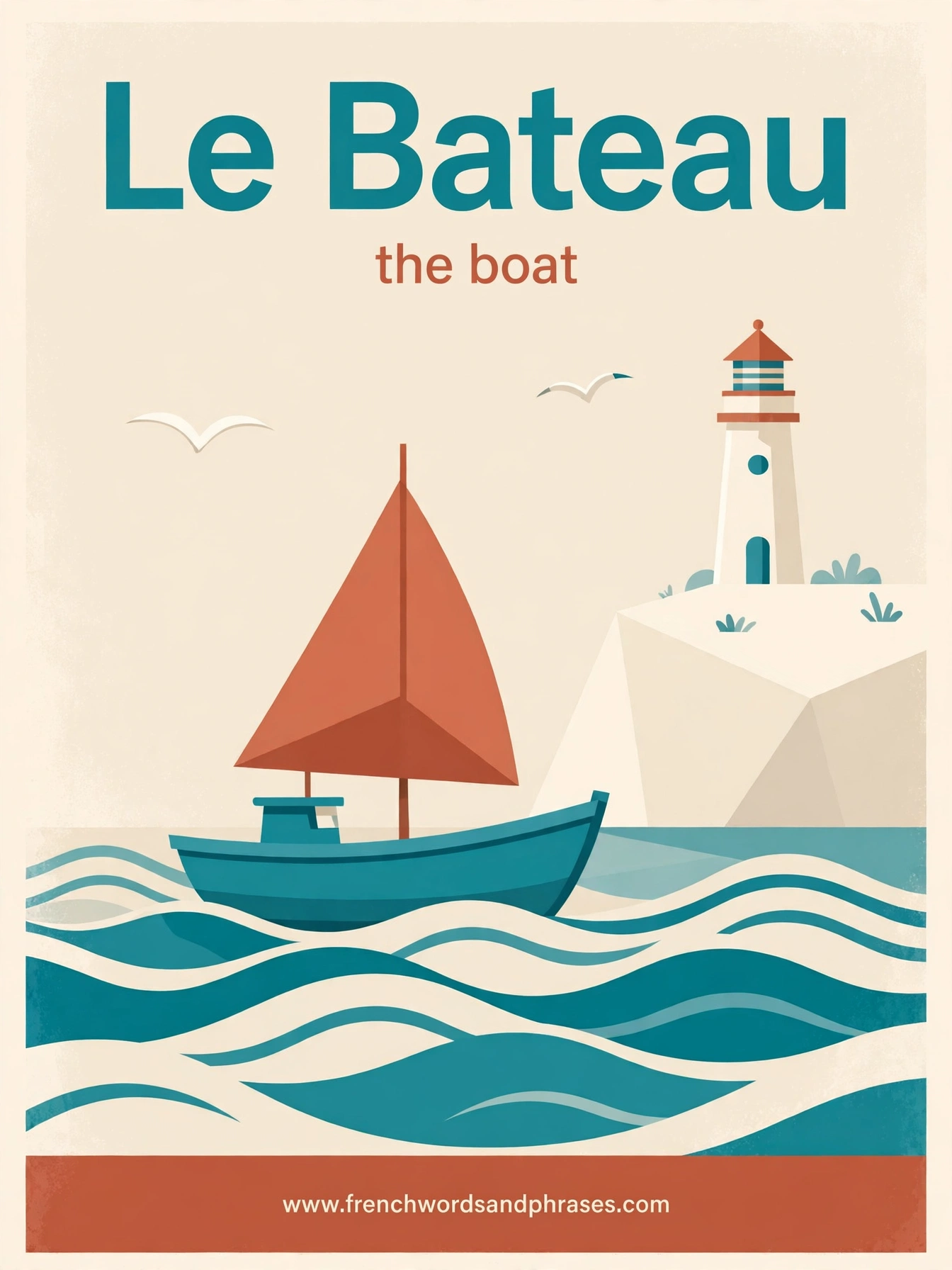
Le bateau means the boat.
The harbour bell rings, the ropes come off the bollards, and the whole quay seems to lean towards the water as the ferry pulls away: « Le bateau part ! » — le bateau is leaving.
In this guide, you’ll learn what bateau means in English, how to use it with its articles, how to form its plural, and how it appears in everyday French. Explore French examples, English translations, and practice quizzes.
Understanding the French Noun Bateau
Bateau is a masculine French noun, learned with its article: le bateau, un bateau. Its plural is one of the classics: words ending in -eau add an -x, not an -s — les bateaux.
It means the boat — anything from a child’s paper boat to a Channel ferry. A small open boat for fishing is un bateau de pêche, a great ocean liner is un paquebot, and the grand word un navire is kept for ships of real size. The bateau also sails through the idioms: mener quelqu’un en bateau is to spin someone a tale, to lead them up the garden path.
Gender: Masculine
Definite article: le — le bateau (the boat)
Indefinite article: un — un bateau (a boat)
Plural: les bateaux — the -eau ending takes an -x
Bigger cousin: un navire — a ship; un paquebot — an ocean liner
English equivalents: The boat; a ship for the larger vessels.
One important usage detail: French splits what English lumps together. A bateau is the everyday word for almost any vessel, but for a big ship prefer un navire or un paquebot, and for a small rowing boat une barque or un canot. And note the plural spelling: bateaux with an -x, exactly like châteaux and gâteaux.
Experience the Word
Bateau is more than a vessel. It is the promise of the other shore — the ferry to the island, the fishing boat at dawn, the deck chair and the salt wind.
Imagine the crossing at sunset: gulls circling the stern, the coast shrinking behind you, and a child at the rail shouting that the boat is flying.
You have not just crossed the water. You have travelled the French way — lentement, face au vent, slowly and into the wind.
How to Use Bateau in French: Complete Guide
Let’s explore how bateau works in French, beginning with its articles — and keep an eye on that famous -x in the plural.
Bateau with the Definite Article (Le, Les)
Used for a particular boat — the one at the quay that everyone is watching.
| Form | French |
|---|---|
| Singular | le bateau |
| Plural | les bateaux |
Example
Le bateau arrive au port avec une heure de retard.
The boat is arriving at the port an hour late.
Bateau with the Indefinite Article (Un, Des)
Used for a boat in general — un bateau, any boat at all.
| Form | French |
|---|---|
| Singular | un bateau |
| Plural | des bateaux |
Example
Il rêve d’acheter un bateau pour pêcher le dimanche.
He dreams of buying a boat to go fishing on Sundays.
Bateau in Quantities and Negatives
Boats are countable, and after quantity words French uses de — beaucoup de bateaux, pas de bateau.
| Expression | French |
|---|---|
| many boats | beaucoup de bateaux |
| a few boats | quelques bateaux |
| too many boats | trop de bateaux |
| no boat | pas de bateau |
| a harbour full of boats | un port plein de bateaux |
Example
En été, il y a beaucoup de bateaux dans le port.
In summer, there are a lot of boats in the harbour.
Quick Quiz 1
Complete the sentence:
Nous prenons ______ pour traverser la Manche. (the boat)
Reveal the answer
le bateau
Nous prenons le bateau pour traverser la Manche.
We are taking the boat to cross the Channel.
The Plural of Bateau
Bateau ends in -eau, so the plural takes an -x — les bateaux, like les châteaux and les gâteaux.
| Number | French |
|---|---|
| Singular | le bateau |
| Plural | les bateaux |
Example
Les bateaux de pêche rentrent au port à l’aube.
The fishing boats come back into the harbour at dawn.
Bateau with Possessive Adjectives (Mon, Ton, Son…)
Possessives agree with the noun: bateau is masculine, so mon, ton, son.
| Owner | French |
|---|---|
| my | mon bateau |
| your (tu) | ton bateau |
| his / her | son bateau |
| our | notre bateau |
| your (vous) | votre bateau |
| their | leur bateau |
Example
Son bateau est amarré au bout du quai.
His boat is moored at the end of the quay.
Quick Quiz 2
Complete the sentence:
______ bateau part à six heures du matin. (Our)
Reveal the answer
Notre
Notre bateau part à six heures du matin.
Our boat leaves at six in the morning.
Bateau with Demonstrative Adjectives (Ce, Ces)
Used to point: ce bateau — this boat here, the big one by the lighthouse.
| Form | French |
|---|---|
| Singular | ce bateau |
| Plural | ces bateaux |
Example
Ce bateau traverse la mer en deux heures.
This boat crosses the sea in two hours.
Bateau with Adjectives
Adjectives agree with bateau, masculine: grand, petit, rapide.
| Adjective | With Bateau |
|---|---|
| grand (big) | un grand bateau |
| petit (small) | un petit bateau |
| vieux (old) | un vieux bateau |
| rapide (fast) | un bateau rapide |
| blanc (white) | un bateau blanc |
Example
Un grand bateau blanc entre lentement dans le port.
A big white boat is slowly entering the harbour.
Quick Quiz 3
Complete the sentence:
Les ______ de pêche sont déjà en mer. (boats)
Reveal the answer
bateaux
Les bateaux de pêche sont déjà en mer.
The fishing boats are already at sea — bateaux with an -x.
Everyday Expressions with Bateau
Crossings, tall tales and missed boats — the bateau phrases of daily life.
| Expression | In English |
|---|---|
| prendre le bateau | to take the boat, the ferry |
| un bateau de pêche | a fishing boat |
| un bateau de croisière | a cruise ship |
| mener quelqu’un en bateau | to spin someone a tale, to lead them on |
| rater le bateau | to miss the boat (also figuratively) |
| être dans le même bateau | to be in the same boat |
Example
Ne le crois pas, il te mène en bateau avec ses histoires.
Don’t believe him, he’s spinning you a tale with his stories.
Words from the Same Family as Bateau
Ports, sails and sailors — the words that travel with bateau.
| French | In English |
|---|---|
| le navire | the ship |
| naviguer | to sail, to navigate |
| le port | the port, the harbour |
| la voile | the sail |
| l’ancre | the anchor |
| le marin | the sailor |
Example
Le marin lève l’ancre et le bateau quitte le port.
The sailor raises the anchor and the boat leaves the port.
Quick Quiz 4
What does « mener quelqu’un en bateau » mean?
Reveal the answer
To spin someone a tale — to lead them on with an invented story.
Arrête de me mener en bateau, dis-moi la vérité !
Stop spinning me tales, tell me the truth!
Bateau in Everyday French: Real-Life Examples
Now that you know the word, let’s see how bateau appears in everyday French.
Example 1 — The crossing
Le bateau quitte le port à six heures.
The boat leaves the port at six o’clock.
Example 2 — At dawn
Les bateaux de pêche rentrent avec les poissons du matin.
The fishing boats are coming back with the morning’s fish.
Example 3 — A child’s toy
L’enfant fait flotter un bateau en papier sur la mare.
The child is floating a paper boat on the pond.
Example 4 — The idiom
Il m’a mené en bateau pendant des semaines.
He led me on for weeks.
Example 5 — In the same boat
Nous sommes tous dans le même bateau, cette année.
We are all in the same boat this year.
Example 6 — A cruise
Leur bateau de croisière visite trois îles.
Their cruise ship is visiting three islands.
Beyond Translation: The Meaning of Bateau
The bateau is woven into the French imagination: the ferry to Corsica, the fishing fleet of Brittany, the peniches — the long canal barges — gliding under plane trees in the south. And the language has filled the word with second meanings: a bateau story is a tall tale, to miss the bateau is to miss your chance, and a piece of news described as très bateau is hopelessly banal — the word even means « cliché » in the newsroom.
To say bateau is to name both the vessel and the voyage, the crossing and the story told about it.
It evokes the quay at dawn and the gulls over the stern, the paper boat on the pond and the ferry lights crossing the night sea.
How to Remember the French Noun Bateau
Remember it this way: Bateau is the boat — masculine, friendly, and famous for its plural: les bateaux with an -x, never an -s.
- You board it — prendre le bateau, le bateau part à six heures.
- You count them — un bateau, des bateaux : the -eau ending always takes -x.
- You doubt the story — mener en bateau, to spin someone a tale.
The key idea is le bateau, les bateaux — the -x plural.
Test Your Knowledge of Bateau
Let’s see how much you’ve learned. Try answering these questions before revealing the answers.
Question 1
Is bateau masculine or feminine?
Reveal the answer
Masculine — le bateau, un bateau.
Question 2
What is the plural of bateau?
Reveal the answer
Les bateaux — words ending in -eau take an -x in the plural.
Question 3
Translate: The boat leaves the port at six o’clock.
Reveal the answer
Le bateau quitte le port à six heures.
Question 4
What is the difference between un bateau and un navire?
Reveal the answer
Un bateau is any boat; un navire is a large ship — the grand, formal word for big vessels.
Question 5
Complete the sentence:
Il y a beaucoup de ______ dans le port. (boats)
Reveal the answer
bateaux
Il y a beaucoup de bateaux dans le port.
There are a lot of boats in the harbour.
Your Final Challenge
Can You Use It?
How would you say this in French?
“The boat leaves the port at six o’clock.”
Reveal the answer
Le bateau quitte le port à six heures.
The boat leaves the port at six o’clock.
A little French. A little curiosity. A richer everyday life.
LEARN FRENCH ONE WORD AT A TIME