
A French Word to Live By
Translate Amie to English
/a.mi/
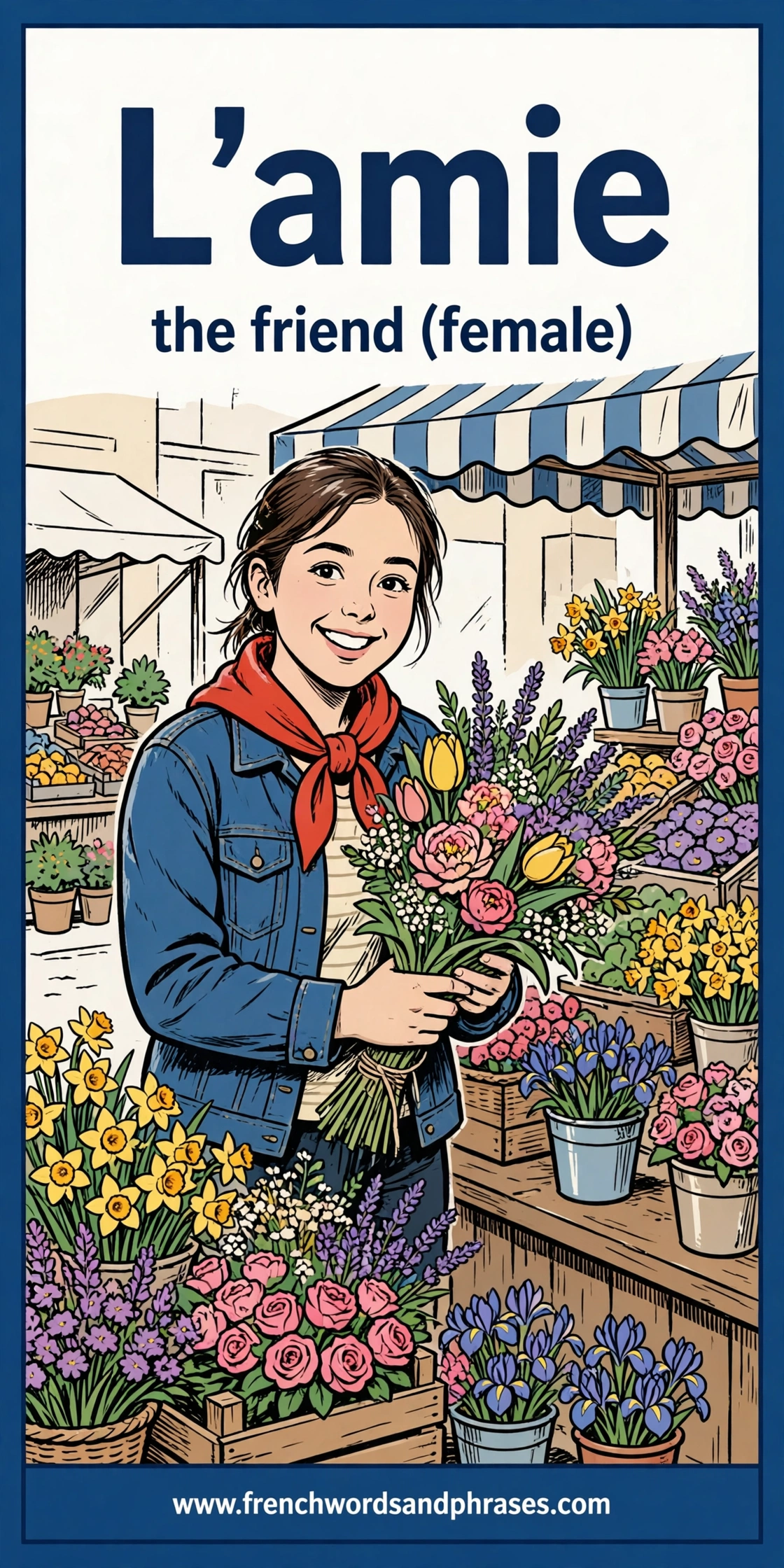
L’Amie means the friend (female).
The girl who keeps your place in the queue, your secret in her pocket and your spare key by her door: l’amie, the female friend — the feminine face of the word French builds out of aimer, to love.
In this guide, you’ll learn what amie means in English, how to use it with its articles, how to form its plural, and how it appears in everyday French. Explore French examples, English translations, and practice quizzes.
Understanding the French Noun Amie
Amie is a feminine French noun, learned with its article: l’amie, une amie. It begins with a vowel, so the article melts into it: l’amie, never la amie in speech. It is the feminine of ami, a male friend, and sounds exactly the same — only the spelling and the articles tell them apart. The pair comes from Latin amicus / amica, built on amare, to love; the ami page on this site is its twin.
It means a friend — a female friend, a girl or woman you are close to: une amie d’enfance, a childhood friend, une amie proche, a close friend, ma meilleure amie, my best friend. As with the masculine, one adjective changes everything: une petite amie is a girlfriend, not a little friend. Spoken aloud, ami and amie are identical — /a.mi/ — so French listeners read the gender from the words around it: une amie, ma meilleure amie, elle.
Gender: Feminine — l’amie
Definite article: l’ — l’amie (the friend), melted before the vowel
Indefinite article: une — une amie (a friend)
Plural: les amies — regular, with a simple -s
Spelling note: sounds exactly like ami — the -e is silent; articles and adjectives carry the gender
The pair: feminine une amie / masculine un ami — see the ami page
English equivalents: The friend (female), a girlfriend (in the friendly sense).
Because amie is feminine but begins with a vowel, its singular possessives borrow the masculine forms: mon amie, ton amie, son amie — never ma amie, which would trip over its own vowels. Adjectives, though, agree in the feminine: ma meilleure amie, my best friend, une vieille amie, a long-standing friend. And une petite amie, like un petit ami, means a girlfriend.
Experience the Word
Amie is the person who hears the whole story — the rehearsal, the disaster and the director’s cut — and still takes your side in public.
Imagine two girls on the train steps with one pair of earphones split between them, laughing at the same second of the same song: voilà une amie, friendship with a shared soundtrack.
You have not just named a companion. You have named the sister you chose — l’amie, the friend, the loved one life let you pick.
How to Use Amie in French: Complete Guide
Let’s explore how amie works in French, beginning with its articles — l’amie, une amie, ma meilleure amie.
Amie with the Definite Article (L’, Les)
Used for a specific friend — the one you are talking about. The vowel opening makes la melt into l’.
| Form | French |
|---|---|
| Feminine singular | l’amie |
| Plural | les amies |
Example
L’amie de ma sœur passe le week-end chez nous.
My sister’s friend is spending the weekend at our house.
Amie with the Indefinite Article (Une, Des)
Used for a friend in general — one friend among the friends of a lifetime.
| Form | French |
|---|---|
| Feminine singular | une amie |
| Plural | des amies |
Example
Une amie m’a invitée à son anniversaire.
A friend invited me to her birthday.
Amie with the Partitive and Quantities (Des amies…)
Friends are counted in circles and handfuls — French measures them with parmi, entre and beaucoup de.
| Quantity | French |
|---|---|
| many friends | beaucoup d’amies |
| among friends | entre amies |
| a few friends | quelques amies |
| a group of friends | un groupe d’amies |
| to make friends | se faire des amies |
Example
Entre amies, on se dit tout.
Between friends (girls), we tell each other everything.
Quick Quiz 1
Complete the sentence:
______ amie de Léa s’appelle Chloé. (the)
Reveal the answer
L’
L’amie de Léa s’appelle Chloé.
Léa’s friend is called Chloé — la melts into l’ before the vowel.
The Plural of Amie
Amie takes a regular plural in -s — and the plural les amies is a whole social world.
| Number | French |
|---|---|
| Singular | l’amie |
| Plural | les amies |
Example
Les amies se retrouvent au café chaque samedi.
The friends meet at the café every Saturday.
Amie with Possessive Adjectives (Mon, Ton, Son…)
Amie is feminine, but it begins with a vowel, so the singular possessives borrow the masculine forms: mon, ton, son — the words must flow.
| Owner | French |
|---|---|
| my | mon amie |
| your (tu) | ton amie |
| his / her | son amie |
| our | notre amie |
| your (vous) | votre amie |
| their | leur amie |
Example
Mon amie Sophie habite juste à côté.
My friend Sophie lives right next door.
Quick Quiz 2
Complete the sentence:
Je te présente ______ amie Nadia. (my)
Reveal the answer
mon
Je te présente mon amie Nadia.
Let me introduce my friend Nadia — mon, not ma, before the vowel.
Amie with Demonstrative Adjectives (Cette, Ces)
Used to point: cette amie, this friend — the one in the story, the one at the door.
| Form | French |
|---|---|
| Feminine singular | cette amie |
| Plural | ces amies |
Example
Cette amie-là, je la connais depuis le lycée.
That friend, I’ve known her since secondary school.
Amie with Adjectives
Adjectives agree with amie — feminine singular: une amie fidèle, ma meilleure amie.
| Adjective | With Amie |
|---|---|
| fidèle (loyal) | une amie fidèle |
| proche (close) | une amie proche |
| meilleure (best) | ma meilleure amie |
| vieille (long-standing) | une vieille amie |
| petite (girlfriend, in the set phrase) | une petite amie |
Example
Ma meilleure amie s’appelle Inès.
My best friend is called Inès.
Quick Quiz 3
Complete the sentence:
C’est ma ______ amie, on se connaît depuis dix ans. (best)
Reveal the answer
meilleure
C’est ma meilleure amie, on se connaît depuis dix ans.
She’s my best friend, we’ve known each other for ten years — meilleure, feminine, to agree with amie.
Everyday Expressions with Amie
School gates, birthdays and secrets — the amie phrases of daily life.
| Expression | In English |
|---|---|
| une amie d’enfance | a childhood friend |
| ma meilleure amie | my best friend |
| entre amies | among friends (girls and women) |
| se faire des amies | to make friends |
| une petite amie | a girlfriend — not a small friend! |
Example
Elles sont amies depuis l’école primaire.
They have been friends since primary school.
Words from the Same Family as Amie
Loving and befriending — the words that travel with amie.
| French | In English |
|---|---|
| un ami | a male friend — the twin page |
| l’amitié | friendship |
| aimer | to love, to like (the verb at the root) |
| amicale | friendly (adjective, feminine) |
| une copine | a mate, a girlfriend (familiar) |
Example
Son amitié compte plus que tout pour moi.
Her friendship means more than anything to me.
Quick Quiz 4
Why do we say mon amie and not ma amie?
Reveal the answer
Because amie begins with a vowel — feminine nouns starting with a vowel borrow mon, ton, son so the words flow.
Mon amie arrive ce soir.
My friend is arriving this evening.
Amie in Everyday French: Real-Life Examples
Now that you know the word, let’s see how amie appears in everyday French.
Example 1 — Introductions
Je te présente mon amie Nadia.
Let me introduce my friend Nadia.
Example 2 — Best friends
Ma meilleure amie s’appelle Inès.
My best friend is called Inès.
Example 3 — Childhood
C’est une amie d’enfance, on a grandi ensemble.
She’s a childhood friend, we grew up together.
Example 4 — An evening
Ce soir, sortie entre amies !
Tonight, a girls’ night out!
Example 5 — Secrets
Une amie sait garder un secret.
A friend knows how to keep a secret.
Example 6 — The pair
Son amie Léa et mon ami Paul se marient.
His friend Léa and my friend Paul are getting married.
Beyond Translation: The Meaning of Amie
Ami and amie are French’s gentlest spelling lesson: two words that sound identical and differ by a single silent letter, because Latin amicus and amica both lost their endings on the road to French and left the gender to the articles. The word still rests on amare, to love — friendship, in French, is love with the volume turned down and the loyalty turned up. Proverbs keep its accounts: les bons comptes font les bons amis, and the plural of amie fills the cafés every Saturday of the year.
To say amie is to say: this one, I chose — and the spelling keeps her secret.
It evokes the shared earphones, the spare key and the 2 a.m. phone call — the chosen sisterhood of everyday life.
How to Remember the French Noun Amie
Remember it this way: Amie is the female friend — feminine with a melted article: l’amie, une amie, but mon amie. Its twin is un ami, a male friend.
- Feminine, vowel first — l’amie, une amie, cette amie.
- The possessive trick — mon amie, ton amie, son amie (never ma amie).
- The twin — un ami for a male friend; the pair is ami / amie.
The key idea is l’amie — the friend (female), feminine; mon amie, twin: un ami.
Test Your Knowledge of Amie
Let’s see how much you’ve learned. Try answering these questions before revealing the answers.
Question 1
Is amie masculine or feminine?
Reveal the answer
Feminine — l’amie, une amie (the article melts before the vowel).
Question 2
How do you say my best friend (a girl)?
Reveal the answer
Ma meilleure amie — mon becomes ma before meilleure, which starts with a consonant.
Question 3
Translate: They have been friends since primary school.
Reveal the answer
Elles sont amies depuis l’école primaire.
Question 4
What does une petite amie mean?
Reveal the answer
A girlfriend — the set phrase, not a friend who is small.
Question 5
Complete the sentence:
______ amies arrivent par le train de midi. (the)
Reveal the answer
Les
Les amies arrivent par le train de midi.
The friends are arriving on the midday train.
Your Final Challenge
Can You Use It?
How would you say this in French?
“My best friend is called Inès.”
Reveal the answer
Ma meilleure amie s’appelle Inès.
My best friend is called Inès.
A little French. A little curiosity. A richer everyday life.
LEARN FRENCH ONE WORD AT A TIME




