
A French Word to Live By
Translate Ami to English
/a.mi/
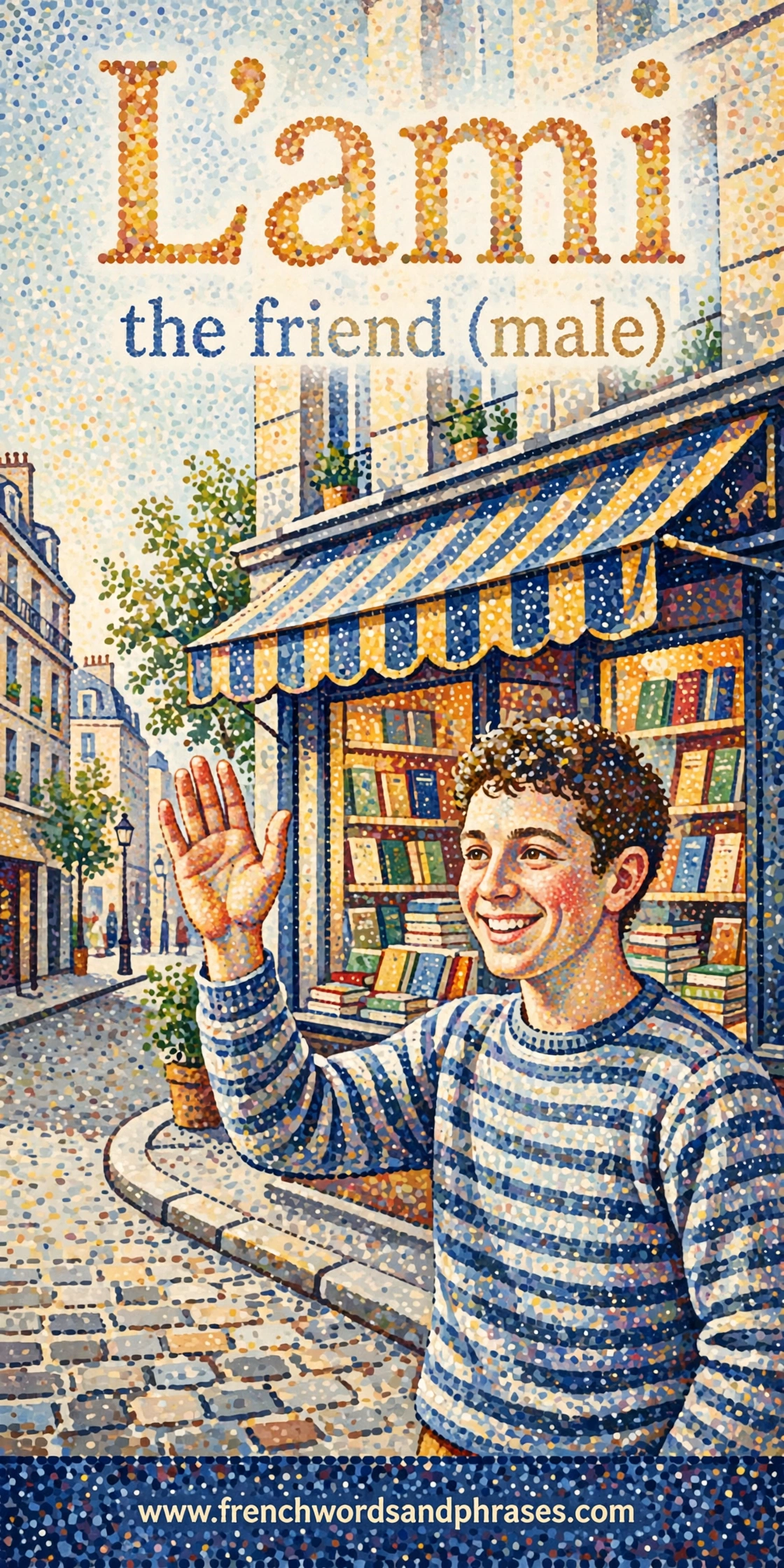
L’Ami means the friend (male).
The boy who saves you a seat, lends you his pen and keeps your secrets in a locked drawer of his head: l’ami, the friend — in French, a word built straight out of the verb to love, aimer.
In this guide, you’ll learn what ami means in English, how to use it with its articles, how to form its plural, and how it appears in everyday French. Explore French examples, English translations, and practice quizzes.
Understanding the French Noun Ami
Ami is a masculine French noun, learned with its article: l’ami, un ami. It begins with a vowel, so the article melts into it: l’ami, never le ami. The word comes from the Latin amicus, from amare, to love — a friend is, in the word’s own memory, someone loved. Its feminine twin is une amie, a female friend, which has its own page on this site.
It means a friend — a male friend, a boy or man you are close to: un ami d’enfance, a childhood friend, un ami proche, a close friend, mon meilleur ami, my best friend. Watch the step up in meaning: un petit ami is not a little friend but a boyfriend. For a woman or girl, French switches to une amie — the pair ami/amie is one of the first gender pairs a learner meets, and this site teaches both.
Gender: Masculine — l’ami
Definite article: l’ — l’ami (the friend), melted before the vowel
Indefinite article: un — un ami (a friend)
Plural: les amis — regular, with a simple -s
Spelling note: from Latin amicus, from amare, to love — the friend is the loved one
The pair: masculine un ami / feminine une amie — see the amie page
English equivalents: The friend (male), a mate, a pal.
Because ami begins with a vowel, the possessives keep the masculine forms mon, ton, son — mon ami — and the plural is where friendship becomes a crowd: entre amis, among friends. Choose your phrase carefully: un ami is a friend, but un petit ami is a boyfriend — one small adjective changes the relationship entirely. A friend of the family is un ami de la famille, and to make friends is se faire des amis.
Experience the Word
Ami is the person who knows your story and stays for the next chapter anyway.
Imagine the school gate in September: two boys who met an hour ago are already trading football cards like diplomats — by Friday, chacun a trouvé un ami, and the year is saved.
You have not just named a companion. You have named chosen family — l’ami, the friend, the loved one you were not born to.
How to Use Ami in French: Complete Guide
Let’s explore how ami works in French, beginning with its articles — l’ami, un ami, entre amis.
Ami with the Definite Article (L’, Les)
Used for a specific friend — the one you are talking about. The vowel opening makes le melt into l’.
| Form | French |
|---|---|
| Masculine singular | l’ami |
| Plural | les amis |
Example
L’ami de mon frère vient dîner ce soir.
My brother’s friend is coming to dinner tonight.
Ami with the Indefinite Article (Un, Des)
Used for a friend in general — one friend among the friends of a lifetime.
| Form | French |
|---|---|
| Masculine singular | un ami |
| Plural | des amis |
Example
Un ami m’a prêté son vélo pour le week-end.
A friend lent me his bike for the weekend.
Ami with the Partitive and Quantities (Des amis…)
Friends are counted in circles and handfuls — French measures them with parmi, entre and beaucoup de.
| Quantity | French |
|---|---|
| many friends | beaucoup d’amis |
| among friends | entre amis |
| a few friends | quelques amis |
| a circle of friends | un cercle d’amis |
| to make friends | se faire des amis |
Example
Il s’est fait beaucoup d’amis dans sa nouvelle école.
He made lots of friends at his new school.
Quick Quiz 1
Complete the sentence:
______ ami de Paul habite à Lyon. (the)
Reveal the answer
L’
L’ami de Paul habite à Lyon.
Paul’s friend lives in Lyon — le melts into l’ before the vowel.
The Plural of Ami
Ami takes a regular plural in -s — one friend is a treasure, les amis are a party.
| Number | French |
|---|---|
| Singular | l’ami |
| Plural | les amis |
Example
Les amis arrivent à sept heures pour l’apéritif.
The friends are arriving at seven for drinks.
Ami with Possessive Adjectives (Mon, Ton, Son…)
Possessives agree with the noun: ami is masculine, so mon, ton, son in the singular.
| Owner | French |
|---|---|
| my | mon ami |
| your (tu) | ton ami |
| his / her | son ami |
| our | notre ami |
| your (vous) | votre ami |
| their | leur ami |
Example
Mon ami Thomas adore le football.
My friend Thomas loves football.
Quick Quiz 2
Complete the sentence:
Je te présente ______ ami Karim. (my)
Reveal the answer
mon
Je te présente mon ami Karim.
Let me introduce my friend Karim — mon, because ami is masculine.
Ami with Demonstrative Adjectives (Cet, Ces)
Used to point: cet ami, this friend — cet, because the noun begins with a vowel.
| Form | French |
|---|---|
| Masculine singular | cet ami |
| Plural | ces amis |
Example
Cet ami-là, je le connais depuis l’école primaire.
That friend, I’ve known him since primary school.
Ami with Adjectives
Adjectives agree with ami — masculine singular: un ami fidèle, un vieil ami.
| Adjective | With Ami |
|---|---|
| fidèle (loyal) | un ami fidèle |
| proche (close) | un ami proche |
| vieux / vieille in the set phrase (long-standing) | un vieil ami |
| petit (boyfriend, in the set phrase) | un petit ami |
| d’enfance (childhood) | un ami d’enfance |
Example
Un ami fidèle vaut plus qu’un trésor.
A loyal friend is worth more than treasure.
Quick Quiz 3
Complete the sentence:
C’est un ami très ______, je peux tout lui dire. (close)
Reveal the answer
proche
C’est un ami très proche, je peux tout lui dire.
He’s a very close friend, I can tell him everything — proche agrees with the masculine noun.
Everyday Expressions with Ami
School gates, weddings and secrets — the ami phrases of daily life.
| Expression | In English |
|---|---|
| un ami d’enfance | a childhood friend |
| mon meilleur ami | my best friend |
| entre amis | among friends |
| se faire des amis | to make friends |
| un petit ami | a boyfriend — not a small friend! |
Example
Nous passons la soirée entre amis.
We’re spending the evening among friends.
Words from the Same Family as Ami
Loving and befriending — the words that travel with ami.
| French | In English |
|---|---|
| une amie | a female friend — the twin page |
| l’amitié | friendship |
| aimer | to love, to like (the verb at the root) |
| amical | friendly (adjective) |
| un copain | a mate, a buddy (familiar) |
Example
L’amitié entre ces deux garçons dure depuis dix ans.
The friendship between these two boys has lasted ten years.
Quick Quiz 4
What does un petit ami mean?
Reveal the answer
A boyfriend — not a small friend; the adjective changes the relationship.
Son petit ami s’appelle Hugo.
Her boyfriend is called Hugo.
Ami in Everyday French: Real-Life Examples
Now that you know the word, let’s see how ami appears in everyday French.
Example 1 — Introductions
Je te présente mon ami Lucas.
Let me introduce my friend Lucas.
Example 2 — Childhood
C’est un ami d’enfance, on se connaît depuis toujours.
He’s a childhood friend, we’ve known each other forever.
Example 3 — Making friends
Elle s’est fait des amis dès la première semaine.
She made friends in the very first week.
Example 4 — An evening
Ce soir, on dîne entre amis.
Tonight, we’re having dinner among friends.
Example 5 — Loyalty
Un vrai ami ne te laisse jamais tomber.
A true friend never lets you down.
Example 6 — The pair
Mon ami Paul et son amie Léa arrivent demain.
My friend Paul and his friend Léa are arriving tomorrow.
Beyond Translation: The Meaning of Ami
Ami carries its meaning in its ancestry: Latin amicus is built on amare, to love, so French friendship is etymologically a form of love — quieter than amour, but from the same root. The language guards the word’s borders carefully: un ami is chosen, proved and kept, where un copain is the lighter companion of school corridors. And the old proverb still balances the books of every friendship: les bons comptes font les bons amis — clear accounts make good friends, a page of its own on this site.
To say ami is to say: this one, I chose.
It evokes the saved seat, the lent bicycle and the secret kept — friendship as the family you build yourself.
How to Remember the French Noun Ami
Remember it this way: Ami is the male friend — masculine with a melted article: l’ami, un ami. Its twin is une amie, a female friend.
- Masculine, vowel first — l’ami, un ami, mon ami, cet ami.
- The twin — une amie for a female friend; the pair is ami / amie.
- The trap — un petit ami is a boyfriend, not a small friend.
The key idea is l’ami — the friend (male), masculine; twin: une amie.
Test Your Knowledge of Ami
Let’s see how much you’ve learned. Try answering these questions before revealing the answers.
Question 1
Is ami masculine or feminine?
Reveal the answer
Masculine — l’ami, un ami (the article melts before the vowel).
Question 2
How do you say a female friend?
Reveal the answer
Une amie — the feminine twin, with its own page on this site.
Question 3
Translate: He made lots of friends.
Reveal the answer
Il s’est fait beaucoup d’amis.
Question 4
What does un petit ami mean?
Reveal the answer
A boyfriend — the set phrase, not a friend who is small.
Question 5
Complete the sentence:
______ amis de mon fils jouent dans le jardin. (the)
Reveal the answer
Les
Les amis de mon fils jouent dans le jardin.
My son’s friends are playing in the garden.
Your Final Challenge
Can You Use It?
How would you say this in French?
“Let me introduce my friend Lucas.”
Reveal the answer
Je te présente mon ami Lucas.
Let me introduce my friend Lucas.
A little French. A little curiosity. A richer everyday life.
LEARN FRENCH ONE WORD AT A TIME




